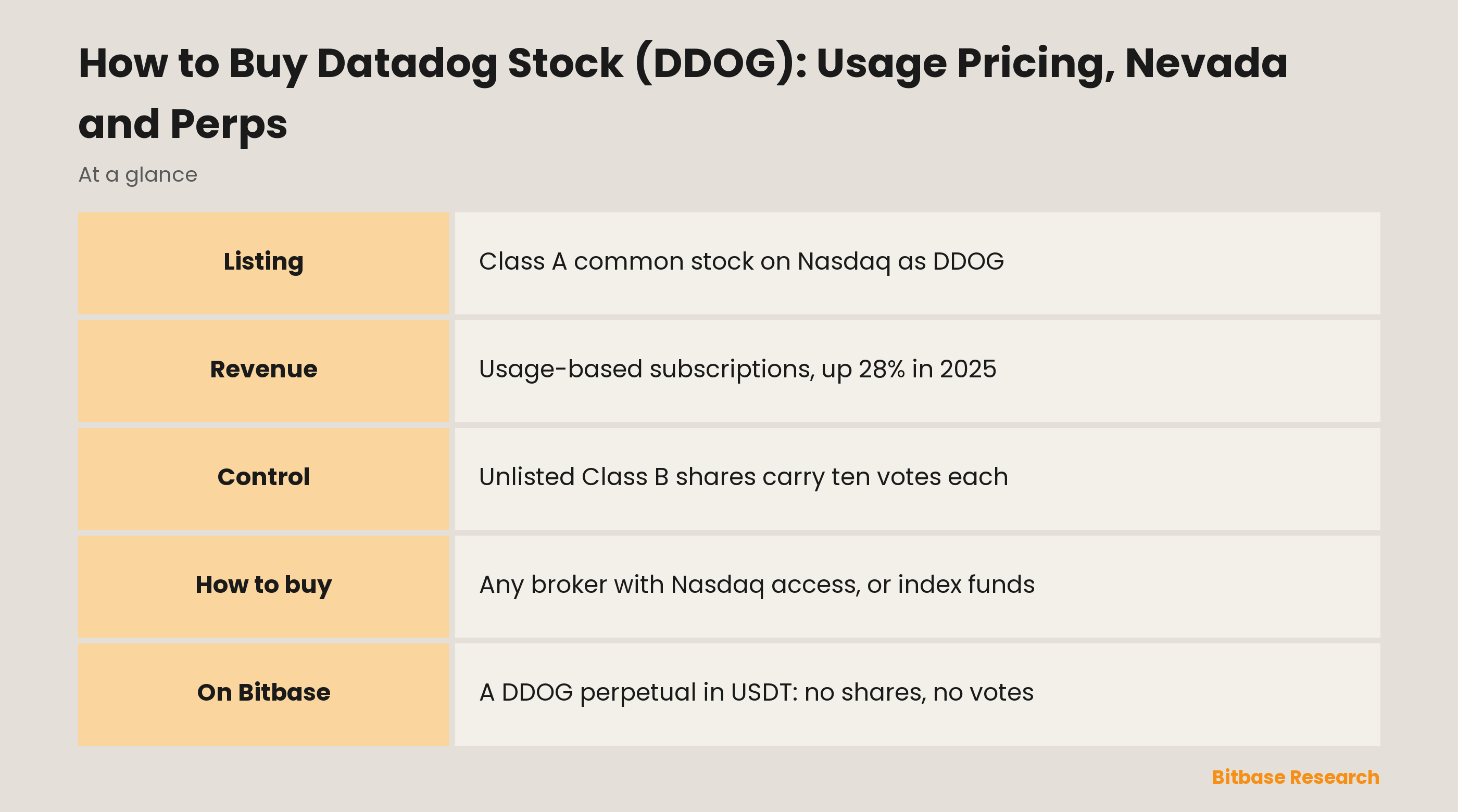
As long as your brokerage account reaches Nasdaq, buying Datadog stock is an ordinary order for DDOG, the ticker of the company's Class A common stock. Datadog sells cloud monitoring and security software that customers pay for according to how much they use it, and since 21 April 2026 it has been a Nevada corporation, with a second, unlisted class of shares that holds ten votes per share. The shares themselves are not sold on Bitbase; what Bitbase lists is a DDOG perpetual contract, margined in USDT, that tracks the share price, keeps trading while Nasdaq is closed and holds no stock.
What Does Datadog Do?
Datadog describes itself as "the AI-powered observability and security platform for cloud applications." In practice, it gathers what running software gives off (metrics from servers and containers, traces that follow a request through an application, logs of each event) and puts it side by side, so engineers can see what broke and why. The data arrives through a single agent and, according to the 10-K, more than 1,000 integrations.
The company was founded in New York in 2010 by Olivier Pomel and Alexis Lê-Quôc, who have been its chief executive and chief technology officer since June of that year. Its first product, Infrastructure Monitoring, launched in 2012. Application performance monitoring (APM) followed in 2017 and log management in 2018, and Datadog says that step made it the first to combine metrics, traces and logs, the "three pillars of observability," in one platform.
The range has kept widening: user-experience tools such as Synthetics and Real User Monitoring; security products that scan cloud infrastructure and code for vulnerabilities and misconfigurations, plus a cloud SIEM; incident response and on-call scheduling; and, since 2024, LLM Observability for teams running large language models. In 2025 it added Bits AI SRE, which the 10-K calls "an always-on, AI-enabled SRE agent built to handle complex troubleshooting."
At the end of 2025 Datadog had approximately 8,100 employees across 35 countries. About 44% of its full-time staff worked outside the United States, 34% of them in France, and research and development is concentrated in the New York and Paris offices.
The 10-K names competitors by category: IBM, Microsoft and SolarWinds in on-premise infrastructure monitoring; Cisco, New Relic and Dynatrace in APM; Cisco and Elastic in log management; and the native tools of AWS, Microsoft Azure and Google Cloud. Cisco, whose own observability line includes Splunk Observability, is profiled in the guide to buying Cisco stock.
How Datadog Makes Money
Nearly all revenue comes from subscriptions; professional services are generally not needed, and the 10-K says revenue from them "has been immaterial to date." What a subscription buys is usage. Each product is metered in its own unit, the one that "best indicates the value we deliver," and customers sign up in one of three ways:
| Subscription type | When revenue is recognized |
|---|---|
| Committed usage, spread over the term | Evenly, month by month |
| Committed usage, drawn down as used | As the product is used |
| Monthly subscription based on usage | As the product is used |
Usage beyond a commitment is charged on top, and most revenue comes from annual subscriptions. The mix shapes the results: a fall in new contracts reaches the evenly spread part only gradually, while usage recognized as it happens "may lead to fluctuations in our revenue and results of operations."
The model is built to grow inside existing accounts, which Datadog calls land-and-expand. Revenue rose 28% in 2025, and about 75% of the increase came from existing customers, 25% from new ones. The company also reports a trailing 12-month dollar-based net retention rate, comparing the annual run-rate revenue (ARR) of a group of customers with what the same group produced a year earlier. It was about 120% at the end of 2025, up on a year before because existing customers used more, and in the low-120% range on 30 June 2026.
| Measure | 31 Dec 2024 | 31 Dec 2025 | 30 Jun 2026 |
|---|---|---|---|
| Customers | About 30,000 | About 32,700 | About 33,400 |
| Customers with ARR of six figures or more | About 3,610 | About 4,310 | About 4,720 |
| Their share of total ARR | 88% | 90% | 91% |
Customer counts exclude free-trial and free-tier users. By billing address, customers outside North America produced about 29% of revenue in both 2024 and 2025 and about 27% in the first half of 2026; the United States alone accounted for about 68% of 2025 revenue.
The main cost of delivering the service is paying third-party cloud providers to host it. Gross margin was 80% in 2025 against 81% in 2024, as cost of revenue rose 33%, mostly from cloud hosting and software. Growth then picked up: revenue rose 36% year on year in the second quarter of 2026 and 34% across the first half.
DDOG Stock at a Glance
| Item | Detail |
|---|---|
| Exchange | Nasdaq Global Select Market |
| Ticker | DDOG |
| Listed security | Class A common stock, one vote per share |
| Other share class | Class B: unlisted, ten votes per share, converts to Class A on sale or transfer |
| Depositary receipt | None: DDOG is the common stock itself |
| Industry | Observability and security software, delivered as a cloud service |
| Index membership | S&P 500, per SPY holdings on 29 October 2026; Nasdaq-100, per QQQ holdings on 28 October 2026 |
| Headquarters | New York City |
| Incorporation | Nevada since 21 April 2026; Delaware from June 2010 |
| Trading since | 19 September 2019 |
| Fiscal year | Calendar year |
| Dividend policy | Has never declared or paid a dividend |
| Share buybacks | None reported in the 2025 annual report |
| SEC identifier | CIK 1561550 |
The table holds only facts that rarely change; the live quote and chart are on the Datadog stock page on Bitbase.
How to Buy Datadog Stock
At most brokers, a first purchase comes down to six steps:
1. Choose a broker with Nasdaq access that accepts clients from your country.
2. Open the account and complete the identity checks. A US broker will usually ask a non-US client for IRS Form W-8BEN, which the IRS says to submit "when requested by the withholding agent or payer whether or not you are claiming a reduced rate of, or exemption from, withholding."
3. Deposit money. Funding in a currency other than US dollars adds a conversion cost.
4. Look up DDOG and confirm that the listing reads Datadog, Inc. Class A common stock.
5. Pick an order type. A market order executes at the best available price; a limit order names a ceiling and can go unfilled.
6. Decide the amount. Fractional orders are possible where the broker supports them.
Class A is the only class on sale. Class B shares are not listed anywhere, so every DDOG share bought on Nasdaq carries one vote, against ten for each Class B share.
From outside the United States, DDOG is a US company's own common stock rather than a depositary receipt, with no conversion ratio to track. Because Datadog has never paid a dividend, there is at present no dividend for US tax to be withheld from. This is general information, not tax advice.
Through an index fund, the exposure is indirect: SPY, which tracks the S&P 500, held DDOG on 29 October 2026, and QQQ, which tracks the Nasdaq-100, held it on 28 October 2026, in each case as one company among many.
Trading DDOG on Bitbase
On Bitbase, Datadog is available only as a derivative: the DDOG perpetual futures contract, with margin and settlement in USDT. Set against the share, it looks like this:
| Feature | DDOG share | DDOG perpetual on Bitbase |
|---|---|---|
| What it is | Class A common stock of Datadog | A USDT-margined contract that tracks the share price |
| Ownership and votes | A stake in the company, one vote per share | No stake and no vote |
| Positions | Bought to own | Long or short, with leverage |
| Hours | Nasdaq sessions | Keeps trading while Nasdaq is closed |
Funding is a payment exchanged between longs and shorts at intervals, and the busier side of the market makes the payment; that is what keeps the perpetual close to the share price. Once the margin on a position runs out, liquidation is triggered by the mark price, not by the last trade. Overnight and at weekends the contract can react to news that the share can only absorb at the next Nasdaq open, so the two prices may start a session apart. The stock perpetual futures guide explains each mechanism.
The contract rules for DDOG on Bitbase set the funding interval and formula, the margin tiers, the leverage limit and how the mark price and funding work while Nasdaq is shut; check them before placing a trade. For other stock-linked markets on the exchange, see the TradFi page.
What Moves DDOG Stock
The largest customers' usage. Datadog groups some of its biggest clients into an "AI-native cohort" that includes its largest customer. That cohort accounted for approximately seven percentage points of year-over-year revenue growth in the fourth quarter of 2025 and "high single digit percentage points" in the second quarter of 2026. The 10-Q filed in August 2026 then added: "Beginning in the third quarter of 2026, we saw our largest customer reduce their usage," a change it says "may cause a deceleration in revenue growth." The filings do not name the customer.
Optimization cycles. Because bills follow usage, customers can spend less without cancelling anything. The 10-K recalls that customers in a cloud-native cohort once "rapidly increased their usage of our product and then optimized," and it warns of "revenue volatility" when such patterns repeat.
Expansion figures. With about three quarters of 2025's revenue growth coming from existing customers, the quarterly updates to six-figure ARR customers and net retention show whether land-and-expand is still working.
Hosting costs. Datadog runs on rented cloud infrastructure, so hosting bills move its gross margin. In the second quarter of 2026, cost of revenue grew 45% while revenue grew 36%, and gross margin slipped to 79% from 80% a year earlier.
The clouds as rivals and channels. AWS, Azure and Google Cloud offer their own monitoring tools and also host Datadog. The company notes that more sales through cloud marketplaces "could reduce both the number of customers with whom we have direct commercial relationships as well as our profit margins on sales made through such marketplaces."
Fourth-quarter bookings. New-customer agreements cluster in the fourth quarter, which the company attributes to the procurement, budgeting and deployment cycles of many of its customers.
DDOG Risks: Usage, Outages and Control
No obligation to renew. "Our customers have no obligation to renew their subscriptions for our products after the expiration of their subscription period." Those that stay can still use less or renew "on terms less favorable to us."
Outages and security. In March 2023 the platform suffered "widespread outages across multiple products and regions," substantially resolved in about a day. A breach could also lead the product to be "perceived as not being secure."
Rented capacity. The products depend on "virtual cloud infrastructure hosted by third-party hosting services," and any capacity limit there "could impede our ability to onboard new customers or expand the usage of our existing customers."
Concentrated voting control. Class B shares held approximately 42% of the voting power on 30 June 2026, and the 2026 proxy statement shows the two co-founders with close to a third of all votes as of 31 March 2026. The 10-K says the structure "will limit the ability of holders of our Class A common stock to influence the outcome of important transactions."
Nevada law. Datadog's articles now name the Eighth Judicial District Court in Clark County, Nevada, as the exclusive forum for most stockholder disputes, and the 10-Q warns that anti-takeover provisions in its charter and in Nevada law "could make an acquisition of our company more difficult."
Dilution and volatility. Zero-coupon convertible notes due in December 2029 may be settled wholly or partly in Class A shares, which "may dilute the ownership interests of our stockholders." The share price itself "may be highly volatile," and there is no dividend to cushion a fall.
Extra risk on the perpetual. Leverage enlarges losses, funding is charged for as long as a position stays open, and if the share opens far from where the contract traded overnight, the move can reach a position's liquidation price before its holder can respond.
How to Research DDOG Yourself
Datadog files with the SEC under CIK 1561550. The 2025 annual report on Form 10-K, filed on 18 February 2026, holds the business description, the risk factors and the customer counts and net retention rate that each 10-Q updates; the second-quarter 10-Q, filed on 6 August 2026, discloses the change in the largest customer's usage. Quarterly results come on Form 8-K, and the proxy statements show who holds the Class B shares and why the board proposed the Nevada move. The investor relations site is investors.datadoghq.com.
Datadog Stock FAQ
Does Datadog pay a dividend?
No. The 10-K states: "We have never declared or paid any dividends on our Class A common stock or Class B common stock," and adds that Datadog does not anticipate paying any "in the foreseeable future."
Can I buy Datadog stock with crypto?
Only indirectly. A broker sells DDOG for US dollars, which means converting crypto to cash and transferring it before placing the order. On Bitbase, a USDT balance can open a position in the DDOG perpetual, which moves with Datadog's share price yet confers no ownership or vote, and which can be liquidated if its margin runs out. The routes from crypto to stocks are laid out in buying stocks with crypto.
What is the difference between Datadog Class A and Class B shares?
Voting and conversion; otherwise the rights are identical. Class A, the listed DDOG share, has one vote. Class B has ten and is not listed; it turns into Class A whenever its holder chooses and, apart from a few exempt cases, on any sale or transfer. The 2019 IPO prospectus also set a final conversion date on the tenth anniversary of the offering, and the Nevada articles keep it, so any Class B shares still outstanding are due to convert in September 2029.
Why did Datadog move from Delaware to Nevada?
Its board argued that an "increasingly litigious environment" in Delaware had created "unpredictability regarding whether Board and management decisions will be enforced," and that Nevada offers more certainty "because of its statutory regime, including its codification of the business judgment rule and fiduciary duties of directors and officers." Stockholders approved the move at a special meeting on 21 April 2026, with both classes voting together, and it took effect the same day. Holders did not need to exchange their shares, and the ticker stayed DDOG.
Is Datadog in the S&P 500?
Yes, judging by the fund that tracks the index: State Street's daily holdings file for SPY, dated 29 October 2026, lists Datadog's Class A shares. DDOG also appeared among QQQ's Nasdaq-100 holdings on 28 October 2026. Constituents can change, so treat both as dated readings.
When did Datadog go public?
In September 2019. The IPO prospectus is dated 18 September 2019, and Class A shares began trading on the Nasdaq Global Select Market the following day. Just before the offering, every existing share, including those held by executives, directors and preferred-stock investors, was reclassified as Class B.
Conclusion
Buying DDOG takes a single Nasdaq order; judging it takes more reading. Datadog's revenue follows how much its customers use, which lifted growth while large AI-native clients scaled up and leaves it exposed now that the largest has started to cut back. The listed Class A share gives one vote in a Nevada company where each Class B share counts ten times as much until 2029. Anyone who wants only the price can use the Bitbase perpetual instead, accepting funding costs and liquidation risk in exchange for owning nothing.
Related reading
Other Bitbase articles on this topic:
- How to Buy Cadence Design Systems Stock (CDNS): Chip Design Tools
- How to Buy Cloudflare Stock (NET): Share Classes and 24/7 Perps
- How to Buy DoorDash Stock (DASH): Dashers, Deliveroo, Instacart
Disclaimer: This article is educational content from Bitbase Academy, provided for information only. It explains what a company or fund does and how the instruments referenced here differ from one another; it does not constitute investment, trading, tax, or financial advice, and it is neither a recommendation nor an endorsement of any security, token, or trading strategy. A tokenized stock is issued by a third party and is designed to give economic exposure to an underlying asset: it is not a share, it carries no shareholder rights, and it depends on the issuer's structure, eligibility rules, and redemption terms, which the issuer can change. Perpetual futures are leveraged derivatives that hold no underlying asset and can be liquidated, and trading hours, product availability, and eligibility differ by instrument and by jurisdiction and can change at any time. Written as of October 2026; verify everything yourself through company filings, the issuer's own documentation, and the product pages of the venue you trade on.
References
[1] Datadog, Inc. Form 10-K for 2025 (SEC EDGAR) www.sec.gov
[2] Datadog, Inc. Form 10-Q, second quarter of 2026 (SEC EDGAR) www.sec.gov
[3] Datadog Form 8-K, April 2026: move to Nevada completed (SEC EDGAR) www.sec.gov
[4] Datadog proxy statement for the April 2026 special meeting (SEC EDGAR) www.sec.gov
[5] Datadog, Inc. articles of incorporation under Nevada law (SEC EDGAR) www.sec.gov
[6] Datadog IPO prospectus, September 2019 (SEC EDGAR) www.sec.gov
[7] Datadog proxy statement for the 2026 annual meeting (SEC EDGAR) www.sec.gov
[8] State Street: SPY daily holdings, 29 October 2026 www.ssga.com
[9] Invesco QQQ: fund overview and holdings (tracks the Nasdaq-100) www.invesco.com
[10] IRS: About Form W-8 BEN www.irs.gov





