
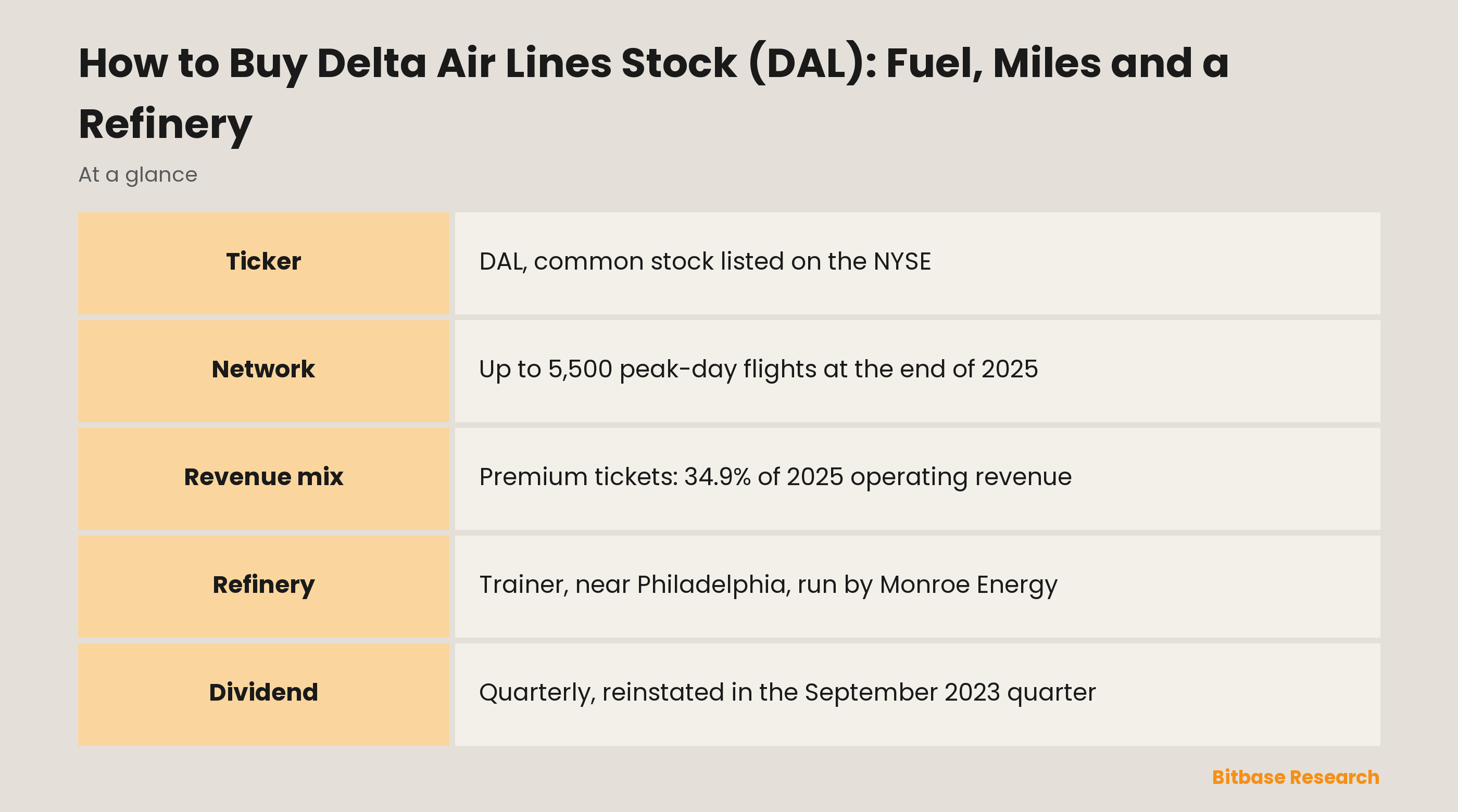
After opening an account with a broker that reaches the New York Stock Exchange, you can buy Delta Air Lines common stock under the ticker DAL, the only security listed on the company's 10-K cover. The Atlanta carrier earns more than fares: its 2025 revenue also came from its own oil refinery near Philadelphia and from American Express cards carrying its SkyMiles brand.
What Does Delta Air Lines Do?
Delta Air Lines, Inc. is incorporated in Delaware and based in Atlanta. Its 10-K describes "a global airline based in the United States" that celebrated its centennial year in 2025.
The network runs through hubs: Atlanta, Detroit, Minneapolis-St. Paul and Salt Lake City at the core, with Boston, Los Angeles, New York-LaGuardia, New York-JFK and Seattle on the coasts. At the end of 2025 Delta offered up to 5,500 peak-day flights to more than 300 destinations on six continents, with a fleet of 1,314 aircraft.
Abroad it works through partners: a transatlantic joint venture with Air France, KLM and Virgin Atlantic, further ventures with LATAM and Korean Air, and a cooperation agreement with Aeroméxico, reinforced by equity stakes that include 49% of Virgin Atlantic's parent.
Beside the airline, Delta TechOps repairs engines and airframes for outside customers, Delta Vacations sells trips designed for SkyMiles members, and Monroe Energy runs the Trainer refinery near Philadelphia, which can process approximately 200,000 barrels of crude oil a day.
In January 2026 Delta agreed to buy 30 Boeing 787-10 jets, which will fly on GEnx engines made by General Electric, with deliveries from 2031.
How Delta Air Lines Makes Money
Operating revenue rose 3% in 2025. The 10-K's revenue table splits it into these lines:
| Revenue line | Meaning in the 10-K | Portion of 2025 operating revenue |
|---|---|---|
| Main cabin tickets | Fares for main cabin seats | 36.9% |
| Premium product tickets | Delta One, First Class, Delta Premium Select, Delta Comfort+ | 34.9% |
| Loyalty travel awards | Flights paid for with SkyMiles | 6.7% |
| Travel-related services | Baggage fees, administrative fees, on-board sales | 3.2% |
| Cargo | Freight carried on passenger aircraft | 1.4% |
| Refinery | Non-jet fuel products sold to third parties | 8.0% |
| Loyalty program | Brand use and other value in miles sold | 5.3% |
| Ancillary businesses | Delta TechOps maintenance work, Delta Vacations | 1.5% |
| Miscellaneous | Lounge access, travel products, codeshare settlements | 2.1% |
We calculated the shares ourselves from the 10-K's figures.
The mix is moving toward the front of the plane. Premium ticket revenue grew 7% in 2025 while main cabin revenue fell 5%, which the 10-K blames on "industry-wide supply exceeding demand for main cabin travel." Domestic flying produced 69.0% of passenger revenue.
The quieter earner is SkyMiles. Delta sells miles to card issuers and other partners, and the 10-K calls the co-brand card deal with American Express "our most significant and valuable contract to sell miles." Remuneration from American Express grew about 11% in 2025, and award trips made up 12% of the revenue miles flown on Delta. Demand has historically peaked in the June and September quarters, when more people go on vacation.
DAL Stock at a Glance
| Item | Detail |
|---|---|
| Exchange | New York Stock Exchange (NYSE) |
| Symbol | DAL |
| Security | Common stock, the only class on the 10-K cover |
| Index | S&P 500 |
| Sector ETF that holds it | Industrial Select Sector SPDR ETF (XLI) |
| Headquarters | Atlanta, Georgia |
| Incorporated | Delaware |
| Fiscal year | Calendar year, ending 31 December |
| Reporting segments | Airline and refinery |
| Dividend policy | Quarterly, reinstated in the September 2023 quarter |
| Share buybacks | Program open through 30 June 2028; unused through 30 September 2026 |
| EDGAR number | CIK 27904 |
Prices move by the second, so the Delta Air Lines stock page on Bitbase carries the live quote, market value and dividend yield that this table leaves out.
How to Buy Delta Air Lines Stock
Delta files as a US company and lists a single share class, which keeps depositary receipts out of the picture:
1. Choose a broker with NYSE access, and check who regulates it.
2. Complete the account opening. Identity checks come first; investors outside the US then hand Form W-8 BEN "to the withholding agent or payer," normally the broker, so dividends can be taxed at a treaty rate.
3. Move money in, remembering that changing your currency into dollars costs something too.
4. Enter the ticker DAL and check that the match is Delta Air Lines, Inc. common stock on the NYSE.
5. Pick the order type. In FINRA's words, a market order "generally will execute at or near the current bid or ask prices," whereas a limit order trades only "at or better than a specified price."
6. Decide on fractions. Not every broker sells part shares, and FINRA notes that "you can't transfer fractional shares to another brokerage firm."
Dividends paid abroad are taxed at source. The IRS states that "most types of U.S. source income received by a foreign person are subject to U.S. tax of 30%"; treaties can reduce the rate, and your home country may tax the same payment.
Owning it indirectly is also possible. On 29 October 2026, State Street's daily holdings files showed Delta inside SPY, the S&P 500 fund, and inside the industrials fund XLI, where United Airlines and Southwest Airlines sat as well.
What Moves DAL Stock
Jet fuel. Fuel was 17% of operating expense in 2025, against 19% in 2024 and 21% in 2023, and most purchase contracts track market indices. In the September 2026 quarter the average jet fuel purchase price was 63% higher than a year earlier, and over nine months fuel's share of operating expense rose to 22%. The 10-Q expects that to last "until market disruptions and geopolitical events are resolved."
The refinery. Delta owns Trainer to offset the refining margin built into jet fuel, but the plant has its own swings. An outage halted production from mid-June 2026, and the refinery segment lost money in the September quarter. Third-party refinery sales still rose 76% that quarter on higher product prices and fewer exchange deals, inflating reported revenue without saying much about the airline.
Premium and loyalty demand. Total revenue rose 21% in the September 2026 quarter, with premium ticket revenue up 18%, and American Express remuneration rose 14% over nine months. Operating income still fell, because expenses grew faster.
The pilot contract. About 20% of the workforce, mainly pilots, is unionized. The pilots' agreement with ALPA becomes amendable on 31 December 2026; under the Railway Labor Act it does not expire, and strikes are generally barred until the Act's bargaining steps are exhausted.
Partners and regulators. On 15 September 2025 the Department of Transportation ordered an end to antitrust immunity for the Aeroméxico agreement; an appeals court stayed the order on 12 November 2025 while the case continues. Stakes in other airlines are marked to market, adding gains in 2025 and losses in the September 2026 quarter.
Things That Can Ground Delta's Earnings
Of the risk factors in Item 1A, four bear most directly on a shareholder:
Fares sold before fuel moves. "Because passengers often purchase tickets well in advance of their travel, a significant rapid increase in fuel price could result in the fare charged not covering that increase."
A refinery accident. Monroe faces hazards "including explosions, fires, toxic emissions and natural catastrophes," and its insurance "does not cover all potential losses, costs or liabilities."
Strikes. "Strikes or labor disputes with our unionized employees may have a material adverse effect on our ability to conduct business."
Technology failures. The July 2024 CrowdStrike outage led to approximately 7,000 flight cancellations over five days, and Delta warns that its safeguards "may not be adequate to prevent future business disruptions."
Class actions filed in July 2015 accusing Delta, American, United and Southwest of restraining capacity are still open; Delta calls the claims "without merit." And one airline stock ties your result to a cyclical industry, with currency swings on top for non-US investors.
Tracing Delta's Numbers to EDGAR and ir.delta.com
Delta files under CIK 27904, and ir.delta.com posts the same 10-K, 10-Q and 8-K reports free of charge. The 10-K's business section holds the hubs, the fuel cost table and union contract dates; the MD&A covers revenue by region and the refinery segment. The latest 10-Q, for the quarter ended 30 September 2026, was filed on 9 October 2026.
Delta Air Lines Stock FAQ
Does Delta Air Lines pay a dividend?
Yes, quarterly. The board reinstated the dividend in the September 2023 quarter and has raised it each year since, according to the 10-K. The next payment, approved on 24 September 2026, is due on 5 November 2026.
Can I buy Delta Air Lines stock with crypto?
Not directly. A broker sells DAL for US dollars, which means converting crypto to cash and wiring it over first; depending on your country, that conversion may be a taxable sale. Once bought, the share comes with voting and dividend rights, a basic point where stocks and crypto part ways.
Is DAL in the S&P 500?
Yes. State Street's SPY holdings file dated 29 October 2026 includes Delta Air Lines, and its weight in the fund shifts from day to day.
Does Delta Air Lines own an oil refinery?
Yes. Its subsidiary Monroe Energy runs the Trainer refinery, whose pipelines supply jet fuel across the northeastern US, including the LaGuardia and JFK hubs. It is a separate reporting segment, and the gasoline, diesel and other products it sells to third parties count as revenue.
Who is Delta's CEO?
Ed Bastian, chief executive since May 2016 and before that Delta's president and chief financial officer. The September-quarter 2026 earnings release still quoted him in that role.
Conclusion
The purchase itself is short work: an NYSE-capable broker, the symbol DAL and a market or limit order. Knowing the company takes longer: an airline whose costs swing with jet fuel, whose growth leans on premium cabins and an American Express card deal, and which owns a refinery. Before sizing a position in a single airline, read the latest 10-Q and note 31 December 2026, the date the pilots' agreement becomes amendable.
Related reading
Other Bitbase articles on this topic:
- How to Buy Canadian National Railway Stock (CNI): Two Tickers
- How to Buy Cintas Stock (CTAS): Uniform Rentals and UniFirst
- How to Buy CPKC Stock (CP): One Railway, Three Countries
- How to Buy United Rentals Stock (URI): Fleet, Specialty, Buybacks
Disclaimer: This article is educational content from Bitbase Academy, provided for information only. It explains what a company or fund does and how the instruments referenced here differ from one another; it does not constitute investment, trading, tax, or financial advice, and it is neither a recommendation nor an endorsement of any security, token, or trading strategy. A tokenized stock is issued by a third party and is designed to give economic exposure to an underlying asset: it is not a share, it carries no shareholder rights, and it depends on the issuer's structure, eligibility rules, and redemption terms, which the issuer can change. Perpetual futures are leveraged derivatives that hold no underlying asset and can be liquidated, and trading hours, product availability, and eligibility differ by instrument and by jurisdiction and can change at any time. Written as of October 2026; verify everything yourself through company filings, the issuer's own documentation, and the product pages of the venue you trade on.
References
[1] Delta Air Lines, Inc. Form 10-K for 2025: business, revenue, fuel, labor and risk factors (SEC EDGAR) www.sec.gov
[2] Delta Air Lines, Inc. Form 10-Q, quarter ended 30 September 2026 (SEC EDGAR) www.sec.gov
[3] Delta Air Lines news release, 9 October 2026: September quarter 2026 financial results (SEC EDGAR) www.sec.gov
[4] State Street SPDR S&P 500 ETF Trust (SPY): fund page and daily holdings www.ssga.com
[5] State Street Industrial Select Sector SPDR ETF (XLI): fund page and daily holdings www.ssga.com
[6] FINRA: Order Types www.finra.org
[7] FINRA: Investing in Fractional Shares www.finra.org
[8] IRS: NRA Withholding www.irs.gov
[9] IRS: About Form W-8 BEN www.irs.gov





