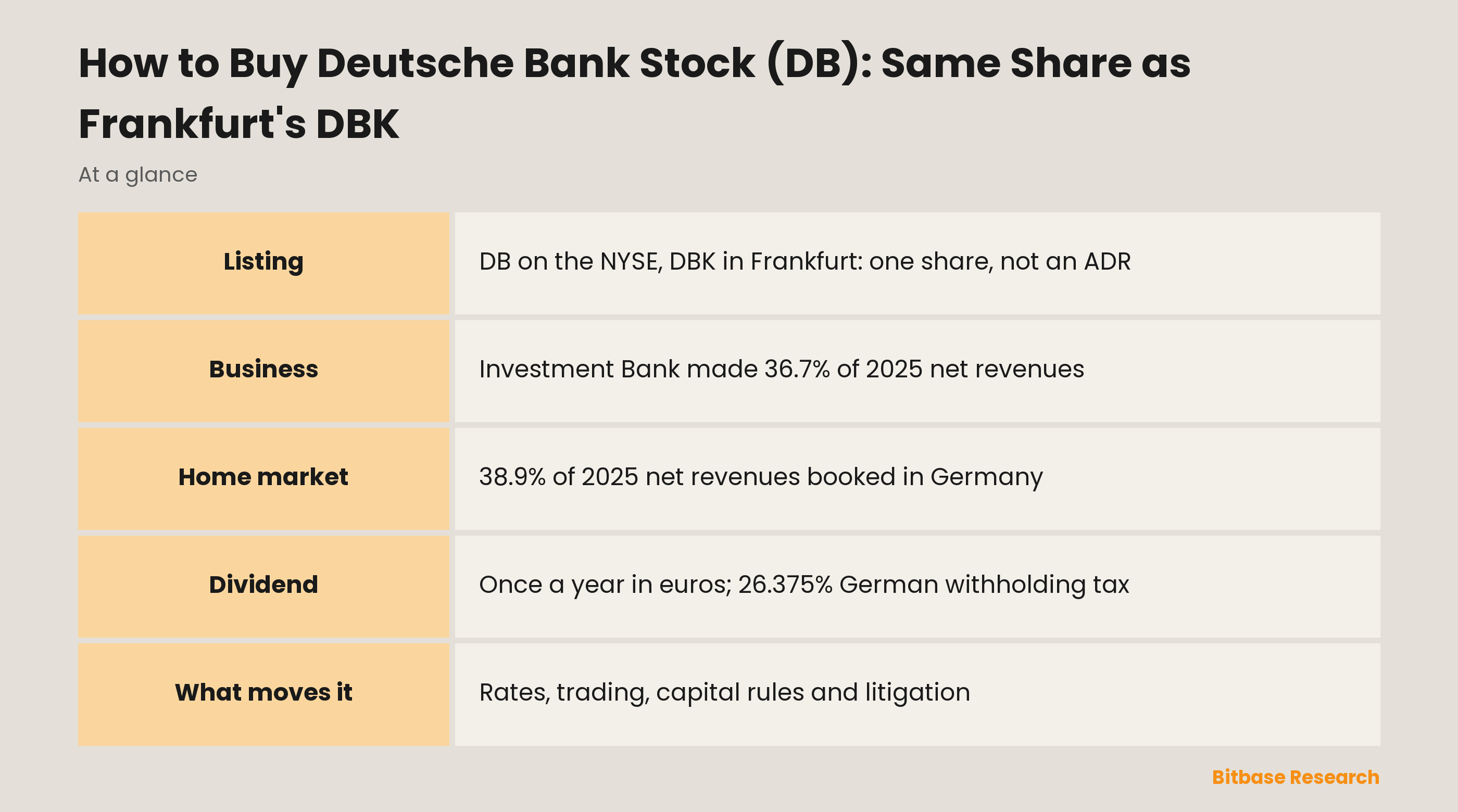
Unlike an ADR, the Deutsche Bank stock traded on the New York Stock Exchange under the ticker DB is the bank's own ordinary registered share, so buying it takes a broker with NYSE access and an order in US dollars, and no depositary or share ratio sits in between. The same share trades in euros in Frankfurt as DBK, and the business behind it leans on its home market: 38.9% of 2025 net revenues were booked in Germany. This guide covers what Deutsche Bank does, how it earns its revenue, how to place the order, what German tax does to the dividend and which risks its annual report puts first.
What Does Deutsche Bank Do?
Deutsche Bank is a universal bank headquartered in Frankfurt am Main. The listed company is Deutsche Bank Aktiengesellschaft, "a stock corporation organized under the laws of Germany," and its annual report on Form 20-F calls it "the largest bank in Germany and one of the largest financial institutions in the world, as measured by total assets." At the end of 2025 it operated in 55 countries with 1,179 branches, 64% of them in Germany.
The original Deutsche Bank was founded in 1870. In 1952 a law on the regional scope of banks split off three regional banks, based in Hamburg, Düsseldorf and Munich; their reunification under the Deutsche Bank name was registered in Frankfurt on 2 May 1957. Two later deals still shape the group: the 2010 takeover offer for Deutsche Postbank AG, followed by a squeeze-out of the remaining Postbank shareholders in 2015, and the purchase of the UK firm Numis Corporation in October 2023.
The bank reports four business segments plus a central one:
Corporate Bank serves companies from the German Mittelstand to multinationals, as well as financial institutions, with cash management, trade finance and lending, trust and securities services and risk management solutions. Those trust and securities services cover "depository receipts," the instrument that Deutsche Bank's own New York listing does without. Business Banking offers a standardized range to small companies and entrepreneurs in Germany.
Investment Bank combines Fixed Income & Currencies (FIC), which covers financing as well as sales, trading and structuring in foreign exchange, rates, emerging markets and credit, with Investment Banking & Capital Markets (IBCM), home to merger advice and debt and equity issuance.
Private Bank "serves over 20 million clients across 60 markets worldwide." In Germany, Personal Banking has around 18 million clients and two main brands: Deutsche Bank "as the Hausbank for financial advice and Postbank as a digital-first provider for everyday banking." It also runs retail banking in Italy, Spain and India, while Wealth Management serves wealthy individuals, entrepreneurs and family offices.
Asset Management is DWS Group GmbH & Co. KGaA, a separately listed affiliate in which Deutsche Bank holds 79.5% and whose passive funds carry the Xtrackers brand.
Corporate & Other holds revenues, costs and resources kept centrally rather than allocated to a segment, plus legacy portfolios.
How Deutsche Bank Makes Money
Group net revenues were essentially flat in 2025, down 0.2% from 2024 on the IFRS figures in the 20-F. The mix shifted underneath:
| Segment | 2025 revenue share | Versus 2024 | What it earns from |
|---|---|---|---|
| Investment Bank | 36.7% | Up 9.3% | Rates, FX and credit trading; financing; advisory and underwriting |
| Private Bank | 30.7% | Up 3.0% | Deposits, loans and investment products for retail and wealthy clients |
| Corporate Bank | 23.5% | Down 1.4% | Cash management, trade finance, lending, trust and securities services |
| Asset Management | 9.8% | Up 16.2% | Management, performance and transaction fees at DWS |
Corporate & Other subtracted 0.8% from the total, which is why the four segment shares exceed 100%.
By type of income, net interest income made up 49.9% of 2025 net revenues, net commission and fee income 34.6%, and net gains on financial assets and liabilities at fair value through profit or loss 14.6%. Net commission and fee income grew 5.0%.
In the Investment Bank, FIC Markets revenues rose 13%, "primarily Rates and Foreign Exchange," and FIC Financing grew 12%, while IBCM fell 6% on Debt Origination, which included a loss on a specific leveraged loan. In the Private Bank, Wealth Management grew 6%. At DWS, performance and transaction fees jumped 115%.
By region, revenues follow the booking office. Germany accounted for 38.9% of 2025 net revenues, the Americas (primarily the United States) 21.3%, the UK 15.8%, the rest of Europe 12.5%, and Asia/Pacific, the Middle East and Africa 12.3%; these figures cover the four segments only. The split differs by business: 73.3% of Investment Bank revenues were booked in the UK and the Americas, while 67.4% of Private Bank revenues came from Germany.
Profit before tax rose 35.3% and profit attributable to shareholders 52.1%, which the 20-F credits to operating performance and the non-recurrence of litigation items that weighed on 2024, among them the Postbank takeover case and Polish foreign-currency mortgages. The cost/income ratio fell to 65.7% from 72.9%.
DB Stock at a Glance
| Feature | DB |
|---|---|
| New York ticker | DB on the New York Stock Exchange (NYSE) |
| Principal market | DBK on the Frankfurt Stock Exchange, also traded on six other German exchanges |
| Form of the NYSE line | Ordinary registered share without par value, not a depositary receipt |
| Share registers | Frankfurt am Main, plus a New York register for NYSE trading |
| Currencies | Dollars on the NYSE, euros on German exchanges |
| Sector | Financials: corporate, investment and private banking, asset management |
| Index funds | Outside the S&P 500; inside State Street's EURO STOXX 50 ETF (29 October 2026 holdings) |
| Headquarters | Frankfurt am Main, Germany |
| Legal form | German stock corporation (Aktiengesellschaft) |
| Financial year | Calendar year, to 31 December |
| SEC filings | Form 20-F each year; Form 6-K for quarterly earnings |
| Dividend | Once a year, in euros, after the AGM vote |
| EDGAR identifier | CIK 1159508 |
For the live price and chart, see the Deutsche Bank stock page on Bitbase.
How to Buy Deutsche Bank Stock
There is one class of ordinary shares, registered in the holder's name, with Frankfurt as the principal market and a second share register in New York "for the purposes of trading the bank's shares on the New York Stock Exchange." The first choice is one of market and currency, not of security.
1. Pick the line. DB on the NYSE trades in US dollars; DBK in Frankfurt or on another German exchange trades in euros. Check which markets your broker reaches and who supervises it.
2. Open the account and pass the identity checks. Your declared tax residence determines how much of the German withholding tax can come back to you.
3. Deposit the money. Dollars for DB, euros for DBK; if you exchange currency first, check the conversion rate.
4. Find the right security. Search DB or DBK and confirm the name reads Deutsche Bank AG. The same 20-F cover registers three gold-linked exchange traded notes on NYSE Arca under DGP, DZZ and DGZ; those are notes issued by the bank, not shares.
5. Choose the order type. In FINRA's words, a market order "generally will execute at or near the current bid or ask prices in the marketplace," but "you might not get the price you saw or were originally quoted, especially in fast-moving markets." A buy limit order "can be executed only at or below the limit price."
6. Size the position. Buying part of a share is possible at some brokers, but "the availability of fractional share trading varies by brokerage firm," you "can't transfer fractional shares to another brokerage firm," and "you might not have shareholder voting rights."
7. Keep the paperwork. Trade confirmations and dividend statements record your cost and the tax withheld.
Registration and voting. Each share carries one vote at the General Meeting. To vote, a holder must appear in the share register and sign up for the meeting by the sixth day before it. If you hold through a broker, only the bank's or custodian's name appears in the register, and "the exercise of certain shareholder rights will depend on the cooperation of the bank or custodian." Shareholders pay the transfer agents no fees for transfers in the register, and none for converting dividends from euros to US dollars.
Dividends and German tax. Deutsche Bank pays a dividend once a year, after the Annual General Meeting resolves it; the record date is the meeting day, and payment normally follows on the third business day. The dividend is declared in euros and based on the parent company's unconsolidated German accounts, so what a NYSE holder receives in dollars depends on the exchange rate. Germany withholds 26.375%, made up of a 25% tax and a 1.375% surcharge. A US resident who qualifies under the tax treaty first receives 73.625% of the declared dividend and can reclaim 11.375% from the German tax authorities, ending at 85%, the equivalent of the 15% treaty rate. If you live in another country with a German tax treaty, part of the tax may be refundable; ask your broker or a tax adviser how the reclaim works for you, and note that it may be taxed a second time where you live.
Owning it through a fund. S&P 500 trackers leave Deutsche Bank out: SPY's holdings list for 29 October 2026 contains no Deutsche Bank line. State Street's EURO STOXX 50 ETF (FEZ), by contrast, lists Deutsche Bank AG registered shares under DBK in its holdings for the same day.
What Moves DB Stock
Interest rates and deposits. Net interest income supplies about half of revenue, so interest rates and deposit pricing matter directly. Corporate Bank revenues slipped in 2025 as "margin normalization and foreign exchange movements" outweighed interest hedging and business growth, and the 2028 plan relies on "the structural hedge rollover, the strength of the German deposit franchise and targeted loan growth" to lift net interest income.
Trading and deal flow. The Investment Bank is the largest segment, and its 2025 growth came from FIC, led by rates and currency trading in volatile markets. The 20-F warns that volatility and "cautious investor sentiment" can hurt revenues "particularly in investment banking, brokerage and other commission and fee-based businesses."
Capital and payouts. The CET1 capital ratio was 14.2% at the end of 2025, up from 13.8% and slightly above the bank's operating range of 13.5% to 14.0%. For 2028 the bank targets a post-tax return on tangible equity above 13%, a cost/income ratio below 60% and a 60% total payout ratio from 2026, distributing excess capital when CET1 is "sustainably above 14%." The dividend proposed for 2025 was around 50% higher per share than a year earlier, the fourth such rise in a row; from 2026 the bank aims for "modest but continuous growth." Buybacks also need supervisory approval.
Litigation. By the end of 2025 the bank had settled 90% of the Postbank takeover claims by value and fully provisioned the rest, while two related appraisal proceedings remain open. In December 2025 the Higher Regional Court in Düsseldorf, in an indicative order in one of them, rejected the argument that compensation should be raised to the price of the 2010 offer.
The German economy. Nearly two-fifths of group revenues and 67.4% of the Private Bank's are booked in Germany. The 20-F records that German GDP "almost stagnated, growing by a mere 0.2% in 2025."
Accounting effects. Corporate & Other swings with the valuation of interest rate hedges that IASB IFRS does not let the bank account for as hedges, the main reason its revenues turned from positive in 2024 to negative in 2025.
Legal, Capital and Market Risks for DB Holders
Of the 20-F's risk factors, five weigh most on a shareholder:
Litigation and investigations. The bank "operates in a highly regulated and litigious environment, potentially exposing the bank to liability and other costs, the amounts of which may be substantial and difficult to estimate." Besides Postbank, the 20-F names industry-wide inquiries into cum-ex trades around dividend record dates, foreign-currency mortgage claims against Deutsche Bank Polska and civil proceedings over 1MDB involving its Malaysian subsidiary.
Financial-crime controls. BaFin issued orders between 2018 and 2023 requiring stronger anti-money-laundering safeguards and transaction monitoring, and in July 2023 the bank and several US units entered a consent order with the Federal Reserve Board on sanctions and anti-money-laundering compliance. "If Deutsche Bank is unable to significantly improve its infrastructure and control environment by the set deadlines," results and reputation "could be materially and adversely affected."
Capital rules and distributions. On 31 December 2025 the bank had to hold a CET1 ratio of at least 11.26%. If it falls short of its requirements, "the ECB or the BaFin may suspend or limit, the payment of dividends or execution of share buybacks," and the bank "cannot assure investors that it will pay dividends or conduct share buybacks."
Resolution powers. If the bank were failing, resolution measures could include "the reduction, including to zero, of the nominal value of shares, the dilution of shareholders or the cancellation of shares outright."
Credit. Investment Bank provisions for credit losses rose markedly in 2025, "all impacting the commercial real estate (CRE) portfolio."
There is also the plain risk of concentration: one stock means one company's fortunes, and no dividend is owed until shareholders vote it.
Where Deutsche Bank Publishes Its Numbers
Deutsche Bank's EDGAR identifier is CIK 1159508. Its 20-F for 2025 was filed on 12 March 2026, and quarterly earnings reports arrive on Form 6-K; the latest, as of 30 September 2026, was furnished on 28 October 2026. In the 20-F, start with the risk factors, the strategy, dividend policy and taxation sections, the segment note and the provisions note, which carries the litigation details.
One trap is specific to this bank: it reports under two versions of IFRS. Filings for US purposes use IFRS as issued by the IASB, while its financial targets and its releases for non-US purposes use IFRS as endorsed by the EU, with the EU carve-out for hedge accounting. On the IASB figures in the 20-F, the 2025 return on tangible equity was 9.4% and the cost/income ratio 65.7%, yet the bank says it met or surpassed its key 2025 targets, which included a return above 10% and a cost/income ratio below 65%, measured on the EU basis. Compare like with like.
The investor relations site lists each dividend's payment date. Live prices are on the stock page linked above, and the full list of stock pages on Bitbase covers other listed companies.
Deutsche Bank Stock FAQ
Is Deutsche Bank stock an ADR?
No. The 20-F states that "Deutsche Bank's ordinary shares are not represented by American Depositary Receipts." The NYSE trades the registered share itself, which sets it apart from banks such as HSBC, whose New York line is an ADS standing for five ordinary shares.
What is the difference between DB and DBK?
They are the same share on two markets. DBK is the symbol on the Frankfurt Stock Exchange, the principal market, where it trades in euros; DB is the symbol on the NYSE, where it trades in US dollars.
Does Deutsche Bank pay a dividend?
Yes, once a year. The dividend for 2025 was put to the Annual General Meeting on 28 May 2026, and the investor relations dividend page gives 2 June 2026 as its payment date. It is declared in euros and subject to German withholding tax, which a qualifying US resident can partly reclaim down to the 15% treaty rate.
Can I buy Deutsche Bank stock with crypto?
Not directly. Brokers take dollars for DB and euros for DBK; crypto is not accepted as payment for the shares. The route is to sell crypto for fiat money, transfer the cash to your brokerage account and then place the order. Depending on your jurisdiction, that sale can itself be a taxable event, so treat the two steps as separate decisions, each with its own cost.
Is Deutsche Bank in the S&P 500?
No. SPY, the S&P 500 fund run by State Street, held no Deutsche Bank shares in its 29 October 2026 holdings file. Being German, the bank turns up in European index funds instead; State Street's EURO STOXX 50 ETF holds its Frankfurt line.
Conclusion
Buying Deutsche Bank needs only a broker with NYSE or German market access: DB in New York and DBK in Frankfurt are the same registered share, with no depositary in between. What you own is a German universal bank whose earnings ride on interest rates, trading and long-running legal matters, and whose payouts depend on capital rules. Before buying, work through the newest 20-F and quarterly 6-K on one accounting basis, check how the German withholding tax will reach you, and size the position as what it is: a bet on a single bank.
Related reading
Other Bitbase articles on this topic:
- How to Buy BNY Stock (BNY): Custody Bank Formerly Traded as BK
- How to Buy Capital One Stock (COF): Card Lender, Discover Network
- How to Buy CIBC Stock (CM): Dividend, Mortgages, Caribbean Sale
Disclaimer: This article is educational content from Bitbase Academy, provided for information only. It explains what a company or fund does and how the instruments referenced here differ from one another; it does not constitute investment, trading, tax, or financial advice, and it is neither a recommendation nor an endorsement of any security, token, or trading strategy. A tokenized stock is issued by a third party and is designed to give economic exposure to an underlying asset: it is not a share, it carries no shareholder rights, and it depends on the issuer's structure, eligibility rules, and redemption terms, which the issuer can change. Perpetual futures are leveraged derivatives that hold no underlying asset and can be liquidated, and trading hours, product availability, and eligibility differ by instrument and by jurisdiction and can change at any time. Written as of October 2026; verify everything yourself through company filings, the issuer's own documentation, and the product pages of the venue you trade on.
References
[1] Deutsche Bank AG, Form 20-F for 2025 (SEC EDGAR) www.sec.gov
[2] Deutsche Bank 20-F for 2025, XBRL cover page (R1) www.sec.gov
[3] Deutsche Bank, Form 6-K of 28 October 2026: earnings report as of 30 September 2026 www.sec.gov
[4] Deutsche Bank, Form 6-K of 29 May 2026: 2026 Annual General Meeting www.sec.gov
[5] Deutsche Bank Investor Relations: Dividend investor-relations.db.com
[6] FINRA: Order Types www.finra.org
[7] FINRA: Investing in Fractional Shares www.finra.org
[8] State Street: SPDR S&P 500 ETF Trust (SPY), holdings as of 29 October 2026 www.ssga.com
[9] State Street: SPDR EURO STOXX 50 ETF (FEZ), holdings as of 29 October 2026 www.ssga.com





