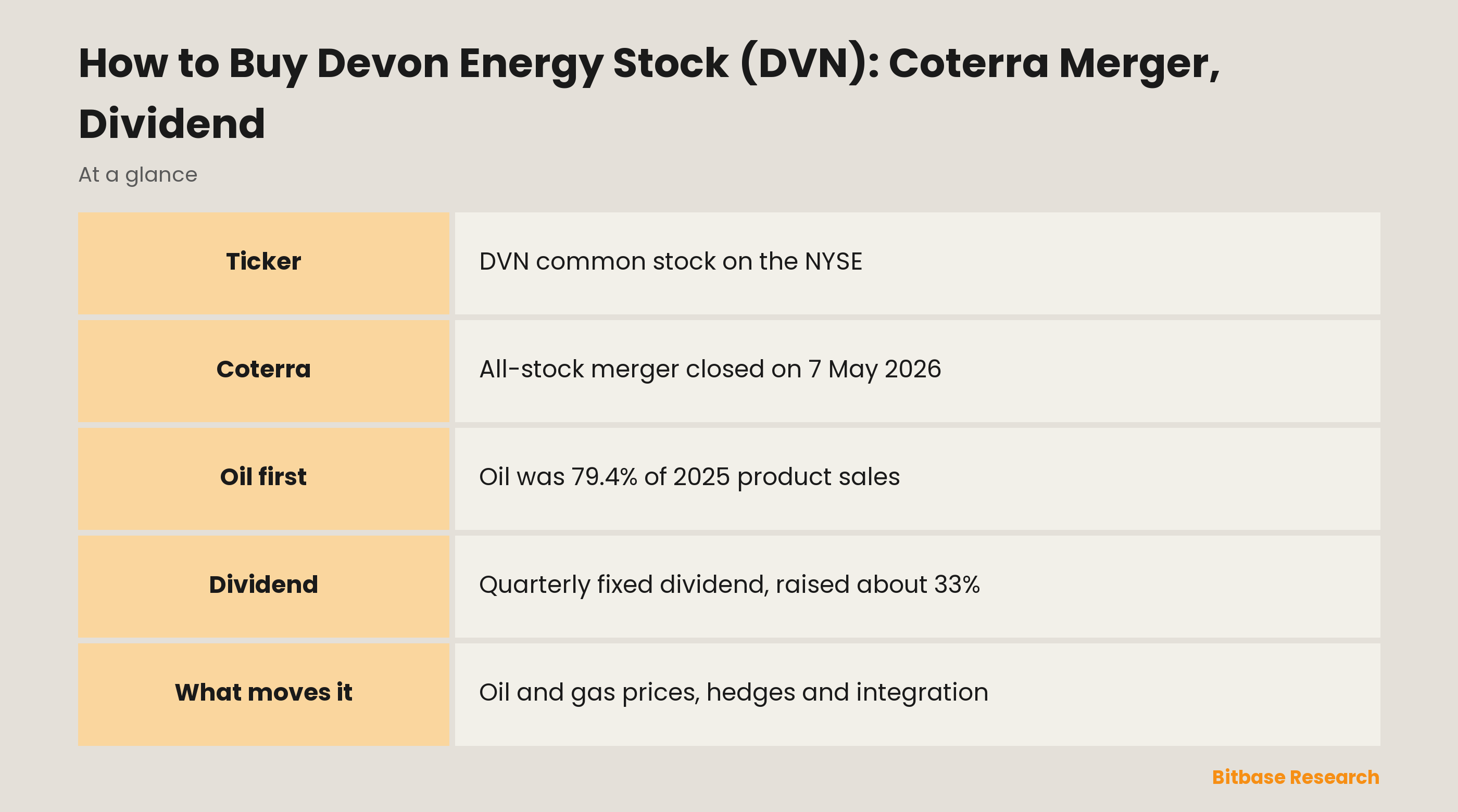
You purchase Devon Energy stock through any brokerage account that reaches the New York Stock Exchange, where its common shares trade under the ticker DVN. The company behind that ticker changed shape in 2026: an all-stock merger with Coterra Energy closed on 7 May, added about 532 million new shares and moved the headquarters from Oklahoma City to Houston. This guide covers what Devon produces, how it earns and pays out its cash, how to order the shares and which risks its filings put first.
What Does Devon Energy Do?
Devon Energy Corporation finds and produces crude oil, natural gas and natural gas liquids (NGLs) on land in the United States. Its annual report describes it as "an independent energy company," the industry's word for a producer that does not also refine crude, and says it was "founded in 1971 and publicly held since 1988." It is incorporated in Delaware.
For 2025 the 10-K names four core areas. The Delaware Basin, part of the wider Permian, is "our largest and most active program," spanning southeast New Mexico and west Texas. The Rockies combine the Williston Basin, where Devon drills the Bakken and Three Forks formations across eastern Montana and western North Dakota, with the Powder River Basin in Wyoming. The Eagle Ford position sits in the DeWitt and Karnes counties of south Texas, and the Anadarko Basin in western Oklahoma, where part of the acreage is developed jointly with Dow.
Two earlier deals still show in the filings. Devon merged with WPX Energy in January 2021, and on 27 September 2024 it bought the Williston Basin business of Grayson Mill, paying partly with about 37.3 million new Devon shares; the 10-K says that purchase significantly expanded its position in the basin.
A much larger deal followed in 2026. On 1 February Devon agreed an all-stock merger with Coterra Energy, a producer with assets in the Permian Basin of Texas and New Mexico, the Marcellus Shale in Pennsylvania and the Anadarko Basin in Oklahoma. Each Coterra share became 0.70 of a Devon share, leaving former Devon holders with about 54% of the combined company and former Coterra holders with about 46%. It closed on 7 May. The combined company kept the Devon name and the DVN ticker; Clay Gaspar stayed as chief executive and Coterra's Tom Jorden became non-executive chair. Its 10-Q now lists five core areas: the Permian Basin, Rockies, Eagle Ford, Anadarko Basin and Marcellus Shale.
Two moves followed. On 20 May Devon bought 16,300 net undeveloped acres in Lea and Eddy counties, New Mexico, through a federal lease sale. And the portfolio review it launched with the merger led, on 8 October, to an agreement to sell its Eagle Ford assets, about 90,000 net acres, to Crescent Energy for cash. That sale was still pending at the end of October 2026.
How Devon Energy Makes Money
Mostly by selling crude. Of Devon's oil, gas and NGL sales in 2025, oil brought in 79.4%, NGLs 13.1% and natural gas 7.5%. Those product sales made up 65.3% of total revenues. Marketing and midstream accounted for another 32.4%, but its expenses slightly exceeded that revenue, so the line added sales rather than profit. No customer accounted for more than 10% of sales revenue in 2025.
Where the barrels come from shifted with the merger:
| Area | Share of 2025 output | Share of Q2 2026 output | What is there |
|---|---|---|---|
| Delaware Basin, reported as Permian from 2026 | 59% | 55% | Oil-rich formations in New Mexico and west Texas, plus Coterra's Permian |
| Rockies | 23% | 15% | Williston Basin, enlarged by Grayson Mill, and the Powder River Basin |
| Anadarko Basin | 10% | 9% | Western Oklahoma, with Coterra's acreage added |
| Eagle Ford | 8% | 6% | South Texas; sale to Crescent Energy agreed in October 2026 |
| Marcellus Shale | None | 15% | Natural gas in Pennsylvania, from Coterra |
Shares are of total output in barrels of oil equivalent, as printed in the 10-K and the second-quarter 10-Q. The Q2 column counts Coterra only from 7 May.
Growth in 2025 came mainly from acquired barrels: total output rose 14% and oil output 12%, led by the Rockies after Grayson Mill. The merger then tilted Devon toward gas: oil was 46.3% of output in 2025 but 37.0% in the second quarter of 2026.
DVN Stock at a Glance
| Feature | Devon Energy |
|---|---|
| Listing venue | New York Stock Exchange (NYSE) |
| Ticker | DVN, the only security registered on the 10-K and 10-Q covers |
| Security | Common stock |
| Sector | Energy: oil and gas exploration and production |
| Index membership | S&P 500 (see FAQ) |
| Headquarters | Houston, Texas, with a significant presence kept in Oklahoma City |
| Incorporated | Delaware |
| Fiscal year | Calendar year, ending 31 December |
| Dividend policy | Quarterly cash dividend, begun in 1993; now described as a fixed dividend |
| Holders of record | 10,200 on 4 February 2026 |
| SEC identifier | CIK 1090012 |
None of that moves with the market; price, market value and yield do. For the live quote, open the Devon Energy stock page on Bitbase.
How to Buy Devon Energy Stock
Devon is a US company and DVN is its common stock itself, not a depositary receipt, so any broker with NYSE access can handle it:
1. Choose a broker that trades NYSE-listed shares, and find out which legal entity you contract with and which regulator oversees it.
2. Open and verify the account. Brokers may ask non-US investors for IRS Form W-8BEN, which the IRS says to submit "when requested by the withholding agent or payer."
3. Deposit money. If your cash is not in dollars, the conversion rate is a cost alongside the commission.
4. Search for DVN and read the result line. You want Devon Energy Corporation common stock. Coterra's old ticker, CTRA, no longer trades on the NYSE; those shares were converted into DVN.
5. Pick an order type. A market order "provides the most certainty that your order will be executed," FINRA says, while a limit order fills only "at or better than a specified price," with the trade-off that "there's a chance your order doesn't get executed at all."
6. Decide whether to buy fractions. "The availability of fractional share trading varies by brokerage firm," and for now, FINRA adds, "you can't transfer fractional shares to another brokerage firm."
7. Save the trade confirmations and statements, which document what you paid and the dividends you receive.
If you plan to trade outside the regular session, first learn how regular-session and extended-hours prices can differ.
Dividend tax outside the US. The IRS states that "most types of U.S. source income received by a foreign person are subject to U.S. tax of 30%," and that a reduced rate "may apply" under a tax treaty; Form W-8BEN is how you document foreign status for that purpose. The country where you live may tax the dividend as well.
Through a fund. State Street's holdings files for 29 October 2026 list DVN in SPY, its S&P 500 fund, and in the sector funds XOP and XLE, where it is a single position in a basket.
What Moves DVN Stock
Oil prices, then gas prices. With oil at 79.4% of 2025 product sales, the 10-K's warning applies directly: its financial condition, results of operations "and the value of our properties are highly dependent on the general supply and demand for oil, gas and NGLs." WTI averaged about 14% less in 2025 than in 2024, and in the first half of 2026 the 10-Q blamed price swings mainly on geopolitical events, "including conflict in the Middle East and disruptions to global oil supply."
Hedges that cut both ways. When it filed its 2025 annual report, Devon had about 30% of its expected 2026 oil and gas output hedged. That protects against falls and gives up part of any rise: in the second quarter of 2026 its unhedged oil price was 103% of WTI, but only 95% after hedge settlements. For the rest of 2026 about 30% of oil and 25% of gas were hedged; for 2027, 15% and 10%.
Permian gas discounts. In the second quarter of 2026 Devon's unhedged gas price was just 12% of the Henry Hub benchmark, as regional discounts in the Permian widened and the 10-Q reported "negative spot pricing at the Waha hub." Devon expects the discounts to keep narrowing as new takeaway capacity starts in the second half of 2026 and early 2027, and with the Marcellus added, gas now weighs more on results.
Integrating Coterra. The merger's success depends, among other things, on synergies that Devon targets by the end of 2027, and the 10-K warns that "there can be no assurances that our businesses can be integrated successfully." The portfolio review adds a second moving part: the Eagle Ford sale covers about 4% of total production, according to the October announcement, and Devon said it would explain the effect on its outlook with third-quarter results.
Federal acreage. Part of Devon's Delaware Basin position is held under federal leases, and the May purchase came through a federal lease sale. The 10-K cautions that new restrictions "on our ability to operate on federal lands could adversely impact our business in the Delaware and Powder River Basins."
Cash returns. The fixed dividend follows "a general target of paying out up to 10% of operating cash flow," and a new buyback program runs to June 2029; both rest on the prices above.
Devon's Main Risks After the Coterra Deal
The second-quarter 2026 10-Q reports no material changes to the FY2025 10-K's risk factors. These bear most directly on a DVN share:
Commodity prices. Lower prices cut revenue, cash flow and the value of Devon's properties, for reasons beyond its control.
Integration. The two companies ran separately until May 2026; if the synergies do not materialize, the 10-K says, the board may delay or not approve "the anticipated increases in our dividends and share repurchase authorization."
Takeaway capacity. Devon depends on midstream systems owned by others, and "all or a portion of our production in one or more regions may be interrupted or shut in from time to time due to losing access to plants, pipelines or gathering systems."
Reserve estimates. "Different reserve engineers may develop different estimates of reserve quantities and related revenue based on the same data." Revisions can lower the value of the properties.
Dividends and buybacks. "We can provide no assurance that we will continue to pay dividends or execute share repurchases at the current rate or at all."
Beyond the company itself, a single-stock position ties your outcome to one producer, and a non-US holder also takes on the dollar.
Reading Devon's 10-K, 10-Q and 8-K Filings
Devon's SEC filings sit under CIK 1090012, and devonenergy.com posts the same documents. Mind the dates: the FY2025 10-K describes Devon before Coterra, and the second-quarter 2026 10-Q is the first to include the combined company.
In the 10-K, Items 1 and 2 describe the basins, Item 1A lists the risks and Item 5 gives the listing, the dividend policy and a graph comparing DVN's total return with the S&P 500 and XOP. The management discussion's tables give each basin's output and realized prices against WTI and Henry Hub, and the structured cover page, R1.htm, shows the single registered security.
Current reports on Form 8-K carry the events in between: the merger agreement on 2 February 2026, its completion on 7 May, the federal lease purchase on 21 May and the Eagle Ford sale agreement on 8 October. The 2026 proxy statement names the companies Devon measures its performance shares against: APA, ConocoPhillips, Coterra, Diamondback Energy, EOG Resources, Expand Energy, Occidental, Ovintiv and Permian Resources, plus the S&P 500 and XOP. The stock page linked earlier carries the live quote, and the list of US stocks on Bitbase covers other companies.
Devon Energy Stock FAQ
Does Devon Energy pay a dividend?
It does, and the 10-K dates its regular quarterly cash dividends to the second quarter of 1993. The FY2025 10-K described a dividend that "can be comprised of a fixed dividend and a variable dividend," and Devon paid variable amounts on top of the fixed one in 2023 and 2024, but each 2025 payment was the fixed rate alone. The second-quarter 2026 10-Q says Devon "pays a quarterly fixed dividend," which it raised by about 33% with the merger. Each payment is declared by the board, and Devon announces the amount and dates.
Can I buy Devon Energy stock with crypto?
Only in two separate steps. A broker settles DVN in US dollars, so the crypto has to be sold for cash first, which may be a taxable event where you live, and the proceeds deposited with the broker. The share you end up with carries dividend and voting rights in the company, which is how a share differs from a crypto asset.
What happened to Coterra Energy (CTRA) shares?
On 7 May 2026 each Coterra share was converted into 0.70 of a Devon share, with cash paid instead of fractional shares, and Coterra stock stopped trading on the NYSE. Former Coterra holders now own about 46% of Devon, and Coterra continues as a Devon subsidiary.
Is DVN in the S&P 500?
Yes. State Street's SPY holdings file for 29 October 2026 lists Devon Energy, and so do its XOP and XLE files. Membership can change, so check the latest file.
Is Devon Energy selling its Eagle Ford business?
It has agreed to. A Devon subsidiary signed the sale to Crescent Energy on 8 October 2026, and the 8-K expected closing in the fourth quarter of 2026 or early 2027, subject to customary conditions. Until then the assets remain Devon's.
Conclusion
Buying DVN needs three things: a broker with NYSE access, the Devon Energy common stock line under DVN, and a clear choice between a market and a limit order. What the share holds changed in 2026: Coterra's Marcellus gas, more Permian acreage and, if the sale closes, no Eagle Ford. The latest 10-Q and the 8-Ks filed since the merger are the documents to read before deciding how much of one producer to own.
Related reading
Other Bitbase articles on this topic:
- How to Buy Cenovus Energy Stock (CVE): Oil Sands Without Mines
- How to Buy Cheniere Energy Stock (LNG): LNG vs CQP and Dividend
- How to Buy Diamondback Energy Stock (FANG): Viper and the Permian
- How to Buy Targa Resources Stock (TRGP): Permian NGLs, Not an MLP
Disclaimer: This article is educational content from Bitbase Academy, provided for information only. It explains what a company or fund does and how the instruments referenced here differ from one another; it does not constitute investment, trading, tax, or financial advice, and it is neither a recommendation nor an endorsement of any security, token, or trading strategy. A tokenized stock is issued by a third party and is designed to give economic exposure to an underlying asset: it is not a share, it carries no shareholder rights, and it depends on the issuer's structure, eligibility rules, and redemption terms, which the issuer can change. Perpetual futures are leveraged derivatives that hold no underlying asset and can be liquidated, and trading hours, product availability, and eligibility differ by instrument and by jurisdiction and can change at any time. Written as of October 2026; verify everything yourself through company filings, the issuer's own documentation, and the product pages of the venue you trade on.
References
[1] Devon Energy Form 10-K, fiscal 2025 (SEC EDGAR) www.sec.gov
[2] Devon Energy 10-K, fiscal 2025: XBRL cover page (SEC EDGAR) www.sec.gov
[3] Devon Energy Form 10-Q, second quarter 2026 (SEC EDGAR) www.sec.gov
[4] Devon Energy Form 8-K, 2 February 2026: merger agreement with Coterra www.sec.gov
[5] Devon Energy Form 8-K, 7 May 2026: completion of the Coterra merger www.sec.gov
[6] Devon and Coterra press release, 7 May 2026: merger completed www.sec.gov
[7] Devon Energy Form 8-K, 21 May 2026: New Mexico federal lease acquisition www.sec.gov
[8] Devon Energy Form 8-K, 8 October 2026: Eagle Ford sale agreement www.sec.gov
[9] Devon Energy press release, 8 October 2026: agreement to exit the Eagle Ford www.sec.gov
[10] Devon Energy 2026 proxy statement (SEC EDGAR) www.sec.gov
[11] State Street, SPY daily holdings, 29 October 2026 www.ssga.com
[12] State Street, XOP daily holdings, 29 October 2026 www.ssga.com
[13] State Street, XLE daily holdings, 29 October 2026 www.ssga.com
[14] FINRA: Order Types www.finra.org
[15] FINRA: Investing in Fractional Shares www.finra.org
[16] IRS: NRA Withholding www.irs.gov
[17] IRS: About Form W-8 BEN www.irs.gov





