
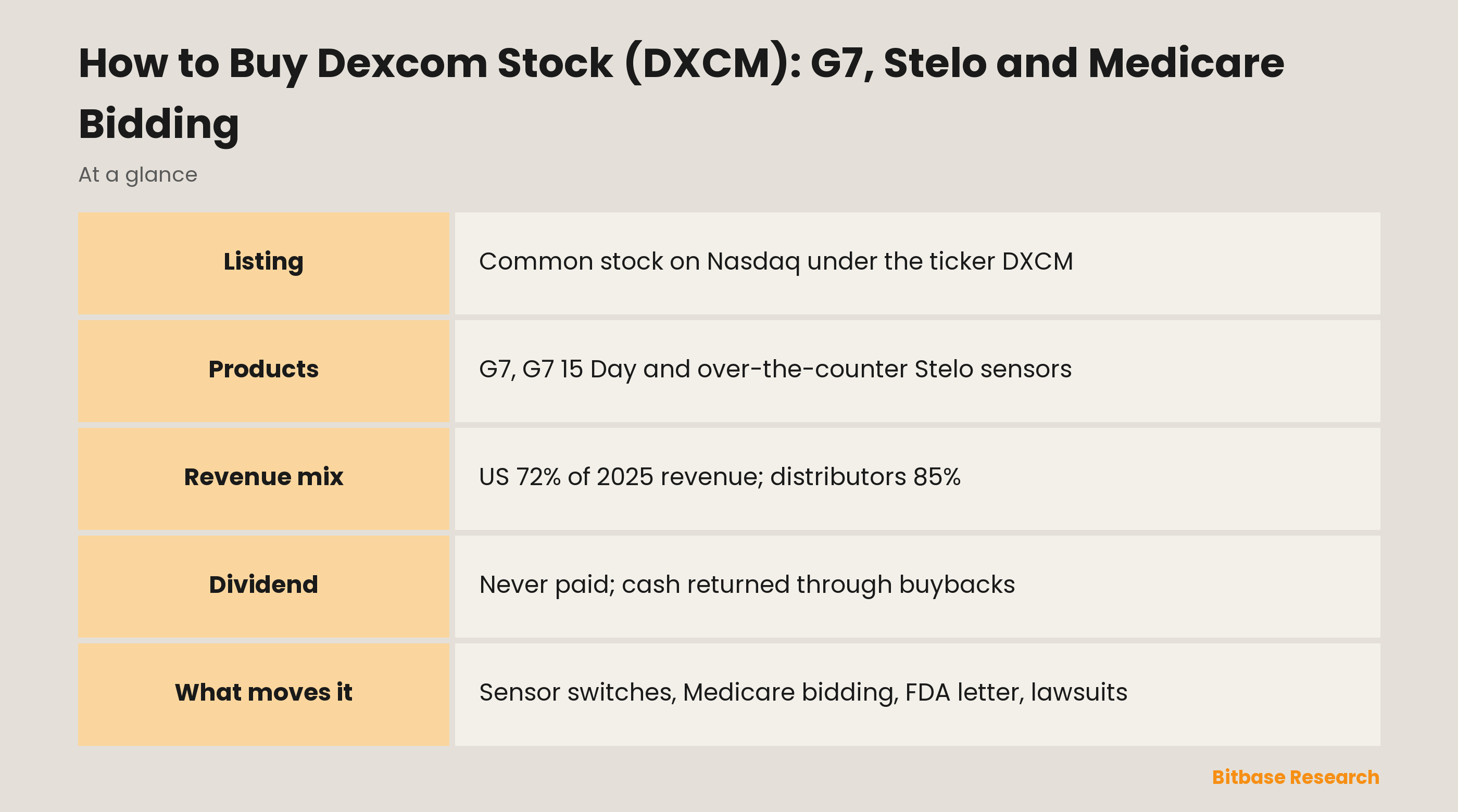
On Nasdaq, Dexcom stock trades under the ticker DXCM, the only class of shares the company has registered, so any brokerage account with access to that exchange can buy it. Dexcom makes continuous glucose monitors, small wearable sensors that send a glucose reading every five minutes, and in 2025 the United States produced about 72% of its revenue while distributors handled about 85%. Below: the products, the order, and what the filings flag, from Medicare bidding to an FDA warning letter.
What Does Dexcom Do?
Dexcom calls itself "a medical device company primarily focused on the design, development and commercialization of continuous glucose monitoring, or CGM, systems for the management of diabetes and metabolic health." A CGM is a thin wire sensor worn under the skin, paired with a transmitter that sends readings to a receiver or a phone. Dexcom received FDA approval for its first product and began selling it in 2006.
The 2025 annual report lists five systems.
G7. Authorized by the FDA in December 2022 and launched in 2023, it is an all-in-one sensor and transmitter worn for 10 days, cleared in the United States for people with diabetes aged two and older.
G7 15 Day. Authorized in April 2025 for adults and launched late that year, it stretches wear to 15.5 days. Dexcom reports a mean absolute relative difference, a standard accuracy measure, of 8.0%, with 94.2% of readings within 20% of the reference, and calls it "the most accurate CGM cleared by the FDA," its own claim.
G6. Authorized in 2018, it was the first CGM the FDA allowed to work in an integrated system with insulin pumps. Dexcom expects to move G6 users to the G7 family by the end of 2026.
Dexcom ONE+. Sold in several European countries since its CE Mark in November 2023, it shares many G7 features.
Stelo. Launched in August 2024 as "the first over-the-counter glucose biosensor in the U.S.," it needs no prescription and was designed for adults with prediabetes or Type 2 diabetes who do not use insulin. In June 2026 the FDA extended it to children aged two and older who do not use insulin.
The Share and Follow apps let up to ten people watch a user's readings, and partners' insulin pumps and pens can take in Dexcom data, in some cases to adjust dosing semi-automatically.
Production happens mainly in Mesa, Arizona and Penang, Malaysia, and a plant being built in Athenry, Ireland is expected to "add substantial manufacturing capacity." Headquarters are in San Diego.
The 10-K names its direct rivals: Abbott's Diabetes Care division, whose Libre sensors Dexcom has competed with "for many years"; Medtronic's diabetes business, spun off into a separate company called MiniMed, which sells the Simplera sensor; and meter makers such as Roche. Both large groups are covered in our Abbott stock guide and Medtronic stock guide.
How Dexcom Makes Money
Dexcom reports one segment. Revenue comes from disposable sensors and from what it calls Reusable Hardware, the transmitters and receivers. Revenue grew 16% in 2025, which the 10-K credits mainly to higher sensor volume from "the continued growth of our worldwide customer base," partly offset by "pricing headwinds due to greater rebate eligibility and channel mix."
The annual report splits revenue by customer location and sales channel:
| Share of 2025 revenue | United States | International | Total |
|---|---|---|---|
| Through distributors | 69% | 16% | 85% |
| Sold directly | 3% | 12% | 15% |
| Total | 72% | 28% | 100% |
Shares are calculated from the 10-K's channel and region table. In the United States almost every sale passes through distributors, including wholesalers; abroad, direct sales are a far larger part of the mix. US revenue rose 15% in 2025 and international revenue 16%.
That puts a lot of weight on a few counterparties. The financial statement notes list three unnamed customers: Customer A at 55% of 2025 revenue, up from 35% in 2023, Customer B at 35% and Customer C at 46%. Each figure is net only of rebates "directly allocable to that customer," and the 10-K adds that "Rebates paid to other entities are excluded; therefore, the combined value may exceed 100%."
Behind the distributors sit the payers. Since April 2023 Medicare has covered CGMs for all insulin users and for others with a history of problematic hypoglycemia; at the end of 2025 Medicaid covered Dexcom in approximately 48 states, and the eight largest US private insurers had CGM policies.
Gross margin was 60.1% in 2025 against 60.5% in 2024, which the 10-K blames on "inefficiencies associated with ensuring supply availability, build configurations that lowered production yield, and total replacement costs." Operating income still rose to about 20% of revenue from 15%, helped by lower legal costs after a patent lawsuit was settled in December 2024. The first quarter is usually weaker than the fourth, as US insurance deductibles reset.
In the third quarter of 2026 revenue rose 11%, with the United States up 14% and international up 5%. Gross margin reached 64.3%, up from 60.5% a year earlier, helped by volume, "G7 15 Day benefits" and better manufacturing efficiency, partly offset by inventory charges tied to the planned end of G6 manufacturing.
DXCM Stock at a Glance
| Feature | DXCM |
|---|---|
| Exchange | Nasdaq Global Select Market |
| Ticker | DXCM |
| Security | Common stock, the only class registered under Section 12(b) |
| Sector | Medical devices: continuous glucose monitoring |
| Main products | G7, G7 15 Day, G6, Dexcom ONE+, Stelo |
| Index membership | S&P 500 and Nasdaq-100 |
| Headquarters | San Diego, California |
| Incorporated | Delaware |
| Fiscal year | Calendar year, ending 31 December |
| Dividends | Never paid; none expected "in the foreseeable future" |
| Stock split | Four-for-one, effective 10 June 2022 |
| Buybacks | Programs authorized in 2025 and May 2026; one approved in October 2026 runs to the end of 2027 |
| SEC identifier | CIK 1093557 |
Price, market value and trading volume change by the second; for live figures, see the Dexcom stock page on Bitbase.
How to Buy Dexcom Stock
Dexcom's common stock trades directly on Nasdaq, with no depositary receipt in between. Six steps:
1. Pick a broker with Nasdaq access. Abroad, that can be a local broker with a US desk or an international platform; check which entity holds your account and who supervises it.
2. Open and verify the account. Brokers ask non-US individuals for IRS Form W-8BEN, which the IRS says to submit "when requested by the withholding agent or payer."
3. Fund it. Paying in a currency other than dollars means a conversion, and the exchange-rate spread can cost more than the commission.
4. Search for DXCM. The result should read DexCom, Inc. common stock on Nasdaq; there is no second share class.
5. Choose an order type. A market order fills at whatever price is available when it arrives; a limit order caps the price you pay and may stay unfilled.
6. Size the position and keep records. Many brokers sell fractional shares for a fixed sum, though not all, and whether a fraction carries a vote depends on the broker. Confirmations and statements document what you paid.
Tax for buyers abroad. Dexcom pays no dividend, so dividend withholding does not arise for now. The general IRS rule is that "most types of U.S. source income received by a foreign person are subject to U.S. tax of 30%," with a lower rate possible under a tax treaty. How a later sale is taxed depends on where you live.
Through index funds. DXCM belongs to the S&P 500 and the Nasdaq-100, so funds tracking them, such as SPY and QQQ, hold a small slice of it.
What Moves DXCM Stock
Moving users to new sensors. Dexcom is retiring the G6 and, in Europe, the older Dexcom ONE by the end of 2026, and in the third quarter of 2026 it won the first two international clearances for the G7 15 Day. Each switch touches margins: replacement costs weighed on 2025, while in 2026 the longer-wearing sensor helped and the G6 wind-down added inventory charges.
Medicare's competitive bidding. In late 2025 CMS extended its competitive bidding program to CGMs and receivers, with contracting in 2027 and payment changes from 1 January 2028. CMS expects to award ten contracts and will pay a single amount set at the 75th percentile of winning bids rather than the highest one, with CGMs moving to monthly rental payments. Dexcom's reading is plain: "we expect that Medicare reimbursement for our CGM systems will decrease beginning in 2028."
People who do not use insulin. Dexcom's core market is people with diabetes on insulin, and it estimates that more than 25 million Americans have Type 2 diabetes without insulin or hypoglycemia risk. Stelo is its over-the-counter route to that group, and in October 2026 Dexcom said its CONNECT trial of the G7 in that population was published in The New England Journal of Medicine. Obesity drugs cut both ways: "While we believe that GLP-1s are a companion product and used in conjunction with our CGM systems, these treatments could potentially compete with our CGM systems and reduce sales of our products."
Manufacturing quality. In March 2025 Dexcom received an FDA warning letter after inspections of its Mesa site in June 2024 and its San Diego site in October and November 2024. It describes "observed non-conformities in manufacturing processes and our quality management system." Dexcom says it has responded and that the letter does not restrict it from producing or selling products, require a recall, or block new 510(k) submissions. Whether the FDA considers it resolved is for later filings to show.
Competition. Abbott can link some Libre sensors to automated insulin delivery systems, and the 10-K cites FDA guidance of 6 January 2026 that broadens the range of products treated as "general wellness devices," including wearables that report blood glucose, which could help rivals from outside medical devices.
Leadership and buybacks. Jake Leach became CEO on 1 January 2026, after running the company on an interim basis during Kevin Sayer's medical leave from September 2025; Sayer returned in March 2026 as Executive Chairman. Dexcom completed its May 2026 buyback program by 30 September 2026 and approved another in October; any program "may be extended, modified, suspended, or discontinued at any time."
Pricing, Quality and Court Risks in Dexcom's Filings
Of the many risks in Item 1A of the 10-K, these bear most on a DXCM share:
Prices. "We have experienced, and anticipate that we will continue to experience, decreasing prices for our products due to future reimbursement changes under Medicare and pricing pressure from managed care organizations and other third-party payors."
Capacity. "If our manufacturing capabilities are insufficient to produce an adequate supply of product at appropriate quality levels, our growth could be limited and our business could be harmed." Single-source parts include transmitter chips and applicator seals.
Concentrated buyers. Certain distribution agreements each produced 10% or more of 2025 revenue, and "a substantial decrease or loss of these sales could have a material adverse effect on our financial results."
Lawsuits. A 2024 securities class action over statements about expected 2024 revenue was dismissed with prejudice on 27 August 2026; the lead plaintiff appealed to the Ninth Circuit on 25 September 2026. A second suit, filed in New York in October 2025 over statements about the G7's accuracy and reliability, awaits a ruling on Dexcom's motion to dismiss. G6 and G7 users have also filed six putative class actions alleging, among other things, that devices were adulterated or misbranded and did not perform as advertised. These are allegations, and Dexcom says it is "unable to reasonably estimate the ultimate outcome" and will defend itself vigorously.
Dilution. Conversion of the senior convertible notes due 2028 could add shares, which the 10-K says "may cause the market price of our common stock to decline, perhaps significantly, even if our business is performing well."
One company, no dividend. A single stock concentrates company risk, and with no dividend any return comes from the share price.
How to Research DXCM Yourself
Dexcom files with the SEC under CIK 1093557: a 10-K each February, 10-Qs for the first three quarters and 8-Ks for events, including results on 12 February, 30 April, 30 July and 29 October in 2026. Its investor relations site, investors.dexcom.com, carries the same reports.
In the 10-K, Item 1 covers products, rivals and Medicare rules, Item 1A the risks and Item 3 the lawsuits; the MD&A has the revenue table by channel and region. Each 10-Q updates the lawsuits.
Two habits help. Read the customer percentages one at a time rather than adding them. And for per-share data from before mid-2022 use restated figures: after the split, "All share and per share information has been retroactively adjusted," the FY2022 10-K says. Live quotes are on the Dexcom stock page linked above, and other listed companies are on our US stock pages on Bitbase.
Dexcom Stock FAQ
Can I buy Dexcom stock with crypto?
Not directly. DXCM shares are bought through a brokerage account in US dollars, so crypto would first have to be sold for cash, possibly a taxable sale, and the money moved to the broker. A share is a stake in a registered company with voting rights, one of the main differences between stocks and crypto.
Does Dexcom pay a dividend?
No. "We have never declared or paid any cash dividends on our capital stock," the 10-K says, and Dexcom does not expect to in the foreseeable future. It has returned cash through buybacks instead.
Is DXCM in the S&P 500 and the Nasdaq-100?
Yes, both. On 9 November 2026, Dexcom appeared in State Street's daily holdings file for SPY and in Invesco's holdings data for QQQ, the fund that tracks the Nasdaq-100. Weights change daily.
Has Dexcom stock ever split?
Yes, four-for-one on 10 June 2022 for shareholders of record on 19 May 2022. Later filings show earlier per-share data on a split-adjusted basis.
What is the difference between Dexcom G7 and Stelo?
The G7 is a prescription CGM for people with diabetes, with alerts, links to insulin pumps and coverage by Medicare and many insurers. Stelo is sold without a prescription to people who do not use insulin: adults with prediabetes or Type 2 diabetes and, since June 2026, children aged two and older.
Who runs Dexcom?
Jake Leach, previously president and chief operating officer, has been chief executive since 1 January 2026. His predecessor, Kevin Sayer, is Executive Chairman, and chief financial officer Jereme Sylvain added the chief operating officer role in September 2026.
Conclusion
Dexcom's revenue rests on sensors that wearers replace every 10 to 15.5 days, and on the insurers and government programs that pay for them. That makes the share a bet on three slower shifts: the move to the G7 15 Day and its margins, the Medicare bidding round that Dexcom expects to cut its payments from 2028, and whether Stelo and the CONNECT results reach people who do not use insulin, with the warning letter and the G7 lawsuits still open. Read the latest 10-K and 10-Q with those in mind, and decide how much weight one medical device maker should carry in your portfolio.
Related reading
Other Bitbase articles on this topic:
- How to Buy Alcon Stock (ALC): Same Share on SIX and the NYSE
- How to Buy Centene Stock (CNC): Medicaid, Ambetter and Wellcare
- How to Buy GE HealthCare Stock (GEHC): Scanners and Imaging Agents
- How to Buy Intuitive Surgical Stock (ISRG): da Vinci, No Dividend
Disclaimer: This article is educational content from Bitbase Academy, provided for information only. It explains what a company or fund does and how the instruments referenced here differ from one another; it does not constitute investment, trading, tax, or financial advice, and it is neither a recommendation nor an endorsement of any security, token, or trading strategy. A tokenized stock is issued by a third party and is designed to give economic exposure to an underlying asset: it is not a share, it carries no shareholder rights, and it depends on the issuer's structure, eligibility rules, and redemption terms, which the issuer can change. Perpetual futures are leveraged derivatives that hold no underlying asset and can be liquidated, and trading hours, product availability, and eligibility differ by instrument and by jurisdiction and can change at any time. Written as of November 2026; verify everything yourself through company filings, the issuer's own documentation, and the product pages of the venue you trade on.
References
[1] Dexcom Form 10-K for 2025 (SEC EDGAR) www.sec.gov
[2] Dexcom 2025 Form 10-K, XBRL cover page (SEC EDGAR) www.sec.gov
[3] Dexcom 2025 Form 10-K, revenue by channel and region, XBRL (SEC EDGAR) www.sec.gov
[4] Dexcom 2025 Form 10-K, customer concentration, XBRL (SEC EDGAR) www.sec.gov
[5] Dexcom Form 10-Q, third quarter of 2026 (SEC EDGAR) www.sec.gov
[6] Dexcom third-quarter 2026 results release (SEC EDGAR) www.sec.gov
[7] Dexcom Form 8-K, December 2025: new chief executive (SEC EDGAR) www.sec.gov
[8] Dexcom Form 8-K, February 2026: Executive Chairman returns (SEC EDGAR) www.sec.gov
[9] Dexcom Form 8-K, September 2026: chief operating officer (SEC EDGAR) www.sec.gov
[10] Dexcom Form 10-K for 2022: stock split note (SEC EDGAR) www.sec.gov
[11] State Street: SPY daily holdings, 9 November 2026 www.ssga.com
[12] Invesco: QQQ holdings data, 9 November 2026 dng-api.invesco.com
[13] IRS: NRA withholding www.irs.gov
[14] IRS: About Form W-8 BEN www.irs.gov





