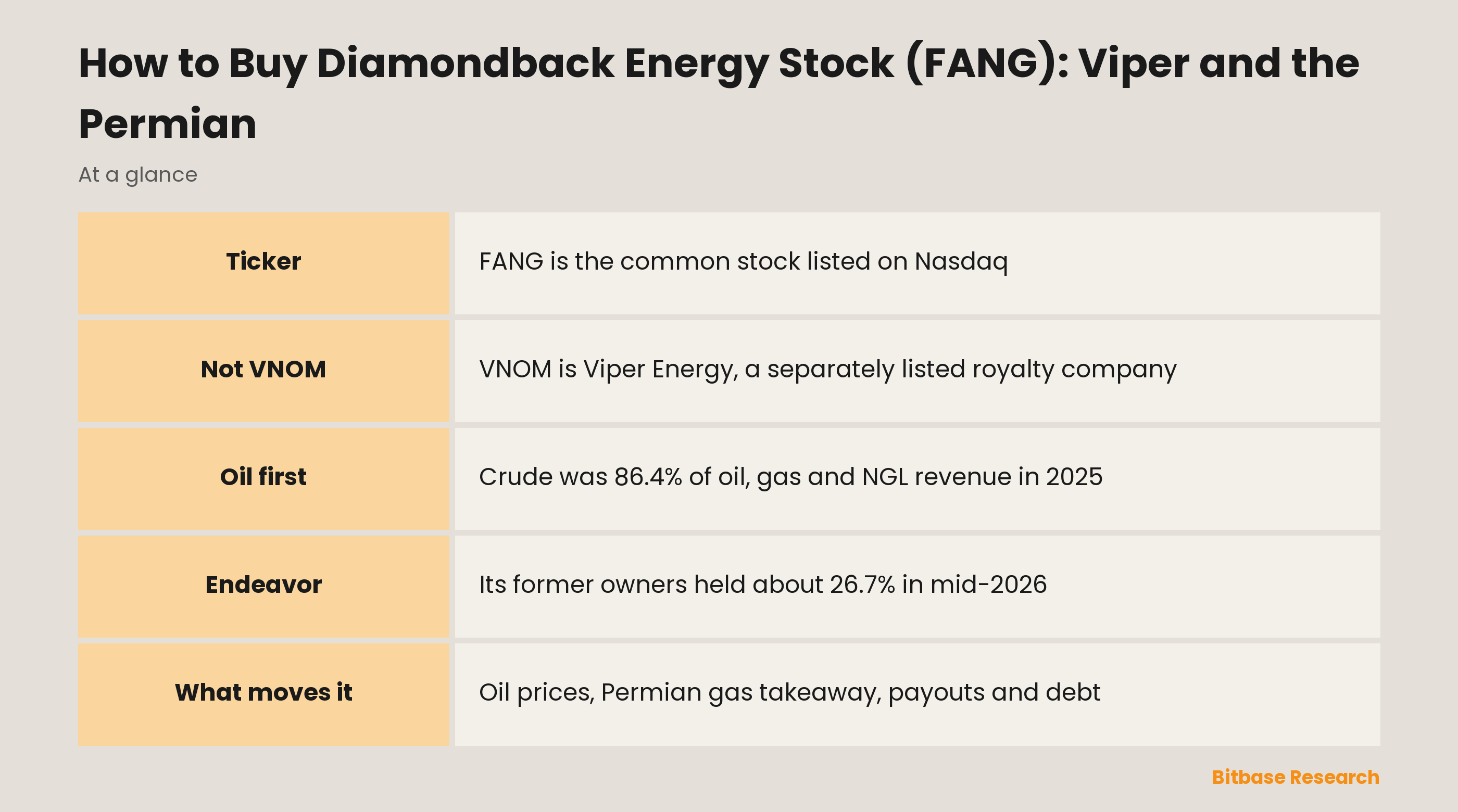
One Nasdaq ticker, FANG, is the only security on Diamondback Energy's annual report cover, and any broker that offers US-listed shares can buy it for you. Behind it is an oil producer that works almost entirely in the Permian Basin of West Texas and has grown fast since buying Endeavor Energy in September 2024: in the second quarter of 2026 its output passed one million barrels of oil equivalent a day. Its royalty arm, Viper Energy, is listed separately as VNOM, and a FANG share holds only Diamondback's stake in it.
What Does Diamondback Energy Do?
Diamondback Energy, Inc. is a Delaware corporation based in Midland, Texas. Its 10-K calls it "an independent oil and natural gas company focused on the acquisition, development, exploration and exploitation of unconventional, onshore oil and natural gas reserves primarily in the Permian Basin in West Texas." It reports one segment, upstream: drilling wells and selling the crude oil, natural gas and natural gas liquids (NGLs) they produce. The shares began trading on Nasdaq on 12 October 2012, the day of the initial public offering.
Most drilling targets the Spraberry and Wolfcamp formations of the Midland Basin, the rest the Wolfcamp and Bone Spring formations of the Delaware Basin. At the end of 2025 Diamondback held about 869,036 net acres in the Permian, 774,645 of them in the Midland Basin. Contiguous blocks support what it calls a "manufacturing" strategy, and it operates about 97% of its acreage.
Acquisitions built the present company. On 10 September 2024 it completed the purchase of Endeavor Parent, LLC, a Permian producer, for cash and about 117.27 million new shares, giving Endeavor's owners 39.8% of Diamondback's stock. Double Eagle followed on 1 April 2025, adding about 40,000 net acres, mainly in the Midland Basin. Kaes Van't Hof has been chief executive since 21 May 2025, succeeding Travis Stice, who became non-executive chairman on 20 May 2026.
Viper Energy (VNOM). Diamondback formed Viper in 2014 to hold mineral and royalty interests, which pay a share of production without paying for the drilling; its Class A stock trades on Nasdaq as VNOM. Diamondback owned approximately 42% of Viper's combined Class A and Class B stock on a fully diluted basis at the end of 2025, and about 39% on 30 June 2026 after selling Viper shares in a March 2026 secondary offering. It still consolidates Viper because it directs the activities that most affect Viper's results, and Viper has no employees of its own. Diamondback sold royalty interests to Viper in May 2025 and again on 1 September 2026, but the 10-K keeps the two apart: "Viper's assets cannot be used by the Company for general corporate purposes, and the creditors of Viper's liabilities do not have recourse to the Company's assets."
How Diamondback Energy Makes Money
Mainly by selling oil. In 2025 crude brought in 86.4% of revenue from oil, natural gas and NGL sales, though it was only 54.0% of production in barrels of oil equivalent:
| Product | Share of 2025 production | Share of 2025 oil, gas and NGL revenue |
|---|---|---|
| Crude oil | 54.0% | 86.4% |
| Natural gas liquids | 23.8% | 10.6% |
| Natural gas | 22.2% | 3.0% |
Calculated from the fiscal 2025 10-K's production table and revenue note; gas is converted at six thousand cubic feet per barrel of oil equivalent.
Permian gas earns a small fraction of what crude does per barrel of oil equivalent. Geography is just as lopsided: the Midland Basin produced 92.0% of 2025 output and earned 92.2% of that revenue.
The buyers are few and large. Four purchasers each took more than 10% of 2025 revenue: Medallion Midstream 16%, Shell Trading (USA) 13%, Enterprise Crude Oil 12% and Vitol 11%. The company argues that losing one would not materially hurt results, "as crude oil and natural gas are fungible products with well-established markets and numerous purchasers." Some contracts commit it to deliver fixed volumes of oil, and since 2023 it has bought third-party barrels to meet some of them; resales of purchased oil were 9.8% of 2025 revenue from contracts with customers.
Viper is consolidated into these figures, and its mineral interests held 11.2% of Diamondback's estimated proved reserves at the end of 2025. Since other shareholders own most of Viper, part of the consolidated profit is reported as theirs; FANG holders should read the line attributable to Diamondback.
In 2025 production rose 53.5% with a full year of Endeavor and nine months of Double Eagle, and total revenues rose 35.8%. But the realized oil price fell 12.9%, and after a fourth-quarter impairment of proved oil and gas properties, net income attributable to Diamondback fell 50.1%.
FANG Stock at a Glance
| Item | Detail |
|---|---|
| Exchange | Nasdaq Global Select Market |
| Ticker | FANG |
| Security | Common stock, the only class registered on the 10-K cover |
| Listed since | 12 October 2012 |
| Related listing | VNOM: Viper Energy, consolidated but separately listed |
| Sector | Energy: oil and gas exploration and production |
| Index membership | S&P 500 (see FAQ) |
| Headquarters | Midland, Texas |
| Incorporated | Delaware |
| Fiscal year | Calendar year, ending 31 December |
| Dividend policy | Quarterly base dividend; the filings also provide for variable dividends |
| Holders with board rights | Former Endeavor owners, about 26.7% on 30 June 2026 |
| SEC identifier | CIK 1539838 |
Prices, market value and yield move all day; for live figures, open the Diamondback Energy stock page on Bitbase.
How to Buy Diamondback Energy Stock
Diamondback is a US company listed on Nasdaq, so there is no depositary receipt to consider: you buy the common stock itself, through a broker.
1. Pick a broker that trades Nasdaq stocks, and check which entity holds your account and who regulates it.
2. Open the account. Non-US investors are usually asked for IRS Form W-8BEN, which the IRS says to submit "when requested by the withholding agent or payer."
3. Fund it. If your money is not in US dollars, the exchange-rate spread is a cost on top of commission.
4. Search for FANG and read the name. You want Diamondback Energy, Inc. common stock. VNOM shares Diamondback's Midland address and trades on Nasdaq too, but it is Viper, a different company.
5. Choose an order type. FINRA says a market order "provides the most certainty that your order will be executed because it's not tied to any restrictions," while a limit order is "an order to buy or sell a security at or better than a specified price."
6. Decide the size. Fractional shares let you invest a set amount, but "the availability of fractional share trading varies by brokerage firm," FINRA notes, and "you can't transfer fractional shares to another brokerage firm."
7. Keep the paperwork, which records your cost basis and dividends.
Outside the United States, FANG dividends are US-source income. The IRS states that "most types of U.S. source income received by a foreign person are subject to U.S. tax of 30%," and a tax treaty can lower that rate, which is what the W-8BEN is for. Your home country may tax the dividend again.
Through a fund, State Street's holdings files for 29 October 2026 list Diamondback in its S&P 500 ETF Trust (SPY), its Energy Select Sector SPDR ETF (XLE) and its S&P Oil & Gas Exploration & Production ETF (XOP). XOP, a benchmark in Diamondback's own performance graph, also holds VNOM.
What Moves FANG Stock
The oil price, almost directly. With crude at 86.4% of product revenue, oil prices go straight to the top line. 2026 brought the opposite of 2025: the second-quarter 10-Q says that "as a result of the ongoing conflict in the Middle East, in 2026 the global crude oil market shifted from a supply-demand surplus to a deficit," and WTI averaged 17.2% more in the first half than a year earlier. Diamondback's realized oil price in the second quarter was 53.1% above the same quarter of 2025; an 8-K filed on 8 October 2026, ahead of full results, put the third-quarter figure 9.8% below the second. Its hedges, such as puts and collars, "may fail to protect us from declines in commodity prices," the 10-K warns, and can cap gains.
Getting gas out of the Permian. In the second quarter of 2026 Diamondback's average realized natural gas price was negative, both before and after hedges. The 10-Q blames regional takeaway constraints, which widened the gap between Waha Hub and Henry Hub prices and "resulted in periods of negative pricing at Waha Hub." The company expected the effect to ease later in 2026 as new contracts and pipeline capacity arrive; each quarter's realized gas price will show whether it did.
How cash is shared out. Under the 10-K's framework the board committed to return at least 50% of quarterly Adjusted Free Cash Flow, down from 75% in early 2024, through buybacks and base and variable dividends, with the rest mostly for debt. In February 2026 the annual base dividend rose 5%. From the second quarter of 2026 the board dropped the minimum to allow "more discretion in the allocation of Free Cash Flow," and in July it doubled the buyback authorization. Total debt fell 12.9% in the first half of 2026.
The former Endeavor owners' shares. They held 26.7% on 30 June 2026, after selling to the company, to other buyers and in a March 2026 secondary offering. Under a November 2025 letter agreement, their vehicle SGF FANG Holdings may sell up to 3.0 million shares a quarter back to Diamondback through the end of 2026. The 10-K warns that such sales, "or the perception that these sales may occur could have the effect of depressing the market price." A 29 September 2026 amendment to their stockholders agreement cut their board rights to two directors at holdings between 10% and 25%, and none below 10%.
Deals and competitors. Drop-downs to Viper and sales of Viper stock change what a FANG share indirectly owns. Many rivals also run refining, the 10-K notes; ExxonMobil is one such integrated business, while Diamondback reports only an upstream segment.
Living With a One-Basin Producer: FANG's Risks
From Item 1A of the 10-K, these bear most directly on a FANG share:
One basin. "Our producing properties are located in the Permian Basin of West Texas, making us vulnerable to risks (including weather-related risks) associated with operating in a single geographic area," and most proved reserves sit in the Wolfberry play of the Midland Basin. ConocoPhillips also drills the Midland and Delaware basins but produces in other regions as well.
Water. Fracturing needs water, and wells bring up produced water that must be disposed of. In September 2021 the Texas Railroad Commission curtailed injection into some disposal wells near Midland and Odessa to control induced seismicity; tighter rules can raise costs.
Delivery commitments. If production falls short, missing contracted oil deliveries "will result in deficiency payments to the counterparty."
Debt. The 10-K says its "substantial level of indebtedness could adversely affect" results and flexibility, and a ratings downgrade could raise borrowing costs.
A large holder group. The Endeavor owners' "level of ownership and influence may make some transactions (such as those involving mergers, material share issuances or changes in control) more difficult or impossible."
Payouts. "There is no guarantee that we will pay any dividends on or repurchase shares of our common stock in the future or at levels anticipated by our stockholders."
The second-quarter 2026 10-Q reported no material change to them. Add single-stock risk, and currency risk if you invest from abroad.
Tracing FANG Figures Back to EDGAR
Diamondback files under CIK 1539838. In the 10-K, Items 1 and 2 cover acreage, production by basin and reserves; Item 1A lists the risks; Item 5 confirms the Nasdaq listing, counts 4,438 holders of record on 20 February 2026 and charts FANG's total return against the S&P 500 and XOP. Note 3 has the revenue split and the four large customers, Note 4 the acquisitions and drop-downs, and the related-party note covers Deep Blue and SGF. The XBRL cover, R1.htm, shows the single registered security.
Each quarter brings a 10-Q, a results release and, weeks earlier, a short 8-K with realized prices, like that of 8 October 2026. Viper reports under CIK 2074176. Copies are at diamondbackenergy.com/investors, and the US stock directory on Bitbase lists other companies.
Diamondback Energy Stock FAQ
Does Diamondback Energy pay a dividend?
Yes, a quarterly base cash dividend, and the filings allow variable dividends on top; the fourth-quarter 2025 release called that year's payouts "base-plus-variable dividends." The company "can provide no assurance that dividends will be authorized or declared in the future"; amounts and dates are in the latest 8-K.
Can I buy Diamondback Energy stock with crypto?
Not directly. FANG is bought through a brokerage account and Nasdaq trades settle in US dollars, so crypto must first be sold for cash and the cash sent to your broker; that sale may be taxable where you live. A share is a registered stake in the company with dividend and voting rights, which is what separates a stock from a crypto asset.
What is the difference between FANG and VNOM?
FANG is Diamondback, the producer that drills and operates wells. VNOM is the Class A stock of Viper Energy, which owns mineral and royalty interests; Diamondback operates about 35% of Viper's net royalty acres. Diamondback owned about 39% of Viper on 30 June 2026 and consolidates it, but they are separate listed companies with separate shareholders, dividends and debt.
Is Diamondback Energy in the S&P 500?
Yes. State Street's SPY holdings file listed Diamondback Energy on 29 October 2026, and the 10-K's performance graph uses the S&P 500 as a benchmark. Index membership can change, so check the latest file.
Conclusion
Buying FANG takes a broker with Nasdaq access, the right ticker and a deliberate choice of order type. The share holds a Permian oil producer that earns mostly from crude, controls a separately listed royalty company and has a large holder group that has been selling down. Before sizing a position, check the newest 10-Q and results release for realized prices, debt and the payout.
Related reading
Other Bitbase articles on this topic:
- How to Buy Cenovus Energy Stock (CVE): Oil Sands Without Mines
- How to Buy Cheniere Energy Stock (LNG): LNG vs CQP and Dividend
- How to Buy Devon Energy Stock (DVN): Coterra Merger, Dividend
- How to Buy TC Energy Stock (TRP): Gas Pipelines After South Bow
Disclaimer: This article is educational content from Bitbase Academy, provided for information only. It explains what a company or fund does and how the instruments referenced here differ from one another; it does not constitute investment, trading, tax, or financial advice, and it is neither a recommendation nor an endorsement of any security, token, or trading strategy. A tokenized stock is issued by a third party and is designed to give economic exposure to an underlying asset: it is not a share, it carries no shareholder rights, and it depends on the issuer's structure, eligibility rules, and redemption terms, which the issuer can change. Perpetual futures are leveraged derivatives that hold no underlying asset and can be liquidated, and trading hours, product availability, and eligibility differ by instrument and by jurisdiction and can change at any time. Written as of October 2026; verify everything yourself through company filings, the issuer's own documentation, and the product pages of the venue you trade on.
References
[1] Diamondback Energy Form 10-K, fiscal 2025 (SEC EDGAR) www.sec.gov
[2] Diamondback 10-K, fiscal 2025: XBRL cover page (SEC EDGAR) www.sec.gov
[3] Diamondback Energy Form 10-Q, second quarter 2026 (SEC EDGAR) www.sec.gov
[4] Diamondback second-quarter 2026 results release (Form 8-K) www.sec.gov
[5] Diamondback fourth-quarter 2025 results release, 23 February 2026 (Form 8-K) www.sec.gov
[6] Diamondback Form 8-K, 8 October 2026: third-quarter realized prices www.sec.gov
[7] Diamondback Form 8-K, 30 September 2026: stockholders agreement amendment www.sec.gov
[8] Diamondback Form 8-K, 10 September 2024: completion of the Endeavor acquisition www.sec.gov
[9] Diamondback Form 8-K, 21 May 2025: chief executive succession www.sec.gov
[10] Diamondback Form 8-K, 20 May 2026: board chair transition www.sec.gov
[11] Diamondback Form 8-K, 17 October 2012: initial public offering www.sec.gov
[12] Viper Energy 10-K, fiscal 2025: XBRL cover page (SEC EDGAR) www.sec.gov
[13] Viper Energy Form 8-K, 8 September 2026: 2026 drop-down completed www.sec.gov
[14] State Street, SPY daily holdings, 29 October 2026 www.ssga.com
[15] State Street, XLE daily holdings, 29 October 2026 www.ssga.com
[16] State Street, XOP daily holdings, 29 October 2026 www.ssga.com
[17] FINRA: Order Types www.finra.org
[18] FINRA: Investing in Fractional Shares www.finra.org
[19] IRS: NRA Withholding www.irs.gov
[20] IRS: About Form W-8 BEN www.irs.gov





