
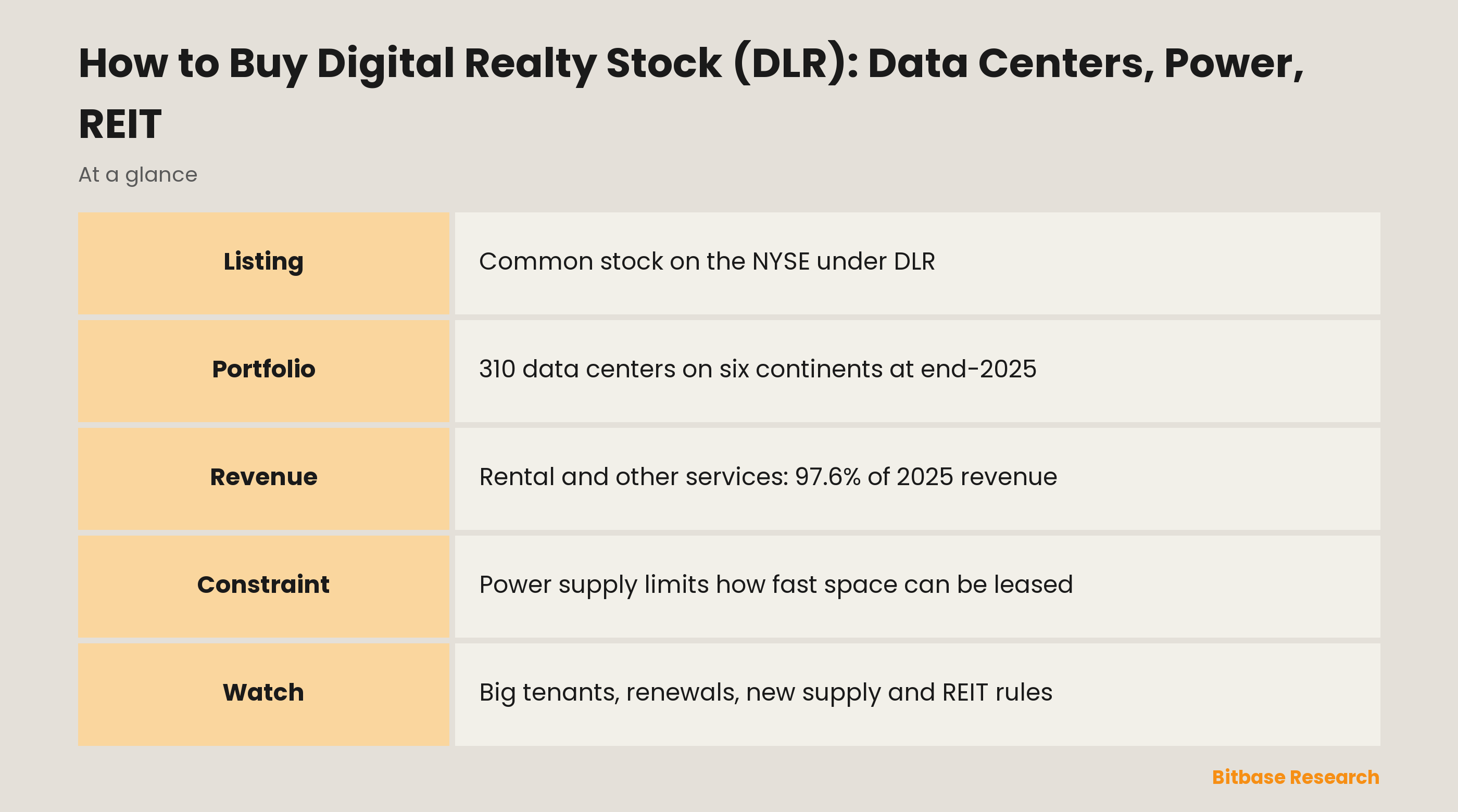
They trade on the New York Stock Exchange under the ticker DLR: Digital Realty's common shares can be bought through a brokerage account with NYSE access, funded in US dollars, with an ordinary buy order. Each share is a piece of a Maryland real estate investment trust whose portfolio, at the end of 2025, counted 310 data centers across the United States, Europe, Latin America, Asia, Africa, Australia and Canada, and that rents space, power and connections inside them to cloud, software and network companies. Because a REIT has to distribute at least 90% of its taxable income, the dividend and the way it is taxed come with every share.
What Does Digital Realty Do?
Digital Realty builds, owns and runs the buildings that servers live in. Its annual report describes the company as "a leading global provider of data center, colocation and interconnection solutions for customers across a variety of industry verticals." The listed parent, Digital Realty Trust, Inc., operates as a REIT for US federal income tax purposes and does business through Digital Realty Trust, L.P., the operating partnership that owns, acquires, develops and operates the data centers.
At 31 December 2025 the portfolio held 310 data centers, 89 of them through unconsolidated entities such as joint ventures:
| Region | Data centers, end of 2025 |
|---|---|
| United States | 118 |
| Europe | 113 |
| Latin America | 36 |
| Asia | 18 |
| Africa | 16 |
| Australia | 6 |
| Canada | 3 |
Counting the joint ventures, those buildings were roughly 84.7% leased. The company also holds land and shells that, by its own estimate, could take more than 3,500 megawatts of additional data center capacity, over 1,000 megawatts of it in Northern Virginia.
The 10-K sorts what it sells by size. The 0–1 megawatt category runs from a single cabinet to about 75 cabinets, on contracts generally lasting two to five years. The above-1 megawatt category covers medium to very large deployments, on contracts generally of five to ten years or more. Around both sits interconnection: a cross connect physically links two customers inside one facility, and ServiceFabric is a platform for ordering connections across the footprint.
Africa came through an acquisition. In August 2022 Digital Realty bought a majority interest in Teraco, which the 10-K calls "the largest and most densely interconnected data center platform in South Africa," and the third-quarter 2026 release reports that stake rising from 61% to about 77%. Among competitors, the 10-K names Equinix, NTT and Global Switch alongside private and regional operators.
How Digital Realty Makes Money
Total operating revenue rose 10.0% in 2025. The income statement shows only two revenue lines:
| Revenue line, 2025 | Includes | % of revenue |
|---|---|---|
| Rental and other services | Rent under operating leases, recoveries of costs such as maintenance, property taxes and insurance, and interconnection services | 97.6% |
| Fee income and other | Mainly management fees from entities in which Digital Realty holds a noncontrolling interest, plus property and construction management | 2.4% |
The small line moved fastest: fee income and other rose 98.3% in 2025, which the MD&A traces to construction and development fees and to joint venture management fees. Geography is close to an even split, with 48.2% of 2025 revenue earned outside the United States, yet the company reports a single operating segment because its largest customers buy capacity across regions.
More than 5,000 customers pay the rent, but a handful carry much of it. At the end of 2025 the largest accounted for about 11.7% of annualized recurring revenue and no other for more than about 9.0%; the top three made up about 26% and the top 20 about 51%. The 10-K names Oracle, Meta Platforms, IBM, LinkedIn, JPMorgan Chase and AT&T among its customers, while other large ones appear only as a "Fortune 50 Software Company" or a "Global Cloud Provider."
Because the operations they support are capital-intensive, leases run longer than ordinary commercial ones. The average remaining term was about five years at the end of 2025, and new leases signed that year in the above-1 megawatt category carried a weighted average term of 10.0 years, against 4.5 years for 0–1 megawatt deals. Renewal pricing differed sharply by size: above-1 megawatt space was renewed at cash rental rates 27.0% above the expiring ones, 0–1 megawatt space at 4.6% above.
Reading the profit line. In 2025 the net gain on disposition of properties, much of it from contributing data centers to the new Digital Realty DC Partners NA Fund, was larger than operating income. That is why REIT investors also watch funds from operations (FFO), which Digital Realty calculates under the Nareit 2018 white paper, stripping out real estate sale gains, impairments and real estate depreciation.
DLR Stock at a Glance
| Fact | Detail |
|---|---|
| Exchange | New York Stock Exchange (NYSE) |
| Ticker | DLR |
| Security | Common stock of Digital Realty Trust, Inc. |
| Other listed securities | Preferred stock, listed separately |
| Tax status | Real estate investment trust (REIT) |
| Operating partnership | Digital Realty Trust, L.P.; the parent is sole general partner and held about 98.2% of the common partnership interest at 30 June 2026 |
| Sector | Data center real estate |
| Index membership | S&P 500 |
| Headquarters | Austin, Texas, per the 2026 10-Q covers (the FY2025 10-K gave Dallas) |
| Incorporated | Maryland, 9 March 2004 |
| On the NYSE since | 29 October 2004 |
| Fiscal year | Calendar year, ending 31 December |
| Dividend policy | Regular quarterly distributions, declared at the board's discretion |
| SEC identifiers | CIK 1297996; the operating partnership files under CIK 1494877 |
Price, market value and yield change through every session, so they are left to the Digital Realty stock page on Bitbase, which shows the live quote.
How to Buy Digital Realty Stock
No depositary receipt is involved: Digital Realty is a US company and DLR is its own common stock. Preferred shares carry separate symbols, and Digital Realty Trust, L.P. units are not listed anywhere, since the 10-K describes the partnership as "structured as a partnership with no publicly traded equity." Then:
1. Pick a broker that can route orders to the NYSE, and find out which legal entity will hold your shares and which regulator supervises it.
2. Settle your tax status when you open the account. Non-US individuals normally sign IRS Form W-8BEN for the broker, and the IRS says to "Submit Form W-8 BEN when requested by the withholding agent or payer whether or not you are claiming a reduced rate of, or exemption from, withholding."
3. Fund the account in US dollars, comparing the currency conversion spread as well as the commission.
4. Look up DLR and check that the listing reads Digital Realty Trust, Inc. common stock, not a preferred series.
5. Choose the order type. An SEC investor bulletin calls a limit order "an order to buy or sell a stock at a specific price or better" and warns that "A limit order is not guaranteed to execute"; a market order generally fills immediately, but at a price that is not guaranteed.
6. Decide between whole and fractional shares. FINRA notes that "The availability of fractional share trading varies by brokerage firm," and that "As a fractional share owner, you might not have shareholder voting rights."
7. Keep trade confirmations and dividend statements, which you will need to report the income, and any later sale, where you are taxed.
Dividends paid to holders outside the US. None of this is tax advice. The IRS describes NRA withholding as the regime "that requires 30% withholding on a payment of U.S. source income," a rate that treaties often reduce. Publication 515 lists REITs among qualified investment entities, and for most private investors one rule matters: a distribution on regularly traded REIT stock, paid to someone who owned no more than 10% of it at any time in the year before, is treated as a dividend rather than as gain from US real property. Your home country may tax it as well, so ask a tax adviser how the treaty applies to you.
Holding it through a fund. State Street's daily holdings files dated 29 October 2026 include Digital Realty in both SPY, which tracks the S&P 500, and XLRE, a fund of real estate stocks. Owning a fund unit spreads the money across the basket and does not put a DLR share in your name.
What Moves DLR Stock
Power, more than floor space. The 10-K warns that even where space is free, its ability to lease it "could be constrained by our ability to provide sufficient electrical power," and that power and cooling systems are hard to upgrade for technologies "such as AI, which are more power-intensive." At the end of 2025 Digital Realty had 769 megawatts of projects underway, 64% of them pre-leased, and it relies on third parties to deliver the extra power capacity that growth needs.
Signings, the lag, and renewals. New leases reach revenue late. In the third quarter of 2026, when Digital Realty signed record total bookings, the weighted-average lag between signing and contractual commencement was 17 months, and leases renewed that quarter rose 11.8% on a cash basis and 17.0% on a GAAP basis. At the end of 2025, agreements covering 23.3% of the square footage were due to expire through 2027, and another 16.8% of net rentable space was available to lease.
A short list of very large tenants. In the third-quarter 2026 supplement, Oracle Corporation was the second-largest customer at 9.9% of annualized recurring revenue, a customer listed only as a "Leading AI Chip Maker" ranked ninth with a weighted average remaining lease term of 13.4 years, and the top 20 came to 53.5%. The 10-K also warns that customers "may choose to develop new data centers or expand their own existing data centers" instead of renting. An overview of AI infrastructure stocks shows where a data center landlord sits beside equipment makers and cloud operators.
Selling into funds and partnerships. After a further contribution in the fourth quarter of 2025, Digital Realty owned 20% of each asset in the Digital Realty DC Partners NA Fund, and after the third quarter of 2026 it closed initial cornerstone equity commitments for a new perpetual capital strategy "focused on stabilized hyperscale data centers in North America." Such deals show up in disposal gains and, through fees, in fee income.
New shares, debt and currency. A REIT that distributes most of its taxable income funds growth largely from outside; the 10-K puts it plainly: "Our growth depends on external sources of capital which are outside of our control." Common shares outstanding rose 7.7% between the 10-K cover count (9 February 2026) and the second-quarter 10-Q count (29 July 2026), as the company sold stock through its at-the-market program and issued shares to Blackstone when it bought out Blackstone's interests in two joint ventures in June 2026. Its own targets include floating rate debt below 20% of the total, so interest rates feed straight into the cost of growing, and with 48.2% of revenue earned abroad, exchange rates move the reported figures.
How a Data Center Landlord Like DLR Can Stumble
Five themes from Item 1A bear most directly on a DLR holder.
A single, specialized use. "A reduction in the demand for data center space, power or connectivity would have a greater adverse effect on our business and financial condition than if we owned a portfolio with a less specialized use."
Power supply and price. "We rely on third parties to provide power to our data centers," the 10-K says, and shortages, outages or load-shedding orders could hurt customers and revenue. Power purchase agreements of five to twenty years fix the price of renewable energy, so a fall in market prices can leave the company paying more than it otherwise would.
Technology and new supply. New ways to deliver power or remove heat, or servers that need less of both, "could make our data center infrastructure obsolete." Meanwhile "many of our competitors have developed and continue to develop additional data center space," and more supply can reduce rental rates.
Concentration by place. Northern Virginia alone produced 21.4% of annualized rent at the end of 2025, ahead of Chicago at 7.1% and Frankfurt at 6.1%, so a local downturn or too many competing buildings in one of those metros can hurt results. The 192 data centers outside the US add currency, tax and political exposure.
Tax status and takeover limits. Losing REIT status would bring corporate income tax and, without statutory relief, a bar on electing REIT treatment again "for four taxable years following the year during which it was disqualified." The charter generally caps any one holder at 9.8% of the common stock, and the 10-K says such provisions may delay, defer or prevent a change of control. For US individuals, REIT dividends "generally are not eligible" for the lower rates on qualified dividends.
Holding one stock concentrates the outcome on a single landlord, and no dividend is owed until the board declares it.
The Documents Behind Every DLR Figure
SEC EDGAR, under CIK 1297996, holds one combined annual report for Digital Realty Trust, Inc. and Digital Realty Trust, L.P.: Item 1 covers the portfolio and products, Item 1A the risks, and the MD&A leasing activity and rental rate changes. Its structured XBRL cover, R1.htm, lists the common stock and each preferred series with its NYSE symbol. Each quarter an earnings 8-K attaches a financial supplement with the top 20 customers, lease expirations and the development pipeline, and the 10-Qs update the cover page, including the Austin address. For comparisons, start from Bitbase's list of US stock pages.
Digital Realty Stock FAQ
Is Digital Realty a REIT?
Yes. Digital Realty Trust, Inc. operates as a REIT, which obliges it to pay out at least 90% of REIT taxable income every year, net capital gains aside; the 10-K adds that it has distributed at least 100% of its taxable income annually since inception. It is a data center REIT, and Welltower shows the same tax structure applied to senior housing.
Does Digital Realty pay a dividend?
Yes. The parent "intends to make, but is not contractually bound to make, regular quarterly distributions" to common stockholders, each at the board's discretion, and common dividends were declared four times in each of 2023, 2024 and 2025. Amounts change, so take the current one from the latest 8-K.
Can I buy Digital Realty stock with crypto?
Not directly. A DLR purchase goes through a broker on the NYSE and settles in US dollars, which means converting crypto to cash and depositing that cash with the broker first; in many countries that conversion is itself a taxable sale. The result is an ordinary common share, and how crypto and stocks differ goes well beyond the way you pay.
How many data centers does Digital Realty have?
The 10-K counts 310 at the end of 2025, including 89 held through unconsolidated entities; the third-quarter 2026 supplement gives 311 at 30 September 2026, including 88.
Where is Digital Realty headquartered?
In Austin, Texas. The 10-Q covers for the first two quarters of 2026 give 601 West 2nd Street in Austin as the principal executive office, while the FY2025 10-K, filed in February 2026, still listed Dallas.
Is DLR in the S&P 500?
Yes. Digital Realty Trust appears, ticker DLR, in the SPY holdings file State Street published for 29 October 2026.
Conclusion
Placing a DLR order takes an account with NYSE access, a check that the line is the common stock, and an order type you understand. The company behind the ticker needs more study. It is a REIT that rents space, power and connections in more than 300 data centers, leans on a short list of cloud and technology tenants, competes for electricity as much as for land, and pays out most of its taxable income. Read the latest 10-K and quarterly supplement before deciding how much one data center landlord should weigh in a portfolio.
Related reading
Other Bitbase articles on this topic:
- How to Buy American Tower Stock (AMT): Carrier Rent, REIT Payouts
- How to Buy Brookfield Corporation Stock (BN): BN vs BAM and BNT
- How to Buy Equinix Stock (EQIX): Data Center REIT on Nasdaq
- How to Buy Realty Income Stock (O): Monthly Dividends, Net Leases
Disclaimer: This article is educational content from Bitbase Academy, provided for information only. It explains what a company or fund does and how the instruments referenced here differ from one another; it does not constitute investment, trading, tax, or financial advice, and it is neither a recommendation nor an endorsement of any security, token, or trading strategy. A tokenized stock is issued by a third party and is designed to give economic exposure to an underlying asset: it is not a share, it carries no shareholder rights, and it depends on the issuer's structure, eligibility rules, and redemption terms, which the issuer can change. Perpetual futures are leveraged derivatives that hold no underlying asset and can be liquidated, and trading hours, product availability, and eligibility differ by instrument and by jurisdiction and can change at any time. Written as of October 2026; verify everything yourself through company filings, the issuer's own documentation, and the product pages of the venue you trade on.
References
[1] Digital Realty Form 10-K, fiscal 2025: portfolio, customers, leasing, REIT rules and risks (SEC EDGAR) www.sec.gov
[2] Digital Realty 10-K, fiscal 2025: structured XBRL cover with registered securities (SEC EDGAR) www.sec.gov
[3] Digital Realty Form 10-Q for the quarter ended 30 June 2026: cover, partnership and Teraco (SEC EDGAR) www.sec.gov
[4] Digital Realty third-quarter 2026 earnings release and financial supplement (Form 8-K, 29 October 2026) www.sec.gov
[5] Digital Realty Form 8-K, 1 July 2026: purchase of Blackstone's joint venture interests completed (SEC EDGAR) www.sec.gov
[6] IRS: NRA Withholding www.irs.gov
[7] IRS Publication 515 (2026): Withholding of Tax on Nonresident Aliens and Foreign Entities www.irs.gov
[8] IRS: About Form W-8 BEN www.irs.gov
[9] SEC Investor Bulletin: Trading Basics, the different ways to buy and sell stock www.sec.gov
[10] FINRA: Investing in Fractional Shares www.finra.org
[11] State Street SPDR S&P 500 ETF Trust (SPY): fund page and daily holdings www.ssga.com
[12] State Street Real Estate Select Sector SPDR ETF (XLRE): fund page and daily holdings www.ssga.com





