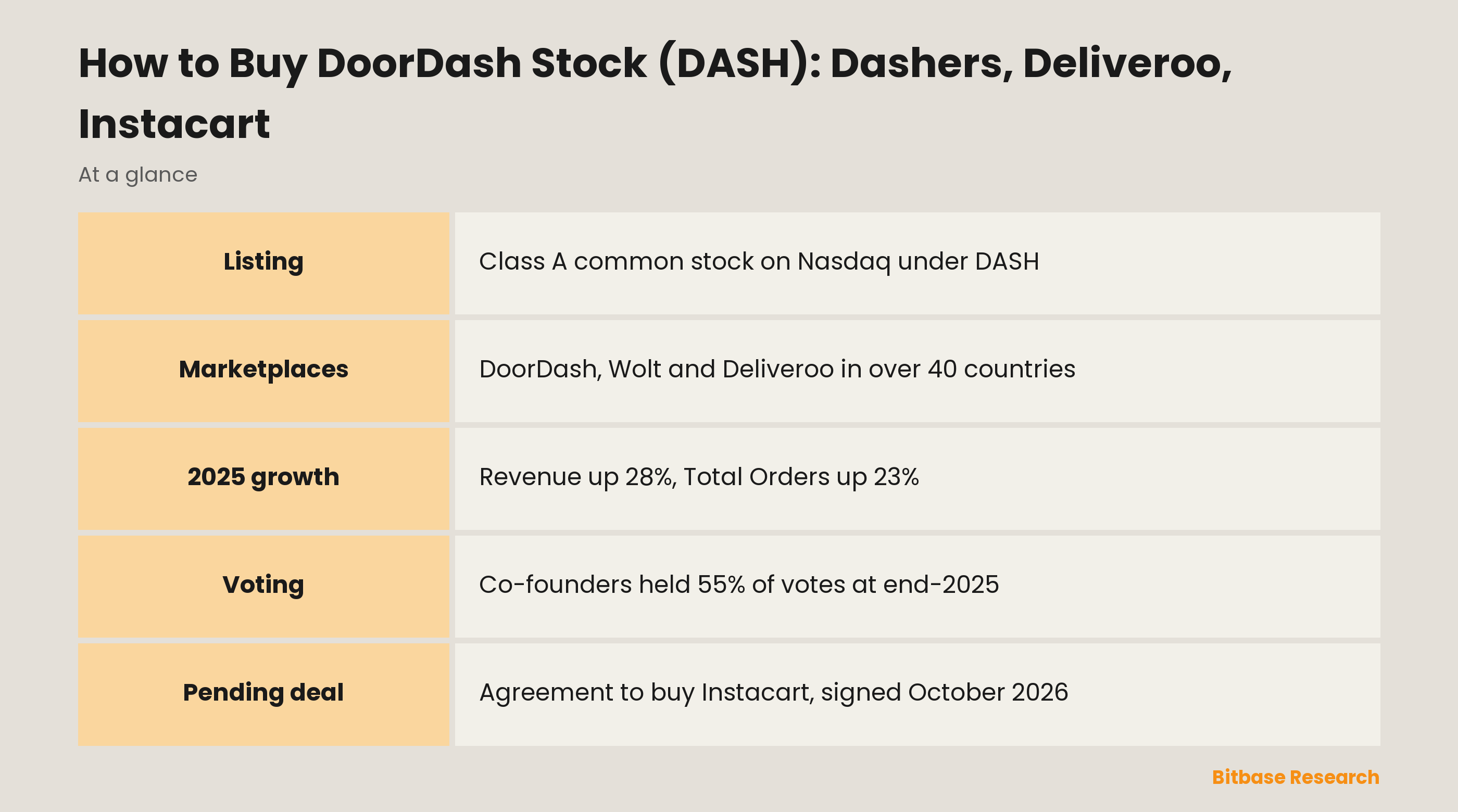
Within reach of any brokerage account that connects to Nasdaq, DoorDash stock is one search away: the Class A common shares trade under the ticker DASH, and they are the only class of the company's stock that is listed. The business behind the ticker now reaches well beyond American takeout, with Wolt added in 2022, Deliveroo in October 2025 and an agreement to buy Instacart announced on 29 October 2026. Below: where the revenue comes from, the steps to an order, and the issues DoorDash's own filings put near the top, namely whether Dashers stay contractors, intense competition and a share structure that leaves control with the co-founders.
What Does DoorDash Do?
DoorDash runs online marketplaces for local commerce. Its annual report names three of them, DoorDash, Wolt and Deliveroo, plus a Commerce Platform; the marketplaces operate in over 40 countries and "account for the vast majority of our revenue today."
Each marketplace serves three groups. Merchants, from restaurants to grocers and convenience stores, get an online storefront, delivery, payment processing and customer support, and can buy advertising inside the apps. Consumers order through the apps: in December 2025 the marketplaces had over 56 million monthly active users, and more than 35 million people held a DashPass, Wolt+ or Deliveroo Plus membership, which lowers delivery and service fees for a subscription. Dashers make the deliveries. The 10-K uses the word for "the independent contractors that use our Marketplaces," who in most places "choose if, when, and where to dash"; over 9 million people dashed in 2025.
The Commerce Platform serves merchants on their own channels. Its best-known piece is Drive, a white-label delivery service for orders taken on a restaurant's or retailer's own website or app; other tools cover online ordering, branded apps and reservations, the last strengthened by the purchase of SevenRooms on 13 June 2025.
The company was incorporated in 2013 as Palo Alto Delivery Inc., took the name DoorDash, Inc. in 2015 and first listed its shares in December 2020. Abroad, it bought the Finnish delivery company Wolt Enterprises Oy on 31 May 2022, then Deliveroo plc, headquartered in London and operating in nine countries from the UK and France to Singapore and the Gulf, on 2 October 2025. DoorDash had over 31,400 employees at the end of 2025, and its 10-K names Amazon, Uber Eats, Prosus and Delivery Hero among its rivals in a market it calls "fragmented and intensely competitive."
How DoorDash Makes Money
Revenue is much smaller than the money that passes through the apps, and that is a matter of accounting. In the vast majority of transactions DoorDash acts as "an agent," so it reports revenue "on a net basis, reflecting amounts collected from consumers, less amounts remitted to merchants and Dashers." What stays with the company is a mix of merchant commissions, consumer delivery and service fees, membership fees, advertising, and the per-order fees merchants pay for Drive.
Three measures sit beside revenue in every report. Total Orders counts all orders completed on the marketplaces and the Commerce Platform. Marketplace GOV is the total value of marketplace orders, including taxes, tips and consumer fees. Net Revenue Margin is revenue as a percentage of Marketplace GOV.
| Measure | 2023 | 2024 | 2025 |
|---|---|---|---|
| Total Orders growth | 24% | 20% | 23% |
| Marketplace GOV growth | 25% | 20% | 27% |
| Revenue growth | 31% | 24% | 28% |
| Net Revenue Margin | 12.9% | 13.4% | 13.4% |
| Revenue from the United States | 90.1% | 87.7% | 83.5% |
| Revenue from outside the United States | 9.9% | 12.3% | 16.5% |
Growth rates and margins as reported in the 10-K; geographic shares calculated from its revenue note, which assigns revenue by the merchant's address, or the consumer's for memberships.
Two shifts stand out. Revenue outgrew orders in 2025, which the company put down to "improved logistics efficiency, increasing contribution from advertising revenue, and a reduction in credits and refunds." And the business is becoming less American: revenue from outside the United States rose about 71.1% in 2025, against about 21.9% at home, with Deliveroo counted from October. Still, no single foreign country reached 10% of revenue in any of the three years.
Restaurants remain the core; the 10-K calls local food delivery logistics "the largest category of our business today." Grocery and retail grow faster: in the third quarter of 2026, Marketplace GOV in the US grocery and retail categories grew "at more than double the pace" of the US restaurant category. That quarter Total Orders rose 28% and revenue 34% from a year earlier, or 17% and 23% without Deliveroo. The company reports a single segment, so there is no table splitting restaurants from groceries or DoorDash from Wolt.
DASH Stock at a Glance
| Feature | DASH |
|---|---|
| Exchange | Nasdaq Global Select Market, since 27 September 2023 |
| Earlier listing | New York Stock Exchange, from the December 2020 IPO to 26 September 2023 |
| Ticker | DASH |
| Listed security | Class A common stock, one vote per share |
| Unlisted classes | Class B, 20 votes per share, held by the co-founders; Class C, no votes, none outstanding |
| Sector | Consumer discretionary; held by the Consumer Discretionary Select Sector SPDR ETF (XLY) |
| Index membership | S&P 500 (State Street SPY holdings file, 29 October 2026) |
| Headquarters | San Francisco, California |
| Incorporated | Nevada since 18 September 2026; Delaware before that |
| Fiscal year | Calendar year, ending 31 December |
| Dividend | None ever declared; buybacks under a February 2025 authorization |
| SEC identifier | CIK 1792789 |
The table holds what stays fixed. Live quotes, volume and market value are on the DoorDash stock page on Bitbase.
The move to Nevada changed the law that governs the company, not the share you buy: each Class A share converted automatically into one Nevada Class A share, holders did not need to exchange anything, and trading continued on Nasdaq as DASH.
How to Buy DoorDash Stock
Because DoorDash is a US company with a single listed line, buyers choose a broker rather than a type of share; no depositary receipt or foreign listing is involved. In practice:
1. Choose a broker with access to Nasdaq-listed stocks. Investors abroad can use a domestic firm that routes orders to US exchanges or a multinational broker; either way, confirm the legal entity that will hold your shares and the regulator that supervises it.
2. Open and verify the account. Expect identity checks and, if you are not a US person, IRS Form W-8BEN; the IRS instruction is to give it "to the withholding agent or payer if you are a foreign person."
3. Fund it. Deposits in euros, pounds or any other currency get converted at some point, and the spread on that conversion is a cost next to the commission.
4. Find the right line. Search DASH and confirm the result reads DoorDash, Inc. Class A common stock on Nasdaq. On crypto platforms the same letters usually stand for Dash, a cryptocurrency with no connection to the company.
5. Set the order. A market order executes at whatever the best available price is when it arrives; a limit order names your price and may sit unfilled.
6. Choose an amount. Some brokers sell slices of a share for a set sum of money; FINRA notes that "the availability of fractional share trading varies by brokerage firm" and that "as a fractional share owner, you might not have shareholder voting rights."
7. Keep the confirmations. They record your purchase price, which matters when you sell.
Outside the United States, the tax rule usually raised for US shares is dividend withholding: "most types of U.S. source income received by a foreign person are subject to U.S. tax of 30%," the IRS says, with reduced rates possible under a tax treaty. DoorDash has never declared a dividend, so the point is theoretical for now; how a gain on sale is taxed depends on where you live.
Through funds, DoorDash comes bundled: S&P 500 trackers such as SPY hold it, and so does the consumer discretionary sector fund XLY, each alongside many other companies.
What Moves DASH Stock
Orders and the margin on them. Every quarterly release reports Total Orders, Marketplace GOV, revenue and Net Revenue Margin. Deliveroo lifts year-on-year comparisons until its first anniversary in the group; DoorDash has said it will stop reporting results excluding Deliveroo from the fourth quarter of 2026, when its totals become "largely comparable with the year-ago period."
The Instacart deal. On 28 October 2026 DoorDash agreed to acquire Maplebear Inc., which does business as Instacart. Instacart stockholders can elect cash, DoorDash stock or a mix, with stock capped at 25% of the total consideration, so at least 75% is paid in cash, funded from cash on hand and new debt. Completion needs Instacart stockholder approval, the end of the US Hart-Scott-Rodino waiting period, clearances in Canada and Israel and other conditions; the companies expect it "in the end of 2027 or the first half of 2028." The agreement sets termination fees in both directions, including one DoorDash would owe if antitrust law blocks the deal.
Rules for Dashers. Pay and classification rules feed straight into costs. The 10-K says Proposition 22's compensation provisions "have increased our costs related to Dashers in California," partly offset by higher fees and commissions. It also cites New York City's minimum earnings standard for food delivery workers, in effect since December 2023, and the EU's Platform Work Directive, in force since December 2024 and now being written into national law. In May 2025 Finland's Supreme Administrative Court decided that Wolt courier partners there were employees, though excluded from the Working Hours Act; DoorDash is seeking an annulment. Uber faces the same question, and the Uber profile shows how its filings classify its drivers.
Warehouses and autonomy. The third-quarter 2026 release says DoorDash is "investing substantial sums" in capabilities "like warehousing and in autonomous delivery," and it presents DashMart, where it manages grocery inventory itself, as part of the case for Instacart.
Weather and the calendar. Demand generally rises "in colder or more inclement weather," just when fewer Dashers tend to be available, a gap the company typically closes with incentive pay. Campus markets add a school-term pattern, so one quarter is a poor guide to the next.
Buybacks and dilution. The board authorized repurchases of Class A stock in February 2025; none were made that year, and by 28 October 2026 DoorDash had bought back 6.8 million shares. Working the other way are employee stock awards, whose sell-to-cover sales the 10-K says "will result in dilution," and any stock issued to Instacart holders.
Why a DASH Share Can Fall
Of the dozens of headings in Item 1A of the 10-K, these bear most directly on a DASH holder:
Dasher classification. "If Dashers that utilize our platform as independent contractors are reclassified as employees under U.S. federal or state law, or the laws of other jurisdictions in which we operate, it could have an adverse effect that is material to our business, financial condition, and results of operations." Reclassification could force changes to pricing and to Dasher pay models.
Competition. "We face intense competition and if we are unable to compete effectively, our business, financial condition, and results of operations could be adversely affected." The rivals range from Amazon to merchants with their own delivery fleets.
Slower growth. "Our business may not continue to grow on pace with historical rates." The section also cites "a history of net losses": DoorDash lost money in 2023 before reporting net income in 2024 and 2025.
Acquisitions. The filing warns about failing to "successfully integrate acquisitions into our business." Deliveroo is still being absorbed, and Instacart would add another integration on top.
Control by the co-founders. Class A carries one vote per share and Class B carries 20. At the end of 2025, Tony Xu, Andy Fang and Stanley Tang held 55% of the voting power between them, which the filing says "will limit your ability to influence the outcome of matters submitted to our stockholders for approval." In August 2026 holders of about 54.2% of the votes approved the move to Nevada by written consent, without a stockholder meeting, and the information statement notes that a Nevada statute "could have the effect of deterring any potential or actual change in control transaction."
Price swings. "The trading price of our Class A common stock may be volatile, and you could lose all or part of your investment."
Beneath these sits the arithmetic of a single stock: with no dividend, any return has to come from the share price, and a holder outside the United States also carries the movement of the US dollar against their own currency.
How to Research DASH Yourself
EDGAR lists DoorDash under CIK 1792789. Annual detail sits in the 10-K and quarterly detail in 10-Qs, while significant events get an 8-K: quarterly results, the Deliveroo completion, the Nevada reincorporation and the Instacart agreement all came that way. Deal material is filed on Form 425, and a Form S-4 registration statement is to follow for the shares DoorDash would issue to Instacart holders. Inside the 10-K, the business description is Item 1, the risk factors Item 1A and the exchange history Item 5; the company also names ir.doordash.com among its channels for material announcements.
One check prevents a common mix-up. The structured cover of the 2025 annual report, R1.htm, still gives Delaware as the state of incorporation, because it was filed in February 2026; 8-K covers from September 2026 onward say Nevada, so rely on the latest filing for governing law. Live prices are on the stock page above, and Bitbase keeps a directory of US stock pages for looking up DoorDash's listed peers.
DoorDash Stock FAQ
Can I buy DoorDash stock with crypto?
Not directly. Nasdaq trades settle in US dollars, so the path runs through a sale: convert the crypto to dollars, move the cash to a broker, then place the DASH order. Depending on where you live, that first sale may be taxable. The two assets also give you different things, since a Class A share is a legal claim on DoorDash with a vote attached, as the guide to what separates a share from a crypto asset sets out.
Does DoorDash pay a dividend?
No. The 10-K says DoorDash has "never declared or paid cash dividends" and does not anticipate doing so "in the foreseeable future"; its revolving credit facility also restricts dividends. Cash returned to shareholders has gone into buybacks instead.
Is DASH on the NYSE or Nasdaq?
Nasdaq. The Class A shares began trading on the New York Stock Exchange on 9 December 2020 and moved to the Nasdaq Global Select Market on 27 September 2023, keeping the ticker DASH. Listing on the Nasdaq exchange is not the same as membership of a Nasdaq index, a difference explained in Nasdaq stock vs the Nasdaq-100 index.
Is DoorDash in the S&P 500?
Yes. DoorDash appears in the 29 October 2026 holdings files of State Street's SPY, which tracks the S&P 500, and of XLY, its consumer discretionary sector fund.
What are DoorDash's Class B and Class C shares?
Class B shares carry 20 votes each, are held by the co-founders and are neither listed nor traded. Class C shares carry no votes, and none were outstanding when the 2025 annual report was filed. The Instacart agreement lets DoorDash pay the stock part of the deal in Class C instead of Class A, provided it first lists Class C on Nasdaq and distributes at least half a Class C share for every existing Class A and Class B share.
Is DoorDash buying Instacart?
It has agreed to, but the deal is not done. The agreement was signed on 28 October 2026 and needs Instacart stockholder approval and antitrust clearances; Instacart holders with about 19% of the voting power have agreed to vote in favour, and the companies expect completion at the end of 2027 or in the first half of 2028. Until then, a DASH share does not include Instacart's business.
Conclusion
The purchase itself is short: a broker that reaches Nasdaq, a glance to confirm the line says DoorDash Class A, then an order. Knowing what the share represents takes longer: a delivery network in more than 40 countries, revenue built from fees net of what merchants and Dashers receive, and a pending deal that would add Instacart. The filings date the points to watch, from the Dasher rules in the 10-K to the Instacart conditions in the October 2026 8-K; read them knowing that the co-founders, not outside shareholders, hold most of the votes.
Related reading
Other Bitbase articles on this topic:
- How to Buy Cloudflare Stock (NET): Share Classes and 24/7 Perps
- How to Buy Datadog Stock (DDOG): Usage Pricing, Nevada and Perps
- How to Buy eBay Stock (EBAY): Take Rate, Dividend and Perps
Disclaimer: This article is educational content from Bitbase Academy, provided for information only. It explains what a company or fund does and how the instruments referenced here differ from one another; it does not constitute investment, trading, tax, or financial advice, and it is neither a recommendation nor an endorsement of any security, token, or trading strategy. A tokenized stock is issued by a third party and is designed to give economic exposure to an underlying asset: it is not a share, it carries no shareholder rights, and it depends on the issuer's structure, eligibility rules, and redemption terms, which the issuer can change. Perpetual futures are leveraged derivatives that hold no underlying asset and can be liquidated, and trading hours, product availability, and eligibility differ by instrument and by jurisdiction and can change at any time. Written as of October 2026; verify everything yourself through company filings, the issuer's own documentation, and the product pages of the venue you trade on.
References
[1] DoorDash Form 10-K for 2025: business, metrics, risk factors (SEC EDGAR) www.sec.gov
[2] DoorDash third-quarter 2026 results release, 29 October 2026 (Form 8-K) www.sec.gov
[3] DoorDash Form 8-K, 29 October 2026: merger agreement with Instacart www.sec.gov
[4] DoorDash Form 8-K, 18 September 2026: reincorporation in Nevada www.sec.gov
[5] DoorDash information statement on Schedule 14C, 27 August 2026 www.sec.gov
[6] DoorDash release on completing the Deliveroo acquisition, 2 October 2025 (Form 8-K) www.sec.gov
[7] State Street: SPY daily holdings, 29 October 2026 www.ssga.com
[8] State Street: XLY daily holdings, 29 October 2026 www.ssga.com
[9] FINRA: Investing in Fractional Shares www.finra.org
[10] IRS: NRA Withholding www.irs.gov
[11] IRS: About Form W-8 BEN www.irs.gov





