
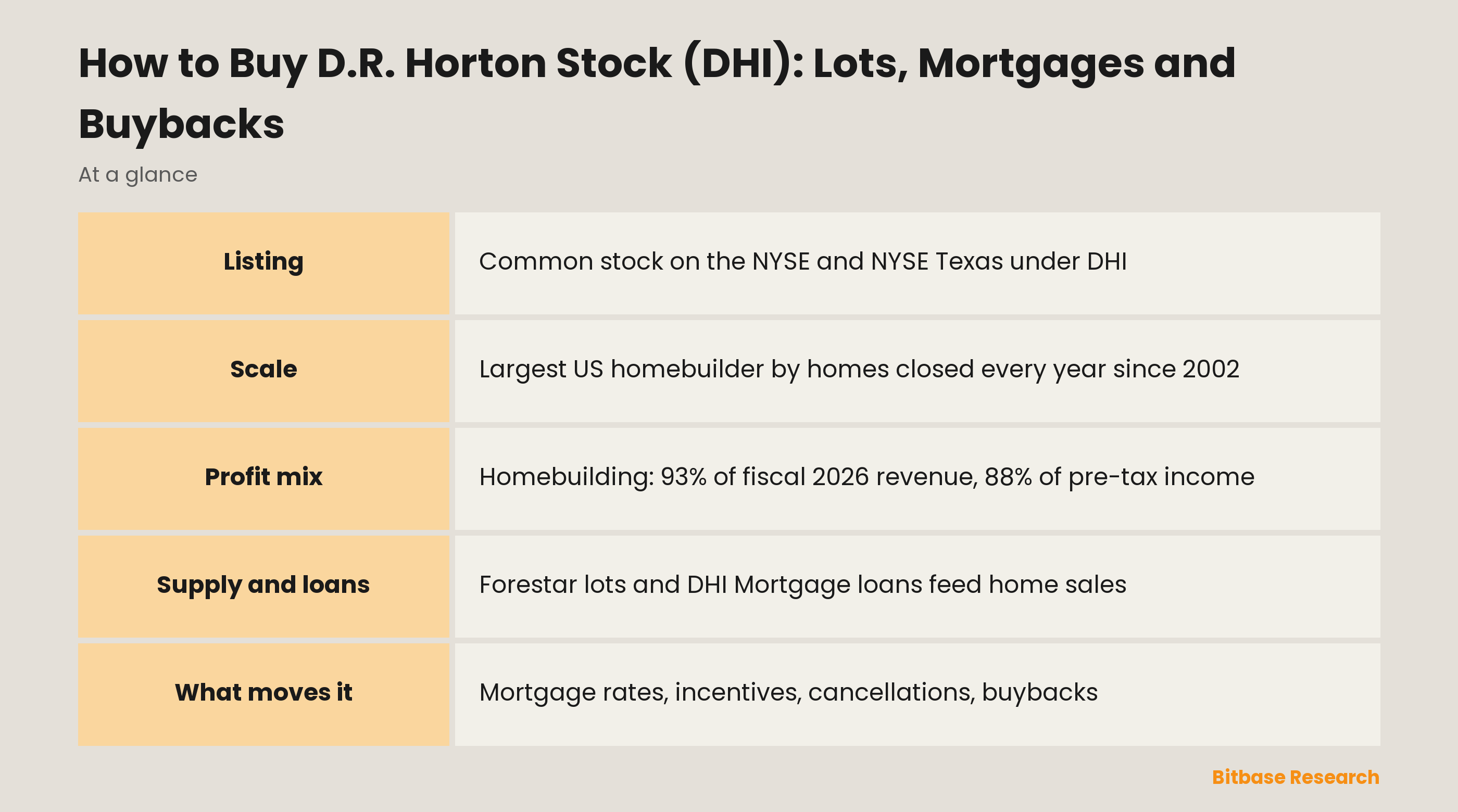
Since D.R. Horton's common stock is listed on the New York Stock Exchange as DHI, any broker with access to US equities can execute the purchase. The company has been the largest homebuilder in the United States by homes closed every year since 2002, and in fiscal 2026 its homebuilding segment produced about 93% of revenue and 88% of pre-tax income, with a majority-owned lot developer and an in-house mortgage lender feeding that machine. Below: the business, the purchase step by step, and what its filings say moves the shares, from mortgage rates and incentives to land contracts and buybacks.
What Does D.R. Horton Do?
The legal name is D.R. Horton, Inc., a Delaware corporation with its head office in Arlington, Texas. According to its annual report, the homebuilding business "began in 1978 in Fort Worth, Texas," and the common stock "has been publicly traded since 1992." Over its first 47 years the company closed more than 1.2 million homes, and its October 2026 earnings release says it has now completed its 25th consecutive year as the country's largest builder by volume.
Homebuilding is the core. The company buys land, gets it approved and developed, and sells finished houses, mostly single-family detached homes: about 84% of home sales revenue in fiscal 2025 came from detached houses, the rest from townhomes and duplexes. Its offering spans entry-level, move-up, active adult and luxury buyers, but the 10-K says the primary focus is "the first time and first time move-up homebuyer." The fourth-quarter release counted about 43,500 first-time buyers among the more than 84,000 homes closed in fiscal 2026.
Operations are run locally. At the end of fiscal 2025 there were 92 homebuilding divisions in 126 markets across 36 states, grouped into six reporting regions: Northwest, Southwest, South Central, Southeast, East and North. By the October 2026 release the footprint had grown to 128 markets in 38 states. Division presidents choose sites, price house plans and run construction; the corporate office keeps cash, financing and land approvals. Subcontractors perform "substantially all" of the land development and building work, and most homes were completed in two to four months in fiscal 2025.
Three reported businesses sit around that core:
Rental. One unit builds single-family homes, leases them up and sells each community in bulk; another develops garden-style apartment communities in fast-growing suburban markets, then leases and sells them.
Forestar. D.R. Horton owns about 62% of Forestar Group Inc., a residential lot developer listed separately under the ticker FOR. In fiscal 2025 Forestar sold 14,240 lots, and 83% of them went to D.R. Horton under a master supply agreement.
Financial services. DHI Mortgage, a wholly owned subsidiary, provided mortgage financing for 81% of the homes the company closed in fiscal 2025, and in-house title companies handle title insurance and closings.
Smaller activities, such as insurance-related operations, water rights and ranch land, are grouped as other. The company also buys builders now and then; in October 2025 it acquired the homebuilding operations of SK Builders in the Greenville, South Carolina area.
How D.R. Horton Makes Money
Almost all of it comes from selling houses. The segment table in the fiscal 2026 earnings release, which covers the year ended 30 September 2026, splits out like this:
| Segment | Share of fiscal 2026 revenue | Share of fiscal 2026 pre-tax income | What it does |
|---|---|---|---|
| Homebuilding | 93% | 88% | Builds and sells homes, plus some land and lots |
| Rental | 4% | Under 1% | Builds and sells single-family rental communities and apartment projects |
| Financial services | 2% | 7% | Mortgage lending and title services, mainly for its own buyers |
| Forestar | Mostly sold to D.R. Horton itself | 5% | Develops residential lots |
Shares are calculated against consolidated totals. Most of Forestar's revenue is lot sales to D.R. Horton, which disappear from the consolidated figures until the house built on each lot closes.
Two points stand out. The mortgage arm earns more than its revenue weight suggests: about 2% of revenue but about 7% of pre-tax income, and its borrowers are mainly people buying a D.R. Horton house. The 10-K says DHI Mortgage sells substantially all of its loans and servicing rights after origination; about 71% of fiscal 2025 loans were sold directly to Fannie Mae, Freddie Mac or into Ginnie Mae securities, and 27% to one other major financial entity.
The rental business is the volatile one. Its pre-tax income fell about 89% in fiscal 2026, and the fourth quarter included inventory impairment charges on nine multi-family rental projects.
Where the houses close matters as well. Homes closed in fiscal 2026 broke down by region as follows:
| Region | Share of fiscal 2026 homes closed | States (fiscal 2025 10-K) |
|---|---|---|
| South Central | 26% | Arkansas, Oklahoma, Texas |
| Southeast | 23% | Alabama, Florida, Louisiana, Mississippi |
| East | 21% | Georgia, the Carolinas, Tennessee |
| North | 13% | Sixteen states from New Jersey to Minnesota |
| Southwest | 11% | Arizona, California, Hawaii, Nevada, New Mexico |
| Northwest | 5% | Colorado, Oregon, Utah, Washington |
The 10-K names California, Florida and Texas among the places where it has some of its larger operations, which ties results to local job markets and to the weather and insurance costs discussed below. The mix also shifts from year to year: North closings rose about 10% in fiscal 2026 while Northwest closings fell about 10%.
DHI Stock at a Glance
| Item | DHI |
|---|---|
| Exchanges | New York Stock Exchange and NYSE Texas |
| Ticker | DHI |
| Security | Common stock, the only class of shares registered for trading |
| Other listed security | Senior notes due 2034, trading symbol DHI 34 on the NYSE (a bond, not stock) |
| Industry | Homebuilding, with rental, lot development and mortgage businesses |
| Index membership | S&P 500 |
| Headquarters | Arlington, Texas |
| Incorporated | Delaware |
| Fiscal year | Ends 30 September |
| Dividend policy | Quarterly cash dividend, set by the board |
| Share repurchases | Ongoing under board authorizations with no expiration date |
| SEC identifier | CIK 882184 |
Price, market value and yield change all day; for live numbers, use the D.R. Horton stock page on Bitbase.
How to Buy D.R. Horton Stock
D.R. Horton is a US company with one class of listed common stock, so there is no depositary receipt between you and the share. The purchase runs through a brokerage account:
1. Pick a broker that reaches the NYSE. Residents outside the United States can use a local broker with a US market gateway or an international broker. Check which legal entity holds your account and which regulator supervises it.
2. Complete the account checks. Expect identity verification and, for non-US persons, a tax form, usually Form W-8BEN. The IRS explains that tax on US-source income paid to foreign persons is generally withheld "from the payment made to the foreign person."
3. Fund it. If your money is not in US dollars, the currency conversion is a cost of its own; ask what spread the broker charges.
4. Find the right line. Type DHI and confirm the name reads D.R. Horton common stock. Do not confuse it with DHI 34, which is the company's 2034 senior note listed on the NYSE.
5. Choose the order. A market order fills quickly, but FINRA warns you "might not get the price you saw or were originally quoted, especially in fast-moving markets." A limit order caps the price you pay, and FINRA notes "there's a chance your order doesn't get executed at all."
6. Decide the size. Many brokers sell fractional shares by dollar amount. FINRA lists two limits worth knowing: "you can't transfer fractional shares to another brokerage firm," and you often cannot trade them outside regular hours.
7. Record the purchase. Keep confirmations and statements. They show your cost basis and the dividends credited, which you need for taxes at home.
Withholding for non-US holders. The IRS says "most types of U.S. source income received by a foreign person are subject to U.S. tax of 30%," with a reduced rate possible under a tax treaty. That applies to DHI's dividends, which your home country may tax again.
Owning it through funds. DHI was listed in State Street's daily SPY holdings file dated 6 November 2026, so an S&P 500 index fund carries a small slice of it alongside every other member of the index.
What Moves DHI Stock
Mortgage rates and affordability. Most buyers borrow to pay for the house, and DHI Mortgage alone financed 81% of fiscal 2025 closings, so rates feed straight into demand. The 10-K says rate increases have "reduced the affordability of our homes and has required us to use pricing adjustments and incentives to adapt to current market conditions." In its fourth-quarter 2026 release the company said conditions "became more challenging during the fourth quarter as rising mortgage rates, affordability constraints and cautious consumer sentiment continued to pressure new home demand."
Incentives and margins. The main tool for keeping sales moving is the incentive, often a buydown of the buyer's mortgage rate. Incentives cost margin: home sales gross margin fell to 21.5% in fiscal 2025 from 23.5% a year earlier, and to 20.7% in the third quarter of fiscal 2026 from 21.8%. Consolidated pre-tax margin went from 17.1% in fiscal 2024 to 13.8% in fiscal 2025 and 11.8% in fiscal 2026. Management said it expects "incentives to remain elevated in fiscal 2027."
Orders, cancellations and seasonality. Net sales orders rose 2% in fiscal 2026, but the cancellation rate climbed to 23% in the fourth quarter from 20% a year earlier. Contracts usually close in one to three months, so both reach revenue fast. The company also tends to close more homes in the third and fourth quarters of its fiscal year, so quarters are not directly comparable.
Land strategy. D.R. Horton prefers to control lots through purchase contracts that give it "the right, but generally not the obligation," to buy at set prices, which limits its exposure mostly to deposits. At 30 September 2026, 77% of the lots it owned or controlled were held under such contracts, and 68% of the homes closed in fiscal 2026 were on lots developed by Forestar or third parties, up from 65% in fiscal 2025.
Buybacks. The company returns a large share of its cash through repurchases. Shares outstanding fell about 8% in fiscal 2026, and about 16% over the two years to 30 September 2026. On 15 September 2026 the board authorized an additional repurchase program with no expiration date.
Costs and policy. The 10-K names lumber, drywall and cement as significant construction costs and says tariffs on items such as steel, aluminum and lumber "may raise our costs."
Where D.R. Horton's Risk Disclosures Point
The risk-factor section of the fiscal 2025 10-K is long; these passages bear most directly on a DHI holding.
A cyclical business. "Our homebuilding, rental and land development operations are cyclical and are significantly affected by changes in general and local economic and real estate conditions," the filing says, listing employment, consumer confidence, financing, interest rates, inflation and demographic trends.
Inventory. "Inventory risks are substantial for our homebuilding, rental and Forestar businesses." If demand falls, the company says it may not fully recover the cost of land and lots it owns, and that "a significant deterioration in economic or homebuilding industry conditions may result in substantial inventory impairment charges."
Mortgage markets. Less agency financing, changes to government programs or higher rates "could decrease our buyers' ability to obtain financing."
Weather and insurance. Many of its larger operations sit in "California, Florida, Texas and other coastal areas," which the company says carry higher risks of hurricanes, wildfires and other events. Homeowner insurance costs in certain regions have also "risen significantly in recent years."
Warranty and litigation. The company typically gives a ten-year limited warranty on major structural defects, and it says its potential liabilities from warranty and construction defect claims "are significant," given how many homes it has sold.
Forestar. On 29 April 2025 a Forestar stockholder filed a derivative complaint in the Delaware Court of Chancery against D.R. Horton, Forestar's executive chairman and certain Forestar directors, over lot sales between the two companies. The company disputes the allegations and, in its 10-Q for the quarter ended 30 June 2026, said it does not expect a material adverse effect, while noting the outcome is uncertain.
The share itself. Dividends are not guaranteed: future payments are "at the discretion of our Board" and depend on earnings, cash flow and capital needs.
How to Research DHI Yourself
D.R. Horton files with the SEC under CIK 882184. Because the fiscal year ends on 30 September, the annual 10-K usually arrives in November, 10-Qs cover the December, March and June quarters, and each quarterly earnings release is attached to an 8-K. For fiscal 2027 the company has scheduled releases on 19 January, 20 April, 22 July and 26 October 2027. The same documents are free in the Investor Relations section of drhorton.com.
Inside the 10-K, the business section gives market counts, the share of homes financed by DHI Mortgage and Forestar's lot sales to the parent, and the segment note sets the four segments side by side. The commitments and contingencies note explains warranty reserves, and the legal proceedings section describes the Forestar complaint.
The quarterly releases add tables by region for orders, closings and backlog, plus lots owned versus controlled and unsold homes in inventory; tracking them over several quarters shows whether incentives are holding demand up. Forestar files its own reports, so the lot pipeline can be checked from the supplier's side too. Live quotes for DHI are on the stock page linked above, and the Bitbase list of US stock pages covers other companies; for a different corner of housing spending, compare our Home Depot stock guide.
D.R. Horton Stock FAQ
Can I buy D.R. Horton stock with crypto?
Not as a direct swap. DHI shares are bought with US dollars in a brokerage account, so crypto would have to be sold for cash and the money transferred to the broker first, and that sale can be a taxable event where you live. What you receive is a registered share with voting and dividend rights, a different kind of asset, as our guide on how crypto differs from stocks explains.
Does D.R. Horton pay a dividend?
Yes, quarterly in cash. After fiscal 2026 the board raised the quarterly dividend by 11%, and executive chairman David Auld said the increase makes "fiscal 2027 our thirteenth consecutive year of dividend growth." The 10-K states that future dividends are at the board's discretion, so check the latest release for the current amount and dates.
Is DHI in the S&P 500?
Yes. The 10-K says the common stock "is included in the S&P 500 Index," and State Street's SPY holdings file dated 6 November 2026 listed DR Horton Inc under DHI.
Where is D.R. Horton stock listed?
On the New York Stock Exchange and on NYSE Texas, both under DHI. The NYSE Texas listing became effective in June 2025. The only other security listed under the company's name is a senior note due 2034, symbol DHI 34, which is debt and pays interest rather than dividends.
What is Forestar, and does D.R. Horton own it?
Forestar Group Inc. is a residential lot developer that trades separately under the ticker FOR. D.R. Horton owned about 62% of it at 30 June 2026 and consolidates its results; buying DHI gives you that stake indirectly, while buying FOR gives you direct exposure to the lot developer alone.
Conclusion
The question with DHI is less about the order ticket than about the housing cycle: the company sells mostly to first-time and move-up buyers, so mortgage rates and the incentives used to offset them show up quickly in its margins. Forestar's lots, the in-house mortgage lender and the scale advantages that, by the 10-K's account, smaller builders may not enjoy to the same degree give it room to adjust, but they do not lift it out of that cycle. Read the newest 10-K and earnings release, compare orders, cancellations and gross margin over several quarters, and size the position knowing it is a bet on one industry.
Related reading
Other Bitbase articles on this topic:
- How to Buy AerCap Stock (AER): Jet Leasing and Dividend Tax
- How to Buy Agilent Stock (A): CrossLab, Ticker A and Dividends
- How to Buy Carrier Stock (CARR): HVAC, Viessmann and Data Centers
- How to Buy Otis Stock (OTIS): Service Makes 91% of Segment Profit
Disclaimer: This article is educational content from Bitbase Academy, provided for information only. It explains what a company or fund does and how the instruments referenced here differ from one another; it does not constitute investment, trading, tax, or financial advice, and it is neither a recommendation nor an endorsement of any security, token, or trading strategy. A tokenized stock is issued by a third party and is designed to give economic exposure to an underlying asset: it is not a share, it carries no shareholder rights, and it depends on the issuer's structure, eligibility rules, and redemption terms, which the issuer can change. Perpetual futures are leveraged derivatives that hold no underlying asset and can be liquidated, and trading hours, product availability, and eligibility differ by instrument and by jurisdiction and can change at any time. Written as of November 2026; verify everything yourself through company filings, the issuer's own documentation, and the product pages of the venue you trade on.
References
[1] D.R. Horton Form 10-K for fiscal 2025 (SEC EDGAR) www.sec.gov
[2] D.R. Horton fiscal 2025 Form 10-K, XBRL cover page (SEC EDGAR) www.sec.gov
[3] D.R. Horton fourth-quarter and fiscal 2026 earnings release, filed with Form 8-K (SEC EDGAR) www.sec.gov
[4] D.R. Horton Form 10-Q for the quarter ended 30 June 2026 (SEC EDGAR) www.sec.gov
[5] D.R. Horton Form 8-K of 15 September 2026: new share repurchase authorization (SEC EDGAR) www.sec.gov
[6] State Street SPDR S&P 500 ETF Trust (SPY): fund page and daily holdings www.ssga.com
[7] FINRA: Order Types www.finra.org
[8] FINRA: Investing in Fractional Shares www.finra.org
[9] IRS: NRA Withholding www.irs.gov





