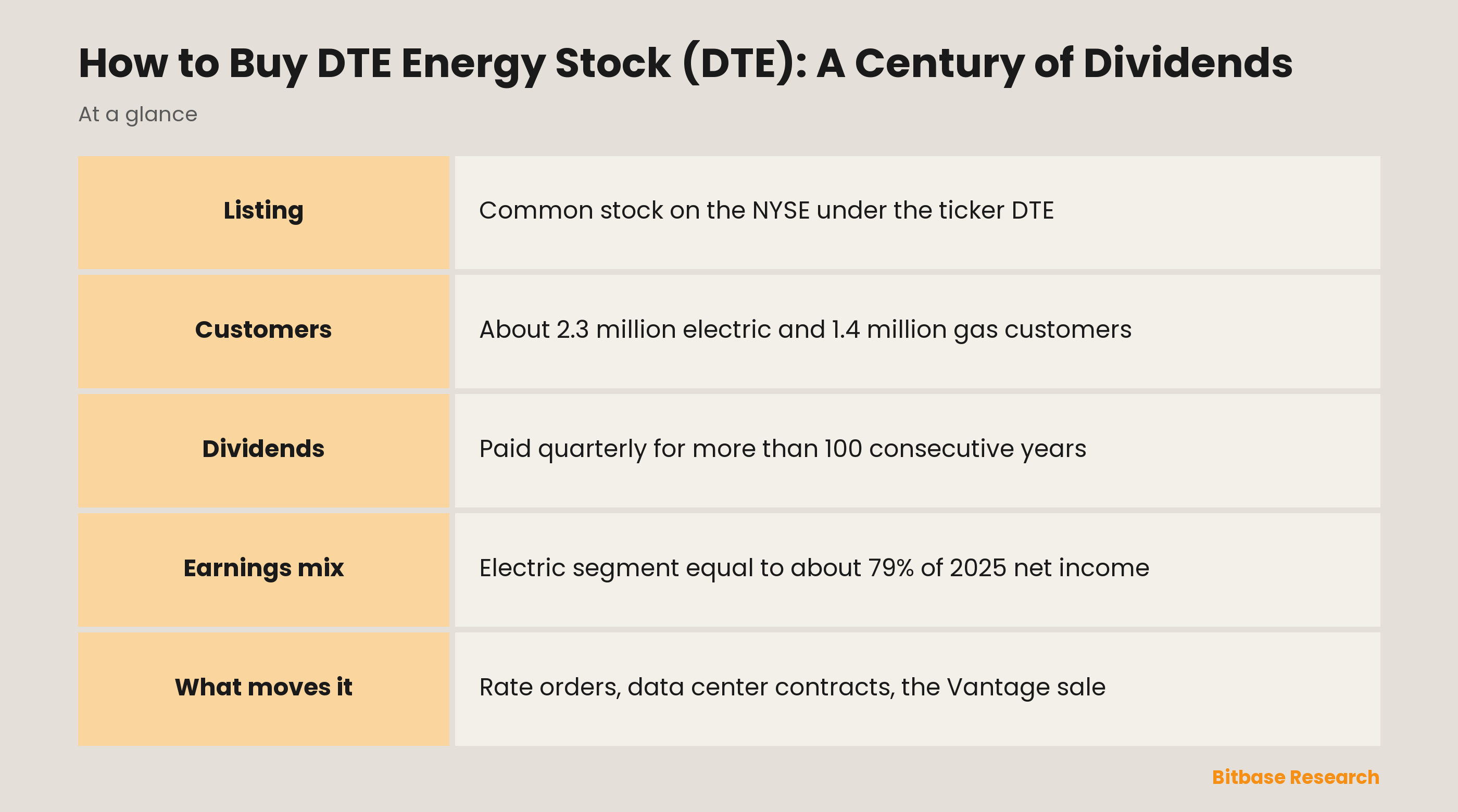
Provided your broker offers stocks listed on the New York Stock Exchange, buying DTE Energy comes down to finding the ticker DTE and choosing how many shares to order. Behind that ticker sits a Detroit holding company whose two utilities serve about 2.3 million electric customers in southeastern Michigan and about 1.4 million gas customers across the state, and which says it has paid quarterly cash dividends for more than 100 consecutive years.
What Does DTE Energy Do?
DTE Energy was incorporated in Michigan in 1995; its operating companies are far older. DTE Electric, organized in 1903, generates, buys, distributes and sells electricity in southeastern Michigan. DTE Gas, organized in 1898, buys, stores, transports and sells natural gas throughout Michigan, owns four underground storage fields and also sells storage and transportation capacity to other companies.
The 10-K splits the group into four segments plus a holding company line:
Electric is mainly DTE Electric. Its largest plant, the coal-fired Monroe station built between 1971 and 1974, supplied 36% of DTE Electric's power plant generation in 2025. The fleet also includes the Fermi 2 nuclear unit (in service since 1988), the Blue Water Energy Center gas plant (2022), a 49% share of the Ludington pumped-storage plant, and wind and solar farms.
Gas is mainly DTE Gas.
DTE Vantage runs non-utility projects: 22 renewable gas recovery sites in ten states that capture methane from landfills and farms, on-site energy systems for factories, airports and a hospital, and a metallurgical coke battery for the steel industry.
Energy Trading markets and trades physical and financial power, gas and environmental products.
How DTE Energy Makes Money
Most of the profit comes from rates set by the Michigan Public Service Commission (MPSC), which the 10-K says "have historically been designed to allow for the recovery of costs, plus an authorized rate of return on investments."
Segment results for 2025, per the 10-K:
| Segment | What it sells | Net income, 2025 vs 2024 |
|---|---|---|
| Electric | Regulated power in southeastern Michigan | Up about 8% |
| Gas | Regulated gas delivery, storage and transport | Up about 15% |
| DTE Vantage | Renewable gas, on-site energy, coke | Up about 14% |
| Energy Trading | Power, gas and environmental trading | Down about 2% |
| Corporate and Other | Holding company costs and debt | Larger loss |
The Electric segment alone earned an amount equal to about 79% of consolidated net income. Energy Trading shows why revenue says little here: its operating revenue jumped about 69% in 2025, mostly on higher gas prices, so it booked almost as much revenue as Electric while earning roughly a tenth as much. Consolidated operating revenue rose about 27%, while net income attributable to DTE Energy rose about 4%.
Seasons matter: electric load peaks in the third quarter, while gas earnings are concentrated in the first and fourth quarters and DTE Gas typically loses money in the third. Michigan caps retail access, under which customers buy power from alternative suppliers, at 10% of sales; it was about 10% in 2025.
DTE Stock at a Glance
| Fact | DTE Energy |
|---|---|
| Exchange | New York Stock Exchange |
| Ticker | DTE |
| Security | Common stock, without par value |
| Other NYSE listings | Four series of junior subordinated debentures (DTW, DTB, DTG, DTK); bonds, not shares |
| Industry | Michigan electric and gas utility, plus non-utility units |
| Index | S&P 500 constituent (State Street SPY holdings, 10 November 2026) |
| Headquarters | One Energy Plaza, Detroit, Michigan |
| Incorporated | Michigan, 1995 |
| Financial year | Ends 31 December |
| Dividends | Paid quarterly; each payment needs board approval |
| SEC filings | CIK 936340; 10-K filed jointly with DTE Electric |
| Holders of record | 37,916 at 31 December 2025 |
For quotes, market value and yield, open the DTE Energy stock page on Bitbase.
How to Buy DTE Energy Stock
DTE shares are issued directly by a Michigan company, with no depositary receipt layer:
1. Pick a regulated broker that offers NYSE stocks where you live.
2. Complete the account checks. Investors outside the US are normally asked for IRS Form W-8BEN so the broker can withhold tax at the right rate.
3. Fund the account. Euros or other currencies are converted into US dollars, usually at a spread.
4. Search for DTE and read the security name. The search can also show DTW, DTB, DTG and DTK, which are DTE Energy debentures; you want the common stock.
5. Choose the order type. A market order fills at the prevailing price; a limit order sets the most you will pay but may not fill.
6. Decide on share size. Some brokers sell fractional shares; ask whether fractions carry votes and can be transferred.
Investors abroad receive dividends that count as US-source income. The IRS says "Most types of U.S. source income received by a foreign person are subject to U.S. tax of 30%," with a lower rate or exemption possible under a tax treaty. This is general background; your own treaty position sets the rate.
Fund route. State Street's holdings files dated 10 November 2026 list DTE Energy in SPY, the S&P 500 fund, and in XLU, its utilities sector fund.
What Moves DTE Stock
Data center contracts. DTE Electric signed a 1.4-gigawatt data center agreement in October 2025 and a 1.0-gigawatt agreement in March 2026; the MPSC approved them in the fourth quarters of 2025 and 2026. The third-quarter 2026 10-Q splits DTE Electric's capital plan for 2027 to 2031 into roughly 59% cleaner generation, 31% distribution and 10% base infrastructure. Our Dominion Energy stock guide covers another utility weighing data center demand.
Michigan rate orders. In February 2026 the MPSC granted DTE Electric about 42% of the base rate increase it had asked for and kept its return on equity at 9.9%, not the 10.75% requested. In September 2026 DTE Gas also kept a 9.8% return on equity after asking for 10.25%. A new electric case filed in April 2026 asks for 10.25%; a final order is expected in February 2027.
Leaving coal. Belle River is due to become a gas-fired peaking plant in 2026, Monroe's four units are expected to retire in 2028 and 2032, and DTE plans to stop burning coal in 2032. Michigan law sets a 100% clean energy standard by 2040, with renewables at 50% of sales by 2030 and 60% by 2035.
The Vantage sale. On 1 November 2026 DTE agreed to sell most of DTE Vantage, including renewable gas recovery, wholesale power and on-site energy, to investors advised by J.P. Morgan Asset Management's Global Infrastructure group. DTE keeps mainly the coke operations. Closing needs regulatory approvals and is expected in 2027. Vantage earned about a tenth of consolidated net income in 2025, so the sale would leave DTE closer to a pure utility.
New shares. DTE set up an at-the-market program in December 2025, and the 10-K says more equity will be needed in 2027 and 2028, which spreads earnings across more shares.
Rate Lag, Fermi 2 and the Risks DTE Spells Out
Rate relief. "The Registrants cannot predict what rates the MPSC will authorize in future rate cases, and unfavorable rate relief could impact our plans for significant capital investment."
Building for data centers. The 10-K lists "construction and operation of energy facilities and storage capacity to serve one or more data centers" among projects exposed to delays and cost overruns.
Nuclear. "Ownership of an operating nuclear generating plant subjects the Registrants to significant additional risks," and the decommissioning trust "may not be sufficient to fund the cost of decommissioning."
Weather. "Mild temperatures can result in decreased utilization of the Registrants' assets, lowering income and cash flows."
Labor. Most union-represented employees work under contracts that expire in 2027.
Holding company cash. "Should a major subsidiary not be able to pay dividends or transfer cash flows to DTE Energy, its ability to pay interest and dividends would be restricted."
A single stock also concentrates risk, and no future dividend is guaranteed.
How to Research DTE Yourself
DTE Energy files with the SEC under CIK 936340. Its 10-K is shared with DTE Electric, so check which registrant a table covers. In 2026, earnings arrived as 8-Ks on 17 February, 30 April, 28 July and 5 November, and each 10-Q updates open rate cases in its regulatory matters note.
Track three items across filings: data center gigawatts under contract, the return on equity in each MPSC order, and the Vantage sale, summarized in a November 2026 8-K. The 10-K also charts five-year total return against the S&P 500 and the S&P 500 Multi-Utilities Index.
To compare other names, browse Bitbase's US stock pages.
DTE Energy Stock FAQ
Can I buy DTE Energy stock with crypto?
No. Brokers settle DTE purchases in US dollars, so crypto must first be sold for cash, which may be taxable where you live. A DTE share gives you a vote and a claim on any dividend the board declares; this explainer on how stocks differ from crypto covers the rest.
Does DTE Energy pay a dividend?
Yes. The 10-K says DTE has paid quarterly cash dividends for more than 100 consecutive years, that future payments need board approval, and that over the long term it targets a payout ratio consistent with pure-play utility companies. Dividends declared per share rose about 7% in 2025.
Is DTE in the S&P 500?
Yes. DTE Energy Company appears in the SPY holdings list State Street published for 10 November 2026.
What are DTW, DTB, DTG and DTK?
Four series of DTE Energy junior subordinated debentures listed on the NYSE. They pay interest and mature on set dates; they are debt, not common stock.
Is DTE Energy selling DTE Vantage?
It has agreed to. The 1 November 2026 agreement covers most of Vantage except the coke operations, and closing is expected in 2027 once regulators approve.
Conclusion
DTE Energy is turning into a simpler bet on Michigan: a regulated electric and gas utility funding a coal exit and data center growth, with its main non-utility unit on the way out. Whether that pays shareholders depends on what the MPSC allows in each rate order and whether the contracted gigawatts arrive on schedule. Read the 2026 rate decisions, the capital plan and the Vantage terms together before deciding how much of one Michigan utility belongs in your portfolio.
Related reading
Other Bitbase articles on this topic:
- How to Buy Ameren Stock (AEE): Callaway, DRPlus, Data Centers
- How to Buy American Water Works Stock (AWK): Rates, PFAS, Merger
- How to Buy Atmos Energy Stock (ATO): Gas Only, Mostly in Texas
- How to Buy PSEG Stock (PEG): New Jersey Grid and Nuclear Plants
Disclaimer: This article is educational content from Bitbase Academy, provided for information only. It explains what a company or fund does and how the instruments referenced here differ from one another; it does not constitute investment, trading, tax, or financial advice, and it is neither a recommendation nor an endorsement of any security, token, or trading strategy. A tokenized stock is issued by a third party and is designed to give economic exposure to an underlying asset: it is not a share, it carries no shareholder rights, and it depends on the issuer's structure, eligibility rules, and redemption terms, which the issuer can change. Perpetual futures are leveraged derivatives that hold no underlying asset and can be liquidated, and trading hours, product availability, and eligibility differ by instrument and by jurisdiction and can change at any time. Written as of November 2026; verify everything yourself through company filings, the issuer's own documentation, and the product pages of the venue you trade on.
References
[1] DTE Energy Form 10-K for 2025 (SEC EDGAR) www.sec.gov
[2] DTE Energy 2025 Form 10-K, XBRL cover page (SEC EDGAR) www.sec.gov
[3] DTE Energy 2025 Form 10-K, XBRL income statement (SEC EDGAR) www.sec.gov
[4] DTE Energy Form 10-Q for the third quarter of 2026 (SEC EDGAR) www.sec.gov
[5] DTE Energy Form 8-K of 5 November 2026 on the DTE Vantage sale (SEC EDGAR) www.sec.gov
[6] State Street, SPY daily holdings www.ssga.com
[7] State Street, XLU daily holdings www.ssga.com
[8] IRS, NRA Withholding www.irs.gov
[9] IRS, About Form W-8 BEN www.irs.gov





