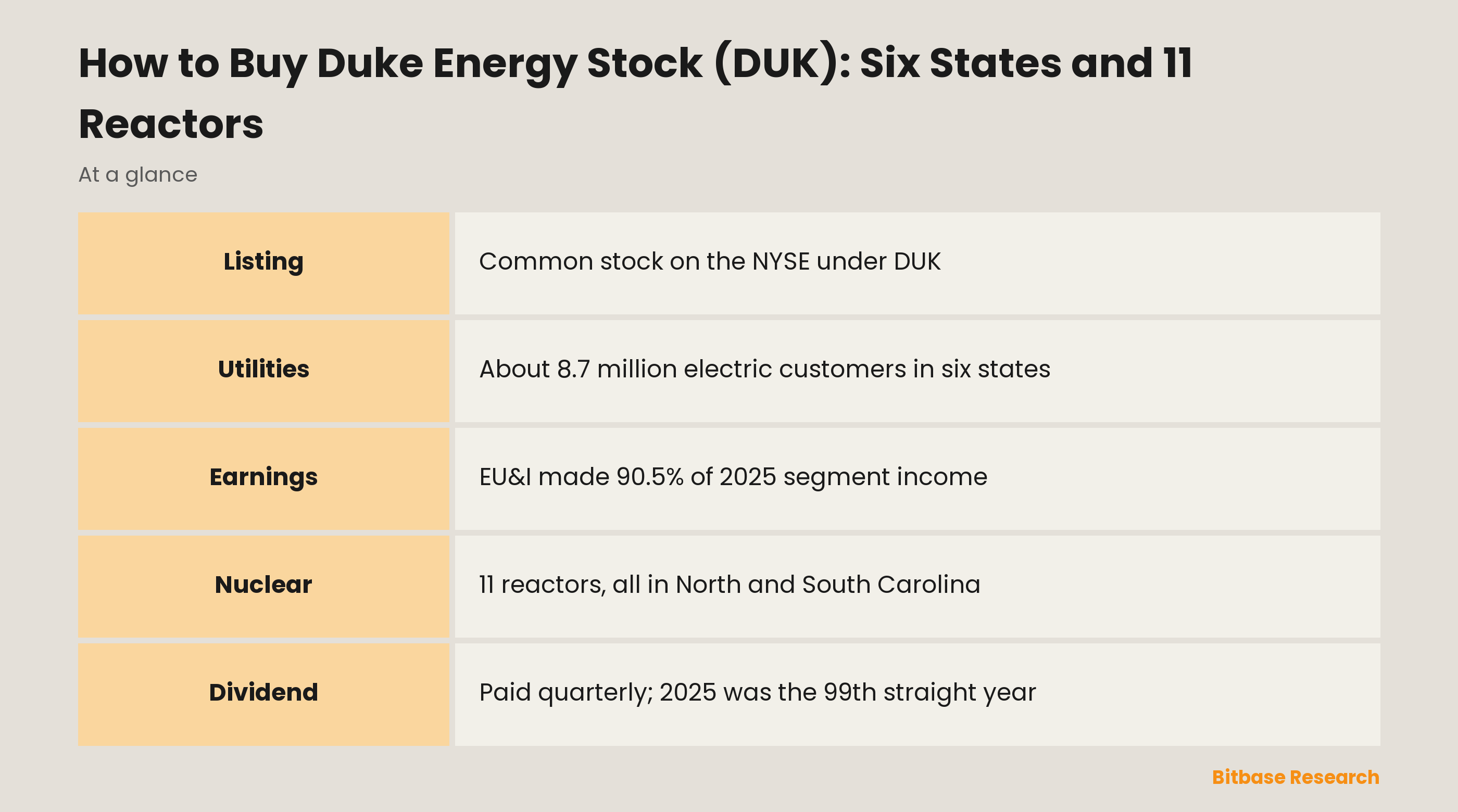
With a single order for the ticker DUK, any brokerage account that reaches the New York Stock Exchange can buy Duke Energy stock. At the end of 2025 its regulated utilities supplied electricity to about 8.7 million customers in six states, and the Charlotte, North Carolina, parent owns, wholly or partly, 11 operating nuclear reactors, all in North and South Carolina. This guide covers where the revenue comes from, how to buy the common stock rather than another Duke security, and which risks the filings stress.
What Does Duke Energy Do?
Duke Energy Corporation, a Delaware-incorporated holding company based in Charlotte, North Carolina, works through subsidiaries; seven of them file one combined annual report with it. The 10-K splits the business into two reportable segments plus a residual called Other.
Electric Utilities and Infrastructure (EU&I) is the electricity business, run through five utilities. Its customers numbered about 8.7 million at the end of 2025, spread over roughly 90,000 square miles of the Southeast and Midwest: six states with an estimated 27 million people. Wholesale power goes to municipalities and electric cooperatives.
| Utility | Electric service area | Approximate customers, end of 2025 |
|---|---|---|
| Duke Energy Carolinas | Parts of North Carolina and South Carolina | 3 million |
| Duke Energy Progress | Parts of North Carolina and South Carolina | 1.8 million |
| Duke Energy Florida | Parts of Florida | 2.1 million |
| Duke Energy Indiana | Parts of Indiana | 930,000 |
| Duke Energy Ohio, including Duke Energy Kentucky | Parts of Ohio and Kentucky | 920,000 |
Each utility is the sole electricity supplier in its territory except in Ohio, where generation is competitive and Duke earns its retail margin on the wires, not the energy. Duke Energy Progress and Duke Energy Florida sit under Progress Energy, which Duke acquired on 2 July 2012.
Gas Utilities and Infrastructure (GU&I) distributes natural gas through Piedmont Natural Gas, owned since 3 October 2016, and through Duke Energy Ohio and Duke Energy Kentucky. Of its roughly 1.8 million customers at the end of 2025, 205,000 were in the Nashville area, a business Piedmont sold to Spire Inc. on 31 March 2026.
Other holds the interest on holding-company debt, unallocated corporate costs, the captive insurer Bison and a 17.5% stake in NMC, a Saudi petrochemical venture. After selling substantially all of its Commercial Renewables business in 2023, Duke describes both segments' operations as substantially all regulated.
EU&I's 2025 energy came 33.5% from natural gas and fuel oil, 27.5% from nuclear, 14.5% from coal and 2.0% from hydro and solar; the other 22.5% was bought from or exchanged with other systems. The nuclear share comes from 11 reactors at six stations: Oconee, McGuire and Catawba at Duke Energy Carolinas, and Brunswick, Harris and Robinson at Duke Energy Progress.
How Duke Energy Makes Money
Duke's segment note shows how lopsided the two businesses are:
| Segment | Business | 2025 revenue share | 2025 segment income share | Segment income vs 2024 |
|---|---|---|---|---|
| EU&I | Electricity at state-approved rates, plus wholesale power | 90.9% | 90.5% | Up 11.9% |
| GU&I | Natural gas delivery at state-approved rates | 9.0% | 9.5% | Up 23.1% |
Revenue shares use sales to outside customers; income shares are of the two segments' combined total. Revenue rose 6.2% and net income available to common stockholders 11.6%, which Duke credits mainly to recovering its growing infrastructure investment and to territory growth.
Retail electricity is the core. Retail sales were 86.9% of EU&I's 2025 operating revenue and wholesale sales 8.3%. Rates are meant to let a utility "collect revenues equal to its cost of providing service plus earn a reasonable rate of return on its invested capital, including equity," and EU&I took 89.7% of the group's 2025 capital investment.
Fuel costs move revenue, not profit. Fuel is billed through recovery clauses, so changes in its cost "have no material impact on operating results of EU&I, unless a commission finds a portion of such costs to have been imprudent." What suffers is cash flow, because collection lags payment.
Weather hits power more than gas. Power sales peak in summer and winter, and decoupling in some jurisdictions softens only part of that swing; GU&I is "generally protected from the impact of weather fluctuations" and earns its margin on delivery, "not on the cost of the underlying commodity."
DUK Stock at a Glance
| Field | Detail |
|---|---|
| Exchange | New York Stock Exchange (NYSE) |
| Ticker | DUK, the common stock of Duke Energy Corporation |
| Other Duke lines on the NYSE | DUKB debentures, DUK PR A preferred depositary shares, three senior notes, DUKU corporate units issued in August 2026 |
| Sector | Regulated electric and gas utilities |
| Index membership | S&P 500, per SPY's holdings on 29 October 2026 |
| Headquarters and incorporation | Charlotte, North Carolina; incorporated in Delaware |
| Share history | One-for-three reverse split just before the Progress Energy merger closed on 2 July 2012 |
| Fiscal year end | 31 December |
| Dividend | Quarterly; 2025 was the 99th consecutive year |
| SEC filer | CIK 1326160, combined annual report with seven subsidiaries |
Quotes, market value and yield change by the second, so they are left out; the Duke Energy stock page on Bitbase shows them in real time.
How to Buy Duke Energy Stock
No depositary receipt is involved, since Duke is a US company listed at home:
1. Choose a broker with NYSE access, and check who regulates it and where your shares will be held.
2. Complete the account checks. Brokers usually ask non-US individuals for IRS Form W-8BEN, the certificate of foreign status for tax withholding.
3. Deposit money. Converting from another currency adds a spread to any commission.
4. Search DUK and check the name. The line you want reads Duke Energy Corporation common stock. DUKB is a debenture, DUK PR A a preferred depositary share, and DUKU a corporate unit combining interests in Duke notes with a contract to buy DUK shares by 1 August 2029.
5. Pick a market or limit order. A market order "provides the most certainty that your order will be executed," says FINRA, though the price may differ from the quote; a limit order fills at "your limit price or a better price," or not at all.
6. Whole or fractional shares. "The availability of fractional share trading varies by brokerage firm," fractions cannot move to another firm, and their owners "might not have shareholder voting rights."
7. Keep the confirmations for your tax records.
Duke's own plan. The InvestorDirect Choice Plan, set out in a January 2025 SEC prospectus, is "a direct stock purchase plan" with dividend reinvestment, open even to people who own no shares. Non-US citizens and residents "must first determine that participating in the Plan will not violate local laws," and should compare its fees with a broker's.
Dividends for non-US holders. The IRS states that "most types of U.S. source income received by a foreign person are subject to U.S. tax of 30%," and that "a reduced rate, including exemption, may apply" under a tax treaty, which the W-8BEN lets your broker apply. Tax at home may follow. None of this is tax advice.
Indirectly, SPY, State Street's S&P 500 fund, and XLU, its utilities sector fund, both held Duke Energy on 29 October 2026.
What Moves DUK Stock
North Carolina rate cases. Duke Energy Carolinas and Duke Energy Progress filed performance-based rate applications on 20 November 2025, each with a two-year rate plan. The Carolinas utility settled with the state's Public Staff and others on 17 July 2026, pending approval by the North Carolina Utilities Commission (NCUC); a Progress order was expected by November. On 22 May 2026 the state Supreme Court upheld the NCUC's previous orders in full.
One Carolinas utility. Duke Energy Progress is to merge into Duke Energy Carolinas. FERC, the NCUC and South Carolina's Public Service Commission approved the combination between January and June 2026, with 1 January 2027 as the target date, and the settlements oblige the companies to guarantee that savings over 14 years offset the identified impacts on retail customers.
Partners and new shares. GIC owns 19.9% of Duke Energy Indiana's holding company. A Brookfield Super-Core Infrastructure Partners affiliate took 9.19% of Florida Progress, Duke Energy Florida's parent, on 3 March 2026 and can reach 19.7% by mid-2028. The Florida money displaces planned debt and stock, but the partners' share of profit never reaches DUK holders. New shares are coming anyway: the 10-K plans common stock issues from 2027 to 2030 through dividend reinvestment and at-the-market programs, and holders of the August 2026 corporate units must buy DUK shares by 1 August 2029.
Nuclear licenses and credits. In March 2025 the NRC renewed Oconee's licenses through 2054, the first Duke plant cleared for 80 years; Robinson, licensed to 2030, has applied to run through 2050, and a "technology neutral" early site permit application near Belews Creek followed on 30 December 2025. Duke expects its Carolinas plants to keep earning nuclear production tax credits; losing or cutting them "could negatively impact our ability to return the anticipated cost benefits to customers."
The pace of coal retirement. Coal still produced 14.5% of EU&I's 2025 energy. Duke "continues to evaluate the retirement date assumptions for all coal-fired generating facilities" and "plans to seek regulatory recovery for amounts that would not be otherwise recovered when any of these assets are retired."
Large new customers. Weather-normal sales grew in 2025 "due primarily to continued residential customer growth and strength in the commercial sector including data center usage," while industrial demand stayed soft. The 10-K adds that large loads such as hyperscale data centers "present unique risks." Electricity is one input behind the AI infrastructure stocks story.
Storms and cold snaps. The 2024 hurricanes Debby, Helene and Milton were paid for through a Florida charge and storm bonds in both Carolinas. Extra fuel and purchased-power costs from the harsh start to 2026, which included Winter Storm Fern, are being recovered over 19 months. Customers pay in the end, but Duke spends the cash first.
Risk Factors That Matter Most for DUK
These risk factors sit closest to the common stock:
Commission decisions. Rates set in rate cases "may limit their ability to recover costs and earn an appropriate return on investment," and adverse rulings, including on appeal, "have, and in the future could have, a material adverse effect."
Stranded investment. If big customers end service agreements early, "stranded assets could result if investments are not fully recovered."
The nuclear fleet. Duke Energy Carolinas, Duke Energy Progress and Duke Energy Florida "may incur substantial costs and liabilities" from nuclear plants, and the NRC can "impose fines or shut down a unit" for non-compliance.
Coal ash. A "CCR-related operational incident" could hurt reputation and results, and "there is no guarantee of full cost recovery."
Cash from subsidiaries. Duke Energy "is a holding company with no operations or cash flows of its own," and its subsidiaries "have no obligation to provide Duke Energy with funds." Deferring dividends on the Series A preferred stock would also bar common dividends.
Ratings and deals. There is "no assurance" of keeping investment-grade ratings, and "no assurance that strategic transactions," such as the remaining Florida closings, "will be completed as expected or at all."
Then come the usual single-stock and currency risks.
How to Research DUK Yourself
Duke files under CIK 1326160. Its 10-K is shared by eight registrants, each filing information about itself "solely on its own behalf," so a Florida or Indiana question is best checked in that utility's own statements; Progress Energy is the intermediate parent of the Progress and Florida utilities.
The business section describes each utility, the segment note splits sales, segment income and investment by segment and registrant, and the regulatory note follows each rate case; 10-Qs and 8-Ks bring the updates. R1.htm, the XBRL cover page, lists every registered Duke security, and the September 2026 8-K cover adds DUKU. Duke also publishes non-GAAP adjusted earnings, so note which measure a headline quotes.
For a utility built differently, see how to buy NextEra Energy stock.
Other companies have their own US stock pages on Bitbase.
Duke Energy Stock FAQ
Does Duke Energy pay a dividend?
Yes, quarterly. 2025 marked the 99th consecutive year, and the dividend rose about 2% in both 2025 and 2024. Future amounts depend on earnings, capital needs and financial condition and "are subject to the discretion of the Board of Directors."
Can I buy Duke Energy stock with crypto?
Not as a direct swap. Brokers price and settle DUK in US dollars, so the crypto must be sold first, possibly with tax due where you live, and the cash moved to a brokerage account. A DUK share is also a registered claim on a company, with dividends and votes, which is how stocks and crypto differ at the root.
Has Duke Energy stock ever split?
Yes, in reverse: a one-for-three reverse split took effect just before the Progress Energy merger closed on 2 July 2012. To compare older per-share prices or dividends with today's, multiply the figures from before July 2012 by three.
Is DUK in the S&P 500?
Yes. SPY, State Street's S&P 500 fund, held Duke Energy on 29 October 2026.
Can I buy shares of Duke Energy Florida or Piedmont?
No. The 10-K says there is "no market for the common equity securities of the Subsidiary Registrants," all of which Duke Energy owns directly or indirectly. GIC and a Brookfield affiliate hold minority stakes in the Indiana and Florida holding companies, but for individual investors DUK is the way in.
Conclusion
Placing the order is the easy part: any broker that reaches the NYSE, the DUK common stock rather than DUKB, DUK PR A or DUKU, and a market or limit order. Retail power in six states brings in most of the revenue, gas and nuclear plants supply most of the energy, and results depend on state commissions and on how the build-out is financed. Before buying, go through the latest annual report, the second-quarter 10-Q and the filings in the pending rate cases.
Related reading
Other Bitbase articles on this topic:
- How to Buy American Electric Power Stock (AEP): Nasdaq, 11 States
- How to Buy Constellation Energy Stock (CEG): Nuclear and Calpine
- How to Buy Dominion Energy Stock (D): NextEra Deal, Data Centers
- How to Buy Southern Company Stock (SO): Vogtle and Data Centers
Disclaimer: This article is educational content from Bitbase Academy, provided for information only. It explains what a company or fund does and how the instruments referenced here differ from one another; it does not constitute investment, trading, tax, or financial advice, and it is neither a recommendation nor an endorsement of any security, token, or trading strategy. A tokenized stock is issued by a third party and is designed to give economic exposure to an underlying asset: it is not a share, it carries no shareholder rights, and it depends on the issuer's structure, eligibility rules, and redemption terms, which the issuer can change. Perpetual futures are leveraged derivatives that hold no underlying asset and can be liquidated, and trading hours, product availability, and eligibility differ by instrument and by jurisdiction and can change at any time. Written as of October 2026; verify everything yourself through company filings, the issuer's own documentation, and the product pages of the venue you trade on.
References
[1] Duke Energy combined Form 10-K, fiscal 2025: business, segments and risk factors (SEC EDGAR) www.sec.gov
[2] Duke Energy Form 10-Q, quarter ended 30 June 2026: rate cases and dispositions (SEC EDGAR) www.sec.gov
[3] Duke Energy Form 8-K, 3 July 2012: Progress Energy merger and reverse stock split (SEC EDGAR) www.sec.gov
[4] Duke Energy Form 8-K, 3 October 2016: completion of the Piedmont acquisition (SEC EDGAR) www.sec.gov
[5] Duke Energy Form 8-K, 13 August 2026: equity units issue (SEC EDGAR) www.sec.gov
[6] Duke Energy Form 8-K, 25 September 2026: cover page with registered securities (SEC EDGAR) www.sec.gov
[7] Duke Energy InvestorDirect Choice Plan prospectus, January 2025 (SEC EDGAR) www.sec.gov
[8] State Street SPDR S&P 500 ETF Trust (SPY): daily holdings file www.ssga.com
[9] State Street Utilities Select Sector SPDR ETF (XLU): daily holdings file www.ssga.com
[10] FINRA: Order Types www.finra.org
[11] FINRA: Investing in Fractional Shares www.finra.org
[12] IRS: NRA Withholding www.irs.gov
[13] IRS: About Form W-8 BEN, certificate of foreign status for withholding www.irs.gov





