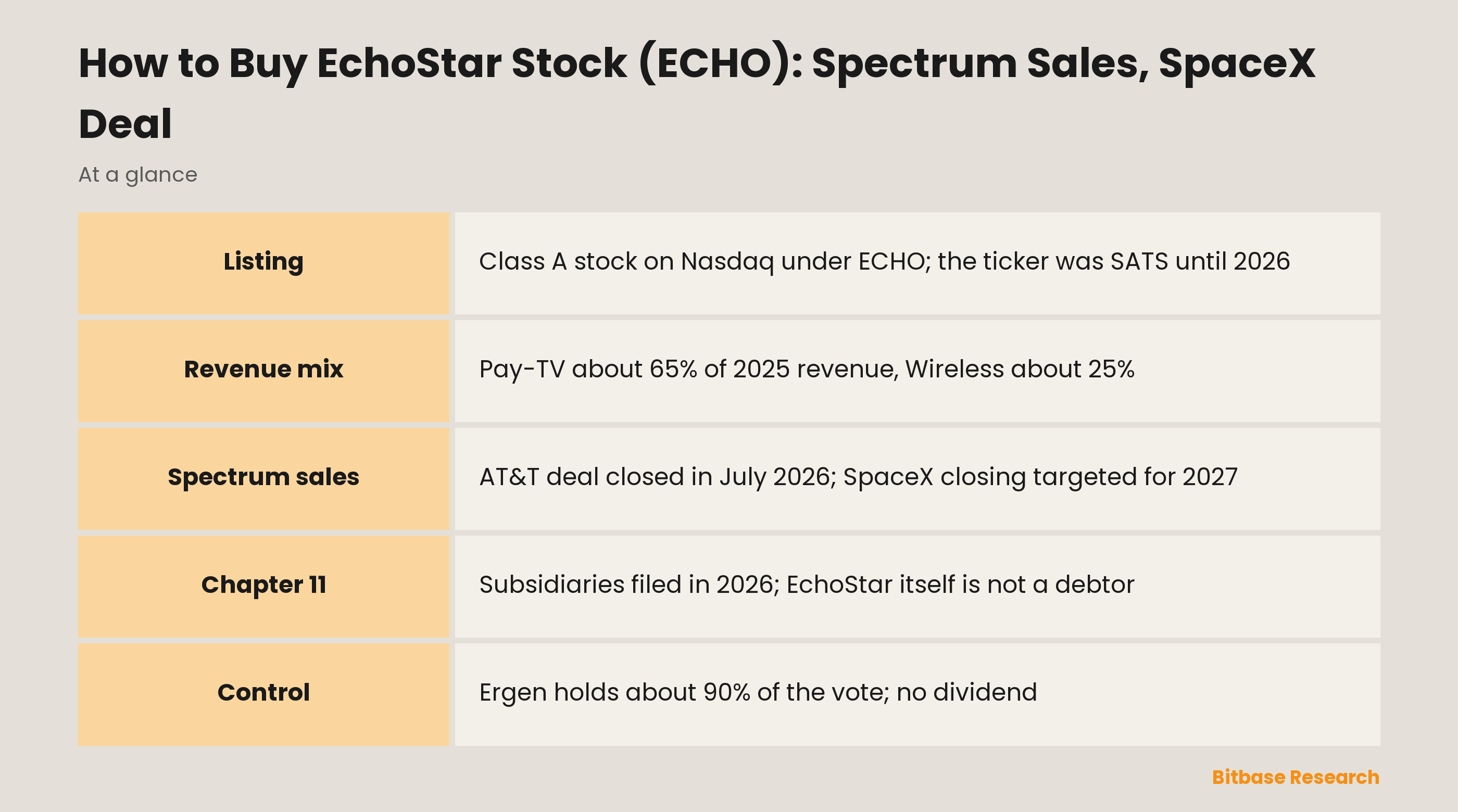
You buy EchoStar stock as its Class A common stock, which trades on Nasdaq under ECHO, the ticker that replaced SATS in 2026, and any broker with access to US shares can place the order. The company spent 2025 and 2026 selling wireless spectrum under pressure from its regulator: one block went to AT&T for cash, another is promised to SpaceX for cash and SpaceX shares, and several subsidiaries entered Chapter 11 while the parent stayed out of court. Below: what EchoStar still runs, how a purchase works, and which filings explain the moving parts.
What Does EchoStar Do?
EchoStar Corporation is a holding company, organized in Nevada in October 2007 and based in Englewood, Colorado. Its subsidiaries sell satellite and streaming television, mobile phone plans and satellite internet, under names that most customers know better than the parent: DISH TV, Sling TV, Boost Mobile and HughesNet. The present group took shape on 31 December 2023, when EchoStar completed its acquisition of DISH Network. Charles Ergen chairs the board and, through his Class B shares, controls the vote.
The 2025 annual report on Form 10-K splits the business into four segments.
Pay-TV combines DISH TV, delivered by satellite, with Sling TV, an internet streaming service aimed at people who do not take traditional satellite or cable packages.
Wireless sells mobile service mainly under the Boost Mobile and Gen Mobile brands. Until November 2025 it ran mostly on capacity bought from T-Mobile and AT&T while building a 5G network of its own. After agreeing to sell spectrum to AT&T, it moved to a "Hybrid MNO" model: EchoStar keeps its network core and billing systems, and AT&T supplies the radio network and spectrum. By 15 November 2025 all customer traffic had moved onto AT&T's network.
Broadband and Satellite Services is the Hughes business. It sells HughesNet satellite internet to households beyond cable and fiber, and networks, equipment and satellite capacity to enterprise, aviation and government customers.
Other holds the remains of the 5G network that EchoStar stopped building in August 2025 and has been decommissioning since.
In May 2025 the Federal Communications Commission opened a review of whether EchoStar had met the build-out duties attached to its spectrum licenses. According to the 10-K, the FCC "made it clear that it viewed our spectrum as being underutilized" and that EchoStar "must sell a material amount of spectrum licenses or face a wide-ranging license revocation." The AT&T and SpaceX sales followed.
How EchoStar Makes Money
In 2025, the last full year reported on the old basis, television still carried the group:
| Segment | Share of 2025 revenue | Change from 2024 | Brands |
|---|---|---|---|
| Pay-TV | about 65% | down 9.2% | DISH TV, Sling TV |
| Wireless | about 25% | up 5.6% | Boost Mobile, Gen Mobile |
| Broadband and Satellite Services | about 10% | down 7.6% | Hughes, HughesNet |
| Other | about 2% | up 88.1% | legacy 5G network |
Segment figures come before intersegment eliminations, so the shares add up to slightly more than 100%. Consolidated revenue fell 5.2%, mostly because Pay-TV shrank. Pay-TV was also the only segment with operating income in 2025; the other three ran operating losses, and the year carried large non-cash impairment charges tied to the end of the 5G build and to the Hughes assets.
Spectrum, turned into cash. The AT&T sale closed on 28 July 2026. EchoStar transferred all of its 3.45 GHz and 600 MHz licenses, and part of the price went straight into an FCC-mandated trust that pays claims from suppliers of the network tied to those licenses. DISH Network notes due 2027 were redeemed at closing.
Spectrum, turned into a future payment. Under an agreement first signed on 7 September 2025 and amended on 5 November 2025, EchoStar is selling its AWS-4 and H-Block licenses and part of its AWS-3 holdings to SpaceX. The licenses moved into a trust on 22 May 2026, and the final step, when SpaceX takes them and pays, "remains targeted for November 30, 2027." Part of the price goes to pay off EchoStar notes secured by those licenses; the rest is to be paid in SpaceX Class A common stock up to a fixed cap, with anything above the cap in cash. Future commercial agreements would also give EchoStar's Wireless subscribers access to Starlink Direct to Cell service.
Reported numbers changed in 2026. When DISH DBS, DISH Wireless and Hughes entered Chapter 11, EchoStar removed them from its consolidated accounts: the DISH units from 30 June 2026 and Hughes from 31 July 2026. DISH DBS emerged from bankruptcy on 1 October 2026 and comes back into the accounts from that date. The third-quarter 10-Q warns that from that quarter "our results of operations are materially different," even though EchoStar continues "to own and manage the operations" of those subsidiaries. Line-by-line comparisons with 2025 will mislead.
ECHO Stock at a Glance
| Feature | ECHO |
|---|---|
| Exchange | Nasdaq Global Select Market |
| Ticker | ECHO; the same Class A stock was listed as SATS before the 2026 change |
| Listed security | Class A common stock, the only class registered for exchange trading |
| Other classes | Class B shares with ten votes each, held by Charles Ergen and family entities; no public market |
| Sector | Pay television, wireless service and satellite broadband |
| Brands | DISH TV, Sling TV, Boost Mobile, Gen Mobile, Hughes, HughesNet |
| Index membership | S&P 500; not in the Nasdaq-100 |
| Headquarters | Englewood, Colorado |
| Incorporated | Nevada, October 2007 |
| Fiscal year | Calendar year, ending 31 December |
| Dividends | None paid in 2024 or 2025, none planned; a share buyback is authorized through 2027 |
| SEC identifier | CIK 1415404 |
Quotes, market value and trading volume change by the second; see the EchoStar stock page on Bitbase for live data.
How to Buy EchoStar Stock
EchoStar's Class A shares are listed directly on Nasdaq, with no depositary receipt in between. A purchase runs in six steps:
1. Pick a broker that reaches Nasdaq. Abroad, check which legal entity holds your account and who supervises it.
2. Complete the account checks. Expect identity verification, and as a non-US individual, a tax status form for the withholding agent, usually the W-8BEN.
3. Fund the account. Paying in euros, won or another currency adds a conversion spread that can cost more than the commission.
4. Search the right ticker. Type ECHO and confirm the result reads EchoStar Corporation Class A common stock. Older charts, articles and data feeds may still list SATS, the symbol on the 2025 10-K.
5. Choose the order type. FINRA notes that with a market order "you might not get the price you saw or were originally quoted, especially in fast-moving markets," whereas "a buy limit order can be executed only at or below the limit price." EchoStar's own filings call trading in its shares speculative while the bankruptcy cases run.
6. Decide the size, then keep records. Fractional shares let you invest a fixed sum, but FINRA warns that "you can't transfer fractional shares to another brokerage firm." Keep confirmations for your cost basis.
Tax for investors abroad. The IRS states that "most types of U.S. source income received by a foreign person are subject to U.S. tax of 30%," with lower rates or exemptions possible under a tax treaty. That applies to dividends, and EchoStar currently pays none.
Indirect ownership. EchoStar sits in the S&P 500, so funds that track that index, State Street's SPY among them, hold it as a small position among about five hundred companies. Buying ECHO, on the other hand, does not buy SpaceX shares: EchoStar is due to receive SpaceX stock only when the sale closes, and SpaceX's own shares are covered in our SpaceX stock guide.
What Moves ECHO Stock
The SpaceX closing. EchoStar's third-quarter 10-Q says investor expectations about its "potential investment in SpaceX may be currently influencing our stock price," and that adverse news about SpaceX, a shift in market perception or a failed closing could hurt the Class A shares materially. The agreement contains termination rights, and November 2027 is a target, not a promise.
The two Chapter 11 cases still open. DISH DBS is out of bankruptcy, but the DISH Wireless and Hughes cases were pending when the 10-Q was filed, with plans still under negotiation. EchoStar itself is not a debtor. Even so, some creditors are seeking standing to pursue claims against EchoStar, and creditors have filed an alternative plan for Hughes that could cost EchoStar control of it.
Pay-TV subscriber trends. Television produced most of 2025 revenue and was the only profitable segment. The 10-K describes "intense and increasing competition" and a dependence on programmers for the channels DISH sells. How quickly DISH TV and Sling TV gain or lose subscribers decides how long that cash flow lasts.
Boost Mobile on AT&T's network. Under the hybrid model, AT&T agreed to supply network services through 31 December 2031, with options to extend, in exchange for minimum purchase commitments. A rival carrier is now Boost's supplier, which the filings list as a risk in its own right.
What the parent does with its cash. The board raised the buyback authorization twice in 2026 and on 30 October 2026 extended it through the end of 2027. No shares were repurchased in the third quarter.
Where the Risk Sits in an EchoStar Share
From the risk sections of the 2025 10-K and the third-quarter 2026 10-Q, these weigh most on a Class A holder:
Speculative trading during bankruptcy. When Hughes filed, EchoStar and Hughes cautioned that "trading in their respective securities during the pendency of the Chapter 11 Cases is highly speculative and poses substantial risks." The 10-Q adds that the cases and the group's debt mean "an investment in our securities may be highly speculative and subject to significant volatility."
One controlling shareholder. Class B shares carry ten votes each. The 10-K says Ergen beneficially owns about 90% of the total voting power, which "may make it impractical for any third-party to obtain control of us."
Network dependence. The 10-Q says that "through the MNSA and the NSA, we depend on T-Mobile and AT&T to provide network services to our Wireless subscribers."
Debt. "We have substantial debt outstanding and may incur additional debt," the 10-K says; the notes secured by the licenses sold to SpaceX stay outstanding until that deal closes.
Price swings. The 10-K warns that the Class A price "has been and may continue to be volatile or may decline regardless of our operating performance."
Beyond that, a single stock concentrates your money in one business mid-restructuring, and there is no dividend to fall back on: the 10-K says EchoStar does "not intend to declare dividends on our common stock."
How to Research ECHO Yourself
All filings sit on SEC EDGAR under CIK 1415404. The 2025 10-K was filed on 2 March 2026 and amended on 30 April 2026. The quarterly 10-Q for the period ending 30 September 2026 was filed on 3 November 2026. Here the 8-Ks matter as much: separate reports cover the AT&T closing in July 2026, the Hughes filing in August and the DISH DBS emergence in October.
In the latest 10-Q, start with the restructuring and deconsolidation note, then the recent developments, then the risk factors, where the Chapter 11 cases now have a section of their own. In the 10-K, the segment table in the management discussion shows which units earn and which lose money. The proxy statement for the annual meeting of 30 October 2026 lists the directors and Ergen's holdings.
Two checks help: search both ECHO and SATS when collecting history, and check what any 2026 figure includes after deconsolidation. Live quotes are on the stock page linked above, and the full list of US stock pages on Bitbase covers other listed companies, including the buyer of the 3.45 GHz licenses in our AT&T stock guide.
EchoStar Stock FAQ
Can I buy EchoStar stock with crypto?
Not directly. ECHO shares are bought in US dollars through a brokerage account, so crypto has to be sold for cash and the money moved to the broker first, and that sale may be taxable where you live. A share is a registered ownership stake in a company, which is how a stock differs from a crypto asset.
Why did the ticker change from SATS to ECHO?
The filings record the change without explaining it: the 2025 10-K lists the Class A stock as SATS, and current reports from late June 2026 onward list ECHO. Company and share class are unchanged.
Is EchoStar bankrupt?
No. EchoStar Corporation, the company whose shares trade as ECHO, is not a debtor in any of the Chapter 11 cases. Its subsidiaries DISH DBS and DISH Wireless filed on 30 June 2026 and Hughes Satellite Systems on 2 August 2026. DISH DBS emerged on 1 October 2026; the DISH Wireless and Hughes cases were still open in the latest 10-Q.
Does EchoStar pay a dividend?
No. The 10-K says the company has not paid cash dividends on its common stock in the past two years and does not intend to declare any. It does have a buyback authorization running through 2027.
Is ECHO in the S&P 500?
Yes. State Street's daily holdings file for SPY, dated 10 November 2026, lists ECHOSTAR CORP A under ECHO. It is not in the Nasdaq-100: Invesco's holdings data for QQQ on the same date does not include it.
Conclusion
EchoStar is easier to buy than to value. Today a share combines a shrinking but profitable television business, a mobile brand running on a competitor's network, satellite internet in Chapter 11 and a claim on SpaceX stock due in late 2027, all under the control of one shareholder. Before you size a position, read the latest 10-Q and the 8-Ks that follow it, and decide how much of your view rests on the SpaceX closing rather than on the businesses EchoStar runs.
Related reading
Other Bitbase articles on this topic:
- How to Buy Chunghwa Telecom Stock (CHT): 10-Share ADS, State Stake
- How to Buy Formula One Stock (FWONK): F1, MotoGP and No Vote
- How to Buy Live Nation Stock (LYV): Ticketmaster and the DOJ Case
- How to Buy Vodafone Stock (VOD): Ten-Share ADS and VodafoneThree
Disclaimer: This article is educational content from Bitbase Academy, provided for information only. It explains what a company or fund does and how the instruments referenced here differ from one another; it does not constitute investment, trading, tax, or financial advice, and it is neither a recommendation nor an endorsement of any security, token, or trading strategy. A tokenized stock is issued by a third party and is designed to give economic exposure to an underlying asset: it is not a share, it carries no shareholder rights, and it depends on the issuer's structure, eligibility rules, and redemption terms, which the issuer can change. Perpetual futures are leveraged derivatives that hold no underlying asset and can be liquidated, and trading hours, product availability, and eligibility differ by instrument and by jurisdiction and can change at any time. Written as of November 2026; verify everything yourself through company filings, the issuer's own documentation, and the product pages of the venue you trade on.
References
[1] EchoStar Form 10-K for 2025 (SEC EDGAR) www.sec.gov
[2] EchoStar 2025 Form 10-K, XBRL cover page (SEC EDGAR) www.sec.gov
[3] EchoStar Form 10-Q for the third quarter of 2026 (SEC EDGAR) www.sec.gov
[4] EchoStar third-quarter 2026 Form 10-Q, XBRL cover page (SEC EDGAR) www.sec.gov
[5] EchoStar Form 8-K, July 2026: AT&T spectrum sale completed (SEC EDGAR) www.sec.gov
[6] EchoStar Form 8-K, August 2026: Hughes Chapter 11 filing (SEC EDGAR) www.sec.gov
[7] EchoStar Form 8-K, October 2026: DISH DBS emerges from Chapter 11 (SEC EDGAR) www.sec.gov
[8] State Street SPDR S&P 500 ETF Trust (SPY): fund page and daily holdings www.ssga.com
[9] Invesco QQQ: fund overview and holdings www.invesco.com
[10] FINRA: Order Types www.finra.org
[11] FINRA: Investing in Fractional Shares www.finra.org
[12] IRS: NRA Withholding www.irs.gov





