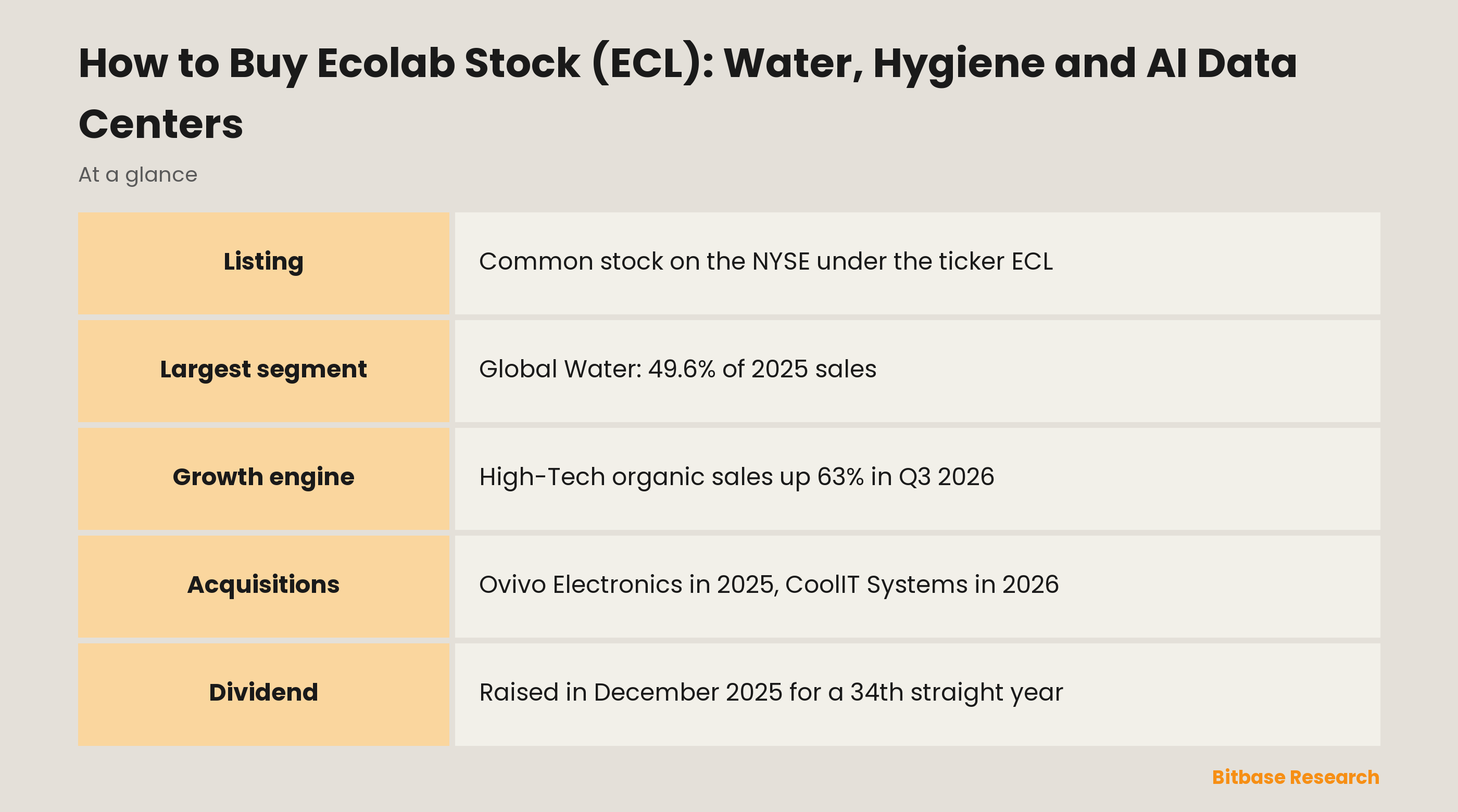
Without a depositary receipt or a second share class to sort out, buying Ecolab comes down to one listing: the common stock trades on the New York Stock Exchange under the ticker ECL, and any broker that offers NYSE shares can take the order. The company sells water treatment, cleaning and sanitizing, pest elimination and contamination control to businesses in more than 170 countries, and its Global Water segment produced 49.6% of 2025 sales. Since December 2025 it has also bought two businesses aimed at chipmaking and AI data centers: Ovivo Electronics and the liquid cooling specialist CoolIT Systems.
What Does Ecolab Do?
Ecolab supplies the chemistry, dosing equipment and on-site service that keep water systems, kitchens, factories and clean rooms running. Its customers are businesses and institutions, not households: refineries, power plants, paper mills, dairies, restaurants, hotels, hospitals and drug makers. The 10-K calls the company "a global leader in water, hygiene and infection prevention solutions and services" and says it helps "protect one-third of the world's food production and a quarter of the power generated."
The company was incorporated in Delaware in 1924 as Economics Laboratory, Inc. and is headquartered in St. Paul, Minnesota. Two deals did much to shape it. On 1 December 2011 it completed its merger with Nalco, a water treatment company based in Naperville, Illinois, and Nalco remains a trademark the 10-K calls material. On 1 December 2021 it bought Purolite, a maker of ion exchange resins used to separate and purify solutions in pharmaceutical and industrial work.
The business is reported in four segments:
Global Water sells water treatment and process chemistry to refineries, power plants, mines, factories and paper mills, plus cleaning and sanitizing for dairies, breweries and food processors. Since January 2026 it has five operating segments: Heavy Water, Light Water, High-Tech, Food & Beverage and Paper. High-Tech is the unit serving semiconductor plants and data centers.
Global Institutional & Specialty sells detergents and sanitizers for commercial dishwashing (warewashing), laundry and housekeeping, plus infection prevention for hospitals and long-term care centers. Its Specialty side serves quick-service restaurant chains and food retailers.
Global Pest Elimination detects, prevents and eliminates rodents and insects in restaurants, food plants, hotels and grocery stores. It is the only segment whose revenue is booked entirely as service.
Global Life Sciences supplies cleaning and contamination control to pharmaceutical and personal care manufacturers, along with Purolite resins and Bioquell decontamination systems that use hydrogen peroxide vapor.
At the end of 2025 Ecolab employed about 48,000 people, more than 25,000 of them in sales and service. Christophe Beck is chairman and chief executive, and since April 2026 he has also been president.
How Ecolab Makes Money
Most revenue comes from products that customers use up and reorder, backed by visits from Ecolab's field staff. In 2025 product and sold-equipment sales made up 78.5% of the total and service and lease sales 21.5%. By segment:
| Segment | Operating segments in 2026 | Typical customers | Share of 2025 sales | Organic sales growth in 2025 |
|---|---|---|---|---|
| Global Water | Heavy Water, Light Water, High-Tech, Food & Beverage, Paper | Refineries, power plants, chip plants, data centers, food processors, paper mills | 49.6% | 2% |
| Global Institutional & Specialty | Institutional, Specialty | Restaurants, hotels, hospitals, quick-service chains, food retailers | 38.0% | 3% |
| Global Pest Elimination | Pest Elimination | Restaurants, food plants, hotels, grocery stores | 7.8% | 6% |
| Global Life Sciences | Life Sciences | Pharmaceutical and personal care manufacturers | 4.7% | 5% |
Shares are calculated from 2025 segment sales at actual exchange rates and rounded. Organic growth, which leaves out acquisitions, divestitures and currency, is as reported in the 10-K.
Growth in 2025 leaned on price more than volume. Organic sales rose 3%, with pricing contributing 2% and volume 1%, and the gross margin widened to 44.5% from 43.5%, which the company attributes to "strong value pricing." Warewashing products alone were about 13% of company sales, yet no customer or distributor reached 10% of revenue in any of the last three years.
The year was uneven inside the segments. Light & Heavy, split up in 2026, grew 2% organically: global high-tech posted double-digit growth "driven by data centers and microelectronics" while basic industries declined. Food & Beverage grew 4%, and Paper slipped as mills ran at lower rates. Reported sales in Institutional & Specialty were flat because the global surgical solutions business, sold on 1 August 2024, dropped out of the comparison.
Profitability also differs. At the fixed exchange rates management uses internally, 2025 operating income was 22.8% of sales in Institutional & Specialty, 19.4% in Pest Elimination, 17.1% in Life Sciences and 16.5% in Global Water. About 47% of 2025 sales came from customers outside the United States, and the 10-K says international operations are generally less profitable than the US business.
ECL Stock at a Glance
| Item | Detail |
|---|---|
| Exchange | New York Stock Exchange (NYSE); also traded on an unlisted basis on other US exchanges |
| Ticker | ECL |
| Security | Common stock; one class registered under Section 12(b) |
| Sector | Industrial and institutional water treatment, hygiene and pest elimination |
| Index membership | S&P 500 |
| Headquarters | St. Paul, Minnesota |
| Incorporated | Delaware, 1924, originally as Economics Laboratory, Inc. |
| Fiscal year | Calendar year; international subsidiaries are consolidated on years ending 30 November |
| Dividend policy | Quarterly cash dividend, raised in December 2025 for the 34th consecutive year |
| SEC identifier | CIK 31462 |
| CUSIP | 278865100 |
This guide leaves out the share price, market value and yield because they change by the minute; for live figures, open the Ecolab quote page on Bitbase.
How to Buy Ecolab Stock
Because Ecolab is both incorporated and listed in the United States, the NYSE line is the share itself. A typical purchase runs like this:
1. Open an account with a broker that trades NYSE stocks. Investors abroad can use a domestic firm that reaches US exchanges or an international broker; confirm the legal entity that will hold the shares and the regulator responsible for it.
2. Declare your tax status. Non-US individuals usually file IRS Form W-8BEN; the IRS instructs a foreign beneficial owner to hand the form "to the withholding agent or payer," which here is the broker.
3. Deposit funds. If your money is not in dollars, the conversion carries a spread on top of any commission, and both are worth comparing.
4. Look up the ticker. Typing ECL should bring up Ecolab Inc. common stock on the NYSE; check the name before continuing.
5. Set the order. A market order, says FINRA, "provides the most certainty that your order will be executed," while with a limit order "you're guaranteed to get your limit price or a better price if your order is executed," though it may never fill.
6. Choose whole or fractional shares. Some brokers sell slices of a share for a fixed sum of cash; FINRA cautions that "you often can't trade fractional shares outside of regular market hours."
7. Keep the records. The trade confirmation fixes your purchase cost, and periodic statements log dividends and tax withheld.
If your broker accepts pre-market or after-hours orders, prices in those sessions can stray from the main session, so first learn how pre-market and after-hours quotes differ.
Tax for investors abroad. Dividends paid to a foreign person face US withholding: the IRS sets a 30% rate on most US-source income of that kind, and a tax treaty between the United States and your country can cut or waive it. The W-8BEN is what lets the broker apply the treaty rate, and your own country may still tax the dividend.
Owning it through a fund. S&P 500 index funds hold Ecolab as one position among hundreds; the SPY holdings file State Street published for 29 October 2026 includes it.
What Moves ECL Stock
Pricing against chemical costs. Ecolab buys more than 10,000 raw materials, mostly inorganic and organic chemicals, and the largest single one is about five percent of purchases. Results turn on whether prices keep pace with input costs. In 2025 pricing added 2% to sales and lifted the gross margin; in the third quarter of 2026 it added 5%, which the company said offset "rising commodity costs."
Chip plants and data centers. High-Tech, which the chief executive calls the company's "largest growth engine," sells water and cooling programs to semiconductor fabs and data centers. Its organic sales rose 63% in the third quarter of 2026 and 40% over the first nine months. Two acquisitions enlarged it: Ovivo Electronics, bought on 16 December 2025, provides "ultrapure water technologies for semiconductor manufacturing," and CoolIT Systems, completed on 2 July 2026, is "a pure-play data center liquid cooling company" making coolant distribution units, cold plates and direct-to-chip systems. Demand here follows the building plans of the chipmakers and data center operators that also drive the listed suppliers of AI infrastructure.
Industrial and hospitality demand. The rest of the portfolio moves with factory output and restaurant traffic. In the third quarter of 2026 the company said Heavy Water and Paper "both returned to solid growth," and Food & Beverage grew 8%. Specialty, by the 10-K's own account, "remains largely dependent upon a limited number of major QSR chains and franchisees and large food retail customers." Weather counts too: the 10-K cites the February 2021 freeze in Texas and along the Gulf Coast, a region that supplies raw materials and buys from the old Light & Heavy unit.
Debt and integration. Paying cash for CoolIT, funded largely with notes issued in May 2026, raised total debt by about 60% between the end of 2025 and the end of September 2026, and third-quarter interest expense rose with it. The 10-K says Ecolab remains committed to "A" range rating metrics over the long term. Meanwhile One Ecolab, a program announced in July 2024 and expanded in February 2026, is moving functional work from many countries into global centers of excellence.
Currency. With about 47% of sales from outside the United States, a stronger dollar shrinks reported figures. Ecolab measures segments at fixed exchange rates that management resets each year, so segment growth in its filings can differ from the change in reported dollars.
The Downside of Holding ECL
Item 1A of the 10-K groups its risks under economic, strategic, legal and financial headings. The ones most relevant to an ECL holder:
End markets. "Our results depend upon the continued vitality of the markets we serve." Foodservice, hospitality, refining, paper and mining are among those named.
Raw materials. "Our results could be materially and adversely affected by difficulties in securing the supply of certain raw materials or by fluctuations in the cost of raw materials."
Acquisitions. "If we are unsuccessful in integrating acquisitions our business could be materially and adversely affected." Goodwill from the Nalco, Purolite and Ovivo Electronics deals could be written down if those businesses underperform, and CoolIT has since added more.
Chemical handling. "A chemical spill or release could materially and adversely impact our business." Many of its disinfecting products count as pesticides under US law, with several hundred registrations at the Environmental Protection Agency.
The ChampionX legacy. "Potential indemnification liabilities pursuant to the separation and split-off of our Upstream Energy business could materially and adversely affect our business and financial statements." A related factor covers the chance that the 2020 split-off is found taxable; Ecolab relied on outside tax counsel and did not seek an IRS ruling.
Debt. "Our indebtedness may limit our operations and our use of our cash flow." The 10-K predates the CoolIT notes, so check the latest 10-Q for the current balance.
Owning a single stock adds risks of its own. Your result depends on a single business, dividends are paid only when the board declares them, and an investor who lives in another currency gains or loses on the dollar as well as on the stock.
How to Research ECL Yourself
Ecolab's SEC filer number (CIK) is 31462. Its reports follow a steady calendar: a 10-K each February, 10-Qs for the first three quarters and 8-Ks for events such as earnings, acquisitions and leadership changes. The same documents are posted at investor.ecolab.com.
Inside the 10-K, segment and customer detail sits in Item 1, the risk factors in Item 1A and the dividend record and buyback authorization in Item 5, while the revenue note breaks sales down by segment and region. Three habits help when comparing years:
1. Check the segment layout. Global Industrial became Global Water in 2025, healthcare moved into Institutional and Life Sciences became its own segment; in 2026 Light & Heavy was split into Heavy Water, Light Water and High-Tech. Each filing recasts prior periods.
2. Check the currency basis. Segment tables use management's fixed rates; consolidated totals use actual rates.
3. Separate organic growth from deals. In the third quarter of 2026 reported sales rose 13% but organic sales 7%, the gap coming mostly from Ovivo Electronics and CoolIT.
To compare Ecolab with other listed companies, open Bitbase's US stock directory.
Ecolab Stock FAQ
Does Ecolab pay a dividend?
Yes, every quarter. In December 2025 the board raised the quarterly dividend by 12%, the 34th consecutive annual increase, and the company has paid cash dividends for 89 consecutive years. Dividends declared per share in the third quarter of 2026 were 12.3% higher than a year earlier. The board decides each payment.
Can I buy Ecolab stock with crypto?
Not directly. Brokers take dollars for ECL, not crypto, so you would first sell the crypto, which can be a taxable event depending on your country, and then move the proceeds into your brokerage account. This guide to buying stocks with crypto explains that two-step route. The outcome is ordinary Ecolab common stock, with the usual dividend and voting rights.
Is ECL in the S&P 500?
Yes. State Street's SPY holdings file dated 29 October 2026 lists Ecolab Inc. under the ticker ECL. Its weight in the index moves every trading day.
What happened to Ecolab's energy business?
Ecolab separated its Upstream Energy business and split it off on 3 June 2020 through a merger and an exchange offer involving Apergy Corporation, since renamed ChampionX. Stockholders who took part in the exchange offer gave up Ecolab shares for ChampionX shares. The two companies still have indemnity agreements, and Ecolab still supplies ChampionX with certain products.
Why did Ecolab buy CoolIT Systems?
To sell cooling hardware as well as water treatment to AI data centers. Announcing the deal on 20 March 2026, Ecolab said that pairing CoolIT's liquid cooling systems with its water, chemistry and monitoring services would create "an end-to-end fluid management and cooling platform for AI data centers." The cash purchase from funds managed by KKR closed on 2 July 2026.
Conclusion
Mechanically, an ECL purchase is the same as for any NYSE stock: an account that reaches the exchange, a glance at the company name and an order at market or at a limit. What the share holds is less uniform: a large base of water, cleaning and pest programs that grows through pricing and new accounts, and a High-Tech arm, enlarged by two debt-funded acquisitions, that depends on chip and data center spending. Read the latest 10-K, the third-quarter 2026 10-Q and the CoolIT filings before deciding how much of one industrial services stock belongs in your portfolio.
Related reading
Other Bitbase articles on this topic:
- How to Buy Agnico Eagle Stock (AEM): Unhedged Gold, NYSE and TSX
- How to Buy Air Products Stock (APD): Hydrogen Exits and NEOM
- How to Buy Barrick Stock (B): Formerly GOLD, ABX on the TSX
- How to Buy Wheaton Precious Metals Stock (WPM): Streams, Not Mines
Disclaimer: This article is educational content from Bitbase Academy, provided for information only. It explains what a company or fund does and how the instruments referenced here differ from one another; it does not constitute investment, trading, tax, or financial advice, and it is neither a recommendation nor an endorsement of any security, token, or trading strategy. A tokenized stock is issued by a third party and is designed to give economic exposure to an underlying asset: it is not a share, it carries no shareholder rights, and it depends on the issuer's structure, eligibility rules, and redemption terms, which the issuer can change. Perpetual futures are leveraged derivatives that hold no underlying asset and can be liquidated, and trading hours, product availability, and eligibility differ by instrument and by jurisdiction and can change at any time. Written as of October 2026; verify everything yourself through company filings, the issuer's own documentation, and the product pages of the venue you trade on.
References
[1] Ecolab Form 10-K for fiscal 2025 (SEC EDGAR) www.sec.gov
[2] Ecolab Form 10-Q for the quarter ended 30 September 2026 (SEC EDGAR) www.sec.gov
[3] Ecolab news release, 27 October 2026: third-quarter results (SEC EDGAR) www.sec.gov
[4] Ecolab news release, 20 March 2026: agreement to acquire CoolIT Systems (SEC EDGAR) www.sec.gov
[5] Ecolab Form 8-K, February 2026: new president and co-chief operating officers (SEC EDGAR) www.sec.gov
[6] Ecolab Form 10-K for fiscal 2011: merger with Nalco (SEC EDGAR) www.sec.gov
[7] Ecolab Form 10-K for fiscal 2021: Purolite acquisition (SEC EDGAR) www.sec.gov
[8] Ecolab Restated Certificate of Incorporation, filed in 2006 (SEC EDGAR) www.sec.gov
[9] State Street: SPY daily holdings, 29 October 2026 www.ssga.com
[10] FINRA: Order Types www.finra.org
[11] FINRA: Investing in Fractional Shares www.finra.org
[12] IRS: NRA Withholding www.irs.gov
[13] IRS: About Form W-8 BEN www.irs.gov





