
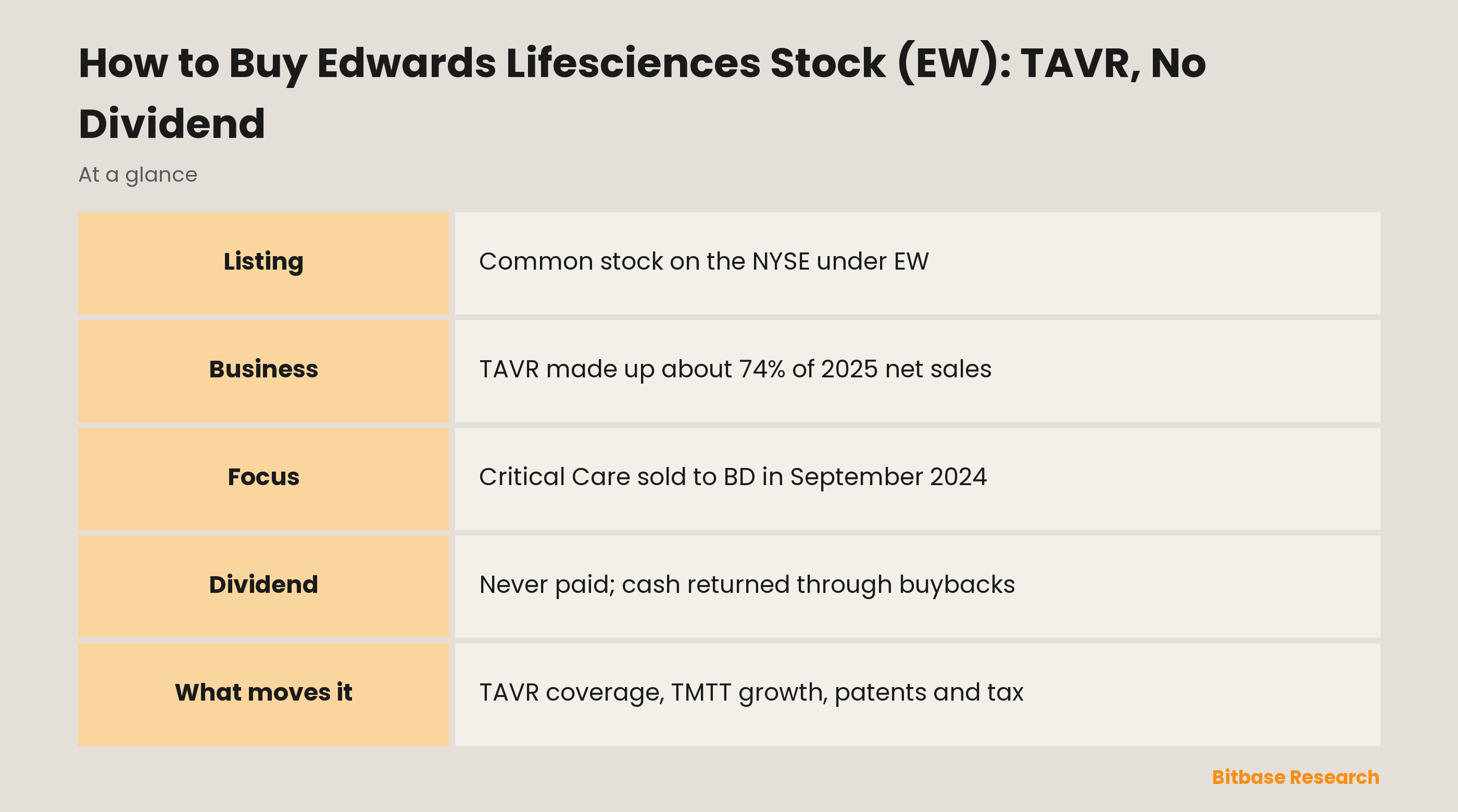
Among the heart-valve companies listed in New York, Edwards Lifesciences trades under the ticker EW, and an order for its common stock can go through any brokerage account that reaches the New York Stock Exchange. The business leans on one therapy: transcatheter aortic valve replacement (TAVR) brought in about 74% of 2025 net sales, and the company pays no dividend and never has. Below: where the revenue comes from, the steps for buying and the risks its filings stress.
What Does Edwards Lifesciences Do?
Edwards Lifesciences makes devices that repair or replace diseased heart valves. Its annual report calls it "the leading global structural heart innovation company," and its products cover both sides of a treatment decision: a surgeon can remove a faulty valve and implant an Edwards tissue valve, or a cardiologist can deliver an Edwards valve or repair system by catheter, a procedure that "can be done while the heart continues to beat."
The 10-K groups the products into three families.
Transcatheter Aortic Valve Replacement (TAVR). The SAPIEN family treats severe aortic stenosis, a narrowing of the valve through which blood leaves the heart, without traditional open-heart surgery. Edwards first sold these valves in Europe in 2007, the United States in 2011 and Japan in 2013, and in 2025 the FDA approved SAPIEN 3 for severe aortic stenosis patients without symptoms.
Transcatheter Mitral and Tricuspid Therapies (TMTT). The PASCAL system repairs leaking mitral or tricuspid valves by drawing the leaflets together. EVOQUE replaces the tricuspid valve, and SAPIEN M3, approved in the United States and Europe in 2025, replaces the mitral valve.
Surgical Structural Heart. Tissue valves for open surgery, led by the INSPIRIS RESILIA aortic valve, the MITRIS RESILIA mitral valve and the KONECT RESILIA valved conduit.
The company began as a spin-off. It was incorporated in Delaware on 10 September 1999 as a Baxter International subsidiary to take over Baxter's CardioVascular business, its shares were distributed to Baxter stockholders in a tax-free spin-off effective 31 March 2000, and NYSE trading began on 3 April 2000. The 10-K names Miles "Lowell" Edwards as the founder; headquarters are in Irvine, California.
Since then the focus has tightened. Critical Care, its monitoring product group, went to Becton, Dickinson and Company (BD) in September 2024, and in December 2025 Edwards sold a smaller business "not focused on implantable medical innovations for structural heart disease." Both now count as discontinued operations. Acquisitions reach into neighbouring conditions instead: JC Medical (2024) for aortic regurgitation, Endotronix (2024) for an implantable heart-failure sensor, Innovalve (2024) for mitral replacement and Autus Valve Technologies (2026) for a pediatric pulmonary valve.
Products are made mainly in the United States, Singapore, Costa Rica and Ireland. Most replacement valves use animal tissue, and the bovine tissue for its pericardial valves comes only from the United States and Australia.
How Edwards Lifesciences Makes Money
Edwards sells to hospitals and other providers, nearly all of which are reimbursed by government programs, private insurers or managed care plans. In the United States it sells "substantially all" of its products through its own sales forces; elsewhere it adds independent distributors, and in all it sells in approximately 100 countries. No single customer accounted for 10% or more of 2025 net sales. Field clinical specialists attend procedures to guide physicians, so clinical support is part of what the company sells.
The three product groups are moving at different speeds:
| Product group | Main products | 2023 share | 2024 share | 2025 share | 2025 growth |
|---|---|---|---|---|---|
| TAVR | SAPIEN family | 77% | 75% | 74% | 9.3% |
| TMTT | PASCAL, EVOQUE, SAPIEN M3 | 4% | 7% | 9% | 56.4% |
| Surgical | INSPIRIS, MITRIS, KONECT RESILIA | 19% | 18% | 17% | 4.9% |
Shares of net sales are as stated in the 10-K, and growth comes from its product group table; total net sales rose 11.5% in 2025. TAVR remains the core, but its share fell three points in two years as TMTT grew from a small base. The 10-K credits TAVR's 2025 gain mainly to the SAPIEN 3 Ultra RESILIA valve and TMTT's to PASCAL and EVOQUE.
The four reporting segments are regions, not products:
| Segment | Share of 2025 net sales | 2025 growth |
|---|---|---|
| United States | 58.4% | 10.5% |
| Europe | 25.0% | 14.8% |
| Japan | 5.8% | 4.4% |
| Rest of World | 10.8% | 14.0% |
Shares are computed from 2025 segment net sales to one decimal place; growth rates are as reported. R&D spending equalled about 18% of 2025 sales, much of it spent on clinical trials whose data support regulatory submissions and the case made to payers.
EW Stock at a Glance
| Field | EW |
|---|---|
| Listing venue | New York Stock Exchange (NYSE) |
| Symbol | EW |
| Share class | Common stock; the 10-K cover registers no other security |
| Sector | Medical technology: structural heart devices |
| Index membership | S&P 500; also held by the Health Care Select Sector SPDR Fund (XLV) |
| Headquarters | Irvine, California |
| Incorporated | Delaware, 1999 |
| Listed | April 2000, after the spin-off from Baxter International |
| Financial year | Ends 31 December |
| Dividend policy | No cash dividend ever paid, and none currently planned |
| Buybacks | Board-authorized repurchase program with no expiration date |
| Stock splits | Two-for-one in 2010 and 2015, three-for-one in 2020 |
| EDGAR number | CIK 1099800 |
Live quotes, market value and trading volume are left out because they change constantly; the Edwards Lifesciences stock page on Bitbase shows them.
How to Buy Edwards Lifesciences Stock
Edwards has one listing and one class of common stock, and as a US company it issues no depositary receipts, so buying it is a standard brokerage trade:
1. Find a broker with NYSE access. Investors outside the US can use a domestic firm that routes orders to US exchanges or an international broker; confirm the legal entity that would hold your assets and its regulator.
2. Complete the account checks. Non-US individuals generally document their foreign status on IRS Form W-8BEN.
3. Add money. Currency conversion carries its own spread, so look at the conversion rate as well as the commission.
4. Locate EW. Confirm the listing shows Edwards Lifesciences Corporation common stock, NYSE.
5. Set the order type. According to FINRA, a market order "provides the most certainty that your order will be executed," though "you might not get the price you saw or were originally quoted." A limit order buys "at or better than a specified price," but "there's a chance your order doesn't get executed at all."
6. Decide how much. Fractional shares make a fixed cash amount possible, but some brokers "don't offer fractional share trading at all," and a fractional owner "might not have shareholder voting rights."
7. Save the confirmations. They and your statements show what you paid.
If your broker offers trading outside the main session, regular-session and extended-hours prices can drift apart, and a limit order guards against paying far more than intended in a thin market.
Tax for non-US holders. Under IRS rules, most US-source income paid to a foreign person faces 30% withholding, which a tax treaty can lower. Edwards pays no cash dividend, so there is currently no dividend for that withholding to apply to; how a gain is taxed depends on where you live.
Through a fund. SPY, State Street's S&P 500 fund, and XLV, its health care sector fund, both hold EW among their many positions.
What Moves EW Stock
TAVR evidence and indications. With about three-quarters of sales in one group, the size of the treated aortic stenosis population matters most. In 2024 the EARLY TAVR trial showed early intervention with SAPIEN 3 was superior to clinical surveillance in severe aortic stenosis without symptoms, and the FDA approval for that group followed in 2025.
Medicare coverage. The 10-K lists "restrictive requirements in the U.S. national coverage determination for transcatheter aortic valve replacement procedures" among the factors that can limit sales. On 10 September 2026 the Centers for Medicare & Medicaid Services issued an updated determination that ended the Coverage with Evidence Development requirement for TAVR in symptomatic severe aortic stenosis and extended coverage, under that requirement and with conditions, to asymptomatic patients. US procedure volumes are where its effect would show.
Hospital capacity. Edwards reports "constrained procedure volumes and sales for our products because more products, including Edwards' own products, are competing for the same facilities and staffing within hospitals." TAVR, mitral and tricuspid procedures compete for the same catheterization labs.
The TMTT ramp. TMTT sales grew 56.4% in 2025, lifting the group from 4% to 9% of sales in two years. How long PASCAL, EVOQUE and SAPIEN M3 keep that pace decides how quickly Edwards depends less on TAVR.
Aortic regurgitation after JenaValve. In July 2024 Edwards agreed to buy JenaValve Technology, which develops a transcatheter treatment for a leaking aortic valve. The Federal Trade Commission moved to block the deal on 6 August 2025; on 9 January 2026 a federal court in Washington, DC granted the FTC's injunction, and the merger agreement was terminated on 14 January 2026. Edwards now pursues the condition with its own SOJOURN valve and the JOURNEY pivotal trial.
Competition and patents. The 10-K names Medtronic and Abbott as primary competitors in TAVR and surgical valves, and Abbott in TMTT. In April 2023 Edwards and Medtronic agreed a 15-year global covenant not to sue over certain structural heart patents, under which Edwards pays annual royalties tied to net sales of certain products.
Currency. In 2025, 42% of net sales were earned abroad, so a weaker dollar against the euro or yen raises reported sales and a stronger one lowers them.
How One Valve Family Shapes the Risk in EW
From the risk factors in the 10-K, these weigh most on an EW share:
Concentration. When one product group supplies about three-quarters of revenue, any setback for the SAPIEN family, from a rival valve to a quality problem, reaches most of the business.
Competition. "We operate in highly competitive markets, and if we do not compete effectively, our business will be harmed."
Reimbursement. If payers decline to reimburse customers or cut reimbursement levels, the company warns, "our ability to profitably sell our products will be harmed."
Patent claims. Third parties may claim infringement, and Edwards "could suffer significant litigation or licensing expenses or be prevented from selling products." In January 2026 Cardiovalve and MTH IP sued over PASCAL, seeking damages and a permanent injunction; trial is scheduled for November 2028.
Tax. The IRS has issued a notice of deficiency for 2015 to 2017 over transfer pricing on royalty transactions between Edwards' US and Swiss subsidiaries. The company plans to contest it in court, and its latest quarterly report says similar disputes may arise for 2018 through 2026.
Trade. The 10-K cites a US Commerce Department investigation under Section 232 into imports of medical equipment, including devices, as a source of tariff uncertainty; three of its four main manufacturing countries are outside the United States.
Then there is the stock itself. A single stock ties your money to one company, and with no dividend the whole return rests on the share price. Holders outside the United States also carry currency risk, since EW is priced in dollars.
How to Research EW Yourself
Edwards' EDGAR number is CIK 1099800, and its filings follow the usual pattern: the 10-K annually, 10-Qs quarterly and 8-Ks for events such as results releases and the January 2026 JenaValve announcement. Within the 10-K, the business section (Item 1) describes the product groups, Item 1A the risks, the MD&A tables give sales by product group and region, and the contingencies and income tax notes track the lawsuits and the IRS case.
Two checks prevent mistakes. Annual reports for 2023 and earlier include Critical Care in their sales, while the current 10-K restates those years without it, so old and new figures do not line up. And per-share history needs adjusting for splits: one share from the April 2000 listing became 12 after the 2010, 2015 and 2020 splits.
CMS keeps the TAVR coverage determination and decision memos on its coverage website. The 10-K's performance graph sets EW against two benchmarks, the S&P 500 Index and the S&P 500 Health Care Equipment Index. Live prices sit on the stock page linked above, and the list of US stock pages on Bitbase covers other companies.
Edwards Lifesciences Stock FAQ
Does Edwards Lifesciences pay a dividend?
No. The 10-K says the company has "never paid any cash dividends" on its capital stock and has "no current plans" to start; it returns cash through buybacks instead.
Can I buy Edwards Lifesciences stock with crypto?
Not directly. The shares trade on the NYSE in US dollars through brokerage accounts, so you would first convert crypto to cash, a sale that may be taxable where you live, and then fund the broker. Owning EW means holding a registered stake in the company, which is how a stock differs from a crypto asset.
Is EW in the S&P 500?
Yes. On 29 October 2026 the holdings list State Street publishes for SPY, an S&P 500 fund, included EW, and so did its list for XLV. Weights change daily.
Has Edwards Lifesciences stock ever split?
Yes: two-for-one in May 2010 and December 2015, and three-for-one in May 2020, which the company called its third split "since it went public in April 2000."
Why did Edwards Lifesciences sell Critical Care?
To concentrate on structural heart disease. Edwards had planned a spin-off, then agreed on 3 June 2024 to sell the unit to BD; chief executive Bernard Zovighian said the company was "laser focused on pursuing a strategy centered on structural heart disease." The sale closed on 3 September 2024.
Conclusion
Placing an EW order is routine: open an account that reaches the NYSE, select the EW common stock and choose a market or limit order. Knowing what the share represents takes more reading. It is a structural heart business built mostly on one valve family, with no dividend and a mitral and tricuspid line that made up 9% of 2025 sales. Read the latest 10-K and 10-Q, including the coverage, patent and tax items, before deciding how much one heart-valve company should weigh in a portfolio.
Related reading
Other Bitbase articles on this topic:
- How to Buy Becton Dickinson Stock (BDX): Waters Deal and Dividend
- How to Buy Boston Scientific Stock (BSX): Farapulse and Watchman
- How to Buy Cardinal Health Stock (CAH): CVS, Generics, Opioids
- How to Buy Stryker Stock (SYK): Mako, Inari and the Dividend
Disclaimer: This article is educational content from Bitbase Academy, provided for information only. It explains what a company or fund does and how the instruments referenced here differ from one another; it does not constitute investment, trading, tax, or financial advice, and it is neither a recommendation nor an endorsement of any security, token, or trading strategy. A tokenized stock is issued by a third party and is designed to give economic exposure to an underlying asset: it is not a share, it carries no shareholder rights, and it depends on the issuer's structure, eligibility rules, and redemption terms, which the issuer can change. Perpetual futures are leveraged derivatives that hold no underlying asset and can be liquidated, and trading hours, product availability, and eligibility differ by instrument and by jurisdiction and can change at any time. Written as of October 2026; verify everything yourself through company filings, the issuer's own documentation, and the product pages of the venue you trade on.
References
[1] Edwards Lifesciences Form 10-K, fiscal 2025 (SEC EDGAR) www.sec.gov
[2] Edwards Lifesciences Form 10-Q for the quarter ended 30 June 2026 (SEC EDGAR) www.sec.gov
[3] Edwards Lifesciences Form 10-K, fiscal 2023, before the Critical Care sale (SEC EDGAR) www.sec.gov
[4] Edwards Lifesciences Form 10-K, fiscal 2000: spin-off from Baxter and NYSE listing (SEC EDGAR) www.sec.gov
[5] Edwards Lifesciences press release, 19 November 2015: two-for-one stock split (Form 8-K) www.sec.gov
[6] Edwards Lifesciences press release, 7 May 2020: three-for-one stock split (Form 8-K) www.sec.gov
[7] Edwards Lifesciences press release, 3 June 2024: agreement to sell Critical Care to BD (Form 8-K) www.sec.gov
[8] Edwards Lifesciences press release, 9 January 2026: court blocks the JenaValve acquisition (Form 8-K) www.sec.gov
[9] CMS, Transcatheter Aortic Valve Replacement coverage page (NCD updated 10 September 2026) www.cms.gov
[10] State Street, SPY daily holdings, 29 October 2026 www.ssga.com
[11] State Street, XLV daily holdings, 29 October 2026 www.ssga.com
[12] FINRA, Order Types www.finra.org
[13] FINRA, Investing in Fractional Shares www.finra.org
[14] IRS, NRA Withholding www.irs.gov





