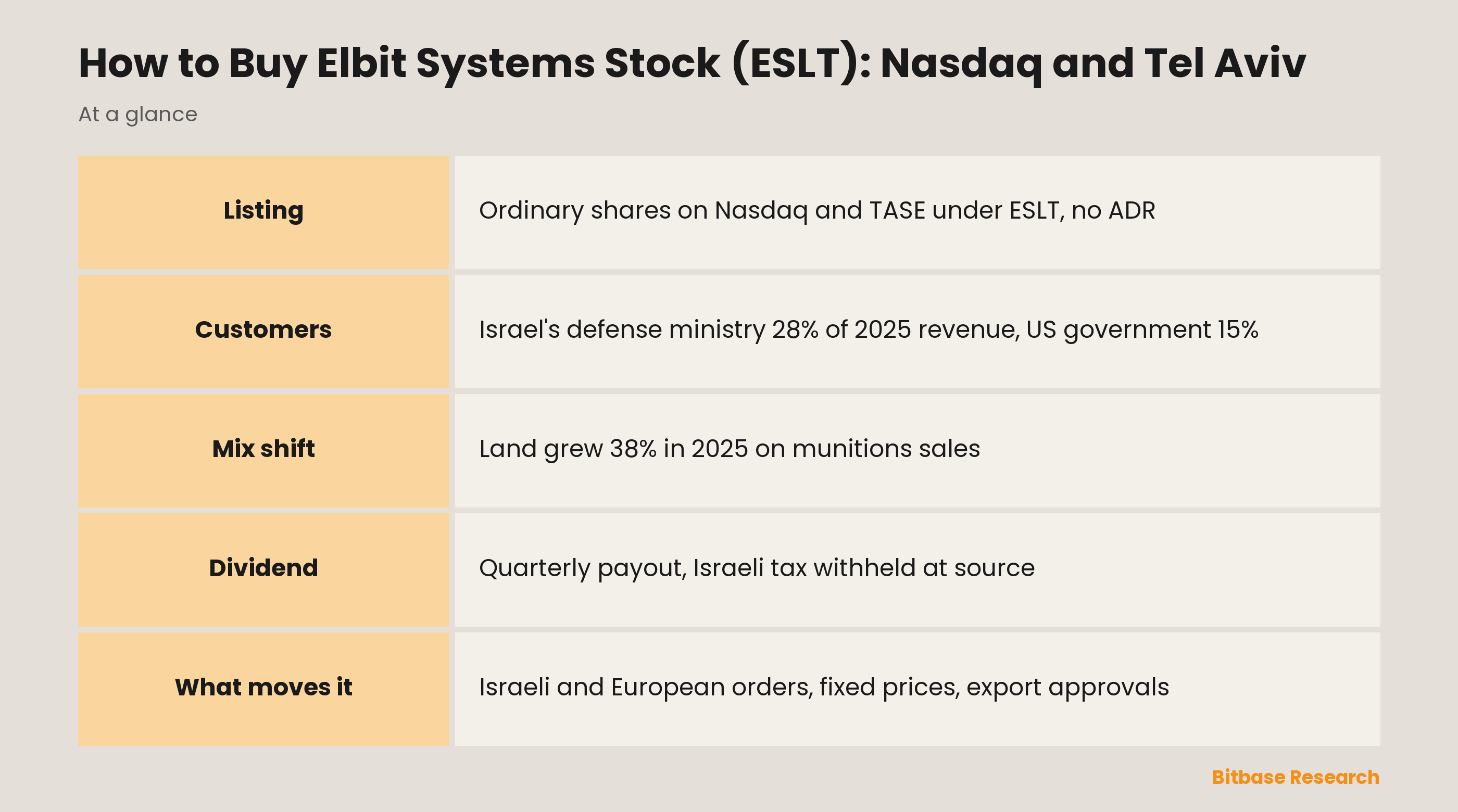
Two exchanges list the same Elbit Systems ordinary shares under the symbol ESLT, Nasdaq in the United States and the Tel Aviv Stock Exchange, so an order can go through any broker that reaches either market, with no depositary receipt in between. The business behind the share has turned toward its home market: Israel's Ministry of Defense accounted for 16% of revenue in 2023 and 28% in 2025, even though 72% of the order backlog at the end of 2025 was for customers outside Israel. This guide covers the five segments, the order itself, Israeli tax on dividends and the risks the company sets out in its annual report on Form 20-F.
What Does Elbit Systems Do?
The 20-F describes Elbit Systems as "an international high technology company engaged in a wide range of programs throughout the world, primarily in the defense and homeland security arenas." It develops airborne, land and naval systems, fits them to new platforms, upgrades platforms already in service, and sells training and support around them.
The company is incorporated in Israel and headquartered in Haifa. Its predecessor, Elbit Ltd., was incorporated in 1966 as Elbit Computers Ltd.; Elbit Systems was formed in 1996, when Elbit Ltd. was demerged and its defense-related assets and business were spun off into the new company. The August 2026 results release puts the workforce at more than 21,000 people.
Elbit reports five segments, four defined by what they sell and one by geography:
Aerospace covers unmanned aircraft systems, helmet-mounted displays and avionics, sensors for precision-guided munitions, aerostructures, simulators and flight academies, plus avionics for civil aircraft.
C4I and Cyber sells command-and-control and intelligence systems, tactical radios and data links, cyber tools, and robotic and autonomous systems.
ISTAR and EW (intelligence, surveillance, target acquisition and reconnaissance, with electronic warfare) builds electro-optic and laser systems, aircraft self-protection suites, signals-intelligence equipment and radars. The high-power laser work sits here: the Israel Ministry of Defense (IMOD) awarded a contract in 2024 to supply laser systems for the "Iron Beam" air defense system, and the first one was delivered in 2025.
Land supplies turrets and systems for armored vehicles, howitzers and rocket launchers, the Iron Fist active protection system, and munitions and ammunition. It took in the activities of IMI Systems, acquired in 2018.
ESA is Elbit Systems of America, headquartered in Fort Worth, Texas. Most of its revenue comes from the US government, its allies and large US prime contractors. Because a non-US company owns it, ESA works under a Special Security Agreement with the US Department of War, formerly the Department of Defense, which lets it take part in classified programs.
How Elbit Systems Makes Money
Sales go "primarily to governmental entities and prime contractors under government defense and homeland security programs," so revenue "is subject to governmental budgetary constraints." Revenue rose 16.3% in 2025, and the mix moved toward Land:
| Segment | Share of 2025 revenue | Share of 2024 revenue | 2025 growth | 2025 operating margin |
|---|---|---|---|---|
| Aerospace | 22.9% | 26.1% | 2% | 7.4% |
| C4I and Cyber | 10.9% | 11.0% | 16% | 6.0% |
| ISTAR and EW | 16.7% | 16.4% | 16% | 8.5% |
| Land | 28.3% | 23.5% | 38% | 11.4% |
| ESA | 21.1% | 23.0% | 7% | 7.2% |
Revenue shares count sales to outside customers; growth and margins use each segment's total revenue, including sales to other segments, as the 20-F reports them.
Land grew "mainly due to the increase in sales of ammunition and munitions in Israel and Europe" and earned about 36% of the five segments' combined operating income. ESA's margin roughly doubled from 3.5% on new night-vision and maritime contracts. For the group, operating income reached 8.5% of revenue, up from 7.2%, and net income attributable to shareholders 6.7%, up from 4.7%.
The segment note names two large customers. The IMOD provided 28% of 2025 revenue, after 25% in 2024 and 16% in 2023; the US government provided 15%, after 15% and 17%. By end-customer location:
| Region | Share of 2025 revenue | Share of 2023 revenue |
|---|---|---|
| Israel | 32% | 19% |
| Europe | 27% | 30% |
| North America | 21% | 24% |
| Asia-Pacific | 16% | 21% |
| Latin America | 1% | 2% |
| Other | 3% | 4% |
Exports are still the larger part: about 68% of 2025 revenue came from exports subject to Israeli export regulations. The backlog grew 24% during 2025; 72% of it was for orders outside Israel (65% a year earlier), and about 54% was scheduled for 2026 and 2027. The company adds that backlog "may not necessarily represent an indication of future sales."
ESLT Stock at a Glance
| Feature | ESLT |
|---|---|
| Exchanges | Nasdaq Global Select Market and Tel Aviv Stock Exchange (TASE) |
| Ticker | ESLT on both exchanges |
| Security | Ordinary shares, nominal value NIS 1.0 each, the only class registered under Section 12(b) |
| Depositary receipt | None: the ordinary shares are listed directly |
| Annual report | Form 20-F as a foreign private issuer, with US GAAP financial statements |
| Sector | Defense electronics, munitions and homeland security systems |
| Headquarters | Haifa, Israel |
| Largest shareholder | Federmann Enterprises, about 41.5% directly and indirectly (5 March 2026) |
| Fiscal year | Calendar year, ending 31 December |
| Payouts | Quarterly cash dividend, with no established dividend policy |
| Index membership | Not in the Nasdaq-100: absent from Invesco's QQQ holdings data on 9 November 2026 |
| SEC identifier | CIK 1027664 |
Prices, market value and yield move with every trade; the Elbit Systems stock page on Bitbase carries live figures.
How to Buy Elbit Systems Stock
No depositary bank sits in the chain: one ESLT share in a US brokerage account is one ordinary share of Elbit Systems Ltd. The order takes six steps:
1. Pick a broker. Any firm that sells US-listed shares reaches the Nasdaq line, quoted in US dollars. Some also connect to TASE, where the same shares trade under the same symbol; check where your order is routed.
2. Open and verify the account. Expect identity checks and a tax-residence form, which the broker needs to handle your dividends.
3. Fund it. Converting your currency into dollars has a cost, so compare exchange rates as well as commissions.
4. Find the right line. Search ESLT and confirm the listing reads Elbit Systems Ltd ordinary shares on Nasdaq.
5. Choose the order type. A market order fills at the next available price; a limit order caps the price you pay and may not fill at all.
6. Keep the records. Confirmations show your cost, and dividend statements show the tax withheld before the cash arrived.
Some brokers sell fractions of a share and others only whole shares, so check before sizing the order.
Israeli tax on dividends. Elbit is an Israeli company, so tax on its dividends is withheld in Israel. The 20-F gives a 25% rate for a non-resident who is not a "principal" shareholder, unless a tax treaty lowers it, and says that after an election the company made in 2022, the combined withholding on its dividends for individuals and non-residents is expected to be approximately 17%. The dividend declared in August 2026 was paid after withholding at 16.8%. Your home country may tax the payment again; start with the taxation section of the 20-F and finish with an adviser.
Israeli law, not US corporate law. Shareholder rights come from the articles and Israeli law. Under the Companies Law, the 20-F notes, a shareholder "has a duty to act in good faith and in a customary manner" toward the company and other shareholders, and a controlling shareholder owes a duty of fairness.
Through funds. Elbit was not among the holdings in Invesco's QQQ data on 9 November 2026; a fund's own holdings file is the only reliable check of whether it owns ESLT.
What Moves ESLT Stock
Israeli demand. The 20-F says that "since October 7, 2023, the IMOD's demand for our products and solutions has materially increased." In 2024 the IMOD also announced a "Blue and White" strategy of expanding local production of defense systems and critical components, which the company says has been reflected in several awards to it. In the second quarter of 2026, Land revenue rose 32%, mainly on ammunition and munitions sales in Israel.
European procurement. Governments have announced plans to raise defense spending, and Europe already provides more than a quarter of revenue. Elbit began establishing facilities in Sweden and Germany in 2025, and its August 2026 release said the quarter's increase in backlog "came mainly from Europe." In October 2026 it announced a contract for rockets and launchers for a European customer under a government-to-government agreement with the IMOD.
Turning backlog into sales. Revenue rose about 16% in the second quarter of 2026, with 73% of the backlog for orders outside Israel. A new munitions site at Ramat Beka in southern Israel has started production, which the 20-F expects to "gradually increase during 2026 and thereafter." Output against the order book is the question each quarter.
Project mix. Most contracts carry fixed prices, so a segment can swing on a few programs. In the second quarter of 2026, Aerospace revenue fell 8%, mainly on "a one-time unfavorable project mix" and lower training sales in Europe, while the group operating margin rose to 9.6% from 8.0%.
US policy. The US government provides 15% of revenue, and Israel receives US security assistance under a 2019–2028 memorandum of understanding. The 20-F also flags a 7 January 2026 executive order under which the US Secretary of War could seek to limit the company's dividends or buybacks if its performance on US government contracts is found lacking.
Tax and the shekel. The effective tax rate rose to 16.4% from 5.6% in the second quarter of 2026, mainly because of the OECD Pillar Two global minimum tax. Wages were about 32% of 2025 cost of revenues, and the 20-F names the shekel's moves against the dollar as a trend that could affect labor costs.
Fixed Prices, Export Licenses and a Controlling Holder
These points from the 20-F's risk factors bear most directly on an ESLT share:
Government budgets. "We derive most of our revenues directly or indirectly from government agencies," and funding "could be reduced, delayed or eliminated." If US security assistance to Israel were reduced or discontinued, the company "may receive fewer U.S. funded orders."
Fixed-price contracts. "Most of our contracts are fixed-price contracts, under which we generally assume the risk that increased or unexpected costs may reduce profits or generate a loss."
Export approvals and trade. Sales from Israel need Israeli export licenses, and ESA's exports need US authorizations under ITAR or EAR, which Washington "may deny" if a transaction runs counter to US policy. The 20-F says some countries, companies and organizations "continue to participate in a boycott of Israeli firms," and that "certain foreign government defense export policies have become more stringent towards Israel." It also reports "organized boycotts and divestment efforts" aimed at some subsidiaries abroad.
Operations and supply. The company describes constraints linked to the conflicts in the region, including reserve-duty call-ups, shipping delays and component shortages, and says these effects eased after the ceasefires described in the filing but "could increase again." Some components come from a single source.
Control and Israeli law. Federmann Enterprises owned about 41.5% of the shares and "may have significant influence" over shareholder votes, including the election of directors. Since 2021 the IMOD has worked toward designating Elbit and most of its Israeli subsidiaries as "defense entities," after which government approval would likely be needed to acquire a specified percentage of its shares or voting rights.
Less US-style reporting. As a foreign private issuer, Elbit files no 10-Q or 8-K reports and is exempt from US proxy rules, so "our shareholders may receive less information about our Company."
The share itself. A single stock concentrates your money in one company. The 20-F lists "the perceived value of investing in an Israeli defense company" among the factors that can move the price, and the dividend rests on board decisions rather than a stated policy.
How to Research ESLT Yourself
Elbit's filings sit on SEC EDGAR under CIK 1027664. The annual report is the 20-F; the one for 2025 was filed on 17 March 2026. Everything else arrives as Form 6-K: quarterly results, contract announcements, meeting results and financing notices. On 28 October 2026 the company said it would publish third-quarter 2026 results on 17 November 2026.
In the 20-F, the operating review holds the segment and regional tables, the segment note the IMOD and US government shares, the backlog paragraph the delivery schedule, and the taxation section Israeli withholding on dividends.
Many contract releases do not name the buyer ("a European country," "a country in Asia-Pacific"), so set each against the next backlog figure rather than adding them up. For a US prime contractor that reports on 10-K and 10-Q forms, our Lockheed Martin stock guide is a useful comparison, and the full list of US stock pages on Bitbase covers other companies.
Elbit Systems Stock FAQ
Can I buy Elbit Systems stock with crypto?
Not directly. A brokerage account is the route to ESLT, so any crypto has to be converted into cash and transferred to the broker first, and in many countries that conversion counts as a taxable disposal. What you end up holding is also different: a share is part-ownership of a company, with a vote and a claim on dividends, one of several differences between stocks and crypto.
Is ESLT an ADR?
No. The ordinary shares are listed directly on the Nasdaq Global Select Market and on TASE under the same symbol, and the 20-F cover shows them as the only class registered under Section 12(b). There is no depositary bank, ratio or ADR fee.
Does Elbit Systems pay a dividend?
Yes, quarterly, though the 20-F says the company does "not have an established dividend policy" and the board may approve payments out of surplus earnings. Israeli tax is withheld first; the August 2026 payment carried a 16.8% rate.
Who controls Elbit Systems?
Federmann Enterprises Ltd. held about 41.5% of the ordinary shares directly and indirectly as of 5 March 2026. Michael Federmann, a member of Elbit's board, controls it through entities under his control and so controls the vote of those shares.
Why does Elbit Systems file a 20-F instead of a 10-K?
It is a foreign private issuer under US securities rules, so it files an annual 20-F and reports in between on Form 6-K. The 20-F notes that the SEC published a concept release on 4 June 2025 on possible changes to that definition; losing the status would mean filing on US domestic forms.
Conclusion
Elbit Systems is a defense group whose largest customer is the government of the country where it is based, and whose order book is filling mainly from Europe and other export markets. Those two forces explain most of what its filings discuss: munitions capacity, fixed-price margins, export approvals, Israeli withholding on dividends and a controlling shareholder with about two-fifths of the stock. Buying the share is an ordinary Nasdaq order; judging it means reading the 20-F, each quarterly 6-K and the backlog figure together, and deciding how much one company with this exposure should weigh in your portfolio.
Related reading
Other Bitbase articles on this topic:
- How to Buy AerCap Stock (AER): Jet Leasing and Dividend Tax
- How to Buy Agilent Stock (A): CrossLab, Ticker A and Dividends
- How to Buy Carrier Stock (CARR): HVAC, Viessmann and Data Centers
- How to Buy Parker Hannifin Stock (PH): Dividend Streak, Aerospace
Disclaimer: This article is educational content from Bitbase Academy, provided for information only. It explains what a company or fund does and how the instruments referenced here differ from one another; it does not constitute investment, trading, tax, or financial advice, and it is neither a recommendation nor an endorsement of any security, token, or trading strategy. A tokenized stock is issued by a third party and is designed to give economic exposure to an underlying asset: it is not a share, it carries no shareholder rights, and it depends on the issuer's structure, eligibility rules, and redemption terms, which the issuer can change. Perpetual futures are leveraged derivatives that hold no underlying asset and can be liquidated, and trading hours, product availability, and eligibility differ by instrument and by jurisdiction and can change at any time. Written as of November 2026; verify everything yourself through company filings, the issuer's own documentation, and the product pages of the venue you trade on.
References
[1] Elbit Systems Form 20-F for 2025 (SEC EDGAR) www.sec.gov
[2] Elbit Systems 2025 Form 20-F, XBRL cover page (SEC EDGAR) www.sec.gov
[3] Elbit Systems second-quarter 2026 results, Form 6-K (SEC EDGAR) www.sec.gov
[4] Elbit Systems Form 6-K, 19 October 2026: rockets and launchers for a European customer (SEC EDGAR) www.sec.gov
[5] Elbit Systems Form 6-K, 28 October 2026: date of third-quarter 2026 results (SEC EDGAR) www.sec.gov
[6] Invesco QQQ: fund overview and holdings www.invesco.com





