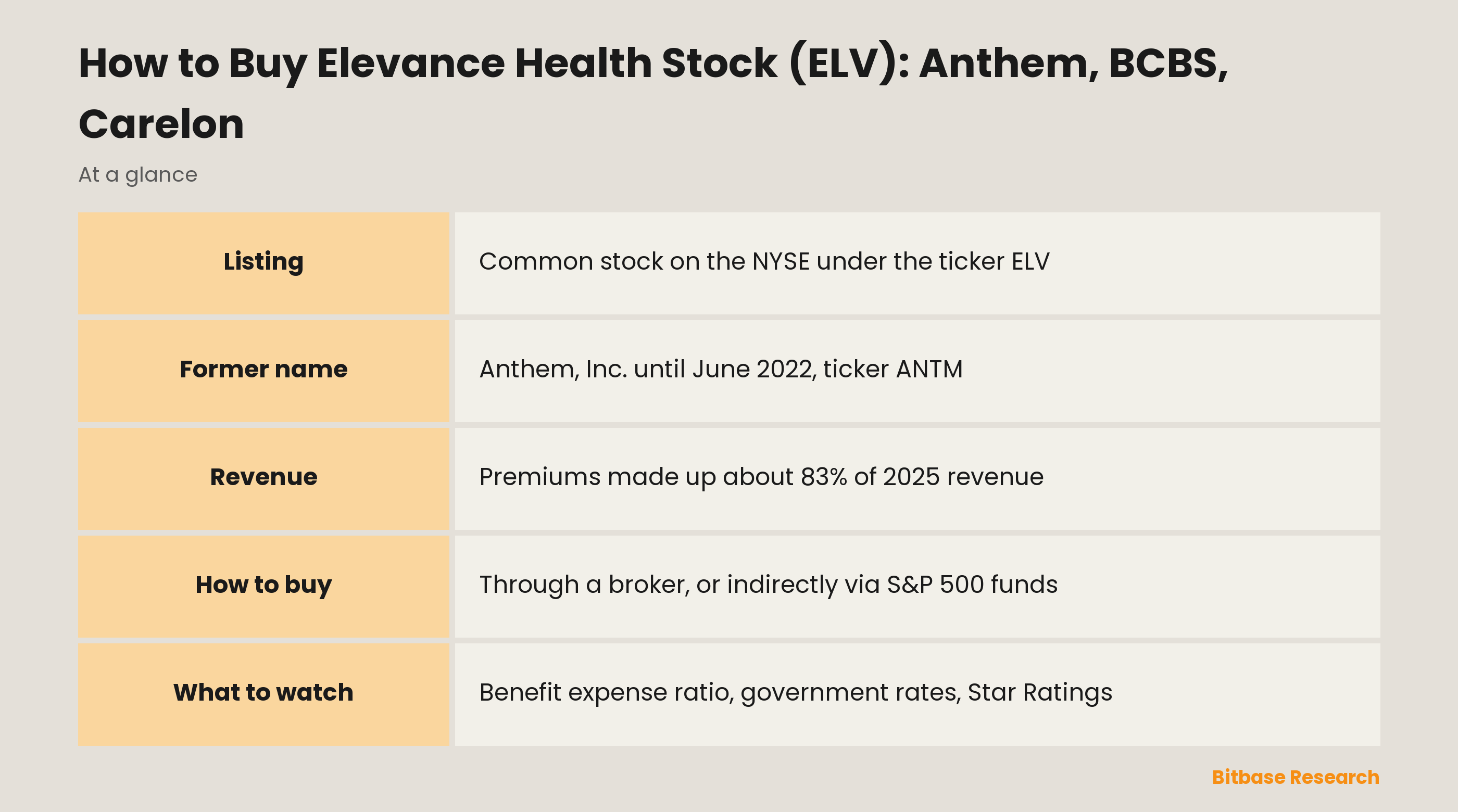
Most brokers with access to the New York Stock Exchange can buy Elevance Health stock for you: the shares trade there as ELV, the ticker that replaced ANTM in June 2022 when Anthem, Inc. took its current name. Behind it is a health insurer that licenses the Blue Cross and Blue Shield names in all or part of 14 states and earned about 83% of its 2025 revenue as premiums. This guide covers what it sells, how to place the order and what its filings flag first.
What Does Elevance Health Do?
Elevance Health calls itself one of the largest US health insurers by medical membership, with about 45.2 million medical members at the end of 2025. Most of its revenue comes from risk-based plans, where it collects a premium and pays the medical bills, sold to individuals, employers, state Medicaid programmes and people on Medicare. For employers that pay their own staff's claims, it runs the plan for a fee instead.
The Blue licence draws the map. Elevance is the Blue Cross licensee for California and the Blue Cross and Blue Shield licensee for Colorado, Connecticut, Georgia, Indiana, Kentucky, Maine, Missouri (outside 30 counties around Kansas City), Nevada, New Hampshire, New York (the New York City area and upstate), Ohio, Virginia (outside the Northern Virginia suburbs of Washington, DC) and Wisconsin. In most of those areas it trades as Anthem Blue Cross or Anthem Blue Cross and Blue Shield; elsewhere it uses brands such as Wellpoint and Simply Healthcare.
The annual report has four segments. Health Benefits holds the plans: employer and individual cover, including Affordable Care Act (ACA) exchange policies, Medicare Advantage and Medicare Supplement, Medicaid and the Federal Employee Program. CarelonRx is the pharmacy business; it delegates certain core services to a CVS Health subsidiary under a new five-year agreement running from January 2027 to the end of 2031. Carelon Services sells care management, behavioural health and home-based care, and Corporate & Other collects smaller businesses and unallocated costs.
The name is the newest part. The company was incorporated in Indiana on 17 July 2001, the year Anthem Insurance converted from a mutual insurer into a stock company, and is headquartered in Indianapolis. It was WellPoint, Inc. until December 2014 and Anthem, Inc. until 27 June 2022; the shares began trading as ELV the next day.
How Elevance Health Makes Money
Premiums supplied about 83% of 2025 total revenue, which rose 12.5%. Product revenue, all of it CarelonRx sales to outside customers, added about 12%, and service fees about 4%. Agencies of the US government alone accounted for about 32% of revenue; Medicaid contracts are with the states.
| Line | What it covers | Share of 2025 operating revenue |
|---|---|---|
| Medicaid (Health Benefits) | State Medicaid and related programmes | 28.7% |
| Commercial (Health Benefits) | Employer and individual plans, insured or self-funded | 25.5% |
| Medicare (Health Benefits) | Medicare Advantage, Supplement and Part D plans | 22.6% |
| Federal Employee Program (Health Benefits) | Federal employees and their families | 7.8% |
| CarelonRx, outside customers | Pharmacy services for clients outside the group | 12.4% |
| Carelon Services, outside customers | Care and data services for clients outside the group | 3.6% |
Shares are of operating revenue (premiums, products and fees); they total slightly over 100% because about 0.6% is eliminated on consolidation.
Medicaid revenue grew 9.0% in 2025 even as Medicaid membership fell 4.7%, after a 15.1% drop in 2024, mainly through states' eligibility redeterminations. Medicare revenue grew 21.6%, helped by 7.9% more Medicare Advantage members. Many members bring in fees rather than premiums: 45.5% sat in employer fee-based plans at the end of 2025, and 14.4% were BlueCard members of other Blue plans, whose local claims Elevance handles for a fee.
Carelon is bigger than its outside sales suggest: 56% of its two segments' 2025 revenue came from Elevance's own health plans and is netted out of the group total.
Profit is a thin layer. The benefit expense ratio, medical costs divided by premiums, rose to 90.0% in 2025 from 88.5% in 2024 and 87.0% in 2023, which the company attributes to higher medical cost trend, "principally within our ACA business." Health Benefits' operating margin fell to 2.5% from 4.2%, while operating gain rose 11.3% at CarelonRx and 33.9% at Carelon Services.
ELV Stock at a Glance
| Item | Detail |
|---|---|
| Exchange | New York Stock Exchange (NYSE) |
| Ticker | ELV since 28 June 2022; ANTM before that |
| Security | Common stock, the only class registered on the 10-K cover |
| ISIN | US0367521038 |
| Index membership | S&P 500, per SPY's holdings report for 30 June 2026 |
| Headquarters | Indianapolis, Indiana |
| Incorporated | Indiana, 17 July 2001 |
| Fiscal year end | 31 December |
| Dividend policy | Quarterly cash dividend, first paid in early 2011; at the board's discretion |
| Share buybacks | Programme authorised since 2003, with no set duration |
| SEC identifier | CIK 1156039 |
The table keeps to what the filings fix. For the live share price, open the Elevance Health stock page on Bitbase.
How to Buy Elevance Health Stock
ELV is a US company's common stock, so no depositary receipt is involved:
1. Choose a broker that reaches the NYSE. Outside the United States, check which entity holds your shares and who regulates it.
2. Open and fund the account. Non-US individuals normally complete IRS Form W-8BEN, which is how a treaty rate on US dividends is claimed; converting other currencies into dollars is a cost too.
3. Search by ticker or ISIN. ELV or US0367521038 should bring up Elevance Health, Inc. common stock on the NYSE; research from before June 2022 calls the same shares ANTM.
4. Pick an order type. FINRA explains that a market order "generally will execute at or near the current bid or ask prices," while a limit order fills only "at or better than a specified price," if at all.
5. Size the position. "The availability of fractional share trading varies by brokerage firm," FINRA notes, and a fractional owner "might not have shareholder voting rights."
Outside the United States, US tax comes off the dividend before it reaches you. The IRS states that "Most types of U.S. source income received by a foreign person are subject to U.S. tax of 30%," and that "a reduced rate, including exemption, may apply" under a tax treaty. Local tax rules then apply on top; this is a general description, not advice.
Index funds are the indirect route. As an S&P 500 constituent, Elevance is held by SPY and other funds that track the S&P 500, at whatever weight the index assigns it.
What Moves ELV Stock
Medical costs against fixed prices. Commercial and Medicaid premiums and Medicare bids rest on "our estimates of future medical costs over the fixed contract period," and on risk-based business "any deviation, favorable or unfavorable, from the medical costs assumed in determining the premium is our responsibility." In its report for the third quarter of 2026, the company said Medicaid cost trends "remain elevated due to higher population acuity and increased utilization of services"; the expiry of enhanced ACA premium tax credits at the end of 2025 "has impacted our Individual market enrollment."
Government rates and ratings. The 10-K warns that "the federal government or any state in which we operate could decrease rates paid to us, pay us less than the amount necessary to keep pace with our cost trends, cancel our contracts retroactively or seek an adjustment to previously negotiated rates." Medicare Advantage plans "with a Star Rating of 4.0 or higher are eligible for quality-based bonus payments"; the third-quarter report says the ratings released in October 2026, used for 2028 payments, put about 49% of Elevance's Medicare Advantage members in such plans, against about 55% under the ratings for 2027. Those federal notices and ratings apply across the industry, which is why the UnitedHealth Group guide tracks them too.
Risk adjustment scrutiny. Medicare Advantage payments scale with members' recorded diagnoses. A Justice Department lawsuit filed in March 2020, United States v. Anthem, Inc., alleges that the company falsely certified diagnosis data sent to CMS, the federal Medicare agency; Elevance calls it "without merit," and fact discovery was due to close in November 2026. Separately, a CMS notice in February 2026 about data from 2015 to April 2023 led Elevance to record an accrual for resubmitting it; in July 2026 CMS closed that matter without sanctions.
The Blue system. Under the settlement of the antitrust case against the Blue plans, certain large national employers with self-funded plans may now "request a second Blue plan bid" alongside the local plan's, effective from September 2024. The licence also requires at least 80% of a licensee's local net revenue from health plans in its service areas to be sold under the Blue names.
What Can Push ELV Shares Down?
Of the risk factors in Item 1A of the 10-K, these bear most directly on the shares:
Cost prediction. "If we fail to appropriately predict, price for and manage healthcare costs, the profitability of our products and services could decline." At a benefit expense ratio of 90.0%, a small miss eats much of the margin.
Concentration. Revenue is concentrated in California, New York, Virginia, Indiana, Ohio, Georgia, Florida and Texas, exposing the company to "state-specific or regional economic downturns or healthcare coverage changes impacting these states."
The licence. If the agreements were terminated, Elevance would lose the Blue names in the affected areas, the BCBSA "would be free to issue a license" there to another entity, and it could charge a re-establishment fee for each of the roughly 34 million Blue enrollees Elevance served at the end of 2025.
Cash at the parent. State insurance laws restrict dividends from subsidiaries, and such "restrictions on our ability to obtain funds from our regulated subsidiaries could limit our ability to repurchase shares, pay dividends and meet our obligations."
The share itself. In the 10-K's performance graph, ELV's total return over the five years to the end of 2025 was 17%, while the S&P 500 returned 96% and the S&P 500 Health Care Index 48%.
How to Research Elevance Health Yourself
Elevance's SEC filings, including those made as Anthem and WellPoint, are indexed under CIK 1156039. The 10-K is the annual report and 10-Qs are quarterly; 8-Ks carry events in between, including results, which in 2026 arrived on 28 January, 22 April, 15 July and 21 October. In the 10-K, Item 1 explains the segments and Blue licences, Item 1A the risks, Item 7 the membership table and benefit expense ratio, Note 14 the litigation and Note 20 the segment figures, including Carelon's affiliated revenue. Live quotes are on the stock page linked above, and more US stock pages on Bitbase cover other listed companies.
Elevance Health Stock FAQ
Is Elevance Health the same company as Anthem?
Yes. Anthem, Inc. became Elevance Health, Inc. on 27 June 2022, and the shares switched from ANTM to ELV the next day; the SEC file number and CIK did not change. Anthem remains the brand on many of its Blue plans. Before December 2014 the company was WellPoint, Inc., which traded as WLP.
Can I buy Elevance Health stock with crypto?
Not directly. Brokers take US dollars for NYSE shares, so the crypto has to be exchanged for cash and moved to the broker before any ELV order, and that exchange may count as a taxable sale, depending on the country. The steps and their costs are set out in our guide to buying stocks with crypto.
Does Elevance Health pay a dividend?
Yes, quarterly. The first cash dividend in the company's history was paid, as WellPoint, in the first quarter of 2011; in 2026, dividends were declared in January, April and July. Each depends on, among other things, regulatory and capital requirements; amounts are in the latest 10-Q.
Is ELV in the S&P 500?
Yes. SPY, the SPDR S&P 500 ETF Trust, listed Elevance Health among its holdings in its report to the SEC for 30 June 2026. Membership can change, so check the date on any holdings file.
Is there a limit on how many Elevance Health shares one investor can own?
Yes. Its articles of incorporation cap holdings at one share less than 10% of voting securities for an institutional investor, one share less than 5% for a non-institutional investor and one share less than a 20% ownership interest for any person, unless a majority of the "continuing directors" approves. The 10-K adds that these limits "may not be exceeded without the prior approval of the BCBSA" and counts them among provisions that could delay or prevent a takeover.
Conclusion
The purchase itself is routine: any broker that reaches the New York Stock Exchange can fill an ELV order. The harder part is the business inside the share: Blue-licensed health plans whose profit is the narrow gap between premiums and medical costs, plus a Carelon arm that sells mostly to those plans. Before putting money into one insurer, read the benefit expense ratio, Medicaid and Medicare Advantage membership and the litigation note in the latest filings.
Related reading
Other Bitbase articles on this topic:
- How to Buy Cencora Stock (COR): Ex-AmerisourceBergen, Walgreens
- How to Buy Cigna Stock (CI): Express Scripts and Rebate Reform
- How to Buy CVS Health Stock (CVS): Insurer, PBM and Drugstores
- How to Buy Thermo Fisher Stock (TMO): Labs, Trials and Clario
Disclaimer: This article is educational content from Bitbase Academy, provided for information only. It explains what a company or fund does and how the instruments referenced here differ from one another; it does not constitute investment, trading, tax, or financial advice, and it is neither a recommendation nor an endorsement of any security, token, or trading strategy. A tokenized stock is issued by a third party and is designed to give economic exposure to an underlying asset: it is not a share, it carries no shareholder rights, and it depends on the issuer's structure, eligibility rules, and redemption terms, which the issuer can change. Perpetual futures are leveraged derivatives that hold no underlying asset and can be liquidated, and trading hours, product availability, and eligibility differ by instrument and by jurisdiction and can change at any time. Written as of October 2026; verify everything yourself through company filings, the issuer's own documentation, and the product pages of the venue you trade on.
References
[1] Elevance Health Form 10-K for fiscal 2025 (SEC EDGAR) www.sec.gov
[2] Elevance Health Form 10-Q for the quarter ended 30 September 2026 (SEC EDGAR) www.sec.gov
[3] Elevance Health Form 8-K, 28 June 2022: name change from Anthem, Inc. (SEC EDGAR) www.sec.gov
[4] Elevance Health Form 10-K for fiscal 2022: first trading day as ELV (SEC EDGAR) www.sec.gov
[5] Anthem, Inc. Form 8-K, 2 December 2014: name change from WellPoint, Inc. (SEC EDGAR) www.sec.gov
[6] Anthem, Inc. Form 10-K for fiscal 2014: ANTM symbol and 2001 conversion (SEC EDGAR) www.sec.gov
[7] WellPoint first-quarter 2011 results release, filed with Form 8-K (SEC EDGAR) www.sec.gov
[8] SPDR S&P 500 ETF Trust (SPY), Form N-PORT holdings report for 30 June 2026 (SEC EDGAR) www.sec.gov
[9] IRS, NRA Withholding www.irs.gov
[10] FINRA, Order Types www.finra.org
[11] FINRA, Investing in Fractional Shares www.finra.org





