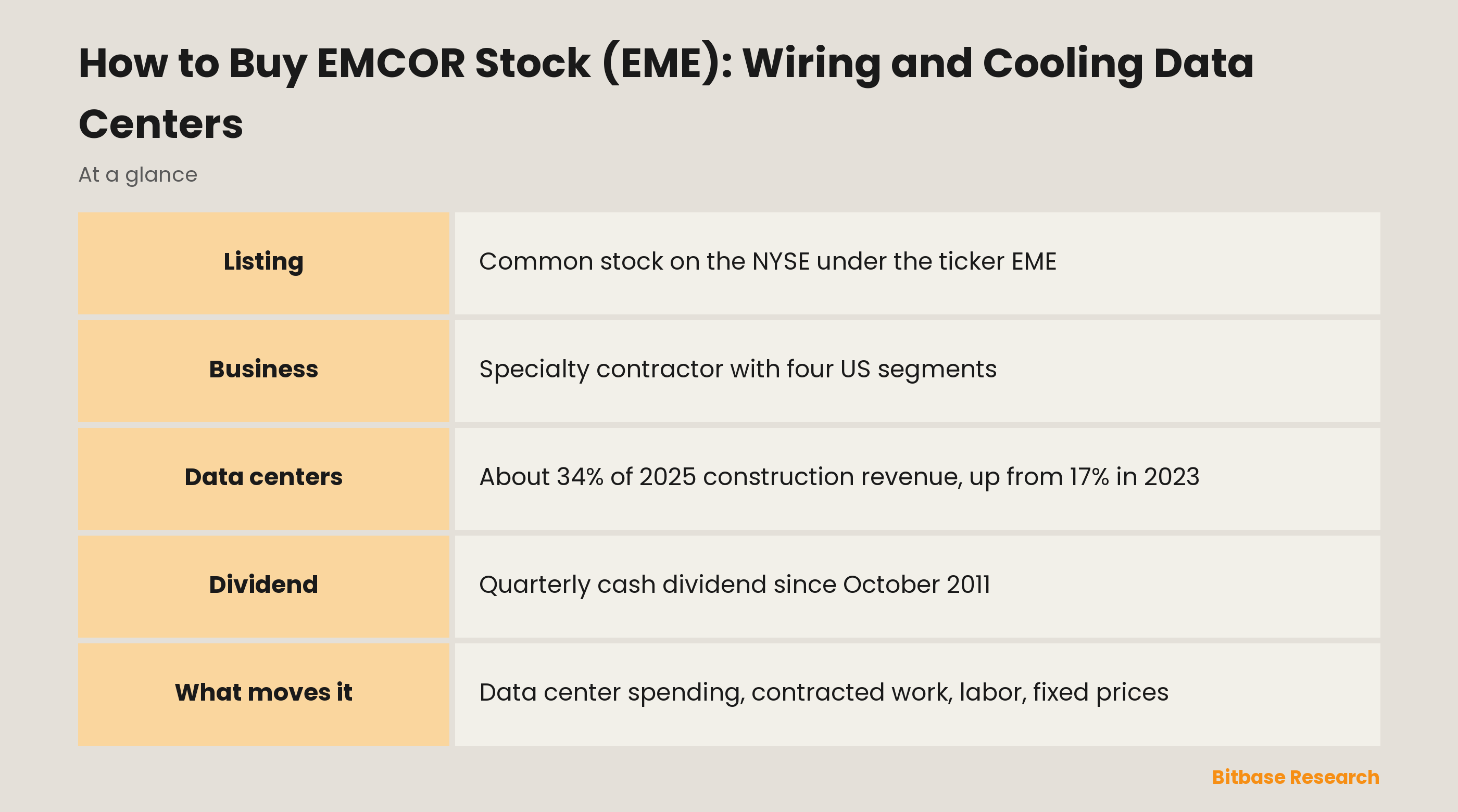
Two things let you buy EMCOR stock: a brokerage account that can trade on the New York Stock Exchange and the ticker EME, under which EMCOR Group, Inc. lists its common shares. The share buys into a specialty contractor that installs and maintains electrical and mechanical systems, and data centers have reshaped its work: the network and communications sector supplied about 34% of 2025 construction revenue, twice its 17% share in 2023. This guide covers the four segments, how an order works, and the contract and labor questions EMCOR's own filings raise.
What Does EMCOR Do?
EMCOR's annual report calls it "one of the largest specialty contractors in the United States and a leading provider of electrical and mechanical construction and facilities services, building services, and industrial services." The work is carried out by approximately 100 operating subsidiaries, overseen from executive offices in Norwalk, Connecticut; the parent is incorporated in Delaware.
Specialty contractor is the phrase to hold on to. EMCOR does not usually put up the whole building. It wires it, pipes it, ventilates it and keeps those systems running, sometimes hired by the owner and often as a subcontractor to a general contractor.
The company reports four segments, all in the United States:
US electrical construction and facilities services handles power, lighting, low-voltage and communications systems. It grew sharply in 2025 after EMCOR bought Miller Electric Company, an electrical contractor operating mainly in the Southeastern United States, on 3 February 2025.
US mechanical construction and facilities services is the largest segment: HVAC, plumbing, process piping, fire protection, sheet metal and the cooling systems that server halls depend on.
US building services maintains and retrofits systems in buildings that already stand. About 77% of its 2025 US revenue came from the mechanical services division (HVAC service, retrofits, building automation), 18% from commercial site-based services and 5% from government site-based services.
US industrial services works mainly for refineries and petrochemical plants: turnarounds, when a unit is shut down for overhaul, specialty welding, and shell and tube heat exchangers.
A fifth segment, UK building services, is gone: EMCOR sold its United Kingdom operations on 1 December 2025. Until then the UK produced about 3% of 2025 revenue and the United States about 97%. At the end of 2025 EMCOR employed approximately 44,000 people, all in the United States.
How EMCOR Makes Money
EMCOR is paid contract by contract. Revenue rose 16.6% in 2025 to a company record, and the 10-K splits it three ways: construction operations about 72%, building services about 21% and industrial services about 7%. By segment:
| Segment | Share of 2025 revenue | 2025 operating margin | What it does |
|---|---|---|---|
| US electrical construction | 30% | 12.1% | Power, lighting, low-voltage and communications systems |
| US mechanical construction | 42% | 12.8% | HVAC, plumbing, piping, fire protection |
| US building services | 18% | 6.0% | Maintenance, retrofits, building automation, site services |
| US industrial services | 7% | 2.0% | Refinery turnarounds, welding, heat exchangers |
| UK building services (sold 1 December 2025) | 3% | 4.4% | Facilities services in the UK |
Operating margin is each segment's operating income divided by its own revenue, as reported in the 10-K; corporate costs and the gain on the UK sale sit outside the segments.
Two sizes of job. Large projects, often running over several years, include data centers, factories, hospitals and public works, and they require the financial strength to post performance bonds. Smaller jobs, usually finished within a year, cover fit-outs, renovations and upgrades; the 10-K says they "are not usually dependent upon the new construction market." In 2025 the large projects made up about 58% of construction revenue.
How the work is priced. "We currently generate, and expect to continue to generate, a significant portion of our revenues from fixed price and similar contracts," the 10-K says. EMCOR estimates the total cost before bidding and recognizes revenue as costs are incurred, so a wrong estimate comes out of its own margin. Call-out repairs, refinery turnarounds and specialty welding are generally billed on time and materials terms instead.
Who the customers are. In 2025 network and communications, the sector that includes data centers, provided 48% of electrical segment revenue and 23% of mechanical segment revenue, up from 34% and 8% in 2023. High-tech manufacturing moved the other way in mechanical, falling to 14% from 23% in 2024 as semiconductor projects were completed. Healthcare, institutional, manufacturing and water work make up much of the rest.
Company-wide operating margin was 10.1% in 2025, against 9.2% in 2024, lifted by the one-time gain on the UK sale.
EME Stock at a Glance
| Feature | EME |
|---|---|
| Exchange | New York Stock Exchange |
| Ticker | EME |
| Security | Common stock; no other class is listed |
| Sector | Specialty contracting: electrical, mechanical, building and industrial services |
| Index membership | S&P 500 |
| Headquarters | Norwalk, Connecticut |
| Incorporated | Delaware |
| Fiscal year | Calendar year, ending 31 December |
| Payouts | Quarterly cash dividend since October 2011; buyback program since September 2011 |
| Chairman and CEO | Anthony J. Guzzi, chief executive since January 2011 |
| SEC identifier | CIK 105634 |
None of these lines covers the share price, valuation or yield, which change all day; the EMCOR stock page on Bitbase shows them live.
How to Buy EMCOR Stock
EMCOR is a US company that files a 10-K, so there is no ADR layer: the shares changing hands on the NYSE are the common stock itself. Through a broker, the route has six steps:
1. Find a broker with NYSE access. Outside the US, that can be a local firm offering American shares or an international broker; check which legal entity holds your account and who regulates it.
2. Get the account approved. Non-US individuals usually complete IRS Form W-8BEN, which the IRS says to submit "when requested by the withholding agent or payer."
3. Fund it. Paying in from another currency adds a conversion, so the exchange rate counts as much as the commission.
4. Search for EME. Confirm the result reads EMCOR Group, Inc. common stock on the New York Stock Exchange.
5. Choose the order type. FINRA explains that a market order "provides the most certainty that your order will be executed," whereas a limit order fills only "at or better than a specified price."
6. Decide the amount. Where a broker offers fractional shares, you can invest a fixed sum, though FINRA notes that "as a fractional share owner, you might not have shareholder voting rights."
Tax outside the US. According to the IRS, "most types of U.S. source income received by a foreign person are subject to U.S. tax of 30%," and a tax treaty can lower that rate, which is why brokers ask for the W-8BEN. Your home country may tax the same dividend too.
Owning it inside a fund. EME appears in the daily holdings file of State Street's SPY dated 10 November 2026, so any fund tracking the S&P 500 holds a small slice of EMCOR alongside hundreds of other companies.
What Moves EME Stock
The data center build-out. The 10-K says demand has "benefited from the expansion of data centers to power AI and cloud computing." In the third quarter of 2026, network and communications reached 46% of the two construction segments' revenue, from 34% a year earlier, and 56% in the electrical segment alone. The filing also states the other side: if spending on data center infrastructure "were to decrease, demand for our services could decline as we transition our resources to other sectors."
Remaining performance obligations. This is the value of contracted work not yet performed. On 30 September 2026 it was a record, 47.2% up on the year, and about 77% of it was expected to become revenue within twelve months. The 10-K cautions that "Amounts included in our remaining performance obligations may not result in actual revenues or translate into profits."
Quarterly results. Third-quarter 2026 revenue rose 28.8%, or 25.5% on an organic basis, and operating margin widened to 9.8% from 9.4% despite a non-cash impairment charge on the intangible assets of one building services business.
Buying contractors. Beyond Miller Electric, EMCOR acquired nine other companies in 2025 and nine more in the first nine months of 2026, among them electrical contractors in Texas, the Midwest and the Southeast. Acquired revenue adds to growth, while the 10-K warns that the benefits depend on due diligence and integration.
Skilled trades. "We cannot be certain that we will be able to maintain an adequate skilled labor force necessary to operate efficiently," the 10-K says. Part of the 2025 dip in electrical margin came from projects in new geographies where EMCOR met "reduced labor productivity or availability."
Where EMCOR's Contracts Can Go Wrong
These Item 1A risks bear most directly on an EME share:
Estimates on fixed prices. Under fixed price, guaranteed maximum price and similar contracts, cost and schedule surprises "may cause actual gross profits from projects to differ from those we originally estimated and could result in reduced profitability or losses on projects."
Customers in cyclical sectors. "Our business is vulnerable to the cyclical nature of the sectors in which our clients operate and is dependent upon the timing and funding of new awards." EMCOR adds that its business "has traditionally lagged recoveries in the general economy."
Contracts that can be cut short. Many contracts "are subject to cancellation or suspension on short notice at the discretion of the client."
Bonding capacity. At the end of 2025 the estimated exposure on bonded projects, assuming every one of those contracts defaulted, equaled about 23% of remaining performance obligations, and the 10-K lists "the lack of availability of adequate levels of surety bonding" among the risks to its outlook.
Union pension plans. About 62% of employees are covered by collective bargaining agreements, and EMCOR contributes to approximately 200 multiemployer pension plans. Leaving one, or sharply cutting the staff in it, can make the company liable for its proportionate share of that plan's underfunding.
Two more risks sit with the share itself. One company concentrates your exposure, and dividends are a board decision that the credit agreement also limits, so past payments promise nothing about future ones.
How to Research EME Yourself
EMCOR's SEC filings sit under CIK 105634. The annual 10-K arrives in February, a 10-Q follows each of the next three quarters, and 8-Ks carry the earnings releases, which in 2026 came on 26 February, 29 April, 30 July and 29 October.
Three places answer most questions: Note 3 on revenue, which breaks each construction segment down by market sector; the remaining performance obligations table, which shows how much contracted work should turn into revenue within a year; and the segment note, which shows whether growth arrives with margin.
Two traps are worth avoiding. Comparisons between 2025 and 2026 include the UK operations in one period and not the other, which is why EMCOR's releases also give organic growth. And third-quarter 2026 operating income includes an impairment charge that the company leaves out of its non-GAAP figures, so compare like with like. Other US companies are listed on the Bitbase stock pages.
EMCOR Stock FAQ
Can I buy EMCOR stock with crypto?
Not directly. A broker sells EME shares for US dollars, so any crypto has to be converted to cash first and moved into the brokerage account, and that conversion can count as a taxable sale in many countries. Owning the share then gives you a stake in EMCOR itself, which is a different thing from holding a token; our guide to crypto versus stocks sets out the differences.
Does EMCOR pay a dividend?
Yes. EMCOR has paid a quarterly cash dividend since 25 October 2011, having paid none before, and in December 2025 the board announced a higher regular dividend starting with the January 2026 payment. The company expects quarterly dividends "will be paid for the foreseeable future"; check the latest 10-Q for the current amount.
Is EME in the S&P 500?
Yes. EMCOR's earnings releases describe it as "a member of the S&P 500," and State Street's SPY holdings file dated 10 November 2026 lists EMCOR Group Inc under EME.
Does EMCOR still operate in the United Kingdom?
No. EMCOR sold its UK operations on 1 December 2025. Until then they formed the UK building services segment, about 3% of 2025 revenue; the four remaining segments are all in the United States.
Which companies compete with EMCOR?
Among larger electrical and mechanical contractors, the 10-K names APi Group, Comfort Systems USA, Dycom, IES Holdings, MasTec, MYR Group, Quanta Services and Tutor Perini; in mechanical services, Carrier and Trane Technologies; and in site-based services, firms such as CBRE and ABM. It also calls the industry "highly fragmented," with thousands of small contractors.
Conclusion
An EME share is exposure to two things: how much electrical and mechanical work America's data centers, hospitals and factories need, and how well EMCOR prices and delivers it. The 2025 and 2026 filings show both pulling in its favor, with a sector mix tilted toward data centers and record contracted work. They also show what could turn: fixed price estimates that miss, customers who can cancel, a skilled workforce that is hard to grow and one market supplying a rising share of revenue. Read the market sector tables in the latest 10-Q before deciding how much one contractor should weigh in your portfolio.
Related reading
Other Bitbase articles on this topic:
- How to Buy Comfort Systems Stock (FIX): Data Centers and Backlog
- How to Buy Dover Stock (DOV): 70 Years of Dividend Raises
- How to Buy D.R. Horton Stock (DHI): Lots, Mortgages and Buybacks
- How to Buy Rocket Lab Stock (RKLB): Electron, Neutron and Perps
Disclaimer: This article is educational content from Bitbase Academy, provided for information only. It explains what a company or fund does and how the instruments referenced here differ from one another; it does not constitute investment, trading, tax, or financial advice, and it is neither a recommendation nor an endorsement of any security, token, or trading strategy. A tokenized stock is issued by a third party and is designed to give economic exposure to an underlying asset: it is not a share, it carries no shareholder rights, and it depends on the issuer's structure, eligibility rules, and redemption terms, which the issuer can change. Perpetual futures are leveraged derivatives that hold no underlying asset and can be liquidated, and trading hours, product availability, and eligibility differ by instrument and by jurisdiction and can change at any time. Written as of November 2026; verify everything yourself through company filings, the issuer's own documentation, and the product pages of the venue you trade on.
References
[1] EMCOR Form 10-K for 2025 (SEC EDGAR) www.sec.gov
[2] EMCOR 2025 Form 10-K, XBRL cover page (SEC EDGAR) www.sec.gov
[3] EMCOR Form 10-Q for the third quarter of 2026 (SEC EDGAR) www.sec.gov
[4] EMCOR third-quarter 2026 earnings release, filed with Form 8-K (SEC EDGAR) www.sec.gov
[5] State Street SPDR S&P 500 ETF Trust (SPY): fund page and daily holdings www.ssga.com
[6] FINRA: Order Types www.finra.org
[7] FINRA: Investing in Fractional Shares www.finra.org
[8] IRS: NRA Withholding www.irs.gov
[9] IRS: About Form W-8 BEN www.irs.gov





