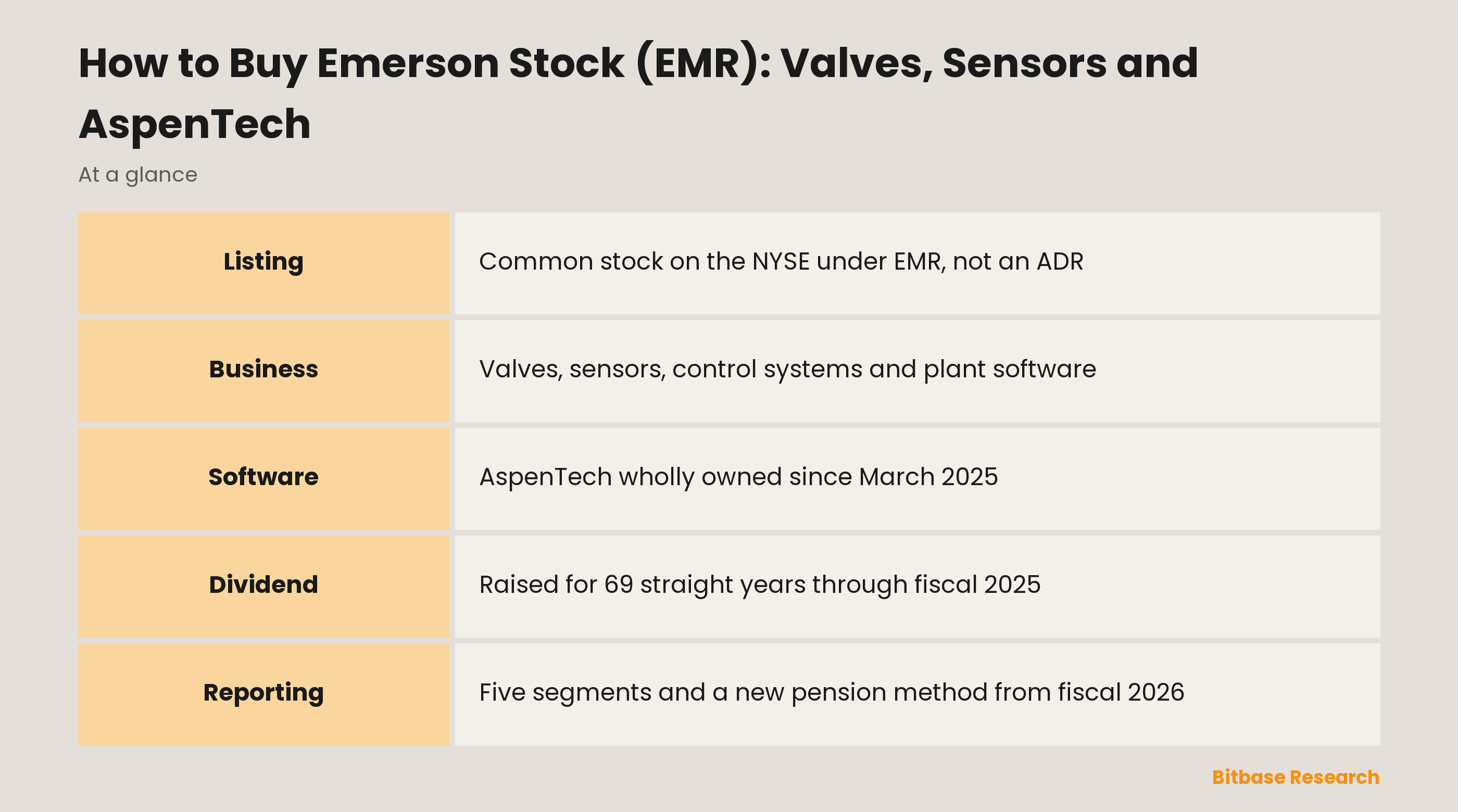
The EMR ticker belongs to Emerson Electric Co., so a brokerage account with access to the New York Stock Exchange is all it takes to buy Emerson stock. Between 2022 and 2025 the St. Louis company sold its Climate Technologies business, now Copeland, bought test specialist NI and took full ownership of software group AspenTech, leaving a business built on valves, sensors, control systems and industrial software. Its fiscal year ends on 30 September, and its proxy statement counts fiscal 2025 as the 69th consecutive year of dividend increases.
What Does Emerson Do?
Emerson calls itself "a global technology and software company." Its customers run plants: chemicals, power and energy on the process side; life sciences, mining, food and paper among hybrid industries; cars, medical devices, packaging and semiconductors among discrete manufacturers. It sells the hardware that measures and moves liquids and gases in those plants, the control systems that direct it, and software that models the whole operation.
The fiscal 2025 10-K reports six segments in two business groups. Intelligent Devices covers Final Control (control and pressure relief valves, actuators and regulators sold as Fisher, Bettis or Crosby), Measurement & Analytical (Rosemount and Micro Motion instruments for pressure, flow, level, temperature and gases), Discrete Automation (ASCO solenoid valves, pneumatics, electrical equipment and Branson materials joining gear) and Safety & Productivity (RIDGID, Greenlee and Klauke tools for plumbers and electricians). Software and Control covers Control Systems & Software, home of the DeltaV and Ovation control systems and, since the 2025 buyout, AspenTech's asset optimization software, and Test & Measurement, the former National Instruments, which sells automated test systems.
Emerson was incorporated in Missouri in 1890 and is headquartered in St. Louis. At the end of fiscal 2025 it had about 120 manufacturing locations, roughly 35 of them in the United States.
Its present shape is recent. In May 2022 Emerson folded two of its software businesses into Aspen Technology and came away owning 55% of the enlarged company. In October 2022 it sold the InSinkErator disposer business to Whirlpool. In May 2023 it sold a majority stake in Climate Technologies, renamed Copeland, to funds managed by Blackstone, then sold the 40% it had kept in August 2024. NI joined in October 2023, and on 12 March 2025 Emerson bought the AspenTech shares it did not yet own. The 10-K names no rivals, saying only that no single company competes with Emerson across all of its product lines.
How Emerson Makes Money
Most revenue is booked when a product ships or, for software, on the first day of the contract term; about 10% is recognized over time, mainly control system projects and software maintenance. Fiscal 2025 net sales grew 3%, and underlying sales, which strip out currency and big deals, also rose 3%: price added 2.5% and volume 0.5%.
| Segment | Business group | Share of fiscal 2025 segment sales | Fiscal 2025 sales growth |
|---|---|---|---|
| Final Control | Intelligent Devices | 24.2% | 4% |
| Measurement & Analytical | Intelligent Devices | 22.9% | 2% |
| Discrete Automation | Intelligent Devices | 13.9% | 1% |
| Safety & Productivity | Intelligent Devices | 7.5% | Down 2% |
| Control Systems & Software | Software and Control | 23.2% | 7% |
| Test & Measurement | Software and Control | 8.2% | 2% |
The shares are worked out from segment sales before intersegment eliminations; after rounding they total 99.9%, and growth is as reported. Intelligent Devices brought in 68.5% of segment sales and Software and Control 31.5%. The 10-K ties Final Control's gain to power markets and Control Systems & Software's to AspenTech, helped by the timing of contract renewals; Safety & Productivity sales fell in every region.
By destination, the Americas took 51% of sales, Asia, the Middle East and Africa 30% (China alone 10%) and Europe 19%. Research, development and engineering spending equaled 8.1% of sales. The order backlog grew about 2.1%, and roughly 75% of it is expected to become revenue within twelve months.
Fiscal 2026 brought five segments. Software & Systems pairs Control Systems & Software with Test & Measurement; Intelligent Devices pairs Final Control with Sensors, the new name for Measurement & Analytical; Safety & Productivity stands alone. Discrete Automation was split three ways: its programmable controllers went to Control Systems & Software, fluid and motion control to Final Control, and electrical equipment and materials joining to Safety & Productivity. Unaudited recast figures in a November 2025 8-K put fiscal 2025 sales at 56.0% Intelligent Devices, 32.3% Software & Systems and 11.7% Safety & Productivity on the new basis.
EMR Stock at a Glance
| Item | Detail |
|---|---|
| Exchange | New York Stock Exchange (NYSE); the fiscal 2025 10-K also names NYSE Texas |
| Ticker | EMR |
| Security | Common stock, the only share class on the exchange registration; no depositary receipts |
| Other EMR codes | Notes due 2029, 2031 and 2037, listed on the NYSE as EMR 29, EMR 31A and EMR 37 |
| CUSIP and ISIN | 291011104 and US2910111044 |
| Sector | Industrial automation: valves, instruments, control systems, software, test systems, tools |
| Index membership | S&P 500 |
| Incorporated and headquarters | Missouri, 1890; St. Louis, Missouri |
| Fiscal year | Ends 30 September; fiscal 2025 ran from October 2024 to September 2025 |
| Dividend policy | Quarterly cash dividend, raised for 69 consecutive years through fiscal 2025 |
| Share buybacks | Authorizations of 60 million shares (March 2020) and 50 million more (November 2025) |
| SEC filer | CIK 32604 |
Quotes, market value and yield are left out because they move all day; for those, open the Emerson stock page on Bitbase.
How to Buy Emerson Stock
EMR is a plain US common share priced in dollars, with no ADR or overseas line to choose between. The steps:
1. Find a broker with NYSE access. Outside the US that can be a local broker offering US markets or an international one; check which legal entity will hold your shares and who regulates it.
2. Complete the tax form. The broker will usually ask a non-US individual for IRS Form W-8BEN; in the IRS's words, "Submit Form W-8 BEN when requested by the withholding agent or payer whether or not you are claiming a reduced rate of, or exemption from, withholding."
3. Add money. Shares settle in dollars, and a poor conversion rate can cost more than the trading fee.
4. Select the right instrument. Emerson's NYSE-listed notes also have codes starting with EMR, so check that the line you pick is Emerson Electric Co. common stock, CUSIP 291011104.
5. Place the order. A market order takes the best price available on arrival; a limit order names your maximum and may go unfilled. If you want less than one share, FINRA warns that "the availability of fractional share trading varies by brokerage firm," that "at the moment, you can't transfer fractional shares to another brokerage firm," and that "as a fractional share owner, you might not have shareholder voting rights."
Dividend tax. The IRS says that "most types of U.S. source income received by a foreign person are subject to U.S. tax of 30%," with a lower rate or exemption possible under a tax treaty. Ask the broker what it will withhold and check how your home country treats the payment.
Through a fund. The SPDR S&P 500 ETF Trust lists Emerson Electric Co in its SEC holdings report for 30 June 2026, so an S&P 500 fund holds a small slice of Emerson among hundreds of companies; the VOO ETF guide explains how one such fund works.
What Moves EMR Stock
Plant and power spending. The 10-K says Emerson's businesses are "largely dependent on the current and future business environment, including capital and consumer spending." Power markets lifted Final Control in fiscal 2025, and in the first nine months of fiscal 2026 the 10-Q credited power and LNG customers at Sensors.
Software renewal timing. Term software license revenue is booked upfront on delivery, so the calendar of AspenTech renewals can move sales and margins between periods. It helped in fiscal 2025; in the nine months to June 2026 Software & Systems still grew 5% on an underlying basis although renewal timing took about 3% off.
Test & Measurement. This segment sells to companies developing new products. It grew 2% in fiscal 2025, with Europe and China soft, then 18% in the first nine months of fiscal 2026, which the 10-Q attributes to aerospace and defense and semiconductor customers.
China and trade. With 59% of sales going to customers outside the United States, regional demand and currencies show up quickly; in the first nine months of fiscal 2026 Intelligent Devices sales in China fell 10%. Tariffs are a named risk; after the Supreme Court ruled in February 2026 that the International Emergency Economic Powers Act does not authorize tariffs, Emerson received refunds in its third fiscal quarter, a benefit kept out of adjusted earnings.
Reported versus adjusted earnings. The deals left heavy amortization: in fiscal 2025 Software and Control's segment earnings margin was 14.5%, against an adjusted EBITA margin of 31.0% that adds back amortization and restructuring. Diluted earnings per share from continuing operations rose 43% and adjusted earnings per share 9%; the 10-K points to NI acquisition accounting and a loss on the Copeland note in the fiscal 2024 base.
New reporting rules. Fiscal 2026 is the first year on the five-segment layout. On 13 October 2026 Emerson also said it would move its pension accounting to mark-to-market, booking actuarial gains and losses each fourth quarter and applying the change retrospectively; that adjustment will stay out of adjusted earnings per share.
What Could Go Wrong for Emerson
Of the fiscal 2025 risk factors, these sit closest to the current business:
A narrower company. After its recent deals, "the Company has a narrower business which is focused on higher growth markets including software, innovation and disruptive technologies, and may encounter more volatility and be more vulnerable to changing market conditions."
Failures inside customers' plants. Its instruments, valves and control systems "are integrated and used in complex process, hybrid and discrete manufacturing environments. As a result, the impact of a catastrophic product failure or similar event could be significant."
Attacks on connected products. "Cybersecurity incidents aimed at the software embedded in our products could lead to third-party claims resulting from damages caused by our product failures, and this risk is enhanced by the increasingly connected nature of our products."
Trade and production abroad. US tariff changes and retaliation "have created a dynamic environment that may have a material adverse impact on our business," the 10-K says; most of Emerson's factories are outside the United States, and emerging markets account for over one-third of sales.
Two more apply to any single stock: your result rests on one company, and 69 years of rising dividends describe the past, not a commitment. If you count in another currency, the dollar rate adds a third.
How to Research EMR Yourself
Emerson files with the SEC under CIK 32604. The 10-K arrives in November (10 November in 2025), 10-Qs cover the quarters to December, March and June, 8-Ks carry results and news, and the proxy for the February annual meeting comes in December. Copies also sit at ir.emerson.com.
In the 10-K, Item 1 covers segments and portfolio moves, Item 1A the risks and Item 5 the buybacks; the MD&A gives segment growth and margins, and Note 20 splits sales by region. The November 2025 8-K holds the recast segment history, and the October 2026 8-K the pension change.
When setting Emerson beside a calendar-year industrial such as Caterpillar (see the Caterpillar stock guide), remember that Emerson's first quarter runs from October to December. Compare segment figures only on the same layout, and keep GAAP and adjusted results side by side. Other companies are listed under US stocks on Bitbase.
Emerson Stock FAQ
Does Emerson pay a dividend?
Yes, every quarter. Its December 2025 proxy statement says fiscal 2025 was the 69th consecutive year of increased dividends, and in November 2025 the board raised the quarterly payment 5%. Check the latest declaration for the amount and dates.
Can I buy Emerson stock with crypto?
Not directly. A broker sells you EMR for US dollars, so the crypto must first be converted to cash and transferred to the brokerage account, and that conversion can itself trigger tax. How to buy stocks with crypto walks through the route; the end result is an ordinary Emerson share.
Is EMR in the S&P 500?
Yes. Emerson Electric Co appears in the SEC holdings report of the SPDR S&P 500 ETF Trust for 30 June 2026. Its weight in the index changes every trading day.
Does Emerson still own Copeland?
No. It sold a majority stake in Climate Technologies, which became Copeland, to Blackstone-managed funds in May 2023, kept 40%, and sold that stake to Blackstone funds in August 2024. The business is reported in discontinued operations.
Has Emerson stock ever split?
Yes. In November 2006 the board approved a two-for-one split in the form of a 100% stock dividend, paid on 11 December 2006 to holders of record on 17 November 2006. Older per-share figures need adjusting before comparison.
Conclusion
The purchase itself is simple: a broker with NYSE access, the common share rather than an EMR-coded note, and an order you understand. Understanding the company takes longer: after its deals, Emerson is an automation supplier whose software sales swing with renewal timing and whose reporting changed in fiscal 2026. The fiscal 2026 10-K, the first on the new segments and pension method, is the document to read before you decide what weight EMR deserves.
Related reading
Other Bitbase articles on this topic:
- How to Buy CPKC Stock (CP): One Railway, Three Countries
- How to Buy CSX Stock (CSX): An Eastern Railroad on Nasdaq
- How to Buy Cummins Stock (CMI): Engines to Data Center Power
- How to Buy Waste Management Stock (WM): Landfills and Stericycle
Disclaimer: This article is educational content from Bitbase Academy, provided for information only. It explains what a company or fund does and how the instruments referenced here differ from one another; it does not constitute investment, trading, tax, or financial advice, and it is neither a recommendation nor an endorsement of any security, token, or trading strategy. A tokenized stock is issued by a third party and is designed to give economic exposure to an underlying asset: it is not a share, it carries no shareholder rights, and it depends on the issuer's structure, eligibility rules, and redemption terms, which the issuer can change. Perpetual futures are leveraged derivatives that hold no underlying asset and can be liquidated, and trading hours, product availability, and eligibility differ by instrument and by jurisdiction and can change at any time. Written as of October 2026; verify everything yourself through company filings, the issuer's own documentation, and the product pages of the venue you trade on.
References
[1] Emerson Electric Co. Form 10-K, fiscal 2025: business, segments, sales, risk factors and portfolio changes (SEC EDGAR) www.sec.gov
[2] Emerson fourth quarter and full year 2025 results release, 5 November 2025, with dividend increase and buyback authorization (Form 8-K, SEC EDGAR) www.sec.gov
[3] Emerson Electric Co. Form 8-K, 20 November 2025: five reportable segments from fiscal 2026, with recast segment results (SEC EDGAR) www.sec.gov
[4] Emerson Electric Co. proxy statement for the 2026 annual meeting, filed 12 December 2025 (Schedule 14A, SEC EDGAR) www.sec.gov
[5] Emerson Electric Co. Form 10-Q for the quarter ended 30 June 2026 (SEC EDGAR) www.sec.gov
[6] Emerson Electric Co. Form 8-K, 13 October 2026: change to mark-to-market pension accounting (SEC EDGAR) www.sec.gov
[7] Emerson Electric Co. Form 10-K, fiscal 2024: AspenTech ownership and earlier portfolio moves (SEC EDGAR) www.sec.gov
[8] Emerson results release, 7 November 2006: dividend increase and two-for-one stock split (Form 8-K, SEC EDGAR) www.sec.gov
[9] SPDR S&P 500 ETF Trust, Form N-PORT-P holdings report for the period ending 30 June 2026 (SEC EDGAR) www.sec.gov
[10] Internal Revenue Service, NRA withholding: US tax withheld on US-source income paid to foreign persons www.irs.gov
[11] Internal Revenue Service, About Form W-8 BEN, Certificate of Foreign Status of Beneficial Owner for United States Tax Withholding and Reporting (Individuals) www.irs.gov
[12] FINRA, Investing in Fractional Shares, 26 June 2025 www.finra.org





