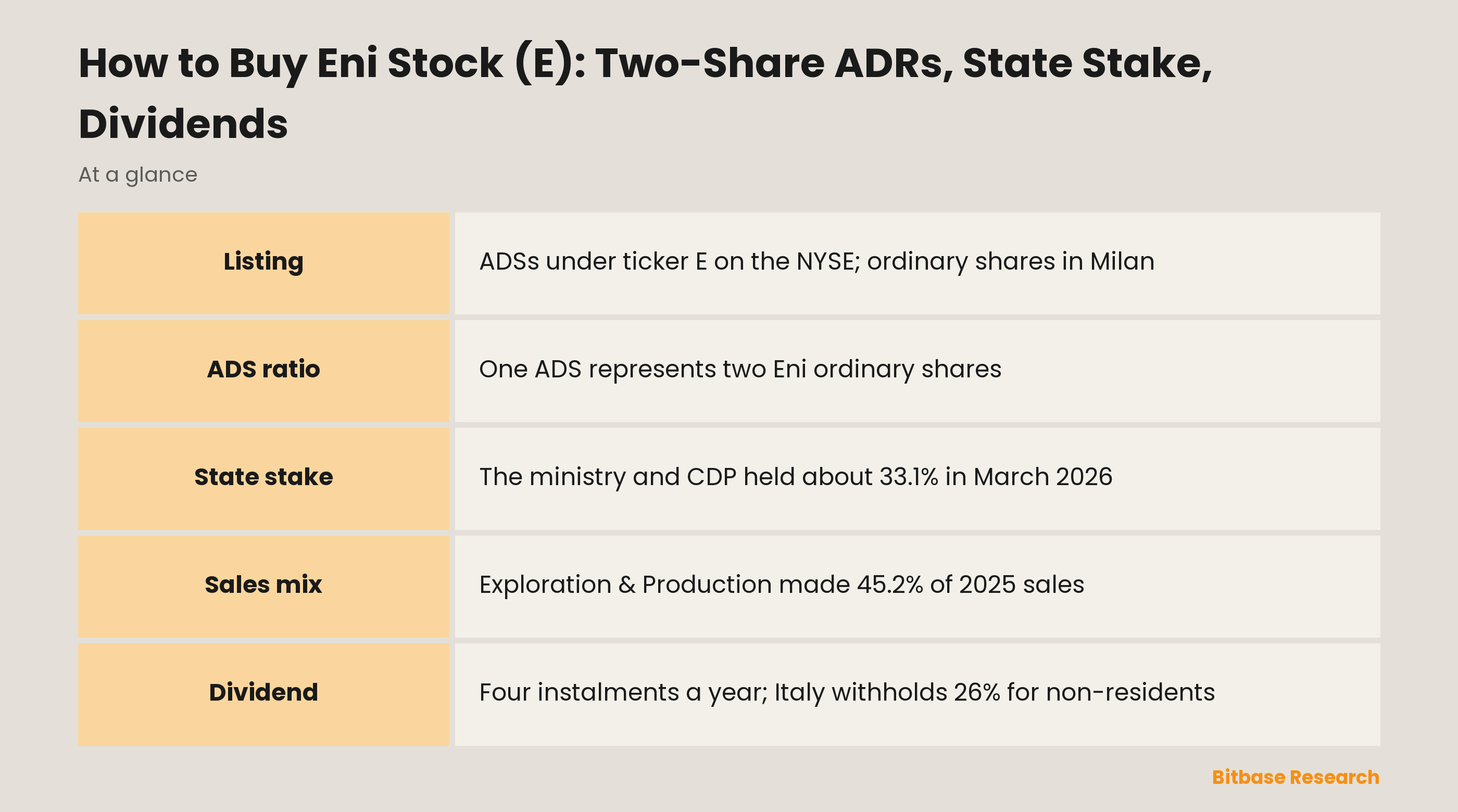
Both Milan and New York quote Eni, so a broker that reaches either market can buy the stock: the ordinary shares trade in euros on Euronext Milan, and the New York Stock Exchange lists American depositary shares under the ticker E, each representing two ordinary shares. Behind the ticker is Italy's former state hydrocarbons agency, still controlled by the Ministry of Economy and Finance: together, the ministry and Cassa Depositi e Prestiti held about 33.1% of the shares in March 2026.
What Does Eni Do?
Eni is an integrated energy company: it explores for and produces oil and natural gas, makes fuels and chemicals, generates gas-fired power and sells "energy products from renewable sources." It began as Ente Nazionale Idrocarburi, a public agency created by a law of 10 February 1953, became a joint stock company in 1992 and has its registered office in Rome. Its sponsored American depositary receipt programme dates from 1995, and in November 2025 it marked thirty years of listing in New York.
The 2025 accounts report five segments. Exploration & Production finds and produces oil and gas in 33 countries, from Italy, Libya and Egypt to Norway, Angola, Kazakhstan and Indonesia. Global Gas & LNG Portfolio and Power sells pipeline gas and liquefied natural gas (LNG) wholesale and runs gas-fired plants in Italy. Refining and Chemicals makes fuels and, through the subsidiary Versalis, chemicals, plastics and elastomers. Enilive produces biofuels at Venice and Gela and through the Chalmette joint venture in the United States, and runs service stations. Plenitude sells gas and electricity to households and businesses, runs solar and wind plants and builds charging points for electric vehicles.
Eni calls its way of holding many of these assets the satellite model: separate companies, partly owned by outside investors, that are meant to fund their own growth. It owns 50% of Azule Energy in Angola, 63.1% of Vår Energi in Norway and 35.92% of Ithaca Energy in the UK, and in June 2026 it contributed Indonesian gas assets to Searah, a joint venture with Petronas, for a 50% interest.
How Eni Makes Money
In the 2025 segment note, sales to customers outside the group split as follows:
| Segment | What it sells | Share of 2025 sales |
|---|---|---|
| Exploration & Production | Crude oil, natural gas, oil trading | 45.2% |
| Enilive | Biofuels, service-station fuels, lubricants | 19.9% |
| Global Gas & LNG Portfolio and Power | Wholesale gas, LNG, power | 15.9% |
| Plenitude | Retail gas and power, renewables, EV charging | 12.3% |
| Refining and Chemicals | Refined products, Versalis chemicals | 6.4% |
| Corporate and other activities | Support functions, remediation | 0.3% |
Shares are of 2025 sales from operations after removing sales between segments.
The table understates the upstream. Exploration & Production earned more operating profit in 2025 than the group as a whole, because Refining and Chemicals and the corporate segment posted operating losses. Chemicals is the drag: the 20-F says the petrochemicals arm "has been incurring operating losses for years (with the sole exception of the year of the COVID pandemic)," and in 2025 Eni definitively shut the crackers at Brindisi and Priolo, with projects under way to convert both sites.
Customers and investment sit far apart. Italy took 34.9% of 2025 sales by destination and other European countries another 37.5%, while Africa received 37.7% of capital expenditure and Asia 26.9%.
At the end of September 2026 Plenitude came under joint control by Eni and Ares, Eni's stake fell from 70% to 65%, and the company was deconsolidated, so its sales are no longer part of Eni's revenue.
Eni (E) Stock at a Glance
| Item | Detail |
|---|---|
| Company | Eni SpA, incorporated in the Republic of Italy |
| New York listing | American depositary shares (ADSs) on the NYSE, ticker E |
| ADS ratio | One ADS represents two ordinary shares |
| Depositary | Citibank, N.A., since 27 June 2017 |
| Home market | Euronext Milan, run by Borsa Italiana; shares quoted in euros |
| Sector | Integrated energy: oil and gas, power, refining, chemicals, biofuels |
| Index membership | FTSE MIB in Milan; EURO STOXX 50 |
| Headquarters | Rome, with offices in San Donato Milanese |
| Financial year | Calendar year, reported in euros under IFRS |
| Dividend pattern | Four instalments: September, November, March and May |
| SEC filings | Form 20-F yearly, Form 6-K in between; CIK 1002242 |
Price, market value and yield change with every trade; for the live quote, open the Eni stock page on Bitbase.
How to Buy Eni Stock
Either line, the dollar-priced ADS in New York or the euro-priced share in Milan, is bought through a broker:
1. Choose the market. A broker with US market access can buy the ADS; one with Italian market access can buy ordinary shares on Euronext Milan.
2. Open, verify and fund the account. The broker records your country of tax residence, which later decides how much Italian tax is withheld. Compare the exchange rate as well as the commission.
3. Find the right line. Search for ticker E and confirm the result reads Eni SpA American depositary shares on the NYSE.
4. Choose an order type. A market order fills at the best available price; a limit order fills only at your price or better, or not at all.
5. Decide on the size. One ADS equals two ordinary shares; whether you can buy a fraction depends on the broker.
6. Keep the records. Confirmations and dividend statements show your cost basis and the tax already withheld.
ADS or ordinary share. Milan is the principal market: on 4 March 2026 the ADSs outstanding represented about 1.67% of Eni's share capital. The deposit agreement lets Citibank charge holders fees, including on cash distributions, and deduct taxes from what it pays out. Other European oil majors, such as Shell and TotalEnergies, set up their New York lines differently, so check the ratio rather than assume it.
Dividends and Italian tax. An ADS carries two shares' worth of each euro instalment, paid later: the second instalment of the 2026 dividend reaches Milan holders on 25 November 2026 and ADS holders on 7 December 2026, net of Italian withholding. Italy levies a 26% substitute tax on dividends paid to non-residents. A US resident holding less than 25% of the voting stock qualifies for 15% under the US-Italy treaty, but only by giving the dividend paying agent an IRS certificate for each payment; otherwise 26% is deducted and the difference must be reclaimed from the Italian tax authorities. Italy has treaties with about 100 countries, so ask your broker which rate applies to you.
Through a fund. Eni is in Milan's FTSE MIB index, and State Street's SPDR EURO STOXX 50 ETF (FEZ) listed it among its holdings on 29 October 2026. Funds that replicate either index own Eni as one holding among many.
What Moves Eni (E) Stock
Crude and gas prices. The 20-F is direct: "An investment in the Company carries significant exposure to fluctuations in global crude oil prices and, to a lesser extent, in prices of other energy commodities."
Where the barrels are. About 84% of Eni's proved hydrocarbon reserves were in non-OECD countries at the end of 2025, "mainly in Africa, Central Asia and Middle East." The risk factors name Libya, Venezuela and Egypt as places of particular political exposure, and production plans carry a "haircut" for possible disruption in "the countries involved in the current Middle East conflict." In the third quarter of 2026, refinery throughput outside Italy fell 12% year on year on lower volumes linked to the closure of the Strait of Hormuz.
Satellite deals. Each transaction changes what an E share holds directly. KKR's 30% of Enilive and Ares's 20% of Plenitude closed in 2025, and Plenitude left consolidation in September 2026. The Searah contribution and the revaluation of the retained Plenitude stake produced gains that Eni treats as special items, so 2026 reported profit includes gains its adjusted figures leave out.
Payouts tied to the oil scenario. Eni plans to return between 35% and 45% of its adjusted cash flow through dividends and buybacks. The buyback is the flexible part: the 20-F sized the 2026 programme to an oil-price assumption and said it would grow if prices or performance beat plan. In October 2026 the board announced an extraordinary dividend for December and raised the buyback by 12%.
Eni's Cautions for E Shareholders
These risk factors bear most directly on an E share:
The energy transition. Stricter climate rules "may end up suppressing demands for our products in medium-to-long term," and investments in low or zero carbon products "may not achieve expected returns."
Litigation. "Eni is the defendant in several civil and criminal actions and administrative proceedings," some of which "might involve allegations of breaching anti-bribery and anti-corruption laws." A climate suit brought in Rome in May 2023 by Greenpeace, ReCommon and 12 citizens was still ongoing when the 20-F was filed.
State control. The by-laws cap every shareholder except the state and entities it controls at 3% of the capital, and voting rights above that limit cannot be exercised; the cap lapses only if a takeover bidder reaches at least 75% of the voting capital. Italy's golden power rules also let the government veto or set conditions on deals involving strategic energy assets.
Above the business, a single stock concentrates your money in one company's outcomes, and the ADS puts depositary fees, a later payment date and a currency conversion between you and each payout.
How to Research Eni Yourself
Eni files with the SEC as a foreign private issuer under CIK 1002242. The 20-F is the annual report, and the 2025 edition was filed on 23 March 2026; 6-Ks carry quarterly results, each dividend instalment and the weekly buyback reports. In the 20-F, start with the risk factors, then the segment note for sales and operating profit by segment and region, the major shareholders section for stakes above 3%, and the taxation section for the withholding rules.
One check avoids a common mistake: the structured cover of the 2025 report, R1.htm, puts the symbol E on the row for ordinary shares, which it marks "Not for trading, but only in connection with the registration of American Depositary Shares." What trades in New York is the ADS. For quotes, use the stock page above, and for other companies browse Bitbase's US stock pages.
Eni Stock FAQ
Can I buy Eni stock with crypto?
Not directly. Eni ADSs and Milan shares are bought through a brokerage account in dollars or euros, so crypto has to be sold for cash first, and depending on where you live that sale may be taxable. An Eni ordinary share carries one vote and a right to dividends, and that bundle of rights is how a listed share differs from a crypto asset.
How many Eni shares does one ADS represent?
Two. The 20-F states that "each ADR represents two Eni ordinary shares," with Citibank, N.A. as depositary. The dividend per ADS is twice the per-share amount, before fees and withholding.
Does Eni pay a dividend?
Yes, in four instalments. The 2026 dividend, approved by the shareholders' meeting of 6 May 2026, is paid in September and November 2026 and in March and May 2027. Formally these are distributions of reserves "in place of" a dividend; amounts and dates are in each 6-K.
Is Eni controlled by the Italian government?
Yes. The 20-F says the Ministry of Economy and Finance "controls Eni" through its own shares and those of Cassa Depositi e Prestiti, in which it holds 82.77%. On 11 March 2026 the ministry held 2.166% directly and CDP 30.918%.
What is the difference between E, ENI and EIPAF?
E is the NYSE ticker of Eni's ADSs. In Milan the ordinary shares appear as ENI, for example in State Street's FEZ holdings file. EDGAR also lists EIPAF, an over-the-counter symbol; it is not the NYSE-listed ADS, so check which line your broker shows before you order.
Conclusion
Buying Eni comes down to one choice: the NYSE ADS under ticker E, worth two ordinary shares and paid later through Citibank, or the ordinary shares in Milan. What each share holds keeps shifting as assets move into ventures, and the payout moves with the oil scenario. Read the latest 20-F and 6-Ks, and check your withholding rate, before deciding how much belongs in one energy stock.
Related reading
Other Bitbase articles on this topic:
- How to Buy Cheniere Energy Stock (LNG): LNG vs CQP and Dividend
- How to Buy Devon Energy Stock (DVN): Coterra Merger, Dividend
- How to Buy Diamondback Energy Stock (FANG): Viper and the Permian
- How to Buy Williams Stock (WMB): Transco and Data Center Power
Disclaimer: This article is educational content from Bitbase Academy, provided for information only. It explains what a company or fund does and how the instruments referenced here differ from one another; it does not constitute investment, trading, tax, or financial advice, and it is neither a recommendation nor an endorsement of any security, token, or trading strategy. A tokenized stock is issued by a third party and is designed to give economic exposure to an underlying asset: it is not a share, it carries no shareholder rights, and it depends on the issuer's structure, eligibility rules, and redemption terms, which the issuer can change. Perpetual futures are leveraged derivatives that hold no underlying asset and can be liquidated, and trading hours, product availability, and eligibility differ by instrument and by jurisdiction and can change at any time. Written as of October 2026; verify everything yourself through company filings, the issuer's own documentation, and the product pages of the venue you trade on.
References
[1] Eni SpA, Form 20-F for 2025 (SEC EDGAR) www.sec.gov
[2] Eni 20-F for 2025, XBRL cover page (R1) www.sec.gov
[3] Eni third-quarter 2026 results and dividend tranche (Form 6-K, 23 October 2026) www.sec.gov
[4] Eni report on treasury share purchases, 19 to 23 October 2026 (Form 6-K) www.sec.gov
[5] State Street: SPDR EURO STOXX 50 ETF (FEZ), holdings as of 29 October 2026 www.ssga.com
[6] SEC EDGAR: Eni SpA filing index (CIK 1002242) www.sec.gov





