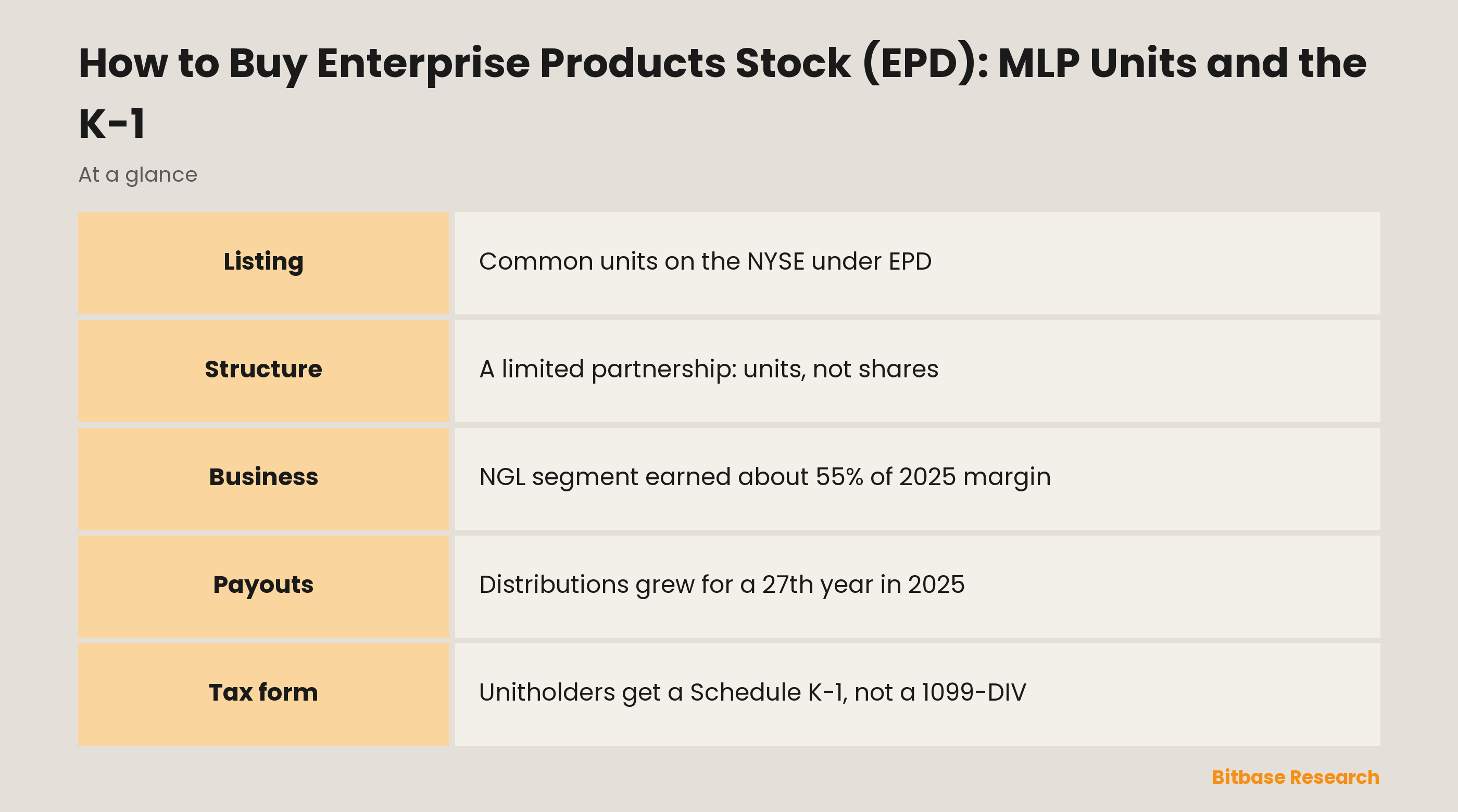
Neither a special account nor a special exchange is needed to buy Enterprise Products: its common units trade on the New York Stock Exchange under the ticker EPD, and any brokerage account with NYSE access can place the order. What lands in the account, though, is a unit of a limited partnership rather than a share of stock, so the quarterly payouts are distributions, not dividends, and the yearly tax form is a Schedule K-1. Behind the units sits a Houston-based network that processes, moves, stores and exports hydrocarbons, and its NGL segment earned about 55% of 2025 segment gross operating margin.
What Does Enterprise Products Do?
Enterprise Products Partners L.P. is a midstream energy business. Its annual report describes a network that links producers of natural gas, NGLs and crude oil "from some of the largest supply basins" in the US, Canada and the Gulf of Mexico "with domestic consumers and international markets." In between, it processes and moves natural gas, natural gas liquids (NGLs) and crude oil, makes propylene and other petrochemicals, and runs barges on US inland waterways.
NGLs need a short explanation. Gas from the wellhead, especially gas produced alongside oil, carries NGLs such as ethane, propane, butanes and natural gasoline, and such streams, the 10-K explains, "are usually not acceptable for transportation in downstream natural gas transmission pipelines or for commercial use as fuel." Enterprise strips the liquids out at plants in Colorado, Louisiana, Mississippi, New Mexico, Texas and Wyoming, splits them into separate products at fractionators such as its Mont Belvieu complex in Texas, and sends them on to chemical plants or export docks.
The docks matter. The Enterprise Hydrocarbons Terminal on the Houston Ship Channel loads liquefied petroleum gases (LPG) for export, and the 10-K notes that "the U.S. has become the largest exporter of LPG in the world, with shipments originating from EHT playing a key role." The first phase of a new ethane and propane export facility on the Neches River in Orange County, Texas, began service in July 2025.
The ownership structure is the other thing to know. Enterprise is a Delaware limited partnership formed in April 1998 to take over NGL businesses of EPCO, a private Texas company. Its general partner, Enterprise Products Holdings LLC, runs it but holds "a non-economic general partner interest"; the economic owners are the holders of common and preferred units. The general partner belongs to Dan Duncan LLC; EPCO and its private affiliates owned about 32.5% of the common units at the end of 2025. The partnership has no employees of its own; EPCO staff do the work. Leadership is also changing: co-chief executive A.J. "Jim" Teague plans to retire on 4 January 2027, leaving W. Randall "Randy" Fowler as sole chief executive.
How Enterprise Products Makes Money
Enterprise earns fees for processing, fractionation, transportation, storage and terminaling, and margins on products its marketing arm buys and sells. The second dominates revenue: product sales made up about 86.2% of fiscal 2025 revenue. That makes revenue a weak guide to profit, and the 10-K says higher marketing revenue "may not result in an increase in gross operating margin or cash available for distribution, since our consolidated cost of sales amounts would also be expected to increase."
Management judges each segment by gross operating margin, and the two yardsticks rank the segments very differently:
| Segment | Share of 2025 revenue | Share of 2025 segment gross operating margin | Margin change vs 2024 |
|---|---|---|---|
| NGL Pipelines & Services | 32.9% | 55.3% | up 0.2% |
| Crude Oil Pipelines & Services | 39.5% | 14.9% | down 8.8% |
| Natural Gas Pipelines & Services | 7.9% | 15.5% | up 22.0% |
| Petrochemical & Refined Products Services | 19.7% | 14.3% | down 7.2% |
Shares are calculated from the fiscal 2025 segment figures in the 10-K and rounded to one decimal.
Crude oil brought in the most revenue but earned less margin than natural gas, because much of that revenue is crude bought and resold. The NGL chain, from processing plants to export docks, is the core, and natural gas grew fastest. In total, segment gross operating margin rose 0.4% in 2025 while revenue fell 6.4%, and net income attributable to common unitholders slipped 1.5%.
Customers are spread out: the top 200 accounted for 96.7% of 2025 revenue, and no single customer reached 10%. The marketing arm's main purpose is to raise volumes on the assets, which "results in additional fee-based earnings for each business segment."
EPD Stock at a Glance
| Item | Detail |
|---|---|
| Exchange | New York Stock Exchange (NYSE) |
| Ticker | EPD |
| Security | Common units representing limited partner interests, the single class on the 10-K's 12(b) cover |
| Preferred units | Exist, but are not publicly traded |
| Legal form | Publicly traded Delaware limited partnership |
| Managed by | Enterprise Products Holdings LLC, the general partner, owned by Dan Duncan LLC |
| Sector | Midstream energy: natural gas, NGLs, crude oil, petrochemicals and refined products |
| Index membership | Not in State Street's S&P 500 trust holdings (29 October 2026); held by the Alerian MLP ETF |
| Headquarters | Houston, Texas |
| Fiscal year | Calendar year, ending 31 December |
| Payout policy | Quarterly cash distributions; 2025 was the 27th consecutive year of distribution growth |
| Tax reporting | Annual Schedule K-1 tax package |
| SEC identifier | CIK 1061219 |
For the live price and trading data, open the Enterprise Products stock page on Bitbase.
How to Buy Enterprise Products Stock
EPD is a US partnership listed in New York, so there is no depositary receipt to consider. The order works like any NYSE purchase; what differs is the paperwork afterwards:
1. Choose a broker with NYSE access. Outside the US, that can be a local firm offering US markets or an international broker. Before funding, ask whether it accepts partnership units for your account type and how it handles the withholding described below.
2. Open and verify the account. Your residence and tax status matter more for a partnership unit than for an ordinary share.
3. Fund it. Currency conversion has a cost, so check the rate as well as the fee.
4. Find the right line. Search EPD and confirm it reads Enterprise Products Partners L.P. common units on the NYSE; the preferred units do not trade publicly.
5. Pick an order type. FINRA says a market order "provides the most certainty that your order will be executed," while with a limit order "you're guaranteed to get your limit price or a better price if your order is executed."
6. Decide on the size. "The availability of fractional share trading varies by brokerage firm," FINRA notes, and a fraction cannot currently be moved to another firm.
7. Keep the records, and expect a K-1. For the 2025 tax year, Enterprise expected to post K-1 tax packages online by 27 February 2026 and to finish mailing them by 6 March 2026.
Units, not shares. An EPD unit is one of the "common units representing limited partner interests" in the partnership. It trades much as a share does, but the rights differ: "Unlike the holders of common stock in a corporation, unitholders have only limited voting rights on matters affecting our business." The payouts are distributions declared by the general partner's board. And because the partnership generally pays no federal income tax, each holder is taxed on a share of its income, reported on Schedule K-1, which a partnership "uses … to report your share of the partnership's income, deductions, credits, etc.," in the IRS's words. Dividends, by contrast, are reported on Form 1099-DIV.
Retirement accounts. The 10-K warns that "virtually all" of its income allocated to tax-exempt holders, "including IRAs and other retirement plans, will be unrelated business taxable income and will be taxable to them."
Outside the United States, the difference is largest. "Non-U.S. unitholders will be subject to U.S. taxes and withholding with respect to their income and gain from owning our common units," the 10-K says, because that income and gain are generally treated as "effectively connected" with a US trade or business, with US filing requirements attached. It adds that "a distribution to a non-U.S. unitholder is expected to be subject to withholding at the highest applicable effective tax rate." When a non-US holder sells, the transferee must generally withhold 10% of the amount realized, a duty that generally falls on the broker handling the sale. The partnership posts the required "qualified notices" on its website, and its own advice is that non-US unitholders "should consult their tax advisors"; ask your broker and a tax adviser before buying, not after.
Through a fund, check the holdings first. State Street's daily holdings file for its S&P 500 trust, dated 29 October 2026, does not list EPD, but the Alerian MLP ETF (AMLP) listed Enterprise Products Partners in its schedule of investments as of 28 February 2026. A fund wraps the units in its own structure, so read its prospectus for how it is taxed.
What Moves EPD Stock
Basin volumes. Fees are earned on what flows through the system. The latest quarterly release highlights the Permian Basin, with record processing volumes in the third quarter of 2026 and "higher natural gas to oil production ratios in the Permian Basin"; an eleventh Delaware Basin plant started up within the past twelve months.
Exports and trade policy. The second phase of the Neches River terminal came into service in the year to September 2026, and a fourth expansion of the Houston Ship Channel LPG terminal is among the next scheduled completions. Among the causes of weaker demand, the 10-K lists "retaliatory tariffs on U.S. hydrocarbons by importing countries," and it warns that tariffs on steel could raise the cost of building and maintaining pipelines.
Prices and spreads. Processing contracts are "either fee-based, commodity-based or a combination of the two," and when the cost of extracting ethane exceeds what it would add, recovery may be deliberately reduced. This "ethane rejection" cuts the volumes available to the pipelines and fractionators. A producer's exposure is different: the ConocoPhillips stock guide explains how an unhedged oil and gas company takes price moves straight into its results, whereas Enterprise feels them through volumes, contract mix and marketing spreads.
New assets. Over the twelve months to September 2026, Frac 14 at Mont Belvieu and the Bahia NGL pipeline came into service, and in January 2026 part of the Seminole NGL pipeline switched to crude as Midland-to-ECHO 2. A new Athena plant in the Midland Basin is due next. Construction "may result in delays, increased costs or decreased cash flows," the 10-K cautions.
Distribution decisions. The 10-K warns that the units' value "may decrease in correlation with any reduction in our cash distributions per unit." The distribution declared for the third quarter of 2026 was 2.8% higher than a year earlier, and 2025 was what the partnership calls its 27th consecutive year of distribution growth. Increases are not automatic: "Management will evaluate any future increases in cash distributions on a quarterly basis," and each payment needs board approval.
Three Layers of Risk in an EPD Unit
The 10-K sorts its risk factors into three groups (the business, the partnership structure and tax), and an EPD unit carries all three.
The business. Changes in hydrocarbon prices and in "the relative price levels among hydrocarbon products" can hurt results, and demand can fall for reasons from economic conditions to foreign tariffs. "Several of our assets have been in service for many years and require significant expenditures to maintain them." Hurricanes can interrupt Gulf Coast operations, and rates on interstate liquids pipelines are regulated by the Federal Energy Regulatory Commission, where shippers can protest them.
The structure. The general partner and its affiliates have "limited fiduciary responsibilities to, and conflicts of interest with respect to, our partnership, which may permit it to favor its own interests to your detriment." Unitholders "are not entitled to elect our general partner or its directors." Units held by anyone owning 20% or more of a class, other than the general partner and its affiliates, cannot be voted. If the general partner and its affiliates ever own 85% or more of the common units, the general partner may buy out the rest at no less than the then-current market price. Unitholders also "may have a liability to repay distributions."
Tax. Publicly traded partnerships are treated as corporations for tax unless 90% or more of their income is "qualifying income"; Enterprise met that test in 2023, 2024 and 2025, but if it were taxed as a corporation, "cash available for distribution to our unitholders would be reduced." Holders may owe tax on their share of income "even if they do not receive any cash distributions," distributions above that share lower their tax basis and in effect become taxable income on a sale, and they "will likely be subject to state and local taxes and return filing requirements in states where they do not live."
The security itself. One partnership is one set of outcomes, and a distribution record is history, not a promise; from another currency, both price and distributions are converted at the going exchange rate.
How to Research Enterprise Products Yourself
Enterprise files with the SEC under CIK 1061219: the annual 10-K, quarterly 10-Qs and 8-Ks for events, including each earnings release and the July 2026 succession notice. The releases also report the change in the declared distribution.
In the 10-K, Items 1 and 2 describe the assets, Item 1A sets out the three groups of risk, Note 10 gives segment revenue and gross operating margin, and Note 16 explains the tax status. The structured cover of the fiscal 2025 report, R1.htm, lists a single registered security: the common units under EPD. The K-1 package and the qualified notices for non-US holders sit on enterpriseproducts.com. Live quotes are on the stock page linked above, and more US stock pages on Bitbase cover other companies.
Enterprise Products Stock FAQ
Is EPD a stock or a partnership unit?
A partnership unit. The NYSE security is Enterprise Products Partners' common units, limited partner interests in a Delaware limited partnership. People call it EPD stock and it trades like one, but holders have limited voting rights, receive distributions rather than dividends and get a Schedule K-1.
Does Enterprise Products pay a dividend?
It pays quarterly cash distributions, the partnership's counterpart to a dividend. Distributions declared for 2025 were 3.6% higher than for 2024, the 27th consecutive year of growth by the partnership's count, and the third-quarter 2026 distribution was up 2.8% on a year earlier. The 8-K releases give each amount and date.
Can I buy Enterprise Products stock with crypto?
Not directly. The units are bought through brokerage accounts and paid for in US dollars, so any crypto would first have to be converted to cash, which can be a taxable sale depending on your country, and the cash then sent to the broker. A unit is a registered partnership interest with its own tax reporting, one of the ways how stocks and crypto differ.
Which tax form do EPD unitholders receive?
A Schedule K-1, sent in a yearly tax package, not the Form 1099-DIV used for dividends. The IRS notes that a partner "may be liable for tax on your share of the partnership income, whether or not distributed," and the 10-K adds that allocated taxable income can differ from the cash distributed.
Is EPD in the S&P 500?
No. State Street's daily holdings file for its S&P 500 trust (SPY), dated 29 October 2026, does not include Enterprise Products Partners, while energy corporations such as Exxon Mobil, covered in the Exxon Mobil stock guide, and Kinder Morgan appear in it. MLP funds such as the Alerian MLP ETF do hold EPD.
Has Enterprise Products ever split its units?
Yes. Its filings record a two-for-one split distributed on 15 May 2002, described at the time as its first, and another distributed on 21 August 2014. Older per-unit figures need adjusting.
Conclusion
Buying EPD takes no more than buying any NYSE stock; the difference comes afterwards. You own units in a partnership its general partner controls, you receive distributions with a long growth record but no guarantee, and you get a K-1 instead of a dividend slip; outside the US, distributions are expected to be withheld at the highest applicable rate. Read the tax risks in the latest 10-K, and ask your broker and tax adviser how they treat partnership units, before deciding how much of one pipeline partnership belongs in your portfolio.
Related reading
Other Bitbase articles on this topic:
- How to Buy Cheniere Energy Stock (LNG): LNG vs CQP and Dividend
- How to Buy Devon Energy Stock (DVN): Coterra Merger, Dividend
- How to Buy Diamondback Energy Stock (FANG): Viper and the Permian
Disclaimer: This article is educational content from Bitbase Academy, provided for information only. It explains what a company or fund does and how the instruments referenced here differ from one another; it does not constitute investment, trading, tax, or financial advice, and it is neither a recommendation nor an endorsement of any security, token, or trading strategy. A tokenized stock is issued by a third party and is designed to give economic exposure to an underlying asset: it is not a share, it carries no shareholder rights, and it depends on the issuer's structure, eligibility rules, and redemption terms, which the issuer can change. Perpetual futures are leveraged derivatives that hold no underlying asset and can be liquidated, and trading hours, product availability, and eligibility differ by instrument and by jurisdiction and can change at any time. Written as of October 2026; verify everything yourself through company filings, the issuer's own documentation, and the product pages of the venue you trade on.
References
[1] Enterprise Products Partners Form 10-K, fiscal 2025 (SEC EDGAR) www.sec.gov
[2] Enterprise Products Partners 10-K, fiscal 2025: XBRL cover page (SEC EDGAR) www.sec.gov
[3] Enterprise fourth-quarter and full-year 2025 results release (Form 8-K exhibit) www.sec.gov
[4] Enterprise third-quarter 2026 results release (Form 8-K exhibit) www.sec.gov
[5] Enterprise news release, 1 July 2026: chief executive succession (Form 8-K exhibit) www.sec.gov
[6] Enterprise news release, 27 February 2002: two-for-one unit split (Form 8-K exhibit) www.sec.gov
[7] Enterprise news release, 15 July 2014: two-for-one split of common units (Form 8-K exhibit) www.sec.gov
[8] IRS: Partner's Instructions for Schedule K-1 (Form 1065) www.irs.gov
[9] IRS: About Form 1099-DIV, Dividends and Distributions www.irs.gov
[10] State Street, SPDR S&P 500 ETF Trust (SPY): daily holdings as of 29 October 2026 www.ssga.com
[11] ALPS ETF Trust: Alerian MLP ETF schedule of investments as of 28 February 2026 www.alpsfunds.com
[12] FINRA: Order Types www.finra.org
[13] FINRA: Investing in Fractional Shares www.finra.org





