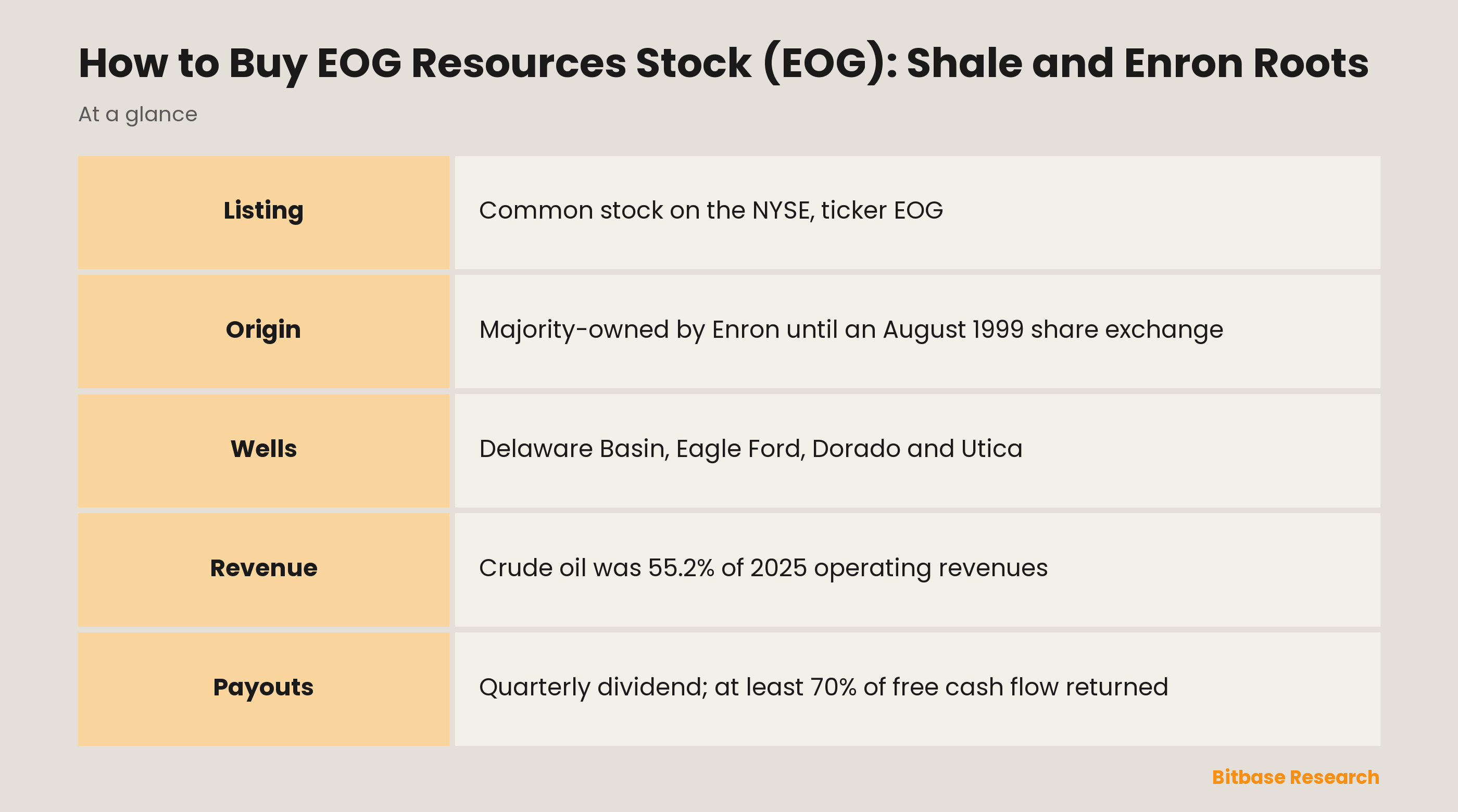
Someone with an ordinary brokerage account can buy EOG Resources on the New York Stock Exchange, where its common stock trades under the ticker EOG. The company was Enron Oil & Gas until 1999, when a share exchange ended Enron's majority stake, and today it drills shale wells from the Delaware Basin in Texas and New Mexico to the Utica play in Ohio. The sections below cover how it earns money, the steps for buying from outside the US, and the factors EOG's own filings tie to the share.
What Does EOG Resources Do?
EOG Resources explores for, develops, produces and markets crude oil, natural gas liquids (NGLs) and natural gas. Its annual report calls it "one of the largest independent (non-integrated) crude oil and natural gas companies in the United States," and adds that "EOG's operations are all crude oil and natural gas exploration and production related." With no refining arm, its income depends on how much its wells yield and what that output sells for; an integrated group works differently, as our guide to Exxon Mobil stock shows.
EOG is a Delaware corporation organized in 1985 and based in Houston, Texas. It says it "implements its strategy primarily by emphasizing the drilling of internally generated prospects in order to find and develop low-cost reserves." At the end of 2025 about 99% of its net proved reserves, measured in oil equivalent, were in the United States and 1% in Trinidad.
The history runs through Enron. As Enron Oil & Gas Company it was majority-owned by Enron Corp., which held approximately 53.5% of its outstanding common stock just before a share exchange closed on 16 August 1999. EOG handed Enron a subsidiary holding its China and India operations, and the EOG shares Enron gave back were retired. The name EOG Resources, Inc. took effect on 30 August 1999.
The 10-K groups US operations into four named areas plus a small remainder:
Delaware Basin. The western part of the Permian Basin, across West Texas and southeastern New Mexico, where EOG completes wells mainly in the Wolfcamp, Bone Spring and Leonard plays. It is the largest area, with about 58.1% of 2025 output on an oil-equivalent basis.
South Texas. The Eagle Ford oil play and the Dorado gas play.
Appalachian Basin. The Utica play in Ohio, enlarged by the August 2025 purchase of Encino, which the 10-K says added 675,000 core net acres.
Rocky Mountain. The Powder River Basin in Wyoming and the Williston Basin in North Dakota.
Abroad, EOG produces gas offshore Trinidad, where it is building a new platform, Coconut, under a 2024 farmout agreement with BP Trinidad and Tobago. In Bahrain it is drilling gas exploration wells under an agreement with Bapco Energies. In Abu Dhabi it holds 100% of the Unconventional Onshore Block 3 oil concession, won in May 2025, and began producing crude there in June 2026.
How EOG Resources Makes Money
EOG sells its output at market prices: crude at the price or index for each sales point, with some exported through the Port of Corpus Christi in 2025, and gas mostly at the local spot price. Two gas arrangements differ. Gas delivered to a liquefaction plant near Corpus Christi can be priced off the Platts Japan Korea Marker, an Asian LNG benchmark, and a 10-year contract signed in February 2024 will, from 2027, sell domestic gas mostly at prices indexed to Brent crude.
The income statement splits revenue into a few lines:
| Revenue line in the 2025 10-K | What it covers | Share of 2025 operating revenues | Change vs 2024 |
|---|---|---|---|
| Crude oil and condensate | EOG's own production | 55.2% | Down 10.2% |
| Natural gas liquids | EOG's own production | 10.5% | Up 12.8% |
| Natural gas | EOG's own production, US and Trinidad | 12.3% | Up 79.9% |
| Gathering, processing and marketing | Third-party oil and gas resold, gathering fees, sand sales | 21.7% | Down 15.3% |
| Other items | Derivative gains, asset sale losses, other income | 0.2% | Small in both years |
Calculated from the fiscal 2025 10-K income statement.
Two prices pulled in opposite directions in 2025. The 10-K attributes the fall in crude revenue to a composite crude price 15% lower than in 2024, which outweighed a 6% rise in crude production, mostly from the Utica and the Permian Basin. Gas went the other way, with a composite price 39% higher and deliveries up 30%. Even so, crude provided about 70.8% of 2025 revenue from selling EOG's own oil, NGLs and gas.
The marketing line looks large but works differently. It mostly covers third-party oil and gas that EOG buys and resells, plus gathering fees and sales of its own sand, and a marketing cost line equal to about 98% of it sits on the other side, so it adds far more to revenue than to profit.
The mix is shifting toward gas. Crude, condensate and NGLs made up about 68% of EOG's US production in 2025, in oil equivalent, against about 72% in 2024; in the first half of 2026 the share was about 66%, against about 70% a year earlier.
The United States segment brought in 98.4% of 2025 operating revenues; the segment note treats all major US producing areas as one segment and reports Trinidad and Other International separately. In 2025 two purchasers, both crude oil refiners, each accounted for more than 10% of revenue, though EOG says losing any one would not have a material adverse effect. Total operating revenues and other fell 4.5% for the year, and net income 22.2%.
EOG Stock at a Glance
| Item | EOG |
|---|---|
| Listed on | NYSE (New York Stock Exchange) |
| Ticker | EOG |
| Security | Common stock, the only listed security on the 10-K cover |
| Former name | Enron Oil & Gas Company, until 30 August 1999 |
| Sector | Energy: independent oil and gas exploration and production |
| Index | S&P 500 constituent; XLE, the energy sector SPDR fund, holds it too |
| Head office | Houston, Texas |
| Incorporated in | Delaware, 1985 |
| Financial year | Ends 31 December |
| Dividend policy | Regular quarterly dividend; special dividends and buybacks under a cash return framework |
| Stock splits | Two-for-one in 2005 and again in 2014 |
| SEC identifier | CIK 821189 |
Quotes, market value and yield move through the trading day; the EOG Resources stock page on Bitbase shows them live.
How to Buy EOG Resources Stock
EOG has one listing and no depositary receipt, so the NYSE share is what you buy wherever you live:
1. Choose a broker with NYSE access, local or international, and check which authority licenses it and who holds client assets.
2. Open the account. A non-US individual is usually asked for IRS Form W-8BEN, the "Certificate of Foreign Status of Beneficial Owner for United States Tax Withholding and Reporting (Individuals)."
3. Fund it, and compare the cost of converting currency, not just the commission.
4. Search for EOG and confirm the line reads EOG Resources, Inc. common stock on the NYSE.
5. Pick an order type. FINRA says a market order "provides the most certainty that your order will be executed," while with a limit order "you're guaranteed to get your limit price or a better price if your order is executed. However, there's a chance your order doesn't get executed at all."
6. Decide on fractions. FINRA notes that "the availability of fractional share trading varies by brokerage firm," that fractional shares cannot be moved to another brokerage, and that their owners "might not have shareholder voting rights."
7. Keep the confirmations and dividend statements for your tax return.
Who sits on the register. On 13 February 2026 the 10-K counted about 3,400 holders of record but about 1,271,000 beneficial owners. Most investors hold EOG the way a new buyer will: a broker or bank appears on the register through its nominee, and the investor is the beneficial owner behind it.
Dividends for non-US holders. The IRS states that "most types of U.S. source income received by a foreign person are subject to U.S. tax of 30%," and a tax treaty with your country of residence may lower or remove that. The W-8BEN is how the broker, as withholding agent, applies it. Your own country may also tax the payout; this is not tax advice.
Through a fund. State Street's holdings files for 29 October 2026 list EOG in SPY, its S&P 500 fund, and in XLE, its energy sector fund; either way EOG is one holding among many.
What Moves EOG Stock
Oil prices, with most 2026 output exposed. Crude is about seven-tenths of the revenue from EOG's own production, and the 10-K says "a majority of our forecasted production for 2026 is subject to fluctuating market prices." Its year-end 2025 derivative tables list natural gas and NGL contracts, so a move in crude reaches most of the barrels it plans to sell.
The Middle East in 2026. The mid-2026 10-Q links volatility to "the ongoing conflict in the Middle East and the related disruption of maritime transportation routes." The average NYMEX crude price in the first half was 22% higher than a year earlier, and second-quarter total operating revenues rose 57%, with Encino's wells now in the figures. In October 2026 an 8-K raised EOG's estimate of third-quarter current tax expense because realized crude prices had come in higher than expected.
Gas, and the indices behind it. As liquids lose share, gas matters more, and not all of it follows Henry Hub. The Brent-linked contract is accounted for as a derivative and marked to market, so changes in its fair value pass through reported earnings each period, before the first delivery in 2027.
Encino and the Utica. EOG completed the purchase of Encino Acquisition Partners, an independent Utica producer, on 1 August 2025, paying cash partly raised through bonds issued that July. Its debt-to-total-capitalization ratio rose from 14% at the end of 2024 to 21% a year later, and the acquired wells' performance is now part of the case.
The cash return framework. Since fiscal 2024 EOG has committed to return "a minimum of 70 percent of annual net cash provided by operating activities before certain balance sheet-related changes, less total capital expenditures" through "regular dividends, special dividends and share repurchases." The board doubled the buyback authorization with effect from 20 May 2026; it has no time limit and can be suspended at any time.
Federal land and royalties. Part of EOG's acreage in New Mexico, North Dakota and Wyoming is leased from the federal government. The Inflation Reduction Act of 2022 set a 16.67% royalty rate on new federal leases, and the July 2025 One Big Beautiful Bill Act reversed it to the earlier 12.5%, so leasing and permitting decisions in Washington reach the company directly.
To set EOG beside another US exploration and production company, read the ConocoPhillips stock guide.
Risk Factors EOG Shareholders Should Read First
Item 1A of the 10-K is long; the passages below matter most to a shareholder.
Prices. "Crude oil, NGLs and natural gas prices are volatile, and a substantial and extended decline in commodity prices can have a material and adverse effect on us." A decline can also limit the company's "ability to pay regular and special dividends on our common stock or repurchase shares."
Depletion. "If we fail to acquire or find sufficient additional reserves over time, our reserves and production will decline from their current levels."
Water. "Our operations are substantially dependent upon the availability of water." In a drought, local authorities can restrict its use for drilling and completions.
Acquisitions. Failing "to effectively integrate the acquired properties into our operations," or to spot problems and estimate reserves accurately, could hurt results; with Encino still new, this one is not abstract.
Payouts. "Our Board may reduce our dividends or cease declaring dividends at any time," and buybacks depend on the share price, cash and other commitments.
Add the risks of holding one stock in a cyclical industry, and currency risk if you do not save in US dollars.
Following EOG's Paper Trail on EDGAR
EOG's SEC filer number (CIK) is 821189, and the company also posts its 10-K, 10-Q and 8-K reports free on eogresources.com. In the 10-K, Item 1 has the area table; Item 5 shows buybacks and a performance graph against the S&P 500 and the S&P 500 Oil & Gas Exploration & Production Index; Item 7 holds the Cash Return Framework and the dividend declarations; and Notes 11, 12 and 16 cover segments, derivatives and Encino. Each 10-Q also estimates how much full-year net income changes with a one-dollar move in oil.
In the filings one barrel of oil equivalent stands for six thousand cubic feet of gas; when gas gains share, reported volume grows faster than revenue. For quotes on EOG's listed peers, browse the US stock pages on Bitbase.
EOG Resources Stock FAQ
Does EOG Resources pay a dividend?
Yes. The board declares a regular dividend each quarter, with recent payments at the end of January, April, July and October; the latest increase in the filings was declared in May 2025. The 10-K stresses that the board "may reduce our dividends or cease declaring dividends at any time."
Does EOG pay special dividends?
Its cash return framework names special dividends as one of three tools, with regular dividends and buybacks, for returning at least 70% of annual free cash flow as the company defines it. Whether one is paid is the board's call; every declaration listed in the 2025 10-K and the mid-2026 10-Q was a regular quarterly dividend.
Can I buy EOG Resources stock with crypto?
No, not as a single transaction. Brokers settle EOG purchases in dollars, so the crypto has to be sold first, possibly with a tax bill, and the proceeds sent to the brokerage account. A share also behaves differently from a token, as how stocks and crypto differ explains.
Was EOG Resources part of Enron?
Yes, until 1999. Enron Corp. owned about 53.5% of Enron Oil & Gas before the August 1999 share exchange, and the company became EOG Resources on 30 August 1999.
Is EOG in the S&P 500?
Yes. SPY held EOG on 29 October 2026, and XLE, the energy sector fund, held it too. Index weights change every day.
Has EOG stock ever split?
Yes. The 10-Ks record two two-for-one splits, one effective 1 March 2005 and one paid as a stock dividend on 31 March 2014.
Conclusion
Buying EOG takes a broker with NYSE access and an order for the ticker EOG. The share itself represents a US shale producer, oil-weighted but drifting toward gas, that grew in Ohio through Encino and returns cash under a stated minimum the board can still revisit. Work through the most recent 10-K and 10-Q, starting with the area table and the Cash Return Framework, before deciding how much one producer should weigh in a portfolio.
Related reading
Other Bitbase articles on this topic:
- How to Buy Cheniere Energy Stock (LNG): LNG vs CQP and Dividend
- How to Buy Devon Energy Stock (DVN): Coterra Merger, Dividend
- How to Buy Diamondback Energy Stock (FANG): Viper and the Permian
Disclaimer: This article is educational content from Bitbase Academy, provided for information only. It explains what a company or fund does and how the instruments referenced here differ from one another; it does not constitute investment, trading, tax, or financial advice, and it is neither a recommendation nor an endorsement of any security, token, or trading strategy. A tokenized stock is issued by a third party and is designed to give economic exposure to an underlying asset: it is not a share, it carries no shareholder rights, and it depends on the issuer's structure, eligibility rules, and redemption terms, which the issuer can change. Perpetual futures are leveraged derivatives that hold no underlying asset and can be liquidated, and trading hours, product availability, and eligibility differ by instrument and by jurisdiction and can change at any time. Written as of October 2026; verify everything yourself through company filings, the issuer's own documentation, and the product pages of the venue you trade on.
References
[1] EOG Resources Form 10-K, fiscal 2025: business, revenue, risk factors (SEC EDGAR) www.sec.gov
[2] EOG Resources Form 10-Q, quarter ended 30 June 2026 (SEC EDGAR) www.sec.gov
[3] EOG Resources Form 8-K, 1 August 2025: Encino acquisition completed (SEC EDGAR) www.sec.gov
[4] EOG Resources Form 8-K, 8 October 2026: third-quarter tax guidance update (SEC EDGAR) www.sec.gov
[5] EOG Resources Form 8-K, August 1999: share exchange with Enron Corp. (SEC EDGAR) www.sec.gov
[6] EOG Resources Form 10-K405, fiscal 1999: change of name from Enron Oil & Gas (SEC EDGAR) www.sec.gov
[7] EOG Resources Form 10-K, fiscal 2005: two-for-one stock split (SEC EDGAR) www.sec.gov
[8] EOG Resources Form 10-K, fiscal 2014: two-for-one stock split (SEC EDGAR) www.sec.gov
[9] State Street SPDR S&P 500 ETF Trust (SPY): daily holdings file www.ssga.com
[10] State Street Energy Select Sector SPDR ETF (XLE): daily holdings file www.ssga.com
[11] FINRA: Order Types www.finra.org
[12] FINRA: Investing in Fractional Shares www.finra.org
[13] IRS: NRA Withholding www.irs.gov
[14] IRS: About Form W-8 BEN, certificate of foreign status for withholding www.irs.gov





