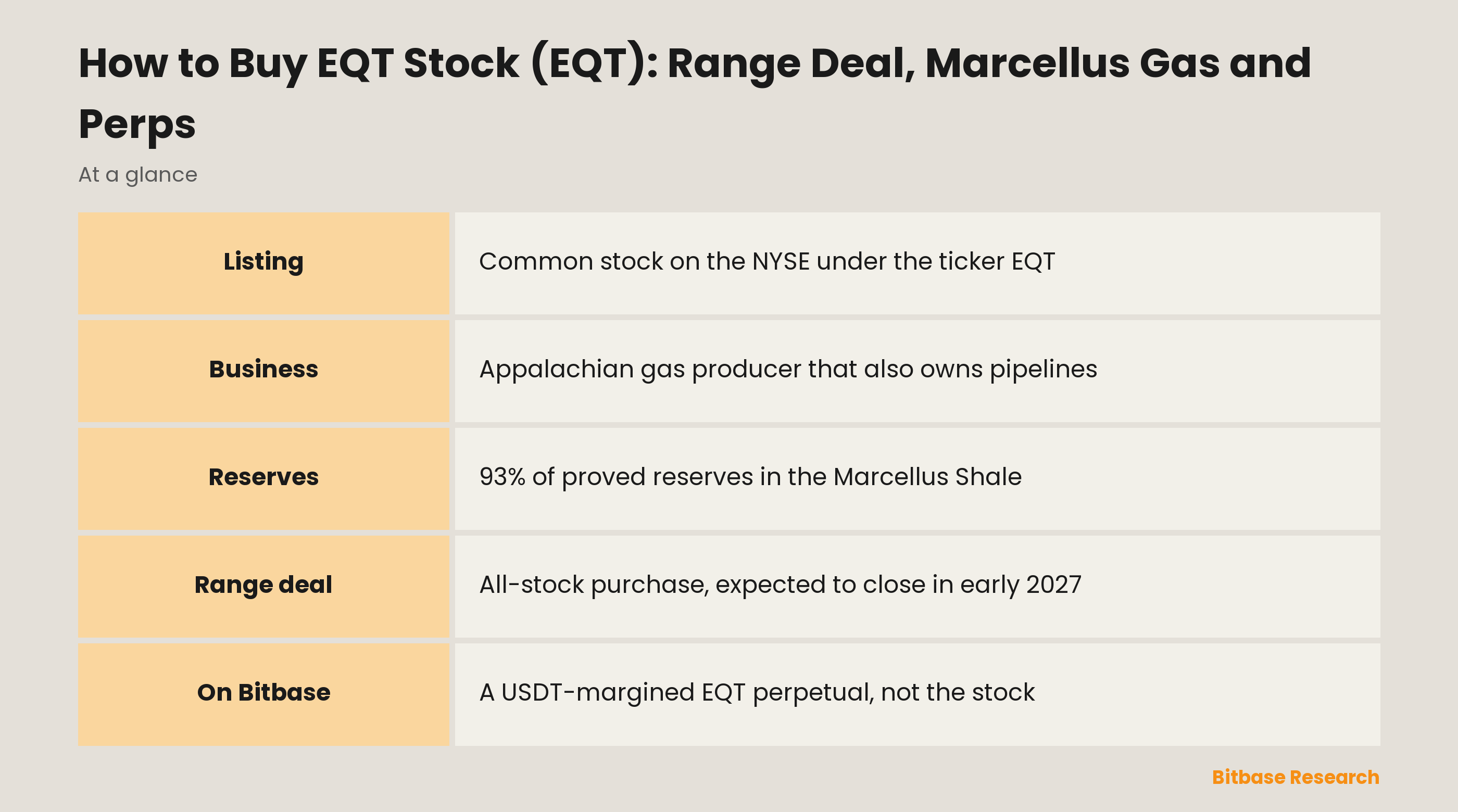
Three letters do double duty here: EQT is both the company's name and its ticker on the New York Stock Exchange, so any broker that sells US shares can fill an order for EQT Corporation common stock. The company produces natural gas in the Appalachian Basin, owns much of the pipe that carries it away, and in October 2026 agreed to buy Range Resources, another Appalachian producer, for stock. Bitbase lists an EQT perpetual settled in USDT, which tracks the share price but is backed by no shares.
What Does EQT Do?
In its annual report EQT calls itself "a vertically integrated natural gas company with upstream, gathering and transmission operations focused in the Appalachian Basin." Upstream means drilling and producing: at the end of 2025 the company held 28.0 trillion cubic feet equivalent (Tcfe) of proved reserves across about 2.3 million gross acres in Pennsylvania, West Virginia and Ohio, and 93% of those reserves sit in the Marcellus Shale. Natural gas is the main product, with natural gas liquids (NGLs) and a little oil alongside.
The midstream half is newer. Since EQT bought Equitrans Midstream on 22 July 2024, the gathering and transmission services Equitrans used to sell it are provided inside the group. EQT also holds an interest in the Mountain Valley Pipeline, a 303-mile line from Wetzel County, West Virginia, to Pittsylvania County, Virginia, which entered service on 14 June 2024. Two additions, MVP Southgate into North Carolina and MVP Boost, are expected by mid-2028, pending regulatory approval.
Acquisitions built most of today's company. EQT Corporation was formed in Pennsylvania in 2008 through a holding company reorganization of Equitable Resources, whose name it dropped in early 2009. It bought Rice Energy in November 2017, and Toby Z. Rice, formerly Rice Energy's operating chief, has been president and chief executive since July 2019. Olympus Energy's acreage joined on 1 July 2025, and on 21 July 2026 EQT added Blackline Midstream's propane terminals in New Hampshire and Rhode Island. Recent filings list the head office in Canonsburg, Pennsylvania.
One caution on the name: EQT AB, the Swedish investment firm, is a separate company.
How EQT Makes Money
EQT reports three segments. Upstream sells the gas, NGLs and oil it produces and books the hedge results tied to those sales. Gathering moves gas from wellheads to larger lines for a fee, mostly for EQT's own wells. Transmission runs interstate pipe and storage for local distribution companies, other producers, marketers and industrial users. Upstream was called Production until December 2025; only the name changed.
The revenue mix in 2025 shows how gas-weighted the company is. Natural gas sales made up about 81% of total operating revenue. Within the sales of its own production, gas was about 91%, NGLs about 8% and oil the rest. Pipeline and other revenue from outside customers, after removing what EQT charges itself, came to about 7%. Total operating revenue rose about 64% from 2024; the 10-K attributes most of the gain in product sales to a higher NYMEX gas price, with volumes also up after production cuts in 2024.
Location shapes what EQT actually receives. The filing explains that gas in the Appalachian Basin "is typically lower relative to NYMEX Henry Hub," because supply in the Northeast is plentiful and pipeline capacity to other regions is limited. That gap, called basis, is one reason owning pipe matters. The stated aim is to be "the leading low-cost producer of natural gas": pipeline contracts supply steadier fees when gas is cheap, and when it is expensive, low costs permit "lower levels of financial hedging."
EQT is also lining up export outlets: by the end of 2025 it had three 20-year agreements to buy liquefied natural gas (LNG), starting from 2030 and 2031, plus a 20-year tolling agreement, though some of the projects behind them had not reached a final investment decision.
EQT Stock at a Glance
| Item | Detail |
|---|---|
| Exchange | New York Stock Exchange |
| Ticker | EQT |
| Share class | One class of common stock, no par value |
| Industry | Natural gas production, gathering and transmission |
| Index membership | S&P 500 since October 2022 (held by SPY on 9 November 2026) |
| Headquarters | Canonsburg, Pennsylvania |
| Incorporated in | Pennsylvania (formed in 2008) |
| Former name | Equitable Resources, Inc. |
| Fiscal year end | 31 December |
| Reportable segments | Three: Upstream, Gathering, Transmission |
| Dividend policy | Quarterly cash dividend, at the board's discretion |
| Share buybacks | Program announced in December 2021 |
| Pending deal | All-stock acquisition of Range Resources, expected to close in the first quarter of 2027 |
Live quotes and charts sit on the EQT stock page on Bitbase.
How to Buy EQT Stock
An order for EQT shares follows the routine any US-listed stock does:
1. Pick a broker that offers NYSE shares and accepts clients from your country.
2. Complete account opening. Expect identity checks; brokers usually ask non-US residents for a Form W-8BEN.
3. Deposit money. If your account is not in dollars, the currency conversion carries a spread or fee.
4. Search for the ticker EQT and confirm the listing name is EQT Corporation, not a similarly named company.
5. Set the order. A market order takes whatever price is available; a limit order names your maximum and may sit unfilled. Some brokers sell fractions of a share.
From outside the United States. EQT files a 10-K, so you buy the same common stock US holders own, with no depositary receipt. Dividends paid abroad may face US withholding tax at a rate that depends on your residence and any tax treaty; this is general information, not tax advice.
Through a fund. As an S&P 500 member, EQT is a small slice of index funds such as SPY.
While the Range deal is pending. If the acquisition closes, Range shareholders receive 0.987 of a new EQT share for each Range share, leaving existing EQT holders with about 73% of the combined company. EQT shareholders must first approve the share issuance at a special meeting.
Trading EQT on Bitbase
Bitbase offers an EQT perpetual futures contract with margin and settlement in USDT. It follows EQT's share price, but no share is bought for you: no dividend, no vote on the Range deal, and no expiry date. Either direction is open, long or short, with optional leverage, and trading continues overnight and at weekends while the NYSE is shut.
Funding is the cost unique to this product: at regular intervals, the more crowded side pays the other, which keeps the contract near the stock's price, and over weeks of holding those payments add up. If your margin runs out, the position is liquidated at the mark price rather than at the last traded price. News does not wait for the opening bell: EQT released its third-quarter 2026 results after the market close, and the perpetual can reprice on that kind of news before the NYSE opens. For the mechanics in detail, read the guide to stock perpetuals.
Several numbers are left out here on purpose: how often funding is paid and how it is calculated, the margin tiers, the leverage cap, and what happens to the mark price and funding while the NYSE is closed. The EQT contract rules hold those details. Bitbase collects its contracts on listed companies on the TradFi page.
What Moves EQT Stock
Gas prices, first and last. EQT's results "depend upon the market prices for natural gas and, to a lesser extent, NGLs and oil," the 10-K says. Henry Hub sets the benchmark; the Appalachian discount moves with regional supply and pipeline space.
Choosing not to produce. EQT sometimes curtails output when prices are weak. Its third-quarter 2026 product sales fell about 10% from a year earlier, mainly because of strategic curtailments, although the first nine months were up about 17% on higher prices.
The Range acquisition. The deal needs both shareholder votes, antitrust clearance and an effective registration statement. Until then the price can reflect the odds of closing, and the 10-Q warns that a failed deal could hurt the stock if the price assumed completion.
Pipes out of the basin. Takeaway capacity decides how much Appalachian gas can reach higher-priced markets. The Mountain Valley Pipeline opened a route into Virginia in 2024, and the two expansion projects planned for mid-2028 would add more; delays would leave more gas competing for local buyers.
New demand. The company names power generation, industry, domestic data centers and LNG exports as growing sources of demand, so supply deals and progress at the LNG plants behind its agreements are news for the stock.
Winter and capital returns. Gas demand generally rises in winter and falls in summer, so a mild winter weighs on prices. EQT pays a quarterly dividend, has a buyback program and a published plan to keep reducing debt.
Where EQT's Gas-Heavy Model Is Exposed
One commodity. Low gas prices could push the company to "revise our shareholder returns initiatives, including the amount of dividends paid on EQT common stock," and past price declines have already caused some asset write-downs.
One region. "Substantially all of our producing properties and midstream infrastructure are geographically concentrated in the Appalachian Basin," the filing says, leaving EQT exposed to local regulation, bottlenecks and weather in one area.
Hedges that cap the upside. "To the extent we have hedged our current production at prices below the current market price, we will not benefit fully from an increase in the price of natural gas."
Deal risk. The 10-Q states that the Range acquisition "is subject to conditions, including certain conditions that are beyond our control and may not be satisfied," and that if it closes, EQT "may not achieve the anticipated benefits."
Litigation and politics. A securities class action over EQT's statements about the 2017 Rice Energy merger was settled with court approval in November 2025, but related shareholder suits were still pending at the 10-K. Some politicians have also called for a windfall profits tax on gas producers or limits on LNG exports, though none had passed.
Extra risk in the perpetual. Leverage enlarges losses, funding is charged for as long as the position stays open, and a gap at the NYSE open can jump past your liquidation price.
How to Research EQT Yourself
On EDGAR, EQT files under CIK 33213, on a calendar fiscal year. Its 2025 10-K arrived on 18 February 2026 and the proxy statement on 26 February. The third-quarter 10-Q followed on 28 October 2026, one day after the results release. The Range agreement came in an 8-K on 26 October 2026; deal communications appear as Form 425, and a registration statement for the new shares is still to come.
In the 10-K, the reserves tables in Item 1 break down proved reserves by product and by state. The revenue note separates gas, NGL and oil sales from gathering and transmission fees. The commodity risk discussion in Item 7 tabulates hedged gas volumes quarter by quarter, including collars. Presentations and webcasts are on ir.eqt.com.
EQT Stock FAQ
Does EQT pay a dividend?
Yes, every quarter, in cash. EQT raised the base payment by 5% in 2025. The board sets amount and timing and may change the rate "at any time for any reason."
Is EQT stock in the S&P 500?
Yes. EQT moved from the S&P MidCap 400 to the S&P 500 in October 2022, and State Street's SPY listed EQT Corp among its holdings on 9 November 2026. Membership is reviewed over time, so confirm it on a current list.
What happens to EQT shares in the Range Resources deal?
Your shares stay EQT common stock on the NYSE under the same ticker. EQT would issue new shares to Range holders, so existing holders would own about 73% of a larger company. Closing is expected in the first quarter of 2027, subject to both votes and regulatory clearance. For a pipeline operator's view of the same Appalachian gas, see the Williams stock profile.
Is EQT Corporation the same company as EQT AB?
No. EQT Corporation is the Pennsylvania gas producer listed on the NYSE as EQT; EQT AB is a separate Swedish investment firm. Check the full name before ordering.
Can I buy EQT stock with crypto?
Brokers do not accept crypto for shares, so coins have to be sold for cash first. With USDT on Bitbase you can trade the EQT perpetual instead, which follows the price but holds no stock, pays no dividend and can be liquidated. The guide to buying stocks with crypto covers the routes from coins to actual shares.
Conclusion
EQT's results rise and fall with the price of Appalachian natural gas, and the pipelines it now owns soften but do not remove that link. The Range acquisition would make the company larger in the same basin, with the same exposure, and it still needs votes and regulatory clearance. The common stock trades on the NYSE through any broker with US access, while the Bitbase perpetual gives price exposure without ownership, at the cost of funding and liquidation risk.
Related reading
Other Bitbase articles on this topic:
- How to Buy Cheniere Energy Partners Stock (CQP): Sabine Pass Units
- How to Buy Ecopetrol Stock (EC): One ADS, 20 Colombian Shares
- How to Buy Halliburton Stock (HAL): Frac Fleets and NYSE Texas
- How to Buy Pembina Stock (PBA): PBA in New York, PPL in Toronto
- How to Buy Woodside Stock (WDS): NYSE ADS, ASX Shares and LNG
Disclaimer: This article is educational content from Bitbase Academy, provided for information only. It explains what a company or fund does and how the instruments referenced here differ from one another; it does not constitute investment, trading, tax, or financial advice, and it is neither a recommendation nor an endorsement of any security, token, or trading strategy. A tokenized stock is issued by a third party and is designed to give economic exposure to an underlying asset: it is not a share, it carries no shareholder rights, and it depends on the issuer's structure, eligibility rules, and redemption terms, which the issuer can change. Perpetual futures are leveraged derivatives that hold no underlying asset and can be liquidated, and trading hours, product availability, and eligibility differ by instrument and by jurisdiction and can change at any time. Written as of November 2026; verify everything yourself through company filings, the issuer's own documentation, and the product pages of the venue you trade on.
References
[1] EQT Form 10-K for 2025 (SEC EDGAR) www.sec.gov
[2] EQT Form 10-Q, third quarter of 2026 (SEC EDGAR) www.sec.gov
[3] EQT Form 8-K, October 2026: Range Resources merger agreement (SEC EDGAR) www.sec.gov
[4] EQT and Range Resources joint news release, 26 October 2026 (SEC EDGAR) www.sec.gov
[5] State Street: SPY daily holdings, 9 November 2026 www.ssga.com





