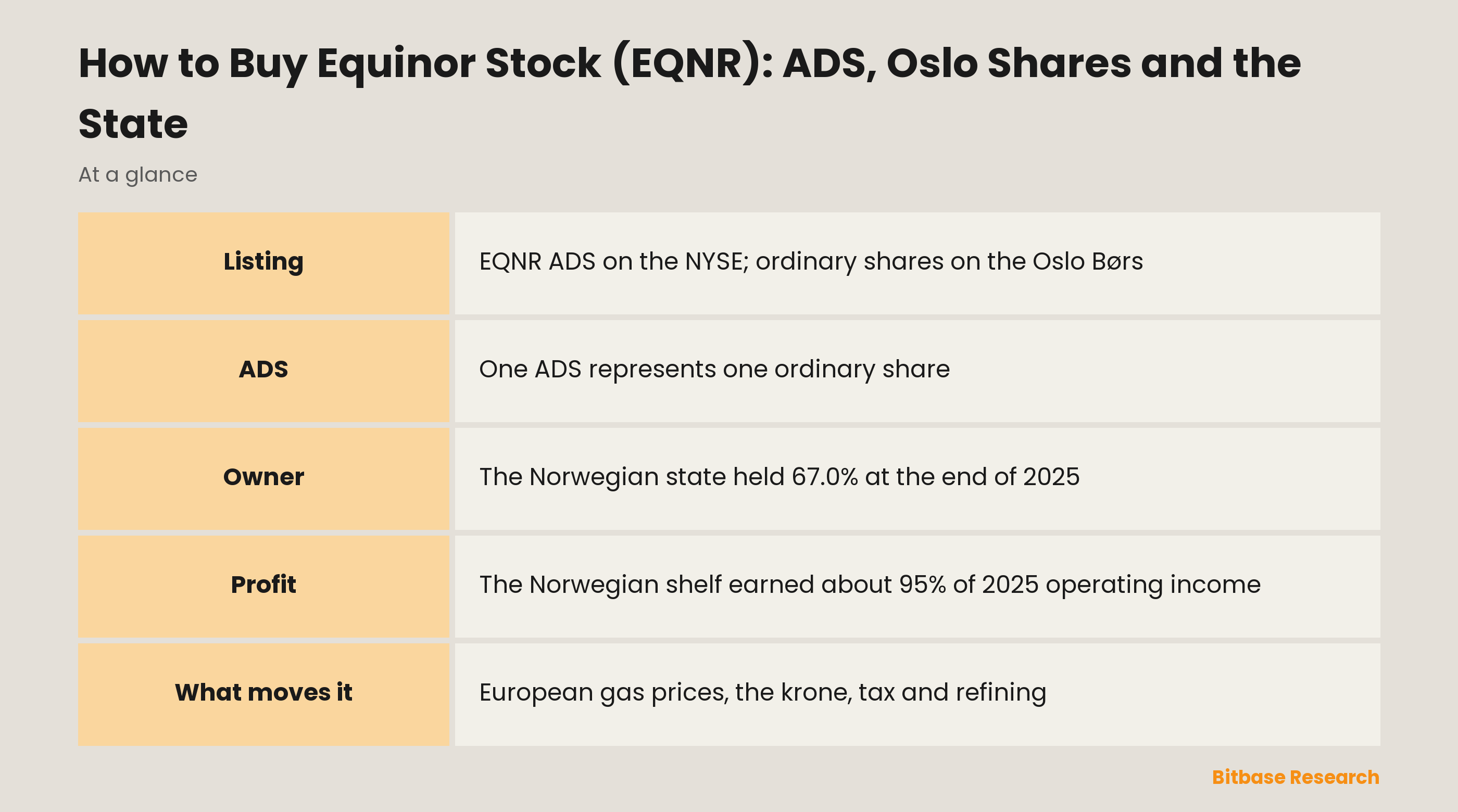
An account with a broker that offers New York Stock Exchange shares is all it takes to buy Equinor: search for EQNR, and each American depositary share (ADS) stands for one ordinary share of Equinor ASA, whose primary listing is on the Oslo Børs. The unusual part is the owner. The Norwegian state held 67.0% at the end of 2025 and keeps that stake level by joining buybacks in proportion, while the Norwegian continental shelf earned about 95% of 2025 net operating income.
What Does Equinor Do?
Equinor ASA, based in Stavanger and active in more than 20 countries, states its objective as "to develop, produce and market various forms of energy and derived products and services." It produces oil and gas, mostly on the Norwegian continental shelf (NCS), sells and trades that output along with refined products and power, and is building a power business of wind farms, batteries and gas-fired plants.
Its 2025 accounts show five segments plus Other. E&P Norway, which the annual report calls "the backbone of our portfolio", delivers around two-thirds of the group's equity production, and Equinor is responsible for 70% of the oil and gas produced in Norway. E&P International and E&P USA hold the rest, about 34% of equity production; the United States is its largest producing country outside Norway. Marketing, Midstream & Processing (MMP) sells, trades, refines and transports, and includes the Mongstad refinery and the trader Danske Commodities. Renewables develops wind, solar and storage; from 2026 it is part of a new Power segment that also takes over MMP's flexible power plants.
The company was founded in September 1972 as Statoil, "the government's commercial instrument" for building Norway's oil and gas industry. It listed in Oslo and New York in 2001 with the state keeping 67%, in the 2000s merged with Norsk Hydro's oil and gas division, and in 2018 renamed itself Equinor to match a broader energy strategy.
The annual report ranks Equinor's shareholder returns against 11 peers, among them Aker BP, Chevron, Shell, TotalEnergies and Ørsted, in which Equinor owns a 10% stake.
How Equinor Makes Money
Revenue and profit come from opposite ends of the group. MMP books nearly all outside revenue, while the Norwegian shelf earns nearly all of the profit, selling its oil and gas inside the group at internal prices derived from market prices.
| Segment | Share of 2025 third-party revenue | Share of 2025 net operating income | What it does |
|---|---|---|---|
| E&P Norway | 0.3% | 95.1% | Oil and gas on the Norwegian shelf |
| E&P International | 0.5% | 1.9% | Oil and gas outside Norway and the US |
| E&P USA | 0.2% | 2.6% | US onshore and offshore oil and gas |
| MMP | 98.8% | 6.7% | Marketing, trading, refining, transport |
| Renewables | 0.1% | Loss | Wind, solar and storage |
| Other | 0.1% | Loss | Projects, technology, corporate functions |
Shares are of the 2025 group totals in the segment note; because two segments lost money, the positive shares add up to more than 100%.
In 2025 about 97.6% of E&P Norway's revenue and other income came from sales to other segments. MMP's revenue also includes barrels Equinor does not own: it markets the Norwegian state's share of production from the shelf and books the state's crude oil, natural gas liquids and most of its LNG gross.
By product, crude oil made up 55.5% of 2025 revenue from contracts with customers and natural gas 24.0%, most of it European gas at 20.2%. Group net operating income fell about 18% from 2024, a year in which, the annual report notes, "oil and gas prices were down due to oversupply and a warm winter." Profit on the shelf is also taxed hard: the statutory rate on NCS income is 78%, and the group's effective tax rate in 2025 was 79.8%.
EQNR Stock at a Glance
| Item | Detail |
|---|---|
| What EQNR is | American depositary share (ADS); each represents one ordinary share |
| New York listing | New York Stock Exchange, ticker EQNR, since the IPO on 18 June 2001 |
| Home listing | Oslo Børs, ticker EQNR, the primary listing; priced in Norwegian kroner |
| Depositary | JPMorgan Chase Bank, N.A. |
| Share structure | One class of shares, one vote each |
| Largest shareholder | Norwegian state, 67.0% held directly at the end of 2025; the National Insurance Fund held another 3.1% |
| Legal form | Norwegian public limited company (ASA), incorporated in 1972; head office in Stavanger |
| Accounts | Calendar year, IFRS, presented in US dollars |
| Dividend policy | Quarterly, declared in US dollars; aims to grow the annual dividend per share in line with long-term underlying earnings |
| SEC filings | CIK 1140625; Form 20-F each year, Form 6-K in between |
The table holds only slow-changing facts. The live quote, volume and market value are on the Equinor stock page on Bitbase.
How to Buy Equinor Stock
To buy EQNR stock or the Oslo shares, remember that one ADS equals one ordinary share; the choice is about currency, trading hours and paperwork.
1. Pick the line. EQNR trades on the NYSE in US dollars, the ordinary shares on the Oslo Børs in kroner.
2. Open and verify an account with a broker that serves your country and that market.
3. Fund it. Compare the exchange rate as well as the commission.
4. Find the right security. Search EQNR and confirm it reads Equinor ASA ADS; the ordinary shares are registered on the NYSE only "not for trading".
5. Choose the order type. A market order fills at the next available price; a limit order caps the price and may not fill.
6. Decide the size. Some brokers sell fractions of an ADS, others only whole units.
Trading in different currencies and time zones, the two lines rarely quote the same price; this guide on why session prices differ explains the gap.
ADS or Oslo share. JPMorgan Chase Bank holds the shares behind the ADSs as depositary. ADS holders vote by instructing it, with "no guarantee" that meeting notices arrive in time, and receive dividends in US dollars after tax withheld, conversion costs and a fee on each cash distribution; the fee schedule also allows an annual charge.
Norwegian withholding tax. Non-residents start from a 25% withholding tax on Equinor dividends, which treaties often lower for holders who show they are the beneficial owner. ADS holders can file treaty documents with JPMorgan; without them, 25% is withheld and the excess must be reclaimed from Skatteetaten, the Norwegian Tax Administration. The 20-F's section for US holders works with a 15% treaty rate. Norway charges no transfer tax on buying or selling the shares or ADSs. Ask your broker how it handles Norwegian dividends; none of this is tax advice.
Through a fund. The 20 largest holders at the end of 2025 include The Vanguard Group, BlackRock and State Street; a fund holds Equinor as one slice of a basket, so check its holdings file first.
What Moves EQNR Stock
European gas prices. European gas brought in 20.2% of 2025 revenue from customers. In the third quarter of 2026, results were "primarily impacted by higher liquid prices and European gas prices," after supply disruptions following the conflict in the Middle East drove "a significant increase in European gas prices during the quarter."
The tax wedge. At 78% on the shelf, tax absorbs most of any price-driven swing in operating income, so operating-profit headlines overstate what reaches shareholders.
Refining and trading. MMP earned only 6.7% of 2025 net operating income, but it swings. In the third quarter of 2026 the Mongstad refinery made a record contribution, helped by refinery disruptions in the Middle East and Russia, while the crude, products and liquids unit lost money on derivative positions in a tight shipping market.
The Norwegian krone. A large share of revenue is in or driven by US dollars, but "a large portion of operating expenses, capital expenditures, capital distribution and income taxes payable accrue in NOK."
US offshore wind. Empire Wind, a New York offshore wind farm that Equinor owns outright, received stop-work orders in April 2025, lifted in May, and on 22 December 2025. Impairments on US offshore wind projects helped push Renewables to a 2025 loss. On 30 September 2026 a court dismissed the project's challenge because the order had expired.
Buybacks. The state's proportional share of each buyback is redeemed and cancelled, so issued shares fell about 8.4% in 2025. The 2026 programme set in February had been enlarged by the third-quarter report.
Risks Specific to Equinor
Prices. "Energy prices and predominantly oil and natural gas prices are the primary drivers of Equinor's financial results, liquidity, and its ability to finance planned capital expenditures."
A controlling owner. "The interests of Equinor's majority shareholder, the Norwegian state, may not always be aligned with the interests of Equinor's other shareholders." With more than two-thirds of the shares, the state can amend the articles of association on its own and controls majority votes, including approval of the dividend.
Political intervention. Equinor's "offshore wind projects as well as exploration and production activities undertaken together with national oil companies are subject to a significant degree of state control and oversight," as Empire Wind's two stop-work orders showed.
The energy transition. The 2025 annual report lowered the company's net carbon intensity ambitions for 2030 and 2035 and warns: "There is no assurance that these ambitions will be achieved."
The payout and the ADS. The board weighs the economy, cash flow, capital spending and flexibility when setting payouts, and 2025 payouts were smaller than in 2024, which had included extraordinary dividends. ADS holders also carry depositary fees and withholding paperwork, and one stock concentrates your money in one company.
How to Research EQNR Yourself
Equinor files with the SEC under CIK 1140625 as a foreign private issuer: a Form 20-F each year and Forms 6-K for quarterly reports and news, the third-quarter 2026 report on 28 October 2026.
The 20-F incorporates much of its business description and its risk factors from the 2025 Annual Report filed with it, while the audited accounts, including the segment note and Note 27 on dealings with the state, are in the 20-F itself. Its structured cover, R1.htm, lists two NYSE securities: the ADS and the ordinary shares behind it. The same reports are on equinor.com/reports.
Equinor Stock FAQ
Is Equinor the same company as Statoil?
Yes. It was founded as Statoil in 1972 and renamed Equinor in 2018; its SEC filings still list the earlier names Statoil ASA and StatoilHydro ASA.
How much of Equinor does the Norwegian government own?
The state held 67.0% directly at the end of 2025, managed by the Ministry of Trade, Industry and Fisheries, plus 3.1% through the National Insurance Fund, Folketrygdfondet. Its shares vote like anyone else's, and an agreement with Equinor holds the stake at 67% through buybacks.
Is EQNR in New York the same as Equinor shares in Oslo?
Each EQNR ADS represents one ordinary share, so the claim is the same. The ADS trades in US dollars on the NYSE, the ordinary shares in kroner on the Oslo Børs; ADS holders vote through the depositary and pay its fees.
Does Equinor pay a dividend?
Yes, quarterly. Equinor announces each dividend with its results, declares it in US dollars and expects to pay about four months later; Oslo shareholders receive kroner. Non-residents start from a 25% Norwegian withholding tax. Amounts change, so check the latest 6-K.
Can I buy Equinor stock with crypto?
Not in one step. A broker sells EQNR for US dollars, so crypto must first be sold for cash and moved into the brokerage account, and that sale can be taxable where you live. This guide to buying stocks with crypto covers the conversion.
Conclusion
Buying Equinor is simple: EQNR in New York and the ordinary shares in Oslo are the same claim, one for one. What you buy is less ordinary: a company two-thirds owned by the Norwegian state that earns nearly all its operating income on the Norwegian shelf and pays most of it in tax. Read the latest 20-F and quarterly 6-K before deciding how much of it belongs in your holdings.
Related reading
Other Bitbase articles on this topic:
- How to Buy Devon Energy Stock (DVN): Coterra Merger, Dividend
- How to Buy Diamondback Energy Stock (FANG): Viper and the Permian
- How to Buy Enbridge Stock (ENB): Pipelines, Dividend, Line 5
Disclaimer: This article is educational content from Bitbase Academy, provided for information only. It explains what a company or fund does and how the instruments referenced here differ from one another; it does not constitute investment, trading, tax, or financial advice, and it is neither a recommendation nor an endorsement of any security, token, or trading strategy. A tokenized stock is issued by a third party and is designed to give economic exposure to an underlying asset: it is not a share, it carries no shareholder rights, and it depends on the issuer's structure, eligibility rules, and redemption terms, which the issuer can change. Perpetual futures are leveraged derivatives that hold no underlying asset and can be liquidated, and trading hours, product availability, and eligibility differ by instrument and by jurisdiction and can change at any time. Written as of October 2026; verify everything yourself through company filings, the issuer's own documentation, and the product pages of the venue you trade on.
References
[1] Equinor ASA Form 20-F for 2025: listing, ADS terms and fees, Norwegian taxation, audited financial statements (SEC EDGAR) www.sec.gov
[2] Equinor 2025 Annual Report, filed with the 20-F: history, business areas, shareholders, buybacks, risk factors (SEC EDGAR) www.sec.gov
[3] Equinor ASA 2025 Form 20-F, structured XBRL cover (R1.htm): registered securities and identifiers www.sec.gov
[4] Equinor ASA 2025 Form 20-F, XBRL segment data (R78.htm): revenue and net operating income by segment www.sec.gov
[5] Equinor ASA, description of securities filed with the 2025 20-F: shares, ADS dividends and voting (SEC EDGAR) www.sec.gov
[6] Equinor third quarter 2026 report on Form 6-K, 28 October 2026 (SEC EDGAR) www.sec.gov





