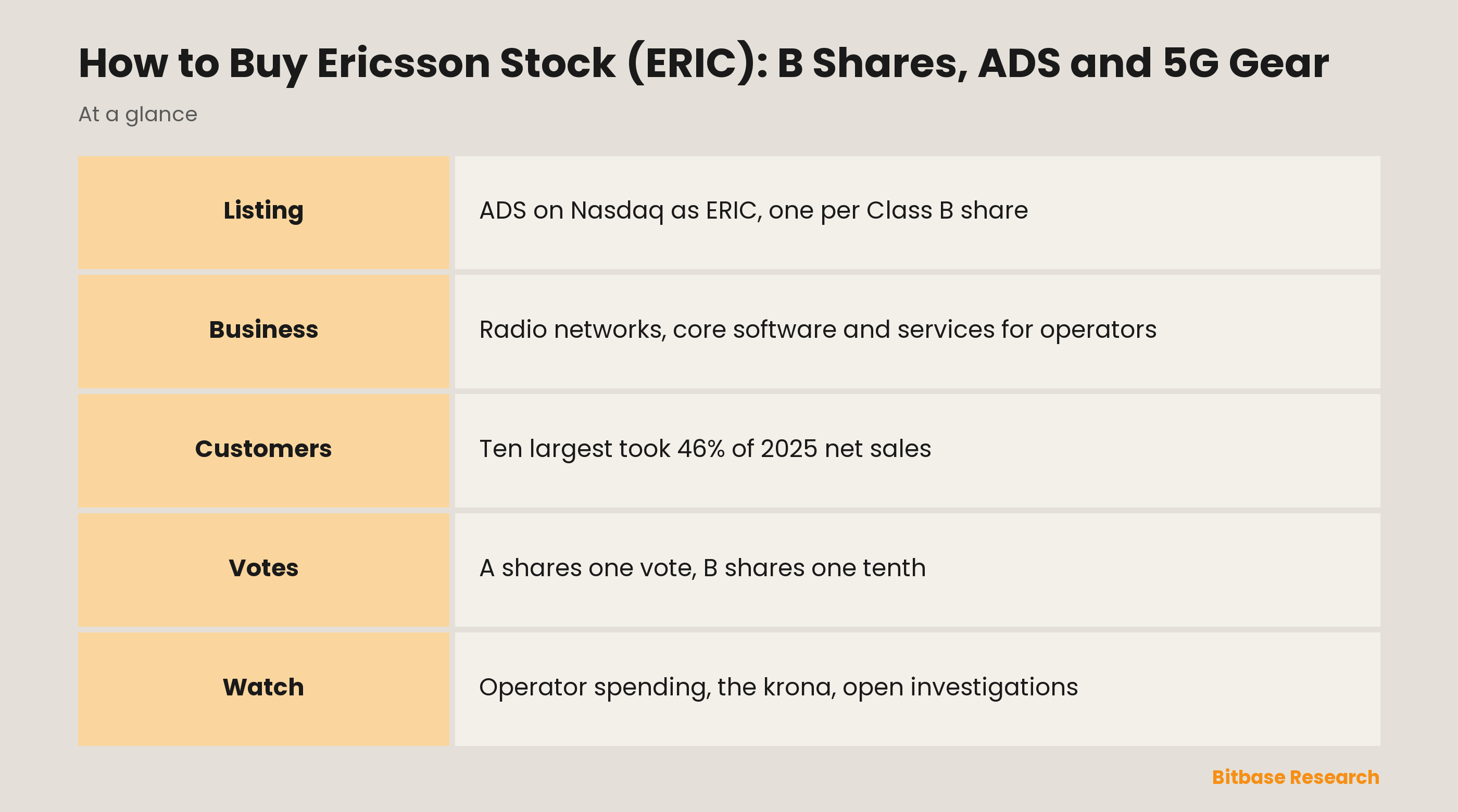
Ericsson is listed in the United States through American depositary shares that trade on Nasdaq under the ticker ERIC, so a brokerage account with US market access is enough to buy them; each ADS represents one Class B share of the Swedish parent company. The US line is the busier one: in 2025 about 4.5 billion ADS changed hands in the United States, against roughly 1.6 billion B shares on Nasdaq Stockholm. Below: what Ericsson sells, how its two share classes split the votes, how dividends reach ADS holders, and the risks its annual report puts first.
What Does Ericsson Do?
Ericsson sells the radio equipment, software and services that telecom operators use to build and run mobile networks. The 2025 annual report counts more than 500 customers, mostly operators, and four segments.
The company dates its start to 1876, when Lars Magnus Ericsson opened a Stockholm workshop repairing telegraph instruments. Today's parent, Telefonaktiebolaget LM Ericsson, was incorporated in 1918, and its shares were listed in Stockholm in 1919. Later came the AXE digital switch, the Nordic Mobile Telephone network of 1981 and, in 2009, one of the first commercial 4G networks, launched with TeliaSonera.
Networks is the core: radio access network hardware and software, plus transport, antennas and deployment services. At the end of 2025 Ericsson supplied 206 live 5G networks in 85 countries, and the 20-F says around 50% of mobile 5G traffic outside China runs over its radio networks. The chief executive's letter puts its market share outside China at around 37%, citing the research firm Dell'Oro.
Cloud Software and Services sells core networks, network management and support systems for operators, often as managed services. Enterprise covers private 5G, Wireless WAN and the communications platform of Vonage, acquired in 2022, which opens network functions to developers through APIs. Other holds media businesses and unallocated activities. Ericsson also licenses more than 60,000 granted patents on fair, reasonable and non-discriminatory terms.
Leadership changed in 2026: Börje Ekholm stepped down as CEO on 30 September, and Per Narvinger, at Ericsson since 1997 and head of Business Area Networks since March 2025, took over on 1 October.
How Ericsson Makes Money
Most revenue comes from selling and servicing networks under multi-year contracts:
| Segment | Share of 2025 net sales | 2025 gross margin | Main products |
|---|---|---|---|
| Networks | 64% | 49.7% | Radio access, transport, antennas, deployment |
| Cloud Software and Services | 26% | 41.7% | Core networks, network management, managed services |
| Enterprise | 9% | 53.9% | Private 5G, Wireless WAN, Vonage platform |
| Other | 1% | 3.0% | Media and unallocated activities |
Reported in Swedish kronor, net sales fell 5% in 2025, mostly because of currency; organic sales, which strip out currency and acquisitions, grew 2%. Hardware made up 37% of sales, software 23% and services 39%. Gross margin rose to 47.6% from 44.1% on cost cuts and efficiency.
By market area, the Americas produced about 35% of 2025 sales, Europe, Middle East and Africa about 30%, South East Asia, Oceania and India about 12% and North East Asia about 7%. The remaining 16% sits in an area called Other, which holds almost all Enterprise sales and patent licensing.
Licensing brought in about 6% of 2025 net sales and can be lumpy: in the third quarter of 2026 it rose partly on retroactive payments for previously unlicensed periods. Sales are also seasonal; on a 2023–2025 average, the fourth quarter brought in 29% of annual sales and the first 23%. Customers are concentrated: the ten largest customers took 46% of 2025 net sales, the largest alone about 14%.
ERIC Stock at a Glance
| Feature | ERIC |
|---|---|
| US listing | Nasdaq, ticker ERIC |
| What trades in the US | American depositary shares, one per Class B share |
| Depositary | Deutsche Bank Trust Company Americas |
| Home listing | Class A and Class B shares on Nasdaq Stockholm |
| Votes | Class A one vote, Class B one tenth of a vote |
| S&P 500 | Not a member |
| Headquarters | Kista, Stockholm, Sweden |
| Reporting | IFRS in Swedish kronor; Form 20-F and 6-K |
| Payouts | Dividend in two instalments; buyback into 2027 |
| SEC identifier | CIK 717826 |
Price and market value change with every trade; see the Ericsson stock page on Bitbase for live figures.
How to Buy Ericsson Stock
The ADS trades in dollars on Nasdaq, the shares in kronor in Stockholm. Outside Sweden the ADS is usually simpler:
1. Pick the line, then the broker. Any broker with US equities can buy the ADS; Stockholm shares need one that offers Swedish stocks. Check which entity holds your account and who supervises it.
2. State your tax residence correctly. Per the 20-F, a reduced treaty rate of Swedish withholding is applied at source only when the owner's tax residency is documented.
3. Fund the account. Compare exchange rates as well as commissions.
4. Find the right line. A search for "Ericsson" can return the ADS and both Stockholm classes; the ADS is ERIC on Nasdaq.
5. Set the order type. The SEC says a market order buys "at the best available price," but "the price at which a market order will be executed is not guaranteed." A limit order fills only "at a specific price or better" and "is not guaranteed to execute."
6. Decide the amount. Whether you can buy a fraction of an ADS is your broker's policy.
What an ADS is. The SEC defines an ADR as "a security that represents shares of non-U.S. companies that are held by a U.S. depositary bank outside the United States," and ADRs "trade in U.S. dollars and clear through U.S. settlement systems." The depositary charges fees for handling dividends and for yearly administration, and holders bear the cost of converting kronor into dollars. At the end of 2025 about 267 million ADS were outstanding, about 9% of the B shares.
A shares and B shares. Both classes share equally in net assets and earnings but differ in votes: one per A share, one tenth per B share. That is how Investor AB held about 24.8% of the votes at the end of 2025 with 9.9% of the shares, and AB Industrivärden about 15.0% of the votes with 2.6% of the shares. An ADS gives you the economics of a B share, the class with fewer votes.
Dividends and Swedish tax. The ordinary dividend comes in two instalments: the payout for 2025 was split into equal halves with record dates in April and September 2026. Sweden withholds 30% from dividends paid to non-residents unless a tax treaty lowers it; for eligible US holders of portfolio investments the treaty rate is 15%. Excess tax can be reclaimed until the end of the fifth calendar year after the payout, and your own country may tax the dividend too.
Through funds. State Street's SPY holdings file dated 9 November 2026 does not list Ericsson, while the same day's file for the SPDR Portfolio Developed World ex-US ETF (SPDW) includes its Class B shares among many holdings.
What Moves ERIC Stock
Operator budgets. The 20-F says "The timing and magnitude of market recovery has been slower than expected." In October 2026 the new CEO described the RAN market as flat, matching Dell'Oro's forecast.
A few big contracts. With one customer near 14% of sales, a single renewal or lost tender can move group results. Many agreements "do not contain committed purchase volumes or prices and may include commitments to future price reductions."
Geopolitics. Many countries restrict Chinese vendors or components in 5G networks, and the 20-F warns that governments could back "a national champion" in markets important to Ericsson, such as the US, India and Japan.
The krona. Much of the cost base is in kronor, while about half of 2025 net sales were in US dollars and more than 15% in euros. The company says "a stronger SEK exchange rate would generally have a negative effect on Ericsson's reported results."
Margins. Gross margin moves with licensing income and component prices. In the third quarter of 2026 reported sales rose 6% and organic sales 7%, led by Networks, but the CEO said component costs "are a headwind to gross margin next year."
Capital returns. A buyback of B shares on Nasdaq Stockholm runs from 23 April 2026 to 31 March 2027 at the latest, and the dividend policy is "stable to progressive."
Where Ericsson's Own Filings Point to Risk
These items from the annual report matter most for an ERIC holder:
Investigations. The US Department of Justice is still investigating matters from Ericsson's 2019 internal Iraq investigation; "The scope and duration of the investigation remain uncertain." China's market regulator has been examining Ericsson's patent licensing there since April 2019 and can impose "behavioral and financial remedies."
Lawsuits. Five suits under the US Anti-Terrorism Act, filed between August 2022 and September 2026, allege that Ericsson's payments ultimately aided terrorist groups; the defendants say they will defend vigorously. In Sweden, 93 claimants, non-Swedish funds and financial institutions, seek damages over allegedly inadequate disclosure of the Iraq report.
Compliance. The 20-F states: "The Company has not been in compliance with all such laws, rules and regulations in the past and cannot assure that all past violations have been addressed or that additional violations will not occur in the future."
Competition and supply. Ericsson describes "intense competition," and key chips come from single or very few suppliers, some with "very limited geographical redundancy."
Deals. Vonage led to impairments in 2023 and 2024, and the 20-F warns that acquisitions may not create the value expected.
The ADS itself. You hold a low-vote class through a fee-charging depositary, with returns passing through two currencies, and one company's setbacks hit the whole position.
How to Research ERIC Yourself
Ericsson files with the SEC under CIK 717826. The 20-F for 2025 was filed on 12 March 2026, and the English version of the Swedish annual report attached to it holds the detail: segment and market area results, note B1 on major customers, risk factors, legal proceedings and a chapter called "The Ericsson share." Quarterly reports, press releases and weekly buyback updates come as Form 6-K; the fourth-quarter 2026 report is scheduled for 22 January 2027.
Read organic growth next to the kronor figure, and check whether a quarter's licensing income includes retroactive payments. For another European company that reaches US investors through a depositary line, see our SAP stock guide; Ericsson also keeps a customer unit for T-Mobile, covered in our T-Mobile stock guide. Other listed companies are on the full list of US stock pages on Bitbase.
Ericsson Stock FAQ
Can I buy Ericsson stock with crypto?
Not directly. ERIC is bought through a brokerage account in US dollars, so crypto must first be sold for cash, a sale that may be taxable where you live. A share also gives different rights from a token, as explained in how stocks differ from crypto.
Is one ERIC share the same as one Ericsson B share?
Economically, yes: each ADS represents one Class B share held by the depositary, though it is priced in dollars and carries depositary fees.
What is the difference between Ericsson A and B shares?
Votes. A shares carry one vote each and B shares one tenth of a vote, with equal rights to earnings. Investor AB and AB Industrivärden held about 40% of the votes at the end of 2025, mostly through A shares.
Does Ericsson pay a dividend?
Yes, an ordinary dividend paid in two instalments a year. Sweden withholds 30% for non-residents unless a treaty lowers it, to 15% for eligible US holders.
Is Ericsson in the S&P 500?
No. Ericsson is a Swedish company and does not appear in SPY's 9 November 2026 holdings; its B shares do appear in developed-market funds outside the US, such as SPDW.
Conclusion
Ericsson's stock is mainly a bet on how much mobile operators will spend on radio networks, from a supplier that depends on a small circle of them. The ADS is easy to own from a US account, but what you hold is a low-vote B share whose dividend starts in kronor, passes through a depositary and is taxed first in Sweden. Read the latest 20-F and quarterly report, follow the open investigations, and decide how much weight one network supplier should carry in your portfolio.
Related reading
Other Bitbase articles on this topic:
- How to Buy Celestica Stock (CLS): From IBM Unit to AI Racks
- How to Buy Ciena Stock (CIEN): Optics, Cloud Buyers, No Dividend
- How to Buy Everpure Stock (P): Formerly Pure Storage, PSTG
- How to Buy NetApp Stock (NTAP): ONTAP in Flash and in the Cloud
Disclaimer: This article is educational content from Bitbase Academy, provided for information only. It explains what a company or fund does and how the instruments referenced here differ from one another; it does not constitute investment, trading, tax, or financial advice, and it is neither a recommendation nor an endorsement of any security, token, or trading strategy. A tokenized stock is issued by a third party and is designed to give economic exposure to an underlying asset: it is not a share, it carries no shareholder rights, and it depends on the issuer's structure, eligibility rules, and redemption terms, which the issuer can change. Perpetual futures are leveraged derivatives that hold no underlying asset and can be liquidated, and trading hours, product availability, and eligibility differ by instrument and by jurisdiction and can change at any time. Written as of November 2026; verify everything yourself through company filings, the issuer's own documentation, and the product pages of the venue you trade on.
References
[1] Ericsson Form 20-F for 2025 (SEC EDGAR) www.sec.gov
[2] Ericsson 2025 Form 20-F, XBRL cover page (SEC EDGAR) www.sec.gov
[3] Ericsson Annual Report 2025, filed with the 20-F (SEC EDGAR) www.sec.gov
[4] Ericsson third quarter report 2026, Form 6-K (SEC EDGAR) www.sec.gov
[5] Ericsson Form 6-K, 16 June 2026: new President and CEO (SEC EDGAR) www.sec.gov
[6] Ericsson Form 6-K, 9 November 2026: share buybacks (SEC EDGAR) www.sec.gov
[7] Ericsson Form 6-K, 18 June 2026: new Head of Business Area Networks (SEC EDGAR) www.sec.gov
[8] SEC Investor Bulletin: American Depositary Receipts www.sec.gov
[9] SEC Investor Bulletin: Trading Basics www.sec.gov
[10] State Street SPDR S&P 500 ETF Trust (SPY), daily holdings www.ssga.com
[11] State Street SPDR Portfolio Developed World ex-US ETF (SPDW), daily holdings www.ssga.com





