
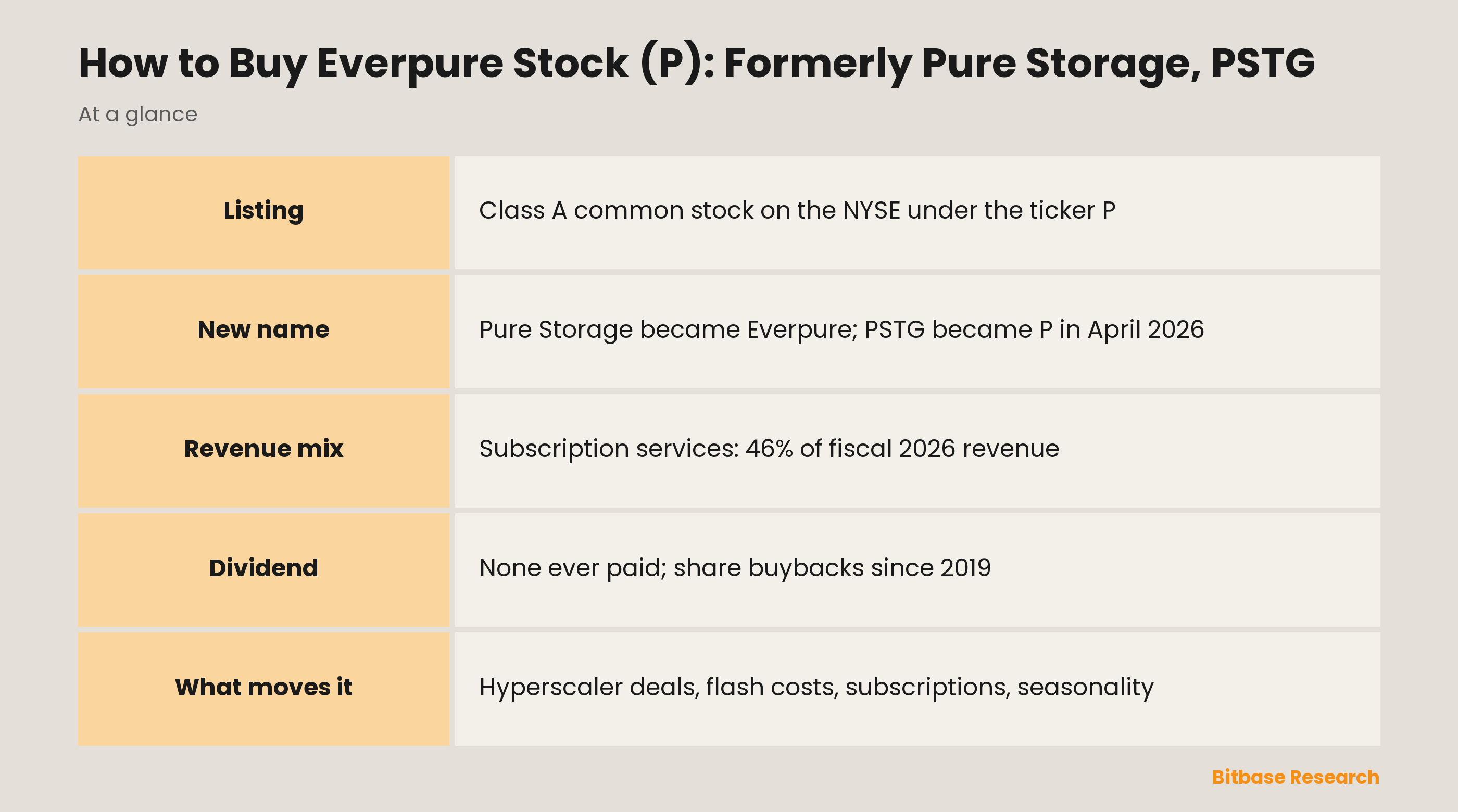
A one-letter ticker, P, now identifies the company investors knew for a decade as Pure Storage, and any broker that reaches the New York Stock Exchange can buy its Class A common stock. The corporate name changed to Everpure in February 2026 and the symbol moved from PSTG to P that April; the flash storage business behind both stayed the same, though it now leans harder on subscriptions and on licensing its flash technology to hyperscale data centres. Below: what Everpure sells, how an order works, and what its filings say moves the shares.
What Does Everpure Do?
Everpure makes enterprise data storage systems built entirely on flash memory, together with the software that runs them. Its 10-K calls it "a global technology company providing an integrated storage and data management platform"; it started out "as a provider of flash-based storage systems." Everpure was set up in Delaware in October 2009 as OS76, Inc., took the Pure Storage name in January 2010 and became Everpure, Inc. in February 2026, a change that reflects its "strategic evolution from redefining storage to rethinking data management."
The hardware comes in two families. FlashArray handles databases, applications and virtual machines, in models from the high-performance //XL to the capacity-oriented //C and //E; the 10-K calls it "the industry's first all-flash array." FlashBlade is the scale-out family for files and objects used in analytics, backup and AI training, and since March 2025 it includes FlashBlade//EXA for GPU clouds and high-performance computing.
Every system runs the Purity operating environment, managed through the cloud-based Pure1 console, while Portworx handles data for Kubernetes containers and Everpure Cloud runs Purity on AWS and Microsoft Azure. Instead of buying off-the-shelf solid-state drives, Everpure designs its own DirectFlash modules, which work directly with NAND flash chips.
What sets the model apart is Evergreen. Under an Evergreen subscription, controllers and flash modules are upgraded in place rather than the whole array being replaced, and under Evergreen//One customers pay for guaranteed capacity and performance instead of for particular machines. In the 10-K's words, "Customers subscribe to storage capabilities and service levels, not to a specific hardware configuration."
Two newer threads matter for the stock. In fiscal 2026, shipments began under what the company describes as "the industry-first Flash design win with a major hyperscaler," and in August 2026 it announced a design win with "a second top-five hyperscaler." On 7 May 2026 it completed the purchase of 1touch, a data intelligence and governance company. Customers number more than 14,500, and contract manufacturers build the hardware to Everpure's specifications.
How Everpure Makes Money
Everpure reports a single segment and splits revenue into two lines, product and subscription services.
| Revenue line | Share of fiscal 2026 revenue | Growth over fiscal 2025 | What it includes |
|---|---|---|---|
| Product | 54% | 16% | FlashArray and FlashBlade systems, hyperscaler royalties, Portworx term licences |
| Subscription services | 46% | 15% | Evergreen//One, Evergreen//Forever and Evergreen//Flex, Everpure Cloud, support |
| Total | All revenue | 16% | Fiscal year ended 1 February 2026 |
Gross margin was 70% overall, 67% on products and 74% on subscription services. Product growth came mainly from enterprise sales of FlashArray and the //E family, plus hyperscaler royalties.
The subscription metrics show how much revenue is already contracted. Subscription annual recurring revenue (ARR) rose 16% in fiscal 2026, and net dollar retention, which measures growth in recurring revenue from existing customers, was 113%, down from 117%. Remaining performance obligations (RPO), contracted revenue not yet recognized, grew 40%, and the company expects about 45% of that total to turn into revenue within 12 months.
Split by where customers are, the United States produced about 67% of fiscal 2026 revenue and grew 12%, while the rest of the world, about 33%, grew 25%. No customer or channel partner accounted for more than 10% of revenue in fiscal 2025 or 2026.
P Stock at a Glance
| Feature | P |
|---|---|
| Exchange | New York Stock Exchange (NYSE) |
| Ticker | P (PSTG until April 2026) |
| Security | Class A common stock, the only class registered under Section 12(b) |
| Legal name | Everpure, Inc. (Pure Storage, Inc. until February 2026) |
| Sector | Enterprise data storage hardware, software and subscriptions |
| Index membership | S&P 500 |
| Headquarters | Santa Clara, California |
| Incorporated | Delaware, October 2009 |
| Fiscal year | 52 or 53 weeks, ending on the first Sunday after 30 January |
| Dividend | None; the company has never paid one |
| Public since | Initial public offering in October 2015 |
| SEC identifier | CIK 1474432 |
Price, market value and valuation ratios change by the second; the Everpure stock page on Bitbase shows live figures.
How to Buy Everpure Stock
Everpure is a US company that files 10-K reports, so what trades on the NYSE is its Class A common stock itself, with no depositary receipt in between. The purchase runs through seven steps:
1. Pick a broker with NYSE access. Abroad, check which legal entity holds your account and who regulates it.
2. Open and verify the account. Non-US residents usually fill in IRS Form W-8BEN to document that they are foreign persons; the IRS tells them to submit it "when requested by the withholding agent or payer."
3. Fund it. Deposits in another currency are converted, and the conversion spread is part of what the trade costs.
4. Search for the right line. Type P and confirm the result reads Everpure, Inc. Class A common stock on the NYSE. Older watchlists and charts may still show PSTG.
5. Choose the order type. According to FINRA, a market order "provides the most certainty that your order will be executed," while a limit order fills only "at or better than a specified price."
6. Decide between whole and fractional shares. Some brokers sell fractions, others restrict them to "large-cap stocks or ETFs" or do not offer them, and FINRA notes that "as a fractional share owner, you might not have shareholder voting rights."
7. Save your records. Confirmations and statements show what you paid.
Withholding for non-US investors. The IRS states that "most types of U.S. source income received by a foreign person are subject to U.S. tax of 30%," with lower rates possible under a tax treaty. Everpure pays no dividend, so for now the rule has nothing to act on.
Through index funds. Because P is in the S&P 500, funds that track that index, State Street's SPY among them, hold Everpure shares.
What Moves P Stock
Hyperscaler deals. Royalties on hyperscaler shipments count as product revenue. The 10-K says that in fiscal 2026 "shipments exceeded our annual forecast," but also that "a design win does not guarantee sales" and that the company may have to fulfil NAND flash purchase commitments if its hyperscale customer reduces demand.
Flash and component prices. According to the 10-K, "the cost of our components increased significantly" during fiscal 2026, and the company raised its own prices in the first half of fiscal 2027. In the second quarter, which ended on 2 August 2026, product gross margin slipped to 65% from 66%, mainly because of component pricing. Revenue that quarter rose 38% and product revenue 54%, which the 10-Q attributes to customer demand together with higher pricing and larger configurations.
The subscription mix. Evergreen//One and similar contracts are recognized over time, so a shift from hardware sales to subscriptions can hold back reported product growth while contracted revenue builds. The company calls this share of sales "difficult to predict." In the second quarter of fiscal 2027, subscription ARR was up 20% and RPO 44% from a year earlier.
Seasonality. Sales are usually lowest in the first fiscal quarter and highest in the fourth, and "a substantial portion of our quarterly sales typically occurs during the last several weeks of the quarter," so one order that slips past quarter end can change a reported quarter.
Rivals and the storage market. The 10-K names Dell EMC, HP Enterprise, Huawei, Hitachi Vantara, IBM and NetApp as established competitors and says the data storage market "has not experienced substantial growth in the past few years." Our Dell stock guide and HPE stock guide look at two of those rivals.
Flash Costs, Hyperscaler Bets and Other Risks at Everpure
From Item 1A of the 10-K, the risks closest to a P share:
Supply. "We rely on a limited number of suppliers and, in some cases, on single-source suppliers, for several key components of our products," and some components come from China. Amid "increased global demand and component scarcity," suppliers may not allocate enough parts.
Pricing and margins. Gross margins "fluctuate from period to period due primarily to our component costs, product pricing, customer mix and product mix." The 10-Q adds that if costs keep climbing, "we may need to increase prices again in the future," which could cost sales.
One large customer. "If our existing hyperscale customer were to delay, reduce or cancel its purchases from us, our business, operating results, cash flows and financial condition would be adversely affected."
The share price. "The trading price of our common stock has been, and will likely continue to be, highly volatile."
There is also no dividend to soften a weak quarter: the company has "never declared or paid cash dividends" and does not expect to pay any "in the foreseeable future," so any return comes from the share price. The buyback program, in place since August 2019, "does not obligate us to acquire any of our common stock."
How to Research Everpure Yourself
All of Everpure's SEC filings, including those made as Pure Storage, sit under one identifier, CIK 1474432: the 10-K for each fiscal year, 10-Qs for the other quarters, and 8-Ks for events such as earnings releases and the February 2026 name change.
In the 10-K, Item 1 describes the products and the hyperscaler programme, Item 1A the risks, and the MD&A the split between product and subscription revenue, with subscription ARR, net dollar retention and RPO. Item 5 states the dividend policy.
Two habits prevent mix-ups. Search under both names and both tickers, since anything before April 2026 says PSTG. And keep the calendar straight: fiscal 2027 ends on 31 January 2027, so its second quarter ran from May to early August 2026. Live quotes are on the Everpure page linked earlier, and Bitbase's list of US stock pages covers other companies.
Everpure Stock FAQ
Can I buy Everpure stock with crypto?
Not directly. Everpure shares are bought with US dollars in a brokerage account, so crypto would first have to be sold for cash and the money moved to the broker, a sale that may be taxable where you live. A share is a stake in a registered company; see what separates stocks from crypto.
Is Everpure the same company as Pure Storage?
Yes. Pure Storage, Inc. changed its corporate name to Everpure, Inc. on 23 February 2026, and the 8-K filed that day says the name was the only change to its charter and bylaws. The ticker moved from PSTG to P on the NYSE in April 2026. The legal entity, its SEC identifier and its Class A common stock stayed the same.
Does Everpure pay a dividend?
No. The 10-K says the company has never declared or paid cash dividends and intends to keep its earnings in the business.
Is Everpure in the S&P 500?
Yes. State Street's daily holdings file for SPY, its S&P 500 fund, listed EVERPURE INC A under the ticker P as of 9 November 2026.
What does Everpure do for hyperscalers?
It licenses its flash technology. Hyperscaler shipments of third-party hardware carry a perpetual licence to Everpure's intellectual property, and Everpure earns royalties on them. In August 2026 it announced a design win with a second top-five hyperscaler.
Conclusion
Everpure is the same flash storage company it was as Pure Storage, but its results now turn on three things the rename does not show: how fast hyperscale royalties grow, how much of the business moves to subscriptions, and whether its price increases keep up with flash costs. The new ticker P is the detail to get right when you place the order. Read the latest 10-K and 10-Q, compare subscription ARR and RPO with revenue across several quarters, and size any position knowing the stock pays no dividend and has a history the company itself calls highly volatile.
Related reading
Other Bitbase articles on this topic:
- How to Buy Celestica Stock (CLS): From IBM Unit to AI Racks
- How to Buy Ciena Stock (CIEN): Optics, Cloud Buyers, No Dividend
- How to Buy Ericsson Stock (ERIC): B Shares, ADS and 5G Gear
- How to Buy Nokia Stock (NOK): One ADR per Helsinki Share
Disclaimer: This article is educational content from Bitbase Academy, provided for information only. It explains what a company or fund does and how the instruments referenced here differ from one another; it does not constitute investment, trading, tax, or financial advice, and it is neither a recommendation nor an endorsement of any security, token, or trading strategy. A tokenized stock is issued by a third party and is designed to give economic exposure to an underlying asset: it is not a share, it carries no shareholder rights, and it depends on the issuer's structure, eligibility rules, and redemption terms, which the issuer can change. Perpetual futures are leveraged derivatives that hold no underlying asset and can be liquidated, and trading hours, product availability, and eligibility differ by instrument and by jurisdiction and can change at any time. Written as of November 2026; verify everything yourself through company filings, the issuer's own documentation, and the product pages of the venue you trade on.
References
[1] Everpure (formerly Pure Storage) Form 10-K for fiscal 2026 (SEC EDGAR) www.sec.gov
[2] Everpure Form 10-Q for the second quarter of fiscal 2027 (SEC EDGAR) www.sec.gov
[3] Everpure second quarter fiscal 2027 results release, Form 8-K exhibit (SEC EDGAR) www.sec.gov
[4] Pure Storage to Everpure name change, Form 8-K of 23 February 2026 (SEC EDGAR) www.sec.gov
[5] Everpure Form 10-Q for the first quarter of fiscal 2027 (SEC EDGAR) www.sec.gov
[6] State Street SPDR S&P 500 ETF Trust (SPY), fund page and daily holdings www.ssga.com
[7] FINRA: Types of Orders www.finra.org
[8] FINRA: Investing in Fractional Shares www.finra.org
[9] IRS: NRA Withholding www.irs.gov
[10] IRS: About Form W-8 BEN www.irs.gov





