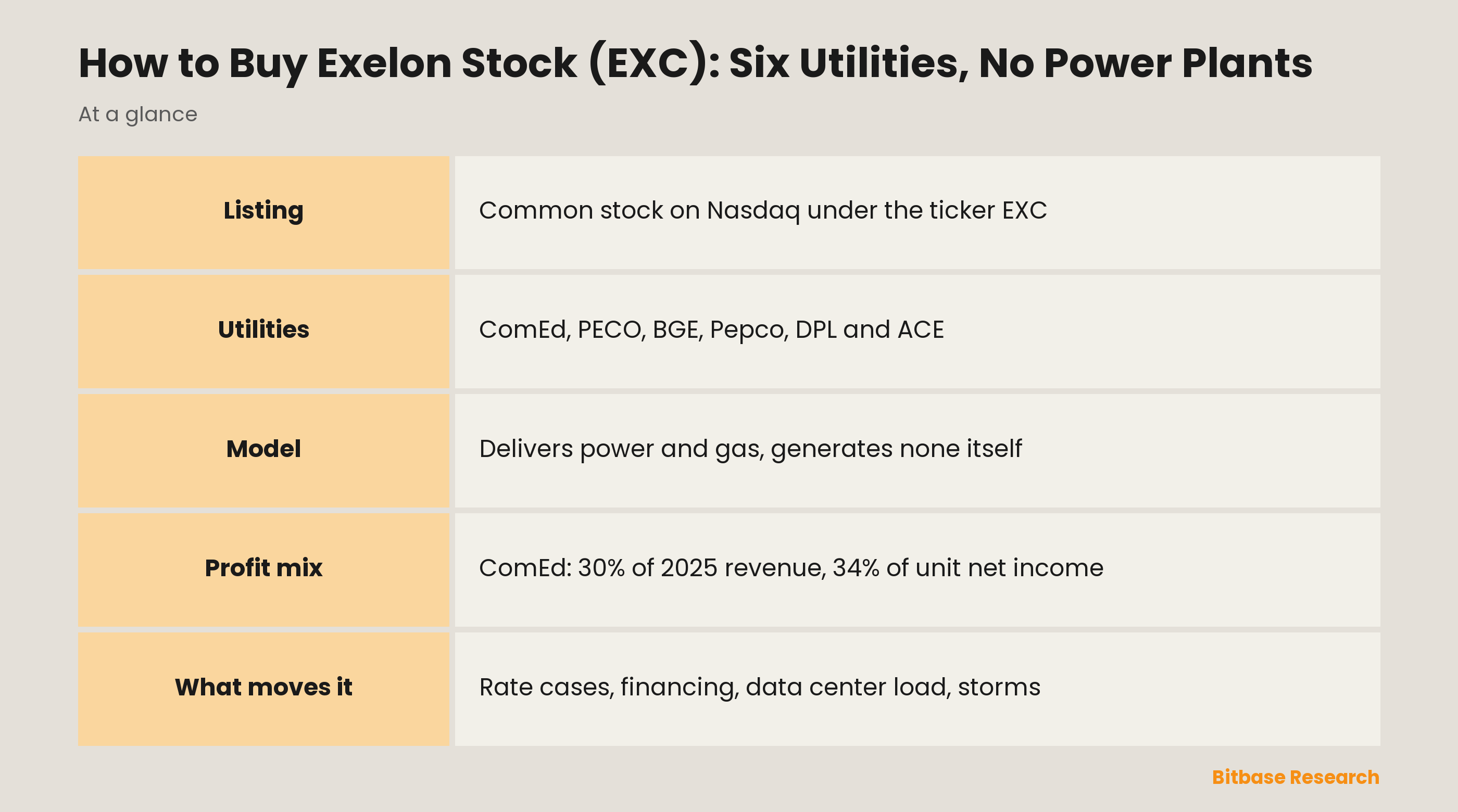
Exelon stock is bought like any other Nasdaq share: open a brokerage account that reaches that exchange, look up the ticker EXC and place an order for the common stock. What sets the company apart is what it leaves out. Its six utilities, from ComEd in Chicago to Atlantic City Electric in New Jersey, delivered electricity to about 9.5 million customers at the end of 2025, yet its annual report says plainly that "Exelon does not generate the electricity it delivers." This guide explains how a wires-only business earns money, how an order works, and which forces the filings keep pointing to.
What Does Exelon Do?
Exelon calls itself "a utility services holding company engaged in the energy transmission and distribution businesses." It owns six regulated utilities, each with its own territory and state regulator:
| Utility | Service area | Delivers | State regulator |
|---|---|---|---|
| ComEd | Northern Illinois, including Chicago | Electricity | Illinois Commerce Commission |
| PECO | Southeastern Pennsylvania, including Philadelphia | Electricity and gas | Pennsylvania Public Utility Commission |
| BGE | Central Maryland, including Baltimore | Electricity and gas | Maryland Public Service Commission |
| Pepco | Washington, D.C., and nearby Maryland counties | Electricity | D.C. and Maryland commissions |
| DPL | Parts of Delaware and Maryland | Electricity, some gas | Delaware and Maryland commissions |
| ACE | Parts of southern New Jersey | Electricity | New Jersey Board of Public Utilities |
Pepco, DPL and ACE sit under an intermediate holding company, Pepco Holdings (PHI). ComEd is the largest, with about 4.2 million electricity customers at the end of 2025.
The word "utility" can suggest power stations, but Exelon has none. Its utilities buy electricity through contracts set by state law and regulators, or on the wholesale markets run by PJM, the regional grid operator, and pass the cost on "without mark-up or with a slight mark-up." Swings in energy sales and procurement costs therefore "have no significant impact" on the utilities' net income. Customers can buy their electricity from a competing supplier; the local utility still delivers it at a regulated rate. Transmission is regulated separately, under formula rates approved by the Federal Energy Regulatory Commission (FERC) and updated every year.
The company looked different until 1 February 2022, when Exelon spun off its generation business, formerly Exelon Generation, as Constellation Energy. Shareholders kept their Exelon shares and received one Constellation share for every three Exelon shares, in a distribution that was tax-free for US federal income tax purposes. Our Constellation Energy stock guide covers that side. Calvin G. Butler Jr. has been chief executive since 2022.
How Exelon Makes Money
A regulated utility earns by investing, not by selling more energy. The utilities may recover "reasonable costs and fair and prudent capital expenditures" and "earn a return on those capital expenditures, subject to commission approval." Profit follows two things regulators control: how much invested capital enters rates and what return they allow on it.
The 10-K reports four business units, with PHI's three utilities together:
| Business unit | Share of 2025 revenue | Share of 2025 net income of the four units |
|---|---|---|
| ComEd | 30% | 34% |
| PECO | 19% | 24% |
| BGE | 22% | 17% |
| PHI (Pepco, DPL, ACE) | 29% | 24% |
Shares are calculated from the segment note of the 2025 10-K; net income shares leave out "Other," the parent's costs and financing, which showed a loss.
Electricity made up about 90.5% of 2025 revenue and natural gas the rest. Households are the core customer: residential accounts produced about 58% of the four units' revenue from contracts with customers.
ComEd shows why revenue is a poor guide to profit. In 2025 its revenue fell 11.6% and its purchased power cost dropped 41%, yet its net income rose 7.6%. The power bill flowed through; the earnings came from the network.
For the group, revenue rose 5.3% in 2025 and net income 12.5%. Management credited rate increases at all four units, favorable weather at PECO and lower storm costs at BGE, partly offset by higher interest and depreciation. PECO's net income rose 47.7%, helped also by lower income tax expense.
EXC Stock at a Glance
| Feature | EXC |
|---|---|
| Exchange | Nasdaq |
| Ticker | EXC |
| Security | Common stock without par value, the sole Exelon class registered under Section 12(b) |
| Sector | Regulated electricity and gas delivery |
| Index membership | S&P 500; also held by the Utilities Select Sector SPDR (XLU) |
| Headquarters | Chicago, Illinois |
| Incorporated | Pennsylvania |
| Fiscal year | Calendar year (closes 31 December) |
| Dividend | Paid quarterly in cash |
| SEC identifier | CIK 1109357, in a combined filing with its utilities |
The share price, market value and yield move all day; for current numbers, open the Exelon stock page on Bitbase.
How to Buy Exelon Stock
Exelon is a Pennsylvania corporation whose common stock trades on Nasdaq, so there is no depositary receipt to choose between. An order takes five steps:
1. Pick a broker with US market access and check which legal entity holds your account and who regulates it.
2. Confirm your tax status. Non-US investors usually complete IRS Form W-8BEN, which the IRS says to submit "when requested by the withholding agent or payer."
3. Deposit funds, comparing the currency conversion rate as well as the commission.
4. Find the right line. Search EXC and check that it reads Exelon Corporation common stock; the utilities issue their own bonds, but EXC is the one Exelon security listed on an exchange.
5. Choose the order and its size. FINRA notes that a market order "provides the most certainty that your order will be executed," while a limit order fills only "at or better than a specified price." Fractional shares let you invest a set amount, but some brokers limit them to "large-cap stocks or ETFs," and "as a fractional share owner, you might not have shareholder voting rights."
Dividends for investors abroad. The IRS says "most types of U.S. source income received by a foreign person are subject to U.S. tax of 30%," and a tax treaty can lower or remove that rate. Your home country may tax the same dividend; this is general information, not tax advice.
Through funds. On 5 November 2026 Exelon appeared in the daily holdings files of two State Street funds: SPY, which tracks the S&P 500, and XLU.
What Moves EXC Stock
Rate decisions. Each utility must ask its commission for new rates, and the 10-K calls these proceedings "at times contentious, lengthy, and subject to appeal." ComEd recovers distribution costs under a multi-year plan for 2024 through 2027, so the plan after that matters for the largest unit. On 28 August 2026 the Maryland Public Service Commission approved higher distribution rates for Pepco with an allowed return on equity of 9.40%.
Spending and how it is paid for. Capital expenditures rose 20% in 2025, and the four-year plan lists smart grid technology, storm hardening, transmission and new business, including data centers. Investment grows the asset base that earns a return, but it has to be financed: net interest expense rose 11.3% in 2025, and Exelon sells new shares through an at-the-market program that runs to May 2028.
Data center demand. Exelon "has forecast substantial increases in load, driven largely by the increasing use of data processing facilities dedicated to cloud services, artificial intelligence technologies, and other applications." Owning no generation, it depends on others to build supply; if they fall short, customers face "greater price volatility." The forecast and the recent past differ: in 2025 ComEd reported lower transmission peak load "due to lower energy demand." The buildout itself is covered in our AI infrastructure stocks guide.
Weather and storms. At ComEd, BGE, Pepco, ACE and DPL in Maryland, decoupling means distribution revenue is "not intended to be impacted by delivery volumes." PECO and DPL in Delaware have no such cushion, and first and third quarter results "are substantially dependent on weather conditions." Storm costs hit everyone: PECO's third-quarter 2026 net income fell, mainly on higher storm costs, the earnings release said.
State policy and Chicago. Bills are political in every Exelon state. Illinois enacted the Clean and Reliable Grid Affordability Act in 2026, raising ComEd's energy efficiency budgets and low-income commitments. ComEd's franchise with the City of Chicago, in place since 1992, can now be ended on one year's notice, and the city holds an option to buy the ComEd system within its limits; neither step has been taken.
Risks in Exelon's Regulated Model
Of the risk factors in Item 1A of the 10-K, these weigh most on an EXC holder:
Regulation. Revenue and earnings "could be negatively affected by legislative and/or regulatory actions," and results are "heavily dependent on the ability of the Utility Registrants to recover their costs." Higher rates can also bring "decreased volumes delivered and increased expense for uncollectible customer balances."
Supply it does not control. Third-party generation "may be insufficient to meet our customers' electricity demand in the short- and medium-term."
Hazards and funding. Electricity and gas operations "are inherently hazardous," with risks "such as wildfires or natural gas explosions." A downgrade below investment grade would require "significant amounts of collateral" and raise borrowing costs.
Reputation. Adverse publicity "could render public service commissions and other regulatory and legislative authorities less likely" to view the companies favorably. In July 2020 ComEd entered a deferred prosecution agreement with federal prosecutors over its past lobbying practices in Illinois; the term ended in July 2023, when the court dismissed the deferred charge.
The dividend. "Exelon's ability to pay dividends on its Common stock depends on the receipt of dividends paid by its operating subsidiaries," and regulators restrict some of those payments: BGE and Pepco cannot pay one that would push their equity ratio below 48%. The board raised the quarterly dividend for 2026 by 5%, but no filing promises more. And owning one stock concentrates your risk in a single business.
How to Research EXC Yourself
Exelon's reports sit on EDGAR under CIK 1109357. The 10-K is a combined filing for eight registrants, Exelon plus its utilities and PHI, so check which company each section covers. Item 1 gives territories and regulators, Item 1A the risks, Note 2 the rate cases and Note 4 the segment results used above. Item 5 sets Exelon's total return against the S&P 500 and the S&P Utility Index.
Quarterly results arrive as 8-K filings; in 2026 they came on 12 February, 6 May, 30 July and 30 October. Releases put GAAP net income next to an adjusted figure that the 10-K says "may not be comparable to other companies' presentations," so compare like with like. The state commissions in the first table publish rate case filings and orders, showing what a utility asked for and what it got. For quotes, use the stock page linked above; Bitbase's directory of US stock pages covers other companies.
Exelon Stock FAQ
Can I buy Exelon stock with crypto?
Not directly. Brokers sell EXC for US dollars, which means converting crypto to cash and transferring it first, and that conversion can count as a taxable sale in your country. Owning a share also brings dividends and a vote in a registered company, one of the ways stocks differ from crypto assets.
Does Exelon pay a dividend?
Yes, quarterly in cash. The board approved an updated policy for 2026 that set the quarterly payment 5% above the 2025 level; check each earnings release for the latest declaration.
Does Exelon generate its own electricity?
No. The 10-K states that "Exelon does not generate the electricity it delivers." Its utilities buy power through contracts and PJM markets, then transmit and deliver it.
Is Exelon the same company as Constellation Energy?
No longer. Constellation was Exelon's generation business until it was spun off on 1 February 2022; holders received one Constellation share for every three Exelon shares.
Is EXC in the S&P 500?
Yes. On 5 November 2026 Exelon Corp was listed among the positions in State Street's daily file for SPY, the fund that tracks the S&P 500.
Conclusion
Exelon has owned no power plants since it spun off Constellation in 2022, so the share stands for something narrower: six regulated delivery networks whose earnings rise with approved investment rather than energy sales, and which depend on regulators, weather and other companies' power plants. Data centers may add load, but others must build the supply. Read the latest 10-K and rate case orders, then decide how much one utility holding company deserves in your portfolio.
Related reading
Other Bitbase articles on this topic:
- How to Buy Brookfield Infrastructure Stock (BIP): Units to Shares
- How to Buy CenterPoint Energy Stock (CNP): Houston Grid and Gas
- How to Buy Con Edison Stock (ED): NYC Grid, Steam and Dividends
- How to Buy Vistra Stock (VST): Nuclear PPAs, Gas Plants and Perps
Disclaimer: This article is educational content from Bitbase Academy, provided for information only. It explains what a company or fund does and how the instruments referenced here differ from one another; it does not constitute investment, trading, tax, or financial advice, and it is neither a recommendation nor an endorsement of any security, token, or trading strategy. A tokenized stock is issued by a third party and is designed to give economic exposure to an underlying asset: it is not a share, it carries no shareholder rights, and it depends on the issuer's structure, eligibility rules, and redemption terms, which the issuer can change. Perpetual futures are leveraged derivatives that hold no underlying asset and can be liquidated, and trading hours, product availability, and eligibility differ by instrument and by jurisdiction and can change at any time. Written as of November 2026; verify everything yourself through company filings, the issuer's own documentation, and the product pages of the venue you trade on.
References
[1] Exelon Form 10-K for 2025 (SEC EDGAR) www.sec.gov
[2] Exelon 2025 Form 10-K, XBRL cover page (SEC EDGAR) www.sec.gov
[3] Exelon Form 10-Q for the third quarter of 2026 (SEC EDGAR) www.sec.gov
[4] Exelon third-quarter 2026 earnings release, filed with Form 8-K (SEC EDGAR) www.sec.gov
[5] Exelon Form 10-K for 2022: separation of Constellation (SEC EDGAR) www.sec.gov
[6] State Street SPDR S&P 500 ETF Trust (SPY): fund page and daily holdings www.ssga.com
[7] Utilities Select Sector SPDR (XLU): fund page and daily holdings www.ssga.com
[8] FINRA: Order Types www.finra.org
[9] FINRA: Investing in Fractional Shares www.finra.org
[10] IRS: NRA Withholding www.irs.gov
[11] IRS: About Form W-8 BEN www.irs.gov





