
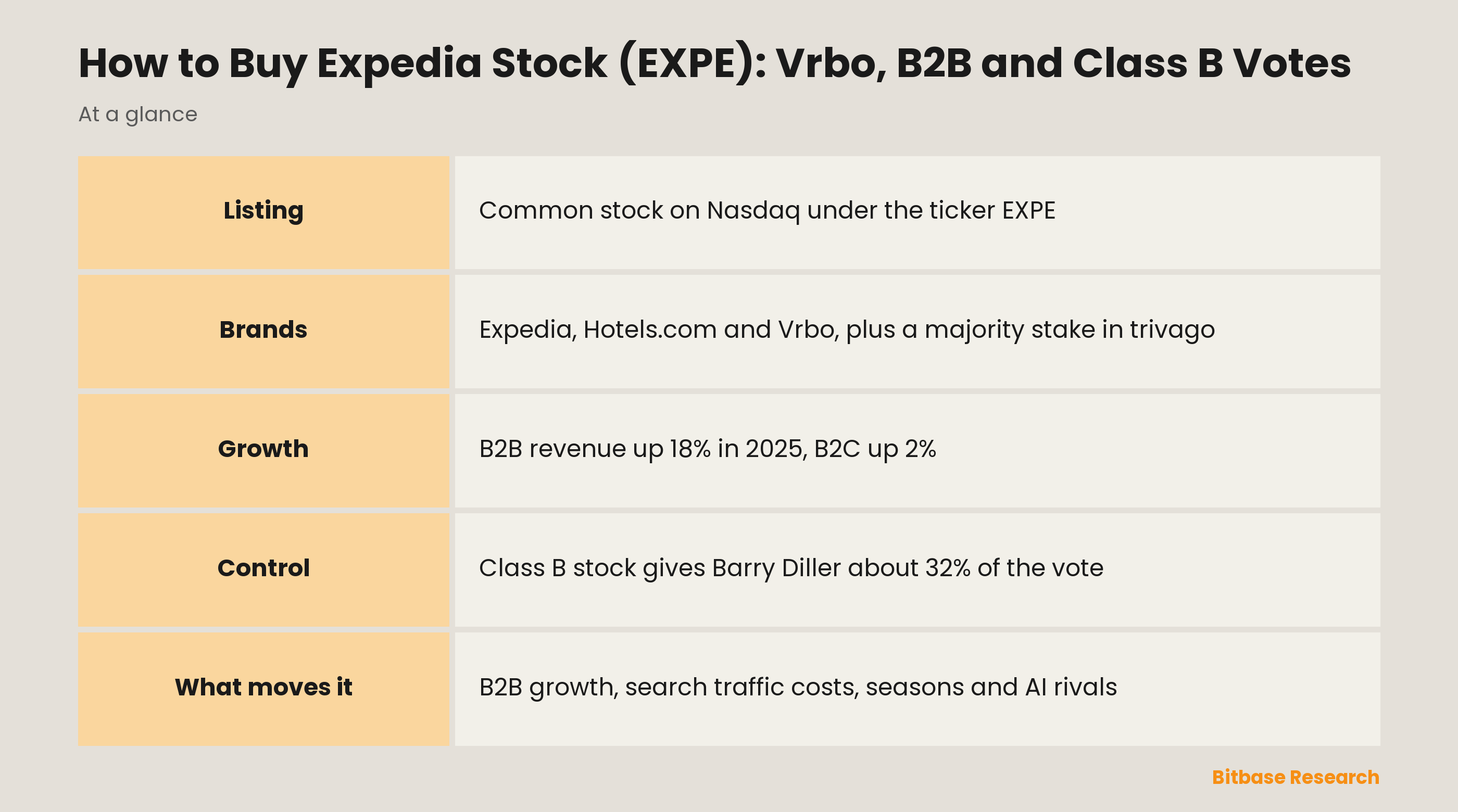
Anyone at a broker with Nasdaq access can buy Expedia Group stock, which trades on the Nasdaq Global Select Market under the ticker EXPE. Behind that ticker sit Expedia, Hotels.com and Vrbo, a business-to-business arm whose revenue grew 18% in 2025 while the consumer brands grew 2%, and an unlisted class of shares that gives chairman Barry Diller about 32% of the vote. What follows covers how the group earns its money, how an order is placed, and what its filings say can move the price.
What Does Expedia Do?
Expedia Group describes itself as "the global travel marketplace." It sells hotel rooms, holiday rentals, flights, car hire, cruises, insurance and activities online, and it rents out its booking technology and travel supply to other companies. At the end of 2025 its sites listed about 3.6 million lodging properties, roughly 2.4 million of them alternative accommodations on Vrbo, along with more than 500 airlines.
The listed company dates from 9 August 2005, when IAC/InterActiveCorp spun off its travel businesses as Expedia, Inc., a newly formed Delaware corporation. A second separation came on 20 December 2011, when TripAdvisor was spun off on its own. The business is older still: the 10-K says it began "nearly 30 years ago" as "one of the first online travel agencies."
The group reports three segments.
B2C runs the consumer brands. Most of the marketing budget goes to Brand Expedia, a full-service travel site; Hotels.com, which concentrates on lodging; and Vrbo, a marketplace for holiday homes. Orbitz, Travelocity, ebookers and Wotif are among the smaller names. One Key, a shared loyalty program for the three core brands, started in the United States in 2023 and reached the United Kingdom in 2024.
B2B supplies hotel rates, other inventory and booking tools to airlines, offline travel agents, online retailers, corporate travel managers and financial institutions. Partners plug in through an API called Rapid, run white-label or co-branded sites, or use an agent booking tool called TAAP. Corporate travel once had its own brand, but Expedia sold Egencia to American Express Global Business Travel in November 2021 and moved to a 10-year lodging supply agreement with the buyer.
trivago is a hotel metasearch site based in Düsseldorf, majority-owned by Expedia and listed separately on Nasdaq as TRVG. It earns advertising fees for sending searchers on to booking sites.
At the end of 2025 it had about 16,000 employees in nearly 50 countries, around half of them in technology roles.
How Expedia Makes Money
Revenue arrives through three business models, and the 10-K gives their 2025 weights: merchant 70%, agency 22%, and advertising, media and other 8%.
Under the merchant model, Expedia is the merchant of record: travelers pay it, generally at booking, and it settles with the hotel later, though it has "no control over the rooms" and carries no inventory risk. Under the agency model, it passes the reservation to the supplier and earns a commission or ticketing fee; most agency gross bookings are flights. Advertising comes from placements on Expedia's own sites and from trivago.
Lodging is the core, at about 80% of 2025 revenue, while air was about 3%. By segment:
| Segment | Share of 2025 revenue | Revenue growth in 2025 | What it sells |
|---|---|---|---|
| B2C | 64% | 2% | Bookings on Expedia, Hotels.com, Vrbo and smaller consumer sites, plus advertising on them |
| B2B | 33% | 18% | Rates, supply and booking technology for partner companies |
| trivago | 3% | 33% | Hotel price comparison, paid for by advertisers |
Shares are calculated from the segment revenue table in the 10-K; for trivago, only third-party revenue counts.
The figure the company leads with is gross bookings, the total retail value of what travelers book, taxes and fees included, after cancellations. Gross bookings rose 8% in 2025, with B2B up 20% and B2C up 3%, which brought B2B to about 30% of the total. Revenue as a share of gross bookings, which Expedia calls revenue margin, held at 12.3% in each of 2023, 2024 and 2025.
Costs show what the model depends on. Direct selling and marketing, chiefly traffic bought from search engines plus commissions to B2B partners and affiliates, came to 49.9% of 2025 revenue. Operating income rose 42% and reached 12.7% of revenue, against 9.6% in 2024. Customers in the United States brought in about 59% of revenue, and those in all other countries about 41%.
EXPE Stock at a Glance
| Feature | EXPE |
|---|---|
| Exchange | Nasdaq Global Select Market |
| Ticker | EXPE |
| Listed security | Common stock, the only class registered under Section 12(b) |
| Unlisted class | Class B common stock, ten votes per share, no public market |
| Sector | Online travel: lodging, flights, car hire, packages and travel advertising |
| Main brands | Expedia, Hotels.com and Vrbo; trivago, majority-owned |
| Index membership | S&P 500 |
| Headquarters | Seattle, Washington |
| Incorporated | Delaware |
| Spun off from IAC | August 2005 |
| Fiscal year | Calendar year, ending 31 December |
| Dividend | Quarterly cash dividend, reinstated in 2025 |
| SEC identifier | CIK 1324424 |
Quotes, market value and yield are left to the Expedia stock page on Bitbase, which updates them as the shares trade.
How to Buy Expedia Stock
EXPE is the common stock of a US company, so no depositary receipt stands in between: a broker anywhere that offers Nasdaq shares sells the same security American investors hold. The order takes six steps:
1. Pick a broker with Nasdaq access. For investors abroad, that can be a local bank with a US-shares service or an international platform; find out which company actually holds your account and which regulator oversees it.
2. Pass the account checks. After identity checks, non-US residents are usually asked for IRS Form W-8BEN, which certifies foreign status for tax withholding.
3. Fund the account. If your money is not in US dollars, the conversion rate can cost as much as the commission.
4. Confirm the line. Search EXPE and check that the result reads Expedia Group, Inc. common stock on Nasdaq. trivago trades on its own as TRVG, and the Class B shares cannot be bought on any exchange.
5. Choose how the order fills. A market order takes the going price. FINRA describes a limit order as one "at or better than a specified price," suited to investors "who know the price they want."
6. Decide between whole and fractional shares. Fractional shares let you invest a fixed sum, but FINRA notes that "you can't transfer fractional shares to another brokerage firm," and that a fractional owner "might not have shareholder voting rights."
Withholding on dividends. Since Expedia pays a cash dividend again, foreign holders meet US withholding. The IRS says most US-source income received by a foreign person is "subject to U.S. tax of 30%," and that "a reduced rate, including exemption, may apply" under a tax treaty. Your home country may tax the same dividend.
Through a fund. On 9 November 2026, State Street's daily holdings file for SPY, the SPDR S&P 500 ETF Trust, listed Expedia Group Inc, so a fund tracking the S&P 500 holds a small slice of EXPE.
What Moves EXPE Stock
B2B against B2C. The partner business is growing much faster than the consumer brands. In the third quarter of 2026 B2B revenue rose 23% and B2B gross bookings 19%, while B2C gross bookings rose 7%; group gross bookings grew 11% and revenue 12%. That growth has a cost: the 10-K names higher B2B partner commissions as the main reason direct selling and marketing went up in 2025.
Bookings now, revenue later. Most hotel revenue is recorded when the stay happens, so revenue "typically lags bookings by several weeks" for hotels and "several months or more" for holiday rentals, and Vrbo bookings are seasonally strongest in the first quarter, for summer stays. Because marketing is spent close to the booking, group revenue and income are "typically the lowest in the first quarter and highest in the third quarter," so each quarter is best compared with the same quarter a year earlier.
Google and the price of traffic. Expedia gets "a significant portion of the traffic" to its sites from search engines such as Google, through paid keywords and organic results, and the 10-K says Google "has used its search market position to promote its own travel services." Any change in rankings or ad prices feeds into the cost line that took about half of 2025 revenue.
AI assistants. The filing warns that "the rapid emergence and adoption of generative and agentic AI is likely to further intensify competition" from companies offering AI-driven trip search and booking. In the November 2026 earnings release, chief executive Ariane Gorin said AI "is opening further opportunities across our business."
Capital returns. The board reinstated a quarterly dividend in February 2025, after none in 2023 or 2024, and a repurchase program authorized in October 2023 has no fixed expiration date; in the third quarter of 2026 the company bought back about 2 million shares. The 10-K lists dividend changes and buybacks that miss "internal or external expectations" among the causes of price swings.
Taxes and legal reserves. Some jurisdictions dispute how hotel occupancy and similar taxes apply to bookings made through Expedia, and most of the 2025 charge for legal reserves came from a settlement over Italian withholding tax. The IRS has issued final transfer-pricing adjustments for the tax years 2011 to 2016, which the company disputes.
Search, Suppliers and Short-Term Rental Rules at Expedia
Item 1A of the 10-K runs long; the risks below are the ones closest to the business described above.
Travel demand. Results depend on "the overall health of the worldwide travel industry," and the filing lists recession, inflation, oil prices, armed conflict, pandemics and extreme weather among the forces it cannot control.
Supplier terms. "A substantial portion of our revenue is derived from compensation negotiated with travel suppliers, in particular lodging suppliers, airlines and GDS partners." Many contracts are renegotiated each year, and suppliers can cut commissions, limit inventory or steer travelers to their own sites.
Competition on all sides. Rivals named in the 10-K include Booking.com, Airbnb and travel metasearch services; it notes that Airbnb has moved into hotels and activities while Booking.com has expanded in flights. For comparison, see our Booking Holdings stock guide and Airbnb stock guide.
Holiday-rental rules. Some cities and countries ban stays of fewer than thirty days, require licenses or cap listings. An EU short-term rental law, which the 10-K said would come into effect in May 2026, requires platforms to obtain registration numbers for listings wherever a member state runs a registration system.
One shareholder's control. Barry Diller, chairman and senior executive, holds all of the Class B stock through trusts and a family foundation: about 4.6% of the common equity on a converted basis, but about 32% of the voting power. The 10-K says he is "in a position to influence, and potentially control, significant corporate actions," and he also chairs IAC, which the filing names as a possible source of conflicts of interest.
Debt and the dividend. The credit agreement limits the company's ability to pay cash dividends under certain circumstances, and future payments are at the board's discretion.
How to Research EXPE Yourself
Expedia files with the SEC under CIK 1324424. The 10-K carries the segment tables, the gross bookings table and the full risk factors; 10-Qs update them for the first three quarters; and each earnings release is attached to an 8-K, filed in 2026 on 12 February, 7 May, 5 August and 4 November. Releases, earnings presentations and call webcasts are also posted at ir.expediagroup.com.
Two reading notes help. "ADR" in Expedia's releases means average daily rate, the average nightly price of rooms booked, not an American depositary receipt; EXPE has none. And gross bookings and revenue measure different things: the first counts what travelers spend, the second only what Expedia keeps, and the gap moves with the merchant and agency mix.
For other listed companies, see the list of US stock pages on Bitbase.
Expedia Stock FAQ
Can I buy Expedia stock with crypto?
Not directly. EXPE shares are bought in US dollars through a broker, so crypto would first have to be sold and the cash moved to the brokerage account, and selling crypto can itself be a taxable event depending on where you live. A share is a legal stake in Expedia Group with a dividend and a vote attached, which is how stocks and crypto differ.
Does Expedia pay a dividend?
Yes, again. The board approved the reinstatement of quarterly dividends on 3 February 2025, and four were paid that year after none in 2023 or 2024; the payment was raised in February 2026. Future dividends are at the board's discretion.
Is EXPE in the S&P 500?
Yes. Expedia Group Inc appeared in State Street's SPY holdings file dated 9 November 2026, and the 10-K compares the stock's five-year return with the S&P 500.
Who controls Expedia's Class B shares?
Barry Diller. At the end of 2025 he, through trusts, and his family foundation owned all 5,523,452 Class B shares, each carrying ten votes against one for a common share. Under a 2021 settlement of stockholder litigation, once he leaves the company the Class B votes of Diller-related persons will be capped at 20% of total voting power on extraordinary transactions and on director nominees the board does not support.
Has Expedia stock ever split?
Yes, in reverse. Immediately before the TripAdvisor spin-off on 20 December 2011, Expedia carried out a one-for-two reverse split of its common and Class B stock, with cash paid in place of fractional shares. Its 2011 10-K adjusts earlier share prices for both events, so check that any long price history you use does the same.
Conclusion
Expedia is less one travel site than a booking engine that consumers, partner companies and advertisers all draw on, and in 2025 and 2026 the partner side did most of the growing. Three things in its filings shape the share: how much the group pays search engines and partners for each booking, how bookings turn into revenue and cash over the seasons, and a share structure that leaves about a third of the vote with one man. Check each of the three in the newest annual and quarterly filings, then judge what share of your savings a single travel business deserves.
Related reading
Other Bitbase articles on this topic:
- How to Buy AutoZone Stock (AZO): Mega Hubs, Buybacks, No Dividend
- How to Buy Carnival Stock (CCL): One Listing, Eight Cruise Lines
- How to Buy Chipotle Stock (CMG): No Dividend, a 50-for-1 Split
- How to Buy Tapestry Stock (TPR): Coach's Parent, Formerly COH
Disclaimer: This article is educational content from Bitbase Academy, provided for information only. It explains what a company or fund does and how the instruments referenced here differ from one another; it does not constitute investment, trading, tax, or financial advice, and it is neither a recommendation nor an endorsement of any security, token, or trading strategy. A tokenized stock is issued by a third party and is designed to give economic exposure to an underlying asset: it is not a share, it carries no shareholder rights, and it depends on the issuer's structure, eligibility rules, and redemption terms, which the issuer can change. Perpetual futures are leveraged derivatives that hold no underlying asset and can be liquidated, and trading hours, product availability, and eligibility differ by instrument and by jurisdiction and can change at any time. Written as of November 2026; verify everything yourself through company filings, the issuer's own documentation, and the product pages of the venue you trade on.
References
[1] Expedia Group Form 10-K for 2025 (SEC EDGAR) www.sec.gov
[2] Expedia Group 2025 Form 10-K, XBRL cover page (SEC EDGAR) www.sec.gov
[3] Expedia Group Form 10-Q for the third quarter of 2026 (SEC EDGAR) www.sec.gov
[4] Expedia Group third-quarter 2026 results release, filed with Form 8-K, Exhibit 99.1 (SEC EDGAR) www.sec.gov
[5] Expedia Form 10-K for 2011 (SEC EDGAR) www.sec.gov
[6] State Street, SPY daily holdings file www.ssga.com
[7] FINRA, Order Types www.finra.org
[8] FINRA, Investing in Fractional Shares www.finra.org
[9] IRS, NRA Withholding www.irs.gov
[10] IRS, About Form W-8 BEN www.irs.gov





