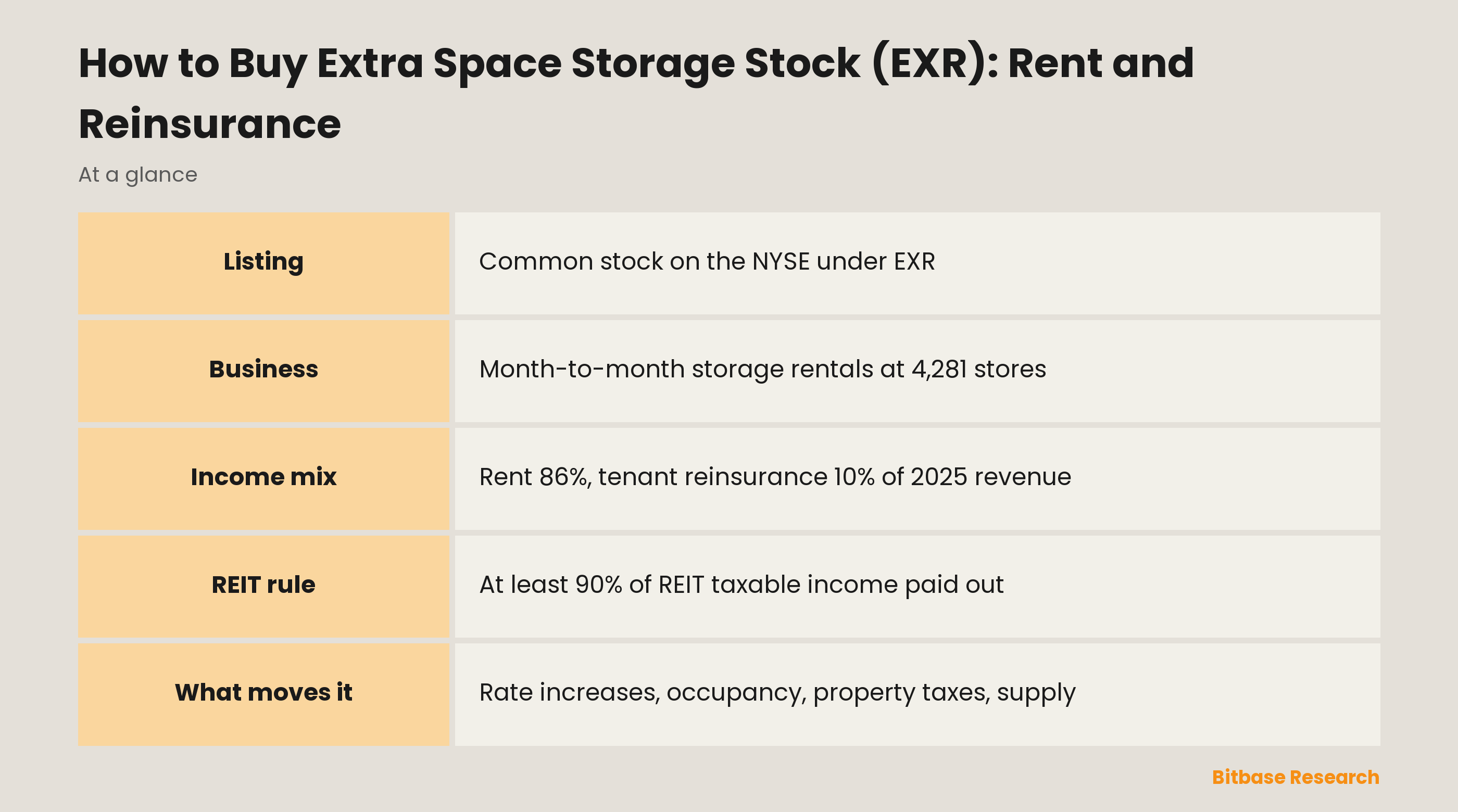
Three letters, EXR, are all you need to search for at any broker that reaches the New York Stock Exchange, where Extra Space Storage's common shares, its only class registered for exchange trading, are listed. Behind the ticker sits a Maryland real estate investment trust that calls itself the largest self-storage operator in the United States: at the end of 2025 it owned or operated 4,281 stores in 43 states and Washington, D.C., and 1,856 of them belonged to other owners who pay it to run them. Below: where its rent and insurance income comes from, how a purchase works, and which forces its filings single out.
What Does Extra Space Storage Do?
Extra Space Storage lets households and small businesses keep their belongings in rented lockers. The 10-K describes the company as "a fully integrated, self-administered and self-managed real estate investment trust" that was formed as a Maryland corporation on 30 April 2004 and closed its initial public offering on 17 August 2004. It carried on the business of Extra Space Storage LLC, in self-storage since 1977, and holds almost everything through an operating partnership, Extra Space Storage LP, a structure known as an umbrella partnership REIT, or UPREIT.
Stores rent space month to month for personal or business use, in units that typically run from 5 by 5 feet to 20 by 20 feet, and tenants move their own goods in and out. The filing says residential customers are often "people who are experiencing life changes such as downsizing their living space," while commercial renters tend to be small business owners. Customers pick a store "based primarily on price and the convenience of the site to their home or business," which is why its sites cluster around population centers.
How the 4,281 stores break down. At 31 December 2025 the company owned 2,007 stores outright, held 11 in consolidated joint ventures and 407 in unconsolidated joint ventures, and managed 1,856 for third parties. Roughly 2.4 million tenants were renting units at these stores. Three states dominate the map: Texas with 549 stores, Florida with 541 and California with 426, about 35% of the total between them. By 30 September 2026 the count had reached 4,411, with 1,963 of them managed for others.
The Life Storage merger. On 20 July 2023 Extra Space closed its merger with Life Storage, which brought 757 wholly-owned stores and one consolidated joint venture store. Life Storage shareholders received 0.895 of an Extra Space share for each share they held. During 2024 the company decided to run every store under one brand, and it wrote off the full value of the Life Storage trade name.
The businesses around the lockers. Managing stores for other owners earns fees, widens the footprint "with little capital investment," and is described as "a potential future acquisition pipeline." A bridge lending program lends to owners of stores the company manages, and it holds preferred stock in other self-storage companies. Tenant reinsurance, covered in the next section, is the largest of these side activities.
The 10-K names three listed self-storage REITs as its primary competitors: CubeSmart, National Storage Affiliates and Public Storage. National Storage Affiliates has since been taken over, in an all-stock deal that Public Storage completed on 22 July 2026.
How Extra Space Storage Makes Money
The 2025 income statement has three revenue lines:
| Revenue line | Where it comes from | Share of 2025 revenue | Change from 2024 |
|---|---|---|---|
| Property rental | Rent and fees at wholly-owned and consolidated joint venture stores | 86% | Up 3.3% |
| Tenant reinsurance | Premiums on insurance that tenants buy for their stored goods | 10% | Up 6.0% |
| Management fees and other income | Fees for running third-party and joint venture stores | 4% | Up 7.1% |
Total revenue rose 3.7% in 2025. Most of the rental growth came from stores acquired in 2024 and 2025.
Why tenant reinsurance matters. A tenant can buy cover for stored goods from an insurer that is not part of the group. A wholly-owned subsidiary of Extra Space then "fully reinsures such policies and thereby assumes all risk of losses under these policies," receiving premiums substantially equal to what tenants pay. The policies are sold at stores the company manages for others as well as its own, so the 10-K ties the 2025 gain mainly to "an increase in the number of stores operated." In the segment note, reinsurance kept about 80% of its revenue as net operating income, against 68% for the rental stores. The flip side is that claims can jump "when significant events occur at stores."
Same-store results. To strip out acquisitions, the company reports a same-store pool, 1,804 stabilized stores in the 2025 10-K. Their revenue was almost flat in 2025, up 0.1%, while their operating expenses rose 4.9%, led by a 7.6% rise in property taxes, so same-store net operating income fell 1.7%. Occupancy at year end was 92.6%, down from 93.3%. Across all rental stores, property taxes made up about 36% of 2025 store operating expenses, the largest line in that total.
Net income and FFO. Extra Space reports funds from operations, or FFO, alongside net income. Under the industry definition the 10-K cites, FFO adds back real estate depreciation and amortization and excludes gains or losses on store sales and impairments. In the third quarter of 2026, net income per diluted share was 50.0% higher than a year earlier, when the prior-year quarter had carried a loss on assets sold, while Core FFO per share, an adjusted version, rose 4.3%.
EXR Stock at a Glance
| Feature | EXR |
|---|---|
| Exchange | New York Stock Exchange (NYSE), since the IPO on 17 August 2004 |
| Ticker | EXR |
| Security | Common stock, the only class registered under Section 12(b) |
| Sector | Real estate: self-storage |
| Legal form | Maryland corporation taxed as a REIT, structured as an UPREIT through Extra Space Storage LP |
| Index membership | S&P 500 |
| Headquarters | Salt Lake City, Utah |
| Fiscal year | Calendar year, ending 31 December |
| Payouts | Quarterly dividends; a REIT must distribute at least 90% of its REIT taxable income |
| Ownership cap | Charter limit of 7.0% of the common stock per holder, subject to exceptions |
| SEC identifier | CIK 1289490 |
Quotes, market value and yield move during every session; the Extra Space Storage stock page on Bitbase shows them live.
How to Buy Extra Space Storage Stock
Extra Space is a US company, so no depositary receipt stands between you and the share: what changes hands on the NYSE is the common stock itself. A purchase usually follows these steps:
1. Find a broker with NYSE access. Check which entity in the group holds your securities and who regulates it.
2. Open the account. Non-US individuals are normally asked for IRS Form W-8BEN, which the IRS says to "submit … when requested by the withholding agent or payer."
3. Fund it in dollars or convert. If you deposit another currency, the conversion rate can cost more than the commission.
4. Search for EXR. Confirm the listing reads Extra Space Storage Inc. common stock on the NYSE; the 10-K cover shows no other registered class.
5. Choose the order type. An SEC investor bulletin warns that "the last-traded price is not necessarily the price at which a market order will be executed." A limit order caps the price instead: "A buy limit order can only be executed at the limit price or lower."
6. Decide on whole or fractional shares. Not every firm offers fractions. FINRA notes that some firms fill them in real time while "others aggregate orders of customers' fractional shares," and that "you often can't trade fractional shares outside of regular market hours."
7. Keep the records. Confirmations and statements record your cost and dividends.
Withholding for investors abroad. This is general information, not tax advice. The IRS says "most types of U.S. source income received by a foreign person are subject to U.S. tax of 30%," and a tax treaty can reduce that. For a REIT, IRS Publication 515 adds a rule: every REIT is a qualified investment entity, and its distribution to a foreign holder is taxed as an ordinary dividend, not as a gain on US real property, as long as the stock is regularly traded on a US securities market and the holder never owned more than 10% of it during the year before the payment. A distribution that is treated as a real property gain is withheld at 21%. Your home country may tax it again.
Through funds. State Street's daily holdings files dated 6 November 2026 list Extra Space Storage in SPY, its S&P 500 trust, and in XLRE, its real estate sector fund.
What Moves EXR Stock
Rate increases for tenants who stay. Leases are month to month, yet tenants who moved out of same-store properties in 2025 had stayed about 17.0 months on average. The company says "existing tenants generally receive rate increases at least annually," while its revenue management systems "analyze, set and adjust rental rates daily." The pricing question is how far those increases can go without losing occupancy.
Occupancy and the moving season. The 10-K says a greater share of revenue and profit typically arrives from May through September, with occupancy highest at the end of July and lowest in late February and early March. It puts average industry occupancy at around 90%; its own same-store pool averaged 93.7% in 2025. In the third quarter of 2026 same-store revenue grew 2.7%, expenses fell 1.8% and same-store net operating income rose 4.6%, with occupancy of 94.0% at quarter end against 93.7% a year before.
Housing turnover and new supply. Among the conditions the risk factors list as able to cut demand are "rising interest rates" and "decreases in the volume of housing market transactions." On the supply side, development of new self-storage facilities "has increased in recent years, which has intensified competition."
Property taxes and rent caps. Taxes are the biggest store operating cost and can be reassessed "including on a retroactive basis." Legal limits matter as well: after wildfires in 2018, 2019 and early 2025 and floods in 2023, California and some localities imposed temporary caps on what Extra Space could charge and how much it could raise rents for existing tenants.
Capital and growth deals. At the end of 2025, 17.9% of its debt carried variable interest rates, not counting debt covered by interest rate swaps, so rate moves feed into interest expense. The 10-K gives its ratings as BBB+ from S&P and Baa2 from Moody's. Buying newly built stores at completion is cheaper than buying stabilized ones but dilutes earnings for the two to four years they take to fill. The board authorized a three-year share repurchase program in November 2023, and in the third quarter of 2026 the company bought back about 2.4 million shares.
The Downside Cases in Extra Space Storage's Filings
Item 1A of the 2025 10-K, unchanged in substance according to the third-quarter 2026 10-Q, includes these risks:
Short leases. "Nearly all of our leases are on a month-to-month basis."
Competition. Local competition "has affected our occupancy levels, rental rates and operating expenses," and rivals' actions "may decrease or prevent increases in our occupancy and rental rates."
Rules after disasters. Emergency or consumer protection rules could lead to an "inability to raise rents, reduced late fee collection and impaired ability to hold auctions."
Reinsurance licences. Through regulatory or private action, the company "may be temporarily or permanently suspended from continuing some or all of our reinsurance activities."
REIT status. Losing it would bring corporate income tax on taxable income and, without statutory relief, bar a new REIT election for four taxable years, which "could adversely affect the value of our securities."
Technology. The company uses artificial intelligence "in assessing marketing decisions and operating our stores," and says rivals using it better could leave it "competitively disadvantaged."
The ownership limit. The 7.0% charter cap protects REIT status but "may inhibit market activity in our stock and could prevent or delay a change in control transaction."
Two risks belong to the shareholder rather than the business. One company is a concentrated bet on a single property type. And no payout is promised: holders receive distributions "when declared by our board of directors," and the 10-K says only that it has "historically made regular quarterly distributions."
How to Research EXR Yourself
All filings sit on SEC EDGAR under CIK 1289490: the 10-K, the 10-Qs for the first three quarters and the 8-Ks. Results arrive by 8-K with an earnings release attached; in 2026 those came on 19 February, 28 April, 28 July and 27 October. The 10-K says copies are also free in the investor relations section of extraspace.com.
In the 10-K, Item 1 covers stores, competition and seasonality, Item 1A the risks, and Item 2 the state-by-state store table. The MD&A sets out the same-store pool and the FFO reconciliation, and the segment note compares the rental and reinsurance businesses. Two cautions help. The same-store pool is reset each year, from 1,804 stores in the 2025 10-K to 1,869 in the third-quarter 2026 release, so compare growth rates only within one report. And the company warns its FFO "may not be comparable to FFO reported by other REITs," which matters when you set EXR against Prologis, an industrial REIT, or other landlords. For quotes on other listed companies, browse the full list of US stock pages on Bitbase.
Extra Space Storage Stock FAQ
Can I buy Extra Space Storage stock with crypto?
Not directly. EXR is bought through a brokerage account in US dollars, so you would first sell crypto for cash, which can be a taxable event where you live, and then move the money to the broker. The result is a share in a listed REIT, which carries dividend and voting rights.
Does Extra Space Storage pay a dividend?
Yes. It has historically paid quarterly distributions, and as a REIT it must distribute at least 90% of its REIT taxable income each year to keep that status. A quarterly dividend was paid in the third quarter of 2026. Each payment still needs a board declaration, so check the latest earnings release for the amount and dates.
Is EXR in the S&P 500?
Yes. The company's October 2026 earnings release calls it a member of the S&P 500 index, and State Street's SPY holdings file dated 6 November 2026 includes Extra Space Storage. Index weights change daily.
What happened to Life Storage?
Extra Space bought it in a merger that closed on 20 July 2023, paying 0.895 of its own share for each Life Storage share. In 2024 it decided to run all stores under one brand and wrote off the Life Storage name.
Who runs Extra Space Storage?
Joseph Margolis is chief executive until his planned retirement on 31 December 2026. His successor, W. Noah Springer, has been president since January 2026 and joined the company in 2006; he is due to become CEO and join the board on 1 January 2027.
Conclusion
Extra Space Storage is a landlord whose tenants can leave on a month's notice, so its results hinge on keeping rate increases and occupancy in balance across thousands of stores, with tenant reinsurance and third-party management adding income on top. The 2025 same-store decline and the stronger 2026 quarters show how quickly that balance can shift. Before buying, read the latest 10-K and quarterly release, check property taxes and occupancy against the prior year, and size the position as one property type in a wider portfolio.
Related reading
Other Bitbase articles on this topic:
- How to Buy CBRE Stock (CBRE): Deals, Buildings and No Dividend
- How to Buy Crown Castle Stock (CCI): A Tower REIT, Fiber Sold
- How to Buy Iron Mountain Stock (IRM): From Boxes to Data Centers
- How to Buy VICI Properties Stock (VICI): Caesars Palace Landlord
Disclaimer: This article is educational content from Bitbase Academy, provided for information only. It explains what a company or fund does and how the instruments referenced here differ from one another; it does not constitute investment, trading, tax, or financial advice, and it is neither a recommendation nor an endorsement of any security, token, or trading strategy. A tokenized stock is issued by a third party and is designed to give economic exposure to an underlying asset: it is not a share, it carries no shareholder rights, and it depends on the issuer's structure, eligibility rules, and redemption terms, which the issuer can change. Perpetual futures are leveraged derivatives that hold no underlying asset and can be liquidated, and trading hours, product availability, and eligibility differ by instrument and by jurisdiction and can change at any time. Written as of November 2026; verify everything yourself through company filings, the issuer's own documentation, and the product pages of the venue you trade on.
References
[1] Extra Space Storage Form 10-K, fiscal 2025: business, stores, segments and risks (SEC EDGAR) www.sec.gov
[2] Extra Space Storage 10-K cover data (XBRL R1): registrant, state, ticker and exchange www.sec.gov
[3] Extra Space Storage Form 10-Q for the quarter ended 30 September 2026 (SEC EDGAR) www.sec.gov
[4] Extra Space Storage third-quarter 2026 earnings release, filed with an 8-K on 27 October 2026 www.sec.gov
[5] Extra Space Storage 8-K of 24 August 2026: CEO retirement and successor www.sec.gov
[6] Public Storage Form 10-Q for the quarter ended 30 September 2026: NSA acquisition (SEC EDGAR) www.sec.gov
[7] IRS: NRA withholding www.irs.gov
[8] IRS Publication 515: withholding of tax on nonresident aliens and foreign entities www.irs.gov
[9] IRS: About Form W-8 BEN www.irs.gov
[10] SEC Investor Bulletin: Trading Basics www.sec.gov
[11] FINRA: Investing in Fractional Shares www.finra.org
[12] State Street: SPDR S&P 500 ETF Trust (SPY) daily holdings www.ssga.com
[13] State Street: Real Estate Select Sector SPDR ETF (XLRE) daily holdings www.ssga.com





