
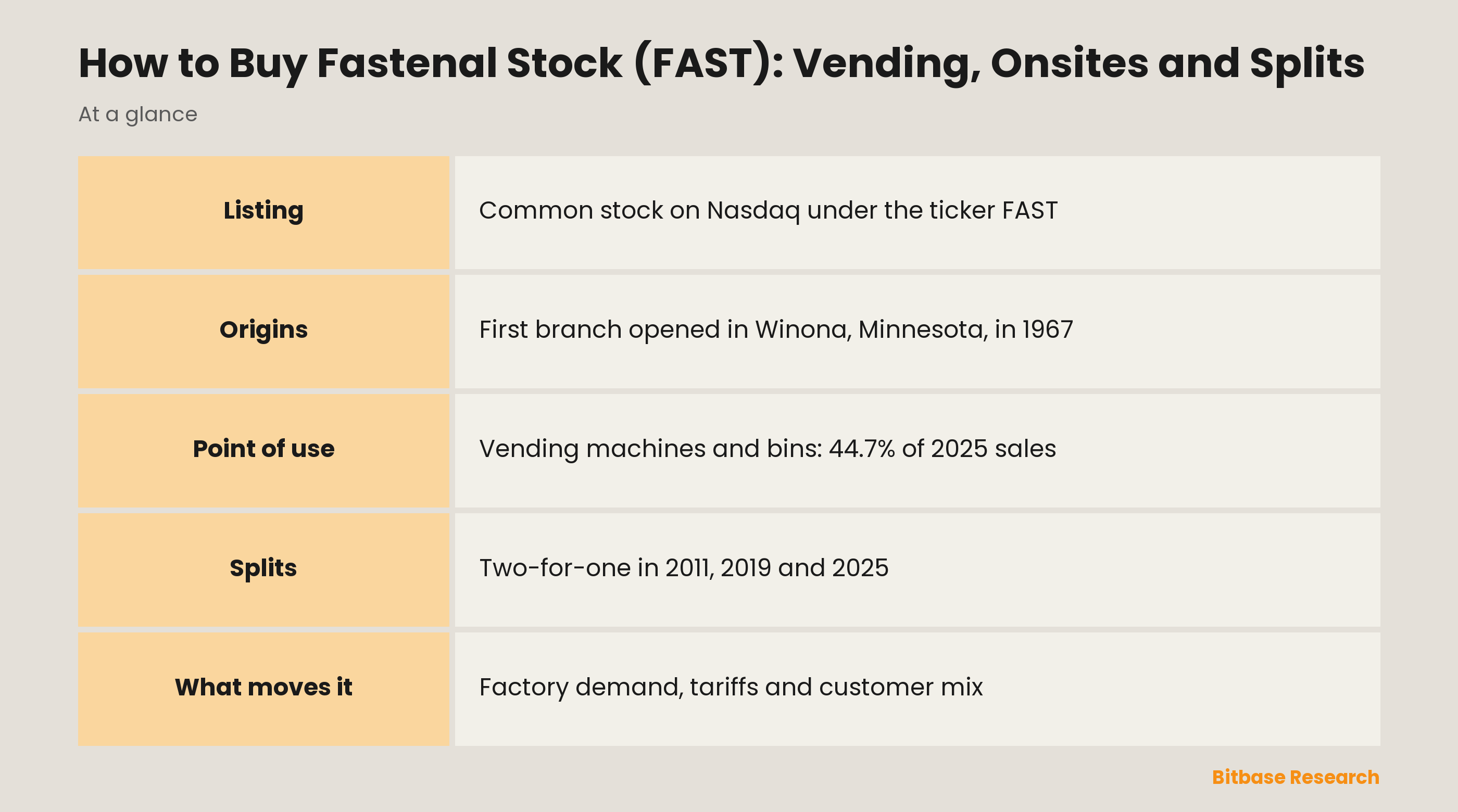
Before buying Fastenal stock, you need only a brokerage account that can trade Nasdaq-listed shares, because the company's common stock trades there under the ticker FAST. The business behind it opened its first branch in Winona, Minnesota, in 1967 to sell threaded fasteners, and it now delivers much of its range through vending machines and managed bins inside customers' own facilities, a channel that carried 44.7% of 2025 sales. This guide covers how Fastenal makes money, how to place the order, and what its filings flag most: tariffs, customer mix and the factory cycle.
What Does Fastenal Do?
Fastenal Company distributes industrial and construction supplies, and the large majority of its transactions are business-to-business. It began as a partnership in 1967, opened its first branch that year in Winona and was incorporated in Minnesota in 1968; the headquarters is still in Winona. The original plan was narrow: supply threaded fasteners through a branch network in small and mid-sized towns. The catalog now spans more than nine major product lines, from bolts and concrete anchors to gloves, janitorial supplies, cutting tools and welding gear.
At the end of 2025 Fastenal had 1,595 branch locations in 25 countries and employed 24,489 people. Fifteen distribution centers serve North America (12 in the US, two in Canada and one in Mexico), and there are two more in Asia and two in Europe. Twelve of the North American centers run automated storage and retrieval systems that handle about 96% of picking.
What sets the model apart is where the inventory sits. Under the name Fastenal Managed Inventory (FMI), the company puts stock at the point of use inside a customer's building. FASTVend is industrial vending, launched in 2008 to give customers tighter control over consumption; about 124,000 machines were in the field at the end of 2025, and Fastenal estimates the market "could support as many as 1.7 million vending units." FASTBin, introduced in 2019, adds scales, infrared sensors, RFID tags or a FASTClick button to bin stock so that a refill request goes out without anyone counting by hand. FASTStock is the scanned version: labeled bins that are scanned once stock falls to a set minimum.
Fastenal also runs Onsites, customer-dedicated selling locations whose inventory is stocked under customer-specific arrangements. The 10-K says this model "provides us with a strategic advantage with our larger customers." About 96% of 2025 net sales came from products made by other companies; the remaining 4% came from items Fastenal manufactured, modified or repaired itself, mostly non-standard threaded fasteners from nine manufacturing locations.
The company changed hands at the top in 2026. Jeffery M. Watts, previously president and chief sales officer, became president and chief executive officer on 16 July 2026, succeeding Daniel L. Florness, chief executive since January 2016.
How Fastenal Makes Money
Fastenal earns a spread: it buys products, keeps them close to the customer and sells them at a markup, then pays for branches, trucks and staff out of that margin. In 2025 gross margin was 45.0% and operating margin 20.2%, against 45.1% and 20.0% a year earlier. Net sales rose 8.7%, and daily sales 9.1% because 2025 had one fewer business day. Pricing contributed 170 to 200 basis points of that growth; the company credits most of the rest to market share gains, in a year when the US manufacturing purchasing managers' index averaged 48.9 and stayed below 50 in ten months out of twelve.
The 10-K lists each product line with the year it joined the catalog:
| Product line | Added | Share of 2025 sales |
|---|---|---|
| Fasteners | 1967 | 30.5% |
| Safety supplies | 1999 | 22.2% |
| Janitorial supplies | 1996 | 9.0% |
| Tools | 1993 | 8.3% |
| Hydraulics and pneumatics | 1996 | 6.9% |
| Material handling | 1996 | 5.7% |
| Cutting tools | 1996 | 5.2% |
| Electrical supplies | 1997 | 4.7% |
| Welding supplies | 1997 | 4.3% |
| Other | — | 3.2% |
Fasteners are still the biggest line but now less than a third of sales; everything else, which Fastenal calls non-fastener products, made up 69.5%. That shift matters for profit, because the 10-K says non-fastener products "typically have a lower gross profit percentage than fasteners." The private-label brands Body Guard and ORMADUS added up to about 11% of 2025 sales.
By customer, manufacturing produced 75.9% of 2025 sales, non-residential construction 8.1%, and other markets, such as resellers, transportation, warehousing and state and local government, 16.0%. Viewed by use, direct materials that go into, or directly support, a customer's production made up 38.7%, and indirect materials for maintenance, repair and safety 61.3%. The United States accounted for 83.2% of revenue, Canada and Mexico 13.5% and all other countries 3.3%.
Contracts anchor the revenue. About 74% of 2025 sales came from customers whose spending was covered by an agreement with Fastenal, and national accounts, built for multi-site customers, made up 65% on their own. No single customer reached 5% of sales.
FAST Stock at a Glance
| Item | Detail |
|---|---|
| Exchange | The Nasdaq Stock Market |
| Ticker | FAST |
| Security | Common stock, the only class registered on the 10-K cover |
| Sector | Wholesale distribution of industrial and construction supplies |
| Index membership | S&P 500 and Nasdaq-100 |
| Headquarters | Winona, Minnesota |
| Incorporated | Minnesota, 1968 |
| Fiscal year | Calendar year, ending 31 December |
| Dividend policy | Regular quarterly cash dividends, each declared by the board |
| Stock splits | Two-for-one in May 2011, May 2019 and May 2025 |
| Chief executive | Jeffery M. Watts, since 16 July 2026 |
| SEC identifier | CIK 815556 |
Quotes, market value and yield shift through every session, so for live numbers go to the Fastenal stock page on Bitbase.
How to Buy Fastenal Stock
Fastenal is a Minnesota company with one listed class of stock, so you will not run into a depositary receipt or a second share line. Buying it works like buying any other Nasdaq stock:
1. Choose a broker with US market access. Outside the United States that can be a local firm that routes orders to US exchanges or an international broker; find out which company legally holds your account and who regulates it.
2. Complete the paperwork. Non-US individuals are normally asked for IRS Form W-8BEN; the IRS tells foreign persons to "submit Form W-8 BEN when requested by the withholding agent or payer whether or not you are claiming a reduced rate of, or exemption from, withholding."
3. Fund the account. If your savings are in another currency, the conversion carries its own cost, so compare the exchange spread as well as the commission.
4. Look up the ticker. Enter FAST and confirm that the result is Fastenal's common stock on Nasdaq before going further.
5. Pick an order type. FINRA says a market order "provides the most certainty that your order will be executed because it's not tied to any restrictions," while a limit order is "an order to buy or sell a security at or better than a specified price."
6. Size the position. Fractional shares let you invest a set cash amount, but FINRA notes that some firms restrict them to certain stocks or "don't offer fractional share trading at all," and that "as a fractional share owner, you might not have shareholder voting rights."
7. Save every confirmation. Trade confirmations show the price paid and anchor any later tax calculation.
If your broker accepts orders before the open or after the close, quotes outside the regular session can differ from the regular one, as our guide on how to read stock prices explains; a limit order puts a ceiling on your price when few shares are changing hands.
For investors abroad, US dividends usually carry withholding tax. According to the IRS, "most types of U.S. source income received by a foreign person are subject to U.S. tax of 30%," and a tax treaty can lower or remove that rate; your own tax authority may still claim its share.
Through funds, Fastenal comes bundled with many other companies. It belongs to both the S&P 500 and the Nasdaq-100, so funds that replicate either index, such as State Street's SPY and Invesco's QQQ, hold it as one small position among many.
What Moves FAST Stock
The manufacturing cycle. Manufacturing customers produced 75.9% of 2025 sales, and in the third quarter of 2026 heavy manufacturing alone accounted for 44.6%; that is the end market of machine builders such as the one in our Caterpillar stock guide. Because of that tilt, the 10-K says, "our business has historically been cyclical," although it argues that supplies used to maintain facilities swing less than parts built into final products.
Tariffs and pricing. Fasteners and private-label goods come mainly from suppliers in Asia, with China and Taiwan a significant source. Since February 2025 Washington has added duties, and pricing lifted sales growth by 170 to 200 basis points in 2025 and by about 240 basis points in the third quarter of 2026. During 2026 the US Supreme Court invalidated tariffs imposed under the International Emergency Economic Powers Act, and new tariffs followed under other statutes. Fastenal says it is not the importer of record for most of what it sells, so its direct exposure to refunds is limited. How quickly it can pass costs on shows up in gross margin.
Customer mix. Growth has come mostly from large contract customers, which buy more at thinner margins. Contract sales reached 76.5% of the total in the third quarter of 2026, up from 73.8% a year earlier. The shift toward larger customers took about 50 basis points off gross margin, which fell to 44.8% from 45.3%, yet operating margin climbed to 21.5% from 20.7% as costs were spread over more sales.
FMI and digital adoption. Signed devices turn into future sales. Digital Footprint, meaning FMI plus other eBusiness sales, made up 61.4% of sales in 2025 and again in the third quarter of 2026, short of the 66% the 10-K expected to reach during 2026, and the company trimmed its 2026 goal for vending and bin signings in the third-quarter report.
Leadership and buybacks. A new chief executive took over in July 2026, and the 10-K lists executive transitions among its risks. Capital returns shifted as well: after no repurchases in 2024 or 2025, Fastenal bought back about 1.7 million shares in the first nine months of 2026.
Fastenal's Exposure to Tariffs, Mix Shifts and Factory Cycles
Item 1A of the 10-K covers dozens of risks. These bear most directly on a FAST share:
Gross margin. "Changes in customer or product mix, downward pressure on sales prices, an inability to capture price increases in response to increased costs associated with tariffs, and changes in volume or timing of orders have caused and could continue to cause our gross profit percentage to fluctuate or decline in the future." Mix alone, it adds, "will likely continue to reduce our gross profit percentage into the foreseeable future."
Trade policy. "Trade policies could make sourcing product from overseas more difficult and/or more costly," and "China represents a significant source of product for North America."
Demand. "A downturn in the economy or in the principal markets served by us and other factors may affect customer spending, which could harm our operating results." The 10-K notes that 2025 results "continued to be impacted by soft manufacturing sector business conditions."
The FMI edge. Competitors could answer with "highly competitive platforms of their own," and Fastenal relies "on a limited number of suppliers for our vending devices, RFID technology, and IR technology."
Valuation and volatility. Two equity risks are unusually frank. The stock "has traditionally had a high beta value, which means fluctuations in the price of our shares will often be sharper than what is experienced by broader market indices," and investors have historically given the company's income "a higher multiple, or premium, than is typical of the broader industrial sector." A premium can shrink even while the business holds up.
Currency. The largest exposure is the Canadian dollar, and Fastenal has "not historically hedged this exposure."
Two general points apply on top of these. Owning one stock concentrates your result in one company, however broad its catalog. And the 10-K gives "no assurances that we will continue to pay dividends in the future or continue to increase dividends at historic rates"; if you hold the shares from another currency, price and dividend both reach you through an exchange rate.
Fastenal's Disclosures, From Cover Page to Monthly Sales Table
Fastenal's SEC filings sit under CIK 815556: an annual 10-K, 10-Qs for the first three quarters, and 8-Ks for events in between; in 2026 quarterly results arrived on 20 January, 13 April, 14 July and 14 October, and the CEO transition was reported the same way.
The 10-K is unusually granular. Beyond the business description in Item 1 and the risks in Item 1A, it tabulates daily sales growth month by month, customer Sites by monthly spending band, FMI signings and installations, and in Note 2 sales by product line, end market and geography. Its performance graph compares the stock with the S&P 500 and the Dow Jones US Industrial Suppliers Index.
Two checks prevent mistakes. The XBRL cover of the 2025 report, R1.htm, lists one registered security, the common stock under FAST. And share counts and per-share figures from before the May 2025 split are restated in the latest 10-K, while filings published before that split use the old basis, so halve their per-share amounts before comparing. For live quotes, return to the stock page linked earlier; for other companies, browse Bitbase's list of US stocks.
Fastenal Stock FAQ
Can I buy Fastenal stock with crypto?
Not directly. FAST is bought through a brokerage account and settles in US dollars, so crypto would first have to be sold for cash and the cash sent to your broker, and in many countries that sale is itself a taxable event. What you end up holding is a registered stake in the company with dividend and voting rights, which is how a stock differs from a cryptocurrency.
Does Fastenal pay a dividend?
Yes. The 10-K says the company has "a long history of paying regular cash dividends," and the board reviews the rate on an ongoing basis. Payments are quarterly; on 13 October 2026 the board declared one payable on 25 November 2026. The amount is set each time, so check the latest earnings release or 10-Q.
Has Fastenal stock ever split?
Yes. Two-for-one splits took effect at the close of business on 20 May 2011, 22 May 2019 and 21 May 2025, each giving holders one additional share for every share they owned. Per-share history from before a split has to be adjusted before comparison.
Is FAST in the S&P 500 and the Nasdaq-100?
Yes. State Street's holdings file for SPY, its S&P 500 fund, and Invesco's file for QQQ, which tracks the Nasdaq-100, both listed Fastenal on 29 October 2026. Membership can change at index reviews.
What happened to Fastenal's Onsite count?
Starting with 2025, Fastenal stopped reporting separate counts of public branches and customer-dedicated Onsites and moved to Sites, grouped by monthly spending. The top band is presented as a proxy for Onsite-like customers: it averaged 2,653 sites in 2025, up from 2,364 in 2024, and 3,288 in the third quarter of 2026.
Conclusion
Buying FAST takes a broker with Nasdaq access, the right ticker and a market or limit order. Understanding it takes more. Growth now comes from large contract customers, vending machines and bins inside their plants, and pricing under shifting tariffs, and those forces pull gross margin in different directions. Read the latest 10-K and 10-Q, including the monthly sales table, before deciding how much of one industrial distributor belongs in your portfolio.
Related reading
Other Bitbase articles on this topic:
- How to Buy CPKC Stock (CP): One Railway, Three Countries
- How to Buy CSX Stock (CSX): An Eastern Railroad on Nasdaq
- How to Buy Cummins Stock (CMI): Engines to Data Center Power
Disclaimer: This article is educational content from Bitbase Academy, provided for information only. It explains what a company or fund does and how the instruments referenced here differ from one another; it does not constitute investment, trading, tax, or financial advice, and it is neither a recommendation nor an endorsement of any security, token, or trading strategy. A tokenized stock is issued by a third party and is designed to give economic exposure to an underlying asset: it is not a share, it carries no shareholder rights, and it depends on the issuer's structure, eligibility rules, and redemption terms, which the issuer can change. Perpetual futures are leveraged derivatives that hold no underlying asset and can be liquidated, and trading hours, product availability, and eligibility differ by instrument and by jurisdiction and can change at any time. Written as of October 2026; verify everything yourself through company filings, the issuer's own documentation, and the product pages of the venue you trade on.
References
[1] Fastenal Form 10-K for 2025 (SEC EDGAR) www.sec.gov
[2] Fastenal 2025 Form 10-K, XBRL cover page (SEC EDGAR) www.sec.gov
[3] Fastenal Form 10-Q for the quarter ended 30 September 2026 (SEC EDGAR) www.sec.gov
[4] Fastenal Form 8-K/A of 16 July 2026 on the CEO transition (SEC EDGAR) www.sec.gov
[5] Fastenal Form 10-K for 2019, recording the 2019 and 2011 splits (SEC EDGAR) www.sec.gov
[6] Fastenal release of 19 April 2011 on a two-for-one stock split (SEC EDGAR) www.sec.gov
[7] State Street: SPY daily holdings, 29 October 2026 www.ssga.com
[8] Invesco: QQQ ETF overview and holdings, 29 October 2026 www.invesco.com
[9] FINRA: Order Types www.finra.org
[10] FINRA: Investing in Fractional Shares www.finra.org
[11] IRS: NRA Withholding www.irs.gov
[12] IRS: About Form W-8 BEN www.irs.gov





