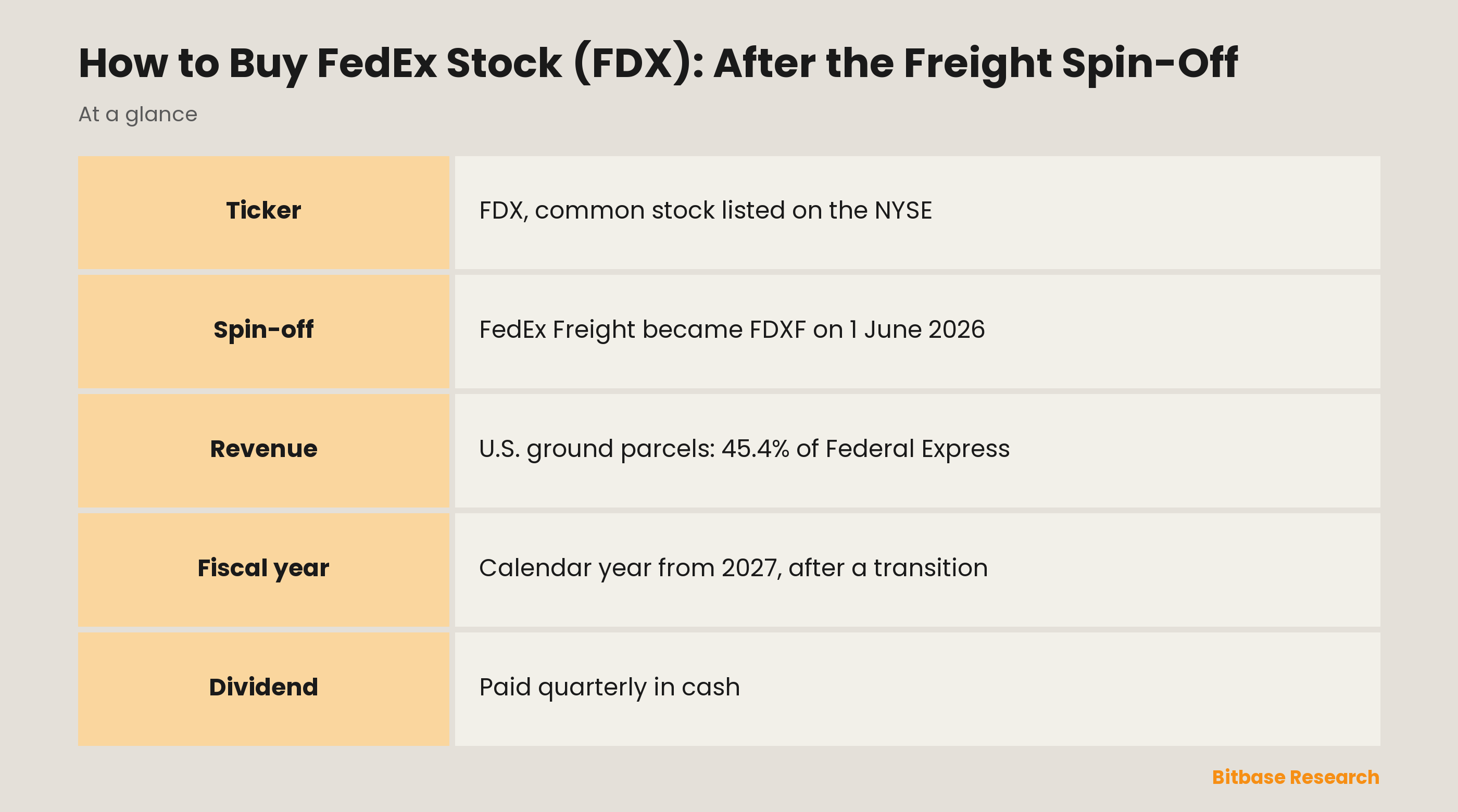
Shipping to more than 220 countries and territories is FedEx's business, and you can buy into it through any broker with access to the New York Stock Exchange, where FedEx Corporation's common stock trades as FDX. The company changed shape in 2026: on 1 June it spun off its less-than-truckload carrier FedEx Freight, handing shareholders one FedEx Freight share for every two FedEx shares, and it moved its fiscal year end from May to December.
What Does FedEx Do?
FedEx Corporation is a holding company incorporated in Delaware in 1997 and based in Memphis, Tennessee; the group dates its founding to 1971. Its operating company, Federal Express, is described in the 10-K as "the world's largest express transportation company and a leading North American provider of small-package ground delivery services." That reach comes from a merger: on 1 June 2024 FedEx Ground was folded into Federal Express under the plan FedEx calls one FedEx. As of 31 May 2026 Federal Express had about 452,000 employees and 700 aircraft.
Since 1 June 2026 there are two segments. Express U.S. Domestic sells overnight and deferred delivery in the United States plus FedEx Ground Commercial and FedEx Home Delivery parcels. Express International carries packages and freight to more than 220 countries and territories and now includes FedEx Logistics, the customs brokerage and forwarding arm. FedEx Office sits outside both, and FedEx Supply Chain, its contract logistics business, was sold to CMA CGM Group on 1 October 2026.
The 10-K names UPS and the US Postal Service among domestic rivals and DHL and UPS abroad, and it notes that high-volume shippers such as Amazon.com "may be considered competitors in addition to customers."
How FedEx Makes Money
Fiscal 2026 ran to 31 May 2026 and still included FedEx Freight. Revenue rose 8%; Federal Express produced 86.9% of it, FedEx Freight 9.3% and the remaining businesses 3.9%. With FedEx Freight gone, the split that matters now is the one inside Federal Express:
| Service line | Share of fiscal 2026 Federal Express revenue |
|---|---|
| U.S. ground parcels | 45.4% |
| U.S. priority (overnight) | 14.1% |
| U.S. deferred | 6.9% |
| International export packages | 18.9% |
| International domestic | 5.7% |
| Freight | 7.4% |
| Other | 1.6% |
Shares are calculated from the 10-K's revenue by service type.
Segment revenue grew 9% on better package yields, more US parcels and higher fuel surcharges, partly offset by the expiry of its contract with the US Postal Service and by trade policy changes, and the segment's operating margin widened to 7.2% from 6.5%. Shipments that start or end outside the United States made up 28.3% of revenue.
List prices rose by an average of 5.9% on 5 January 2026, demand surcharges apply when the network is busy, and a fuel surcharge resets every week. Jet fuel cost 3.2% of fiscal 2026 revenue, and FedEx holds no jet fuel hedges.
The 10-Q for the period to 30 September 2026, the first under the new structure, shows the post-spin-off mix: over the four months from June, Express U.S. Domestic brought in 64.4% of revenue and Express International 32.6%.
FDX Stock at a Glance
| Item | Detail |
|---|---|
| Exchange | New York Stock Exchange (NYSE) |
| Ticker | FDX |
| Security | Common stock; other symbols such as FDX 27 belong to FedEx notes |
| Index membership | S&P 500 |
| Headquarters | Memphis, Tennessee |
| Fiscal year | Ended 31 May through fiscal 2026; calendar year from 2027 |
| Dividend policy | Quarterly cash dividend, approved by the board |
| Share buybacks | Repurchase program authorized in July 2026 |
| Former segment | FedEx Freight, listed separately as FDXF; FedEx keeps 19.9% |
| SEC identifier | CIK 1048911 |
Quotes, market value and yield move with every trade; the FedEx stock page on Bitbase shows them live.
How to Buy FedEx Stock
FedEx has one class of common stock on the NYSE, so no depositary receipt stands between you and the share:
1. Choose a broker with NYSE access, and find out which legal entity will hold your account and which regulator supervises it.
2. Complete the account opening and identity checks. The IRS tells a foreign person to give Form W-8 BEN "to the withholding agent or payer," which lets a broker apply any treaty rate to US dividends.
3. Fund it, counting the currency conversion spread as part of the cost.
4. Search for FDX and confirm the result reads FedEx Corporation common stock. FDXF is FedEx Freight, a separate company, and FDX 27 is a bond.
5. Pick an order type. FINRA says a market order "provides the most certainty that your order will be executed," while a limit order fills only "at or better than a specified price."
6. Consider a fraction. "The availability of fractional share trading varies by brokerage firm," FINRA notes, and a fractional owner "might not have shareholder voting rights."
Outside the United States, withholding applies to dividends: the IRS says "most types of U.S. source income received by a foreign person are subject to U.S. tax of 30%," unless a treaty lowers the rate, and the country where you live may also tax the income.
Through funds, FedEx arrives as one holding among many. State Street's daily files for SPY, its S&P 500 trust, and XLI, its industrials fund, both listed FedEx on 29 October 2026; XLI also holds the railroad Union Pacific.
What Moves FDX Stock
The leftover FedEx Freight stake. FedEx kept 19.9% of FedEx Freight and has said it will dispose of the stake within 24 months of the spin-off, by exchanging shares to repay some FedEx debt or by passing them to FDX holders as a dividend or in exchange for FDX shares. Meanwhile the stake is marked to market: the 10-Q to 30 September 2026 books a gain over the four months from June and a loss in the July to September quarter. FedEx strips this out of its adjusted figures, so reported and adjusted earnings can differ widely.
Network 2.0. This multi-year rebuild of the US and Canadian surface network consolidates sorting facilities and pickup-and-delivery routes. It is complete in Canada, reached about 360 US locations by 31 May 2026, and FedEx expects to finish the US rollout by the end of calendar 2027.
Trade. The 10-K calls transportation "highly cyclical" and ties volumes to "the rate of global trade growth." After the US Supreme Court struck down tariffs imposed under the International Emergency Economic Powers Act on 20 February 2026, FedEx sued for a full refund, while 14 class actions seek refunds from FedEx itself; the company says the impact could be material.
Rates and competition. Another average increase of 5.9% takes effect on 4 January 2027, and the 10-K warns that competitors' pricing could limit its ability to maintain or raise prices.
The air fleet. An emergency FAA directive grounded every Boeing MD-11 in November 2025; by 30 September 2026 most of the fleet was back in service.
Hazards Named in the FedEx Annual Report
Of the risks in the fiscal 2026 10-K, these bear most directly on an FDX share:
The economy. "While macroeconomic risks apply to most companies, we are particularly vulnerable." FedEx ships less when people buy less.
Transformation. Failing to execute its transformation programs "in the expected time frame and at the expected cost may materially and adversely affect our future results," and the old Federal Express and FedEx Ground networks may not integrate as planned.
The spin-off. FedEx "may not realize the anticipated benefits." It holds an IRS private letter ruling that the separation is generally tax-free for US federal income tax purposes, but if the IRS disagreed, the distribution "could be treated as a taxable dividend or capital gain" for shareholders.
Competition and labor. "We face intense competition." Apart from pilots, FedEx's US and Canadian employees are not unionized; organizing drives or labor law changes could disrupt the network.
Above these sits concentration: one stock ties your result to one company, and a non-dollar investor also carries currency risk.
Researching FDX: EDGAR, the 10-KT and the IR Site
FedEx files under CIK 1048911, and investors.fedex.com posts the same reports. The fiscal 2026 10-K, filed on 20 July 2026, covers the year to 31 May 2026 with FedEx Freight inside. The next annual report is a transition report on Form 10-KT for June to December 2026, and the 10-Q to 30 September 2026 shows three-month and four-month columns, with FedEx Freight as discontinued operations in prior-year figures. The 8-Ks of May and June 2026 set out the spin-off terms.
FedEx Stock FAQ
Does FedEx pay a dividend?
Yes, quarterly in cash. The 10-K says FedEx expects "to continue to pay regular quarterly cash dividends," with each payment approved by the board and the amount reviewed once a year. Amounts and dates are in the latest 10-Q.
Can I buy FedEx stock with crypto?
Not directly. FDX trades in US dollars through a brokerage account, so crypto has to be sold for cash first, and that sale may be taxable where you live. The share you end up with is a registered stake with voting and dividend rights, which is how a listed share differs from a crypto asset.
What did FDX shareholders receive in the FedEx Freight spin-off?
One FedEx Freight share for every two FedEx shares held at the close of business on 15 May 2026, plus cash for fractions. FedEx Freight began trading on the NYSE as FDXF on 1 June 2026, and holders kept their FDX shares. FedEx distributed 80.1% and retained 19.9%.
Why is FedEx reporting a seven-month transition period?
Its fiscal year end moved from 31 May to 31 December, effective 1 June 2026. June to December 2026 gets its own annual report, and from 2027 the fiscal year follows the calendar.
Is FDX in the S&P 500?
Yes. State Street's holdings file for SPY listed FedEx on 29 October 2026, with FedEx Freight in the same file.
Conclusion
The order is routine: a broker with NYSE access, FDX on the screen, a market or limit order. What the share holds changed in 2026: Federal Express in two segments, without FedEx Freight's trucking business but with a 19.9% stake that FedEx plans to dispose of within 24 months. Read the latest 10-Q and 8-Ks, and mind the shifted fiscal calendar, before comparing figures across years.
Related reading
Other Bitbase articles on this topic:
- How to Buy CPKC Stock (CP): One Railway, Three Countries
- How to Buy CSX Stock (CSX): An Eastern Railroad on Nasdaq
- How to Buy Cummins Stock (CMI): Engines to Data Center Power
Disclaimer: This article is educational content from Bitbase Academy, provided for information only. It explains what a company or fund does and how the instruments referenced here differ from one another; it does not constitute investment, trading, tax, or financial advice, and it is neither a recommendation nor an endorsement of any security, token, or trading strategy. A tokenized stock is issued by a third party and is designed to give economic exposure to an underlying asset: it is not a share, it carries no shareholder rights, and it depends on the issuer's structure, eligibility rules, and redemption terms, which the issuer can change. Perpetual futures are leveraged derivatives that hold no underlying asset and can be liquidated, and trading hours, product availability, and eligibility differ by instrument and by jurisdiction and can change at any time. Written as of October 2026; verify everything yourself through company filings, the issuer's own documentation, and the product pages of the venue you trade on.
References
[1] FedEx Corporation Form 10-K, fiscal year ended 31 May 2026: business, revenue by service type, risk factors (SEC EDGAR) www.sec.gov
[2] FedEx Corporation Form 10-Q, quarter ended 30 September 2026: new segments, FedEx Freight stake, tariff refunds (SEC EDGAR) www.sec.gov
[3] FedEx Corporation Form 8-K, 13 May 2026: FedEx Freight distribution, record date and retained stake (SEC EDGAR) www.sec.gov
[4] FedEx Corporation Form 8-K, 1 June 2026: completion of the FedEx Freight spin-off and FDXF listing (SEC EDGAR) www.sec.gov
[5] FedEx Corporation third-quarter 2026 earnings release, 28 October 2026: FedEx Supply Chain sale, 2027 rate increase (SEC EDGAR) www.sec.gov
[6] State Street SPDR S&P 500 ETF Trust (SPY): fund page and daily holdings www.ssga.com
[7] State Street Industrial Select Sector SPDR ETF (XLI): fund page and daily holdings www.ssga.com
[8] FINRA: Order Types www.finra.org
[9] FINRA: Investing in Fractional Shares www.finra.org
[10] IRS: NRA Withholding www.irs.gov
[11] IRS: About Form W-8 BEN www.irs.gov





