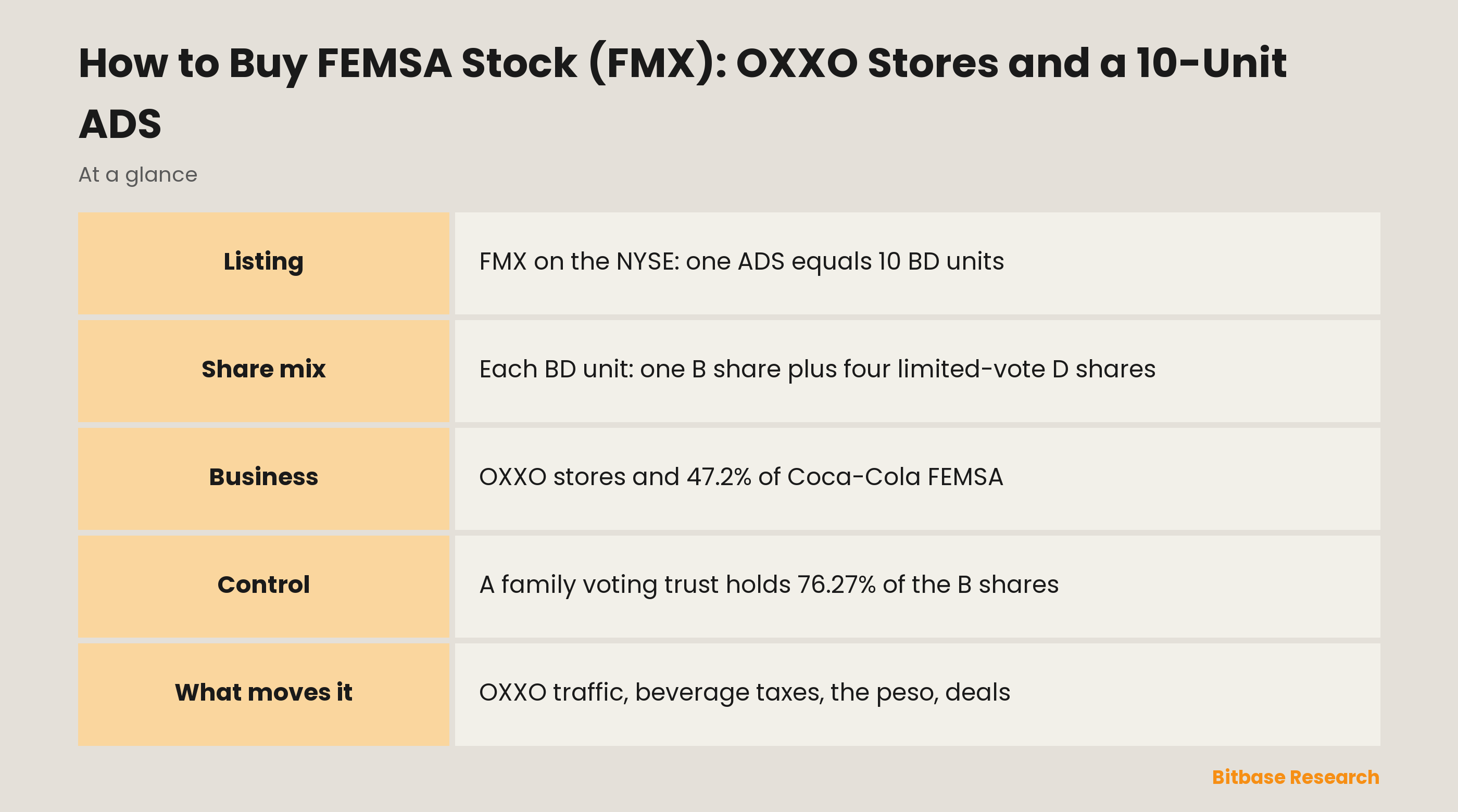
Ten BD units sit behind every FMX share on the New York Stock Exchange, so buying FEMSA comes down to placing an order for the FMX American depositary share (ADS) with any broker that reaches the NYSE, or for the units themselves on the Mexican Stock Exchange. Each BD unit bundles one full-vote B share with four limited-vote D shares, which means one ADS carries 50 shares in all. Behind that structure sits a Monterrey group that runs the OXXO convenience chain, owns 47.2% of the world's largest Coca-Cola franchise bottler and is still steered by a family voting trust.
What Does FEMSA Do?
FEMSA is the everyday name of Fomento Económico Mexicano, S.A.B. de C.V., a holding company organized under Mexican law and based in Monterrey. It was incorporated in 1936 as Valores Industriales, but it traces its roots to Cervecería Cuauhtémoc, Mexico's first brewery, founded in 1890. Descendants of some of the brewery's founders still take part in the voting trust that controls the company. Beer, once the core, is gone: FEMSA sold the last of its Heineken shares in May 2025.
That sale was one step in FEMSA Forward, a strategy announced in February 2023 to concentrate on retail, beverages and digital. Since then the group has also sold Jetro Restaurant Depot, its refrigeration equipment maker, its plastics operations and the Solistica logistics business. What remains employs more than 369,000 people in 18 countries, according to its 6-K filings.
The businesses it kept fall into five reported divisions:
1. Proximity Americas. The OXXO small-format store chain, which the 20-F calls the largest in Latin America by number of stores: 25,587 locations at the end of 2025, of which 24,297 were in Mexico and the rest in Colombia, Chile, Peru and the United States. The US stores came mainly from the 2024 purchase of 249 convenience stores from Delek, most of them in Texas.
2. Coca-Cola FEMSA. The largest franchise bottler of Coca-Cola trademark products in the world by volume, with about 12.3% of the Coca-Cola system's global volume in 2025. It bottles and distributes in most of Mexico, Central America, Colombia, much of Brazil, the Buenos Aires area and Uruguay, and also distributes Monster products in every country where it operates.
3. Proximity Europe. Valora, acquired in 2022, with 2,755 kiosks, convenience stores and bakery outlets in Switzerland, Germany, Austria, Luxembourg and the Netherlands under brands such as k kiosk, avec, BackWerk and Brezelkönig.
4. Health. Pharmacies and related operations: 4,503 locations in Mexico, Chile, Ecuador and Colombia.
5. Fuel. OXXO Gas, with 552 service stations across 17 Mexican states, mostly in the north.
Outside those divisions sit Spin, which pairs the Spin by OXXO debit card and wallet with Spin Premia, a loyalty program the 20-F says accounts for up to 49.3% of OXXO sales, and Bara, a discount grocer with 636 stores.
The map keeps shifting. From the third quarter of 2026 the group reports OXXO Mexico on its own and puts the OXXO stores outside Mexico together with the fuel stations in a segment called Americas & Mobility, so older and newer reports do not line up. José Antonio Fernández Garza Lagüera became chief executive on 1 November 2025.
How FEMSA Makes Money
Most of FEMSA's revenue comes from selling everyday goods: drinks, snacks, groceries, medicines and fuel. OXXO also earns fees on bill payments, deposits and remittances made at its tills, which the company books as agency income rather than product sales. Consolidated revenue grew 7.6% in 2025, helped by every business unit, favorable currency translation and a full year of the US stores.
| Division | Share of 2025 revenue | Revenue growth in 2025 |
|---|---|---|
| Proximity Americas (OXXO) | 39.1% | 7.0% |
| Coca-Cola FEMSA | 34.7% | 4.3% |
| Health | 10.5% | 10.5% |
| Fuel | 8.0% | 2.8% |
| Proximity Europe | 6.8% | 14.6% |
Shares are each division's revenue divided by consolidated revenue; division figures include sales between FEMSA businesses, which are eliminated in the consolidated total.
Two different engines sit in that table. OXXO grows mainly by opening stores: the chain added a net 1,125 locations in 2025, while same-store sales rose only 1.0%, after 4.2% in 2024 and 14.2% in 2023. Coca-Cola FEMSA grows with volume and price, and its volume fell 1.8% in 2025, with Mexico down 5.2%. Health grew on retail sales in Chile, Colombia and Ecuador and 8.0% same-store growth, while it closed a net 422 stores in Mexico in a restructuring. Europe's 14.6% gain owed something to currency translation.
Profit did not follow revenue. The consolidated gross margin narrowed by 50 basis points to 40.6%, with Health's falling to 27.1% from 30.1%, and consolidated net income fell 17.9%. The main reasons were financial: FEMSA holds a large dollar cash position, and as the peso strengthened in 2025 it booked a non-cash foreign-exchange loss after a gain the year before, while net interest expense rose. The effective tax rate on continuing operations was 36.4%, above Mexico's 30% statutory rate, partly because Spin's losses are not deductible.
Geography matters as much as the divisions: 64% of 2025 revenue came from Mexico.
FMX Stock at a Glance
| Item | Detail |
|---|---|
| Issuer | Fomento Económico Mexicano, S.A.B. de C.V. (FEMSA), organized under Mexican law |
| US security | ADS on the New York Stock Exchange, ticker FMX, listed since May 1998 |
| ADS ratio | One ADS represents 10 BD units |
| What one BD unit holds | One Series B share, two Series D-B shares, two Series D-L shares |
| Mexican lines | BD units (FEMSA UBD) and B units (FEMSA UB) on the Mexican Stock Exchange |
| Voting | B shares carry full votes; D-B and D-L shares vote only on a short list of matters |
| ADS depositary | The Bank of New York Mellon |
| Sector | Retail and beverages |
| Headquarters | Monterrey, Nuevo León, Mexico |
| Financial year | Calendar year; IFRS, reported in Mexican pesos |
| Dividend policy | Annual dividends declared by shareholders, paid in installments |
| SEC identifier | CIK 1061736; files Form 20-F and Form 6-K |
The shares cannot be separated: they change hands only as units, either B units of five B shares or BD units. At 1 April 2026 about 46.41% of BD units were held as ADSs. The 20-F cover also lists two FEMSA bonds on the NYSE, tickers FMX43 and FMX50; they are debt securities rather than equity. For live quotes, use the FEMSA stock page on Bitbase.
How to Buy FEMSA Stock
FMX can be bought through any brokerage that offers NYSE-listed securities. To buy the units directly you need a broker connected to the Mexican Stock Exchange.
1. Choose the line. FMX trades in dollars in New York; FEMSA UBD trades in pesos in Mexico City and holds the same mix of shares.
2. Open and verify an account with a brokerage regulated where you live.
3. Fund it. Holding a third currency? Then the exchange rate the broker charges matters as much as its commission.
4. Search for FMX, not FEMSA's bonds. The two senior notes on the NYSE share the FMX prefix; check that the security is the ADS.
5. Pick an order type. A limit order caps the price you pay; a market order takes the price available.
6. Choose a size. Fractional ADSs are offered by some brokers and not by others, so confirm this before sizing the order.
ADS or units. An ADS holder may receive notice of a shareholder meeting too late to send voting instructions to the depositary; if no instructions arrive, the depositary can give a proxy to a person the company designates. The 20-F adds that holders of ADSs, and holders of BD units in the United States, may be unable to take part in a rights offering, and that under Mexican law the depositary cannot sell those rights for them, so their stake could be diluted. The Bank of New York Mellon charges fees for services such as distributing dividends, can deduct them from cash dividends, and passes on costs such as the peso-to-dollar conversion. Holding BD units directly avoids the depositary but requires a broker that settles in Mexico.
Mexican withholding. Mexico withholds 10% on dividends paid from profits earned in 2014 or later; distributions of earlier profits are not. A non-resident who sells ADSs through a recognized exchange and lives in a country with a Mexican tax treaty owes no Mexican tax on the gain; others may be taxed at 10% or more. How your own country treats the dividend and the Mexican tax depends on where you live, so ask your broker or a tax adviser.
No foreign cap. The 20-F states that foreign investment in FEMSA's shares is not limited under Mexico's foreign investment law.
Through a fund. The iShares MSCI Mexico ETF listed Fomento Economico Mexicano SAB de CV among its holdings on 31 May 2026, next to Coca-Cola Femsa.
What Moves FMX Stock
OXXO traffic in Mexico. The chain is the largest division and Mexico supplies most of the revenue, so same-store sales are the number to watch. Growth slowed from 14.2% in 2023 to 1.0% in 2025. The 20-F warns that the store count grew at a compound rate of 5.8% from 2023 to 2025 and that, as small-format stores fill Mexico, new sites may be fewer and weaker.
The Coca-Cola FEMSA stake. FEMSA owns 47.2% of the bottler, or 56.0% of its full-voting stock, and appoints up to 13 of its 21 directors. The Coca-Cola Company owns 27.8% and appoints up to five. Coca-Cola FEMSA is listed in its own right, files its own 20-F and trades on the NYSE as KOF, so its results arrive twice: once in its own reports and once inside FEMSA's.
Beverage taxes and health trends. Mexico's tax reform for 2026 raised the special tax on drinks with added sugar or high-fructose corn syrup from 1 January 2026 and created a new per-liter tax on drinks with non-caloric sweeteners. The 20-F also lists health concerns, limits on ingredients and advertising, and the effect of weight-loss drugs among the forces that could reduce demand.
The peso. Results are in pesos, but the ADS is priced in dollars. The peso gained about 13.7% against the dollar in 2025 after losing about 23.4% in 2024. A stronger peso lifts the dollar value of Mexican earnings but, as in 2025, can produce foreign-exchange losses on FEMSA's dollar cash. Peso-denominated debt, including hedges, made up 53.4% of total debt at the end of 2025.
Portfolio moves. In 2026 alone FEMSA split its Brazilian joint venture with Raízen, keeping the OXXO stores there; saw BradyPLUS, a US distributor it part-owns, merge with Imperial Dade, leaving FEMSA about 18.75%; and agreed to bring QED Investors into its lending business.
Health in Colombia and Mexico. In April 2026 the Colombian unit, Cruz Verde, told EPS Sanitas it would not renew a medication dispensing contract under the mandatory health plan, due to expire on 30 September 2026. In Mexico, new management's priority is stabilizing operations rather than expanding.
Cash returns. Shareholders approved an ordinary and an extraordinary dividend at the March 2026 meeting, each paid in four installments on 23 April, 16 July and 15 October 2026 and 14 January 2027. FEMSA also buys back ADSs through accelerated share repurchase agreements with US banks; it announced another on 14 September 2026, with final settlement expected before the end of 2026.
Weak Spots Behind OXXO and the Bottler
A family trust in charge. "A majority of our voting shares are held by a voting trust, which effectively controls the management of our company, and the interests of which may differ from those of other shareholders." At 1 April 2026 the trust held 76.27% of the B shares, enough to elect most of the board. It runs to 31 December 2030 and can be renewed for further ten-year terms.
Limited votes for most outside holders. The D-B and D-L shares in every BD unit vote only on matters such as a change of corporate form, certain mergers or dissolution, and the 20-F says plainly that their holders "will not be able to influence our business or operations."
Dependence on The Coca-Cola Company. Coca-Cola FEMSA must buy concentrate from TCCC affiliates at prices TCCC sets, and its bottler agreements renew for ten-year terms unless either side gives notice. "Coca-Cola FEMSA's business depends on its relationship with The Coca-Cola Company," the 20-F says.
Mexico itself. "Adverse economic conditions in Mexico may adversely affect our financial position and results of operation." The filing also cites organized crime, which can cut store traffic and has at times forced temporary closures, and US tariffs that could slow the economy.
A control weakness. Management concluded that FEMSA's disclosure controls were not effective at the end of 2025 because of a material weakness in IT general controls over the ERP systems at Coca-Cola FEMSA. It also concluded that the financial statements are fairly presented and need no adjustment.
A holding company's dividend. FEMSA has no significant operations of its own, so dividends depend on what its subsidiaries pay up, and the 20-F says it cannot assure that dividends will be paid.
How to Research FMX Yourself
FEMSA files under CIK 1061736. Like América Móvil, another Mexican group with an NYSE listing, it files an annual report on Form 20-F rather than a 10-K, the latest on 24 April 2026, and uses Form 6-K for quarterly figures, meeting resolutions and transactions. The 20-F follows the standard order: risk factors first, then the divisions and the results, then the voting trust, the unit structure, dividend rights and taxes, with depositary fees near the end.
Three habits help. Read Coca-Cola FEMSA's own 20-F alongside FEMSA's, since the bottler supplies a third of revenue. Check whether a figure is per B share, per D share, per unit or per ADS: a D share receives 125% of the dividend on a B share. And remember the 2026 change in segments. If you are weighing other beverage names, the Monster Beverage guide covers the energy-drink brand that Coca-Cola FEMSA distributes, and the Bitbase stock pages list other listed companies.
FEMSA Stock FAQ
How many FEMSA shares does one FMX ADS represent?
Fifty. One ADS represents 10 BD units, and each BD unit contains one Series B share, two Series D-B shares and two Series D-L shares, so an ADS holds 10 B shares, 20 D-B shares and 20 D-L shares.
What is the difference between FEMSA's B units and BD units?
A B unit holds five full-vote B shares and trades in Mexico as FEMSA UB. A BD unit holds one B share and four limited-vote D shares, trades in Mexico as FEMSA UBD and is the unit behind the FMX ADS. Because each D share receives 125% of the B-share dividend, a BD unit collects more dividend than a B unit, but far fewer votes.
Does FEMSA pay a dividend?
Yes. FEMSA has historically declared annual dividends. In March 2026 shareholders approved an ordinary dividend and an extraordinary one, each paid in four installments between April 2026 and January 2027. Amounts are set in pesos per share, and Mexico generally withholds 10% on dividends from profits earned since 2014.
Who controls FEMSA?
A voting trust of founding-family groups, including the Garza Lagüera, Garza Garza and Baillères families, held 76.27% of the full-vote B shares at 1 April 2026. Outside the trust, William H. Gates III, including Cascade Investments, held 14.02% each of the D-B and D-L shares and 8.19% of the total capital.
Is FEMSA the same company as Coca-Cola FEMSA?
No. Coca-Cola FEMSA is a separate listed company, trading on the NYSE as KOF, in which FEMSA owns 47.2% and The Coca-Cola Company 27.8%. Buying FMX gives you a slice of the bottler alongside OXXO, the pharmacies and the fuel stations.
Can I buy FEMSA stock with crypto?
Not directly. FMX settles in dollars and the Mexican units settle in pesos, so you would first sell crypto for one of those currencies and move the cash to a brokerage account. In many countries that sale is a taxable event, so look up how crypto sales are taxed in your country before you start.
Conclusion
Buying FEMSA is a choice between the FMX ADS in dollars, worth ten BD units, and the units themselves in pesos in Mexico. Either way you hold mostly limited-vote D shares beside a family trust that controls the B shares. What you own is OXXO's store growth, a 47.2% stake in Coca-Cola FEMSA, pharmacies, fuel stations and a loss-making fintech arm, all measured in pesos. Read the latest 20-F and the 6-K dividend resolutions, and check what Mexican withholding means for your own tax position, before deciding how much of a portfolio one Mexican conglomerate should take.
Related reading
Other Bitbase articles on this topic:
- How to Buy Coca-Cola Europacific Partners Stock (CCEP): No ADR
- How to Buy Diageo Stock (DEO): Four Shares per ADS and Guinness
- How to Buy Dollar General Stock (DG): Small Towns, Thin Margins
- How to Buy Kimberly-Clark Stock (KMB): Huggies, Kleenex, Tylenol
Disclaimer: This article is educational content from Bitbase Academy, provided for information only. It explains what a company or fund does and how the instruments referenced here differ from one another; it does not constitute investment, trading, tax, or financial advice, and it is neither a recommendation nor an endorsement of any security, token, or trading strategy. A tokenized stock is issued by a third party and is designed to give economic exposure to an underlying asset: it is not a share, it carries no shareholder rights, and it depends on the issuer's structure, eligibility rules, and redemption terms, which the issuer can change. Perpetual futures are leveraged derivatives that hold no underlying asset and can be liquidated, and trading hours, product availability, and eligibility differ by instrument and by jurisdiction and can change at any time. Written as of November 2026; verify everything yourself through company filings, the issuer's own documentation, and the product pages of the venue you trade on.
References
[1] FEMSA, Form 20-F for 2025 (SEC EDGAR) www.sec.gov
[2] FEMSA 20-F for 2025, XBRL cover page (R1) www.sec.gov
[3] FEMSA, Form 6-K: 2026 shareholders' meeting resolutions www.sec.gov
[4] FEMSA, first-quarter 2026 results (Form 6-K) www.sec.gov
[5] FEMSA, Form 6-K: QED to invest in FEMSA's lending venture www.sec.gov
[6] FEMSA, third-quarter 2026 results (Form 6-K) www.sec.gov
[7] iShares MSCI Mexico ETF, schedule of investments, 31 May 2026 www.sec.gov
[8] Coca-Cola FEMSA filings on SEC EDGAR (ticker KOF) www.sec.gov





