
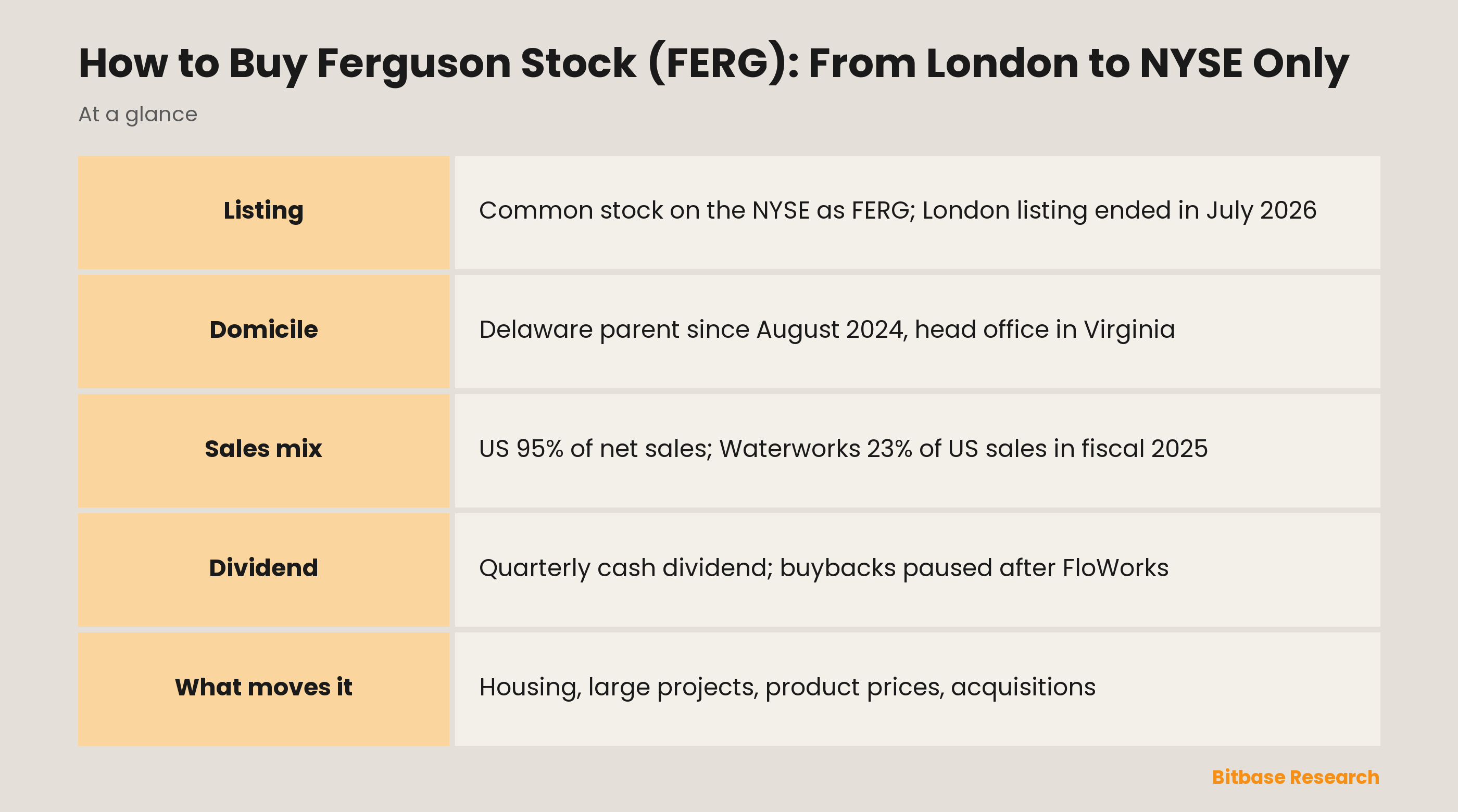
Buying into Ferguson now goes through one market, the New York Stock Exchange, where the company's common stock trades as FERG and any broker offering US shares can take the order. Ferguson cancelled its secondary London listing on 20 July 2026, two years after its parent company moved from Jersey to Delaware, and in fiscal 2025 its largest US customer group was not home plumbing but Waterworks, at 23% of US net sales. Below: what the distributor sells, how an order works, and why its fiscal calendar changed.
What Does Ferguson Do?
Ferguson is a distributor: it buys products from manufacturers and resells them to trade customers. Its filings call it "North America's largest value-added distributor of essential water and air solutions, serving the specialized professional" in residential and non-residential construction. The range runs from plumbing, heating, ventilation and air conditioning (HVAC), appliances and lighting to pipes, valves and fittings (PVF) and water and wastewater products, sold through branches, showrooms, sales teams and e-commerce.
The business has European roots. The company says it "maintained businesses throughout Europe, Canada and the United States in the 1900s," turned its focus to North America in the early 2000s and disposed of its European operations. On 1 August 2024, Ferguson plc, a company incorporated in Jersey, completed a merger that put a new Delaware parent, Ferguson Enterprises Inc., on top of the group. Each Ferguson plc ordinary share was exchanged one-for-one for common stock of the new parent, which kept the FERG symbol on the NYSE. Headquarters are in Newport News, Virginia.
The group reports two segments, both defined by geography:
| Segment | Share of net sales | Main brand | Network on 31 December 2025 |
|---|---|---|---|
| United States | 95% | Ferguson | 1,517 branches, 9 regional distribution centers, five market distribution centers, about 32,000 associates |
| Canada | 5% | Wolseley | 212 branches, one market distribution center, about 3,000 associates |
The 95/5 split held in the five-month transition period to December 2025 and in each of fiscal 2025, 2024 and 2023.
Scale is the selling point. At the end of 2025 Ferguson had about 37,000 suppliers, none above 5% of inventory purchases, and sold more than 1 million unique products a year through 1,729 branches with about 35,000 associates. No single customer accounted for more than 1% of net sales in the transition period or in fiscal 2025, and about 95% of the products it sells in the United States come from US-based suppliers.
Beyond moving boxes, Ferguson sells services such as virtual design, fabrication, valve actuation, kitting and project management, plus private-label goods it calls Own Brand. Buying other distributors is part of the model too. The 10-KT says "acquisitions also remain a core part of our growth strategy," mostly smaller deals that "bolt-on to our existing branch network." The largest recent one closed on 31 August 2026: FloWorks, a distributor of valves and flow control products with over 60 locations and 25 service centers in the United States and Canada. By 9 November 2026 the chief executive counted eleven acquisitions completed during the year.
How Ferguson Makes Money
Ferguson earns a distribution margin, charging for stock on hand, delivery and technical help. Gross profit was 30.7% of sales in fiscal 2025, up from 30.5% the year before, and 30.6% in the transition period.
The company does not report profit by product. It does split US net sales by customer group, and over three years the mix has tilted toward infrastructure and commercial work:
| US customer group | Fiscal 2023 | Fiscal 2025 | Aug to Dec 2025 |
|---|---|---|---|
| Waterworks | 21% | 23% | 24% |
| Ferguson Home | 24% | 21% | 21% |
| Residential Trade Plumbing | 17% | 15% | 15% |
| Commercial/Mechanical | 12% | 14% | 15% |
| HVAC | 11% | 12% | 11% |
| Industrial | 7% | 7% | 7% |
| Facilities Supply | 5% | 5% | 4% |
| Fire & Fabrication | 3% | 3% | 3% |
Shares are of US net sales; the company does not break Canada down this way, citing materiality. Fiscal 2023 and fiscal 2025 are the years to 31 July.
Seen by end market, residential and non-residential customers "each account for approximately half" of net sales. Within that, repair, maintenance and improvement (RMI) brings in about two-thirds and new construction about one-third, based on management estimates. That mix cushions a housing slowdown: repairs go on when building stops.
Commodity products are a smaller but volatile slice. In the United States, goods with large amounts of plastic, copper and steel "can represent up to approximately 15% of annual net sales," and their prices follow commodity markets. The business is "not highly seasonal," though sales peak in spring and summer.
In fiscal 2025 net sales rose 3.8%: acquisitions added 1.0%, one fewer sales day cost 0.4%, and pricing slipped on commodity deflation. In the transition period, net sales rose 4.5% on low to mid-single-digit price inflation and acquisitions; in the United States, non-residential sales grew about 11% while residential slipped about 1%.
FERG Stock at a Glance
| Feature | FERG |
|---|---|
| Exchange | New York Stock Exchange, its only listing since 20 July 2026 |
| Ticker | FERG |
| Security | Common stock; one registered class, no depositary receipts |
| Sector | Distribution of plumbing, HVAC, waterworks and industrial products |
| Index membership | S&P 500 |
| Headquarters | Newport News, Virginia |
| Incorporated | Delaware; group parent since 1 August 2024 |
| Former listing | London Stock Exchange, secondary listing cancelled on 20 July 2026 |
| Fiscal year | Calendar year from 2026; previously ended 31 July |
| Payouts | Quarterly cash dividend; share buyback program |
| SEC identifier | CIK 2011641 |
None of the table covers price, valuation or yield, which move all day; the Ferguson stock page on Bitbase shows them live.
How to Buy Ferguson Stock
Since 2024 the parent is a US corporation with a US listing, so no depositary receipt sits in the chain: what trades on the NYSE is the common stock itself. An order takes seven steps:
1. Pick a broker that reaches the NYSE. Investors outside America can use a home-market broker with US access or a global one; check which entity holds your account and who regulates it.
2. Complete the paperwork. Brokers ask non-US individuals to certify their foreign status, usually on IRS Form W-8BEN.
3. Fund it. Money sent in euros, pounds or any other currency is converted into dollars, and the spread on that conversion can cost more than the commission.
4. Find the right line. Search FERG and confirm the listing reads Ferguson Enterprises Inc. common stock on the NYSE. Old watchlists may still carry the London line.
5. Choose an order type. FINRA says a market order "provides the most certainty that your order will be executed," while a limit order buys only "at or better than a specified price."
6. Decide the size. Fractional shares let you invest a fixed sum, but some brokers offer them only for "large-cap stocks or ETFs" or not at all, and "as a fractional share owner, you might not have shareholder voting rights."
7. File the records. Statements show your cost basis and dividends for tax.
Taxes for investors abroad. Ferguson is now a US corporation, so US rules apply to its dividends. The IRS says "most types of U.S. source income received by a foreign person are subject to U.S. tax of 30%," with a lower rate or exemption possible under a tax treaty; that is why brokers request the W-8BEN. Your home country may tax the same dividend again.
Former London holders. If you bought Ferguson in London before 20 July 2026, ask your broker how the position is held now; the filings confirm the cancellation but do not describe what each type of UK account had to do.
Through index funds. Ferguson is a constituent of the S&P 500, so funds that track that index, State Street's SPY among them, hold it as one small position among hundreds.
What Moves FERG Stock
Housing and interest rates. About half of sales go to residential customers. The 10-KT notes that the Federal Reserve "began to lower interest rates in late 2025" but warns that "mortgage rates could remain elevated." In the transition period US residential sales fell about 1%; in the third quarter of 2026 they grew 6% despite weak new construction.
Large capital projects. Non-residential work carried growth in 2025 and 2026. The company says "recent spikes in large capital project activity have led to increased demand" and that a slowdown or cancellation of such projects could reduce sales. In the third quarter of 2026, non-residential sales rose 15%, and total net sales rose 9.5%, of which 7.0% was organic growth and 2.7% came from acquisitions.
Product prices. Inflation helps reported sales while deflation hurts them, and margin depends on timing. Gross margin in the third quarter of 2026 was 30.9%, 40 basis points below a year earlier, when it had been "temporarily elevated by the timing and extent of supplier price increases."
Tariffs. The 10-KT says that if tariffs "are fully implemented and we are unable to pass on the costs of these tariffs to our customers, our gross profits will be reduced."
Deals and capital returns. Acquisitions add sales but also debt. Ferguson financed FloWorks with new senior notes and a term loan, and it "temporarily paused" share repurchases while it did so, expecting to resume as leverage moves back toward the lower end of its target range of one to two times net debt to adjusted EBITDA.
Canada. In the third quarter of 2026 Canadian net sales fell 4.5%, as divestments and a weaker exchange rate outweighed slight organic growth.
Housing Slowdowns, Price Swings and Debt in Ferguson's Risk Factors
Of the risks in the 10-KT, these bear most directly on the shares:
Concentration in one economy. Results depend on conditions "particularly in the U.S. where we generated 95% of our net sales in the transition period."
Rates and end markets. "Rate increases or the lack of anticipated rate decreases could result in weak or no growth in our end markets."
Suppliers turning competitor. "We have experienced and may continue to experience competitive pressure from certain of our suppliers vertically integrating and selling their products directly to customers."
Price pass-through. An "inability to pass on all or a portion of product price inflation to our customers in a timely manner could reduce our profit margins," while sustained deflation can squeeze them from the other side.
Debt and deals. The company "may incur substantial additional indebtedness in the future, in particular in connection with future acquisitions," and it warns that it "may not realize any anticipated benefits" from those transactions.
Pensions from the UK era. Ferguson still runs defined benefit plans in Canada and the United Kingdom; the UK plan is its largest, closed to future service and backed by a bulk annuity policy, but changes by regulators or trustees, or an insurer failure, could force "significant additional costs."
Owning one stock also concentrates your money in one business, and neither payouts nor buybacks are promised: dividends are at the board's discretion, and the company "may suspend or terminate the share repurchase program at any time."
How to Research FERG Yourself
Ferguson Enterprises files with the SEC under CIK 2011641. Filings before August 2024 sit under the old parent, Ferguson plc, which filed as a separate registrant.
The calendar needs care. "Fiscal 2025" means the twelve months to 31 July 2025, reported in a 10-K. The board then moved the year end to 31 December, so the next annual report was a 10-KT covering only August to December 2025, and 2026 is the first calendar fiscal year. Check which period any annual figure means. Quarterly results in 2026 came out with 8-Ks on 24 February, 5 May, 10 August and 9 November.
In the 10-KT, Item 1 describes the segments and network, Item 1A lists risk factors, the management discussion breaks down sales by market, and Note 2 holds the customer group table above. Item 5 charts Ferguson's total return against the S&P 500 and the S&P 500 Industrials index; it uses London prices before the NYSE listing of 11 March 2021, converted to dollars. For other US-listed distributors, compare our Grainger stock guide and Fastenal stock guide.
Compare adjusted figures with adjusted ones, and note how much growth was organic and how much bought; the releases split the two. For quotes, use the FERG page mentioned above or browse every US stock page on Bitbase.
Ferguson Stock FAQ
Can I buy Ferguson stock with crypto?
Not directly. FERG shares are bought in US dollars through a brokerage account, so crypto has to be sold for cash and the money moved to the broker first, and selling crypto can create a tax bill in many countries. Our guide on how to buy stocks with crypto walks through that route.
Is Ferguson still listed on the London Stock Exchange?
No. Ferguson announced on 16 June 2026 that it intended to cancel its secondary London listing, and the cancellation took effect on 20 July 2026. Since then the NYSE is its only listing.
Is Ferguson a British company?
Not any more. The old parent, Ferguson plc, was incorporated in Jersey and listed in London, but since 1 August 2024 the parent has been Ferguson Enterprises Inc., a Delaware corporation based in Virginia.
Does Ferguson pay a dividend?
Yes, quarterly. The 10-KT says the company "currently anticipates that cash dividends will continue to be paid on a quarterly basis in amounts comparable to dividends paid in prior periods." Check the latest earnings release for amounts and dates.
Is FERG in the S&P 500?
Yes. Ferguson Enterprises Inc. appeared in the 6 November 2026 holdings list of SPY, State Street's S&P 500 fund. Weights change daily.
What is Ferguson's transition period?
It is the five months from 1 August to 31 December 2025, which Ferguson reported on Form 10-KT after its board, on 11 September 2025, moved the fiscal year end from 31 July to 31 December. Its fiscal year now matches the calendar year.
Conclusion
Ferguson today is three things at once, and each one changes how its numbers should be read: a Delaware company with British roots that no longer trades in London, a distributor whose growth now leans on waterworks and large commercial projects while housing stays soft, and a buyer of other distributors whose debt rises with each large deal. Read the 10-KT and the latest quarterly release, keep the old and new fiscal calendars apart, and decide how much one building-supply distributor should weigh in your portfolio.
Related reading
Other Bitbase articles on this topic:
- How to Buy Comfort Systems Stock (FIX): Data Centers and Backlog
- How to Buy Dover Stock (DOV): 70 Years of Dividend Raises
- How to Buy D.R. Horton Stock (DHI): Lots, Mortgages and Buybacks
- How to Buy Rockwell Automation Stock (ROK): Allen-Bradley Controls
Disclaimer: This article is educational content from Bitbase Academy, provided for information only. It explains what a company or fund does and how the instruments referenced here differ from one another; it does not constitute investment, trading, tax, or financial advice, and it is neither a recommendation nor an endorsement of any security, token, or trading strategy. A tokenized stock is issued by a third party and is designed to give economic exposure to an underlying asset: it is not a share, it carries no shareholder rights, and it depends on the issuer's structure, eligibility rules, and redemption terms, which the issuer can change. Perpetual futures are leveraged derivatives that hold no underlying asset and can be liquidated, and trading hours, product availability, and eligibility differ by instrument and by jurisdiction and can change at any time. Written as of November 2026; verify everything yourself through company filings, the issuer's own documentation, and the product pages of the venue you trade on.
References
[1] Ferguson Form 10-KT, August to December 2025 (SEC EDGAR) www.sec.gov
[2] Ferguson Form 10-KT, XBRL cover page (SEC EDGAR) www.sec.gov
[3] Ferguson Form 10-KT, XBRL net sales by customer group (SEC EDGAR) www.sec.gov
[4] Ferguson Form 10-K for the year to 31 July 2025 (SEC EDGAR) www.sec.gov
[5] Ferguson third-quarter 2026 earnings release, filed with Form 8-K (SEC EDGAR) www.sec.gov
[6] Ferguson second-quarter 2026 earnings release: London listing cancelled (SEC EDGAR) www.sec.gov
[7] Ferguson Enterprises Form 8-K12B: new US parent company, August 2024 (SEC EDGAR) www.sec.gov
[8] Ferguson Form 8-K: change in fiscal year, September 2025 (SEC EDGAR) www.sec.gov
[9] State Street SPDR S&P 500 ETF Trust (SPY): fund page and daily holdings www.ssga.com
[10] FINRA: Order Types www.finra.org
[11] FINRA: Investing in Fractional Shares www.finra.org
[12] IRS: NRA Withholding www.irs.gov





