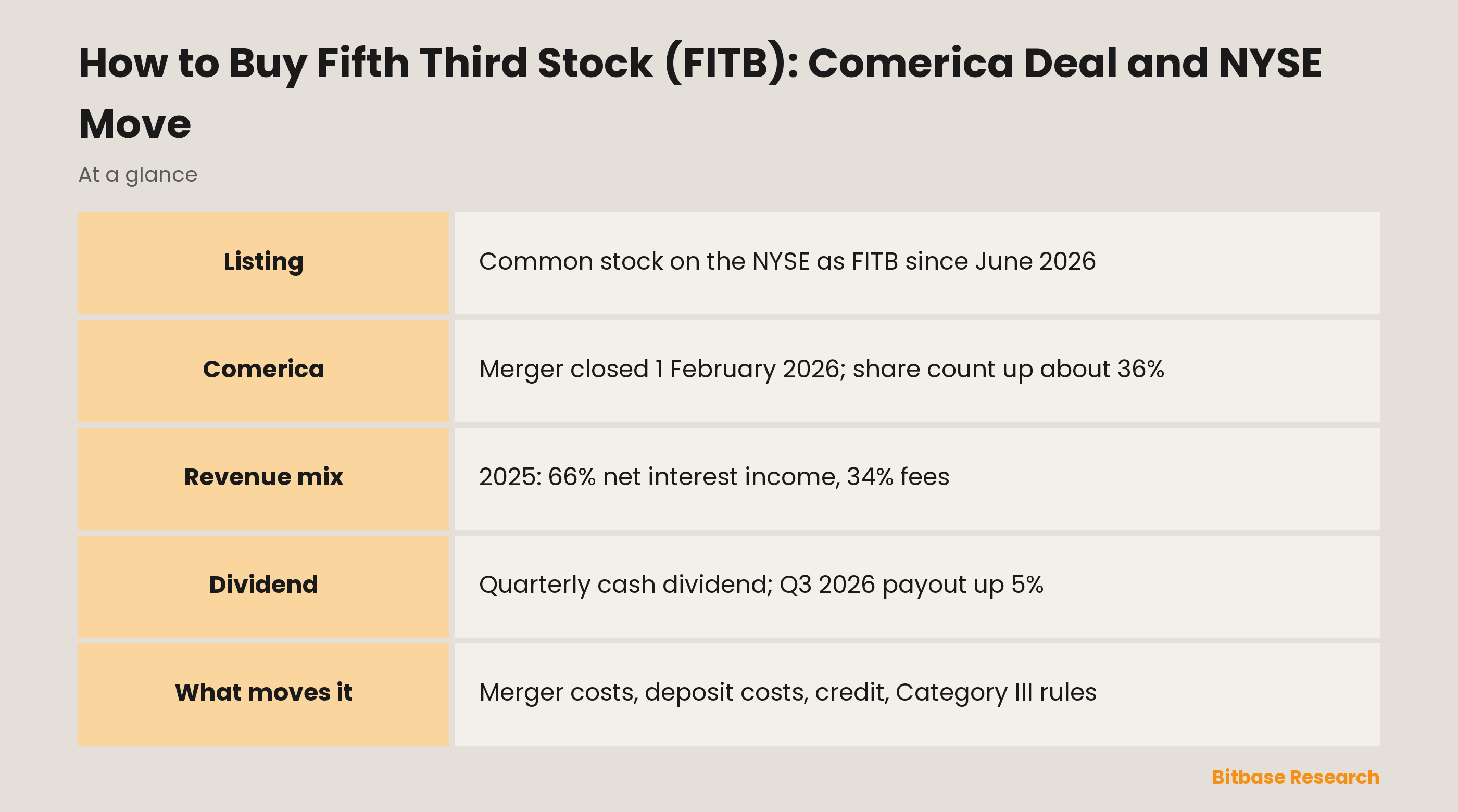
In June 2026 Fifth Third Bancorp moved its common stock from Nasdaq to the New York Stock Exchange and kept the ticker FITB, so buying a share now takes a brokerage account with NYSE access and an order for that symbol. The Cincinnati lender is also a bigger company than its own 2025 annual report describes: on 1 February 2026 it completed an all-stock takeover of Comerica, the Dallas bank, which added branches in Michigan, Texas and California and raised the number of Fifth Third shares by about 36%. Below: how the bank earns its money, how an order works, and what to watch while two banks become one.
What Does Fifth Third Do?
Fifth Third Bancorp is a bank holding company, organized in Ohio in 1975, that has elected to be treated as a financial holding company. Almost everything it does runs through one subsidiary, Fifth Third Bank, National Association. The company dates its history to 1858; "Since 1858, we've been helping individuals, families, businesses and communities grow," its press releases say.
At the end of 2025 the 10-K described a regional bank with 1,130 full-service banking centers in twelve states, from Ohio, Kentucky, Indiana, Michigan and Illinois in the Midwest to Florida, Tennessee, Georgia, the Carolinas, West Virginia and Alabama in the Southeast, and 18,676 full-time equivalent employees. Its stated strategy for deposits included "expanding retail presence in high-growth markets, such as in the Southeast."
The Comerica deal changed that map. The merger agreement was signed on 5 October 2025 and closed on 1 February 2026, when Comerica and its holding company merged into a Fifth Third subsidiary and Comerica's two banks were folded into Fifth Third Bank the same day. Comerica had been based in Dallas, with branches mainly in Michigan, Texas and California. By 30 September 2026 Fifth Third operated 1,429 full-service banking centers and 2,549 ATMs in fifteen states, and its total assets were about 41% larger than at the end of 2025. The third-quarter 10-Q calls the result "one of the largest banks in the U.S."
The bank reports three business segments:
Commercial Banking lends to and serves "large and middle-market businesses and government and professional customers." Beyond loans and deposits it sells cash management, foreign exchange and trade finance, derivatives and capital markets services, asset-based lending, real estate finance, public finance, commercial leasing and syndicated loans. Much of what Comerica brought shows up here: the segment's average assets in the third quarter of 2026 were about 67% larger than a year earlier.
Consumer and Small Business Banking covers checking and savings accounts, residential mortgages, home equity lines, credit cards, auto loans made through dealers, solar energy installation loans and other consumer credit, along with products for small businesses. It reaches customers through the branch network and through indirect and correspondent lenders.
Wealth and Asset Management offers wealth planning, investment management, brokerage, insurance, trust and estate services to individuals, companies and nonprofit groups.
Items not assigned to a segment, such as most of the securities portfolio and the interest rate risk the bank manages centrally, sit in a fourth line called General Corporate and Other.
How Fifth Third Makes Money
A bank like this one earns money two ways. The first is the spread between what it earns on loans and securities and what it pays on deposits and debt, called net interest income. The second is fees. For 2025, the 10-K says, "net interest income on an FTE basis and noninterest income provided 66% and 34% of total revenue, respectively." FTE means fully taxable equivalent, an adjustment that treats tax-exempt interest as if it were taxable.
The fee side is spread across several businesses. In 2025, measured against total noninterest income:
| Fee line | Share of 2025 noninterest income | What it includes |
|---|---|---|
| Wealth and asset management | 23% | Personal asset management, brokerage and trust fees |
| Commercial payments | 21% | Treasury management, merchant processing, commercial cards and embedded payments |
| Consumer banking | 19% | Deposit fees, including overdrafts, and card and processing revenue |
| Capital markets | 14% | Corporate bond fees and institutional brokerage, among others |
| Commercial banking | 11% | Operating lease income, business lending fees and lease remarketing fees |
| Mortgage banking | 7% | Mortgage origination and servicing revenue |
The rest came from other income and securities gains.
Profit by segment tells a second story. In 2025, Consumer and Small Business Banking produced about 61% of the pre-tax income of the three business segments, Commercial Banking about 33% and Wealth and Asset Management about 6%. Commercial Banking's pre-tax income was about 24% lower than in 2024, hit by lower net interest income and a larger provision for credit losses; the 10-K says the higher charge-offs behind that provision included "the fraud-related impairment of an asset-backed finance commercial loan."
After Comerica, the weights moved. In the first nine months of 2026, Commercial Banking produced about 51% of the three segments' pre-tax income, Consumer and Small Business Banking about 42% and Wealth and Asset Management about 7%. These shares leave out General Corporate and Other, which posted a pre-tax loss in both periods.
Deposits are the raw material. Average core deposits, the stable checking, savings and smaller time deposits, equaled 77% of average total assets in both 2024 and 2025. In the third quarter of 2026 the company said commercial payments revenue was helped by revenue from the Direct Express government prepaid card program and by "the continued expansion of embedded finance solutions through Newline."
FITB Stock at a Glance
| Feature | FITB |
|---|---|
| Exchange | New York Stock Exchange since June 2026; also registered on NYSE Texas |
| Ticker | FITB (common stock) |
| Security | Common stock without par value; four preferred series trade separately as depositary shares |
| Sector | Regional banking: commercial, consumer and wealth services |
| Index membership | S&P 500 |
| Headquarters | Cincinnati, Ohio |
| Organized | Ohio, 1975 |
| Fiscal year | Calendar year, ending 31 December |
| Footprint | 1,429 banking centers in fifteen states (30 September 2026) |
| Payouts | Quarterly cash dividend; share buybacks under a 100 million share authorization from June 2025 |
| SEC identifier | CIK 35527 |
Prices, market value and yields change during every session; for live numbers, open the Fifth Third stock page on Bitbase.
How to Buy Fifth Third Stock
Fifth Third is an Ohio company listed in New York, so the share you buy is ordinary common stock, not a depositary receipt. Five steps cover the whole process:
1. Find a broker with NYSE access. Outside the United States, that may be a local broker that offers US shares or an international one. Check which legal entity holds your account and which authority supervises it.
2. Open the account and declare your tax status. The IRS asks a foreign person who is the beneficial owner of US income to give Form W-8BEN "to the withholding agent or payer," which for shareholders is usually the broker.
3. Move money in. If your money is not in dollars, the currency conversion is a cost of its own, so compare the exchange rate as well as the commission.
4. Pick the right line. Search for FITB and confirm the result reads Fifth Third Bancorp common stock on the NYSE. Your broker may also show the preferred depositary shares, quoted as FITB PrA, FITB PrI, FITB PrK and FITB PrM; they carry their own dividend terms and are a different security.
5. Choose the order and the size. A market order fills at the going price; a limit order fills only at your price or better, and may not fill at all. Some brokers let you buy a fraction of a share for a set amount of money; others do not.
Once the order fills, keep the trade confirmations and statements: they record your purchase price and the dividends you receive.
Dividend tax for investors abroad. For US-source dividends paid to a nonresident alien, the IRS instruction to the payer is "Withhold at 30% or lesser tax treaty rate," and the beneficial owner "may claim the lesser tax treaty rate by filing Form W-8 BEN with the withholding agent." Your home country may tax the same dividend again.
Old Comerica shares. If you held Comerica common stock on 1 February 2026, you now hold Fifth Third: each Comerica share became 1.8663 Fifth Third shares, with cash in place of fractions. Holders of Comerica's preferred stock received a new Fifth Third Series M preferred with comparable terms.
Through a fund. FITB appeared in the 5 November 2026 holdings file of State Street's SPY, a fund that tracks the S&P 500, so S&P 500 index funds hold it as one small position among hundreds.
What Moves FITB Stock
Making the merger pay. Comerica changed the size of everything at once. In the first nine months of 2026, total revenue rose 40% and net interest income 44%, but noninterest expense rose 71%, carrying merger costs for retention, severance, contract terminations and system conversions. Net income rose 2%, but spread over many more shares, diluted earnings per share fell 22%. In the third-quarter release, chief executive Tim Spence said the systems conversion had been completed "less than a year after we announced the Comerica acquisition," and added: "We are building a Fifth Third that is better and not just bigger." Whether the cost savings and new customers follow is what the next few reports will show.
Interest rates and deposit costs. With about two-thirds of 2025 revenue coming from net interest income, the margin matters most. The net interest margin was 3.34% in the third quarter of 2026, up from 3.13% a year earlier, and net interest income was 49% higher, which the release attributed mainly to Comerica, "with further support from fixed-rate asset repricing." The same release warned that "competition for deposits is heating up," and noted that former Comerica sweep balances moving into interest-bearing deposits raised costs.
Credit quality. Net charge-offs were 0.60% of average loans in 2025, up from 0.45% in 2024, largely because of that one commercial loan written down after a fraud. In the third quarter of 2026 the annualized ratio was 0.31%, against 1.09% in the same quarter of 2025. The question for a shareholder is whether losses stay isolated as the loan book absorbs Comerica's borrowers.
A tougher regulatory category. US bank rules sort large banks into categories by size, and the bigger ones face stricter standards. Fifth Third moved from Category IV to Category III in the third quarter of 2026, which means stricter liquidity rules and an annual Federal Reserve stress test instead of one every other year, and single-counterparty credit limits from the fourth quarter of 2028. The stress test result sets part of the capital the bank must hold, and therefore how much it can pay out.
Growth outside the Midwest. Fifth Third has been expanding its retail presence in the Southeast and now owns Comerica's Texas and California franchise. The third-quarter release reported consumer household growth of 7% in the Southeast and 8% in the Southwest. Those markets cost money before they pay: the 10-Q ties part of the rise in occupancy expense to the "continued expansion into the Southeast markets, Texas and California."
Merger, Credit and Funding Risks at Fifth Third
The risk factors in the 10-K are long. These are the ones closest to the share price, quoted from the filing:
Credit. "Deteriorating credit quality has adversely impacted Fifth Third in the past and may adversely impact Fifth Third in the future." The 2025 fraud loss is a recent example.
Rates. "Fifth Third's income and cash flows depend to a great extent on the difference between the interest rates earned on interest-earning assets such as loans and investment securities and the interest rates paid on interest-bearing liabilities such as deposits and borrowings." Those rates, the filing adds, depend on factors "beyond Fifth Third's control."
Deposits. "If Fifth Third is unable to maintain or grow its deposits, it may be subject to paying higher funding costs." Customers can move money to the stock market or other alternatives when they think those pay better.
The merger itself. Fifth Third "expects to incur substantial expenses related to the Comerica Merger," and warns that it "may fail to realize all of the anticipated benefits" or that "those benefits may take longer to realize than expected." The same section notes that the larger company may face "increased scrutiny" from regulators.
Dilution from deals. "Future acquisitions may dilute current shareholders' ownership of Fifth Third." The Comerica merger already did so: on the day it closed, Fifth Third issued new shares equal to about 36% of those it had outstanding at the end of 2025.
Payments and litigation. The filing says real-time payment networks such as RTP and FedNow will "likely reduce float benefits" and add fraud risk. In 2006 the company was also added as a defendant in the merchants' antitrust class action over Visa and MasterCard interchange fees, and the third-quarter 2026 results carried a charge for "interchange litigation matters."
Two further risks belong to the stock rather than the bank. The 10-K says plainly that "Fifth Third's stock price is volatile," and that price moves "may be unrelated to Fifth Third's performance." And the dividend depends on the holding company receiving dividends from the bank, which "may be restricted by, among other things, regulatory constraints." A single bank stock is a concentrated position, however familiar the branch sign.
How to Research FITB Yourself
Every filing sits on SEC EDGAR under CIK 35527: the annual 10-K, 10-Qs for the first three quarters, and 8-Ks for events. In 2026 the quarterly earnings releases came out on 20 January, 17 April, 17 July and 19 October, filed as 8-Ks; the October filing also carried the slides for the conference call. The same documents are free at ir.53.com, the investor relations site.
In the 10-K, start with the business section for the footprint, the risk factors for the issues above and the segment note, which sets the three segments side by side. The capital section of the MD&A shows the regulatory ratios and the buyback authorization. Because the Comerica merger closed after the 2025 year ended, the 2025 10-K describes Fifth Third alone; for the combined bank, read the 2026 10-Qs, whose business combination note explains the deal. The 10-K's performance graph compares Fifth Third's shareholder return with the S&P 500, the S&P Banks index and the KBW Banks index.
For other banks, our guides to PNC stock and Truist stock use the same layout. Live quotes for FITB are on the stock page linked earlier, and Bitbase's list of US stock pages covers other listed companies.
Fifth Third Stock FAQ
Can I buy Fifth Third stock with crypto?
Not directly. FITB shares trade in US dollars through a brokerage account, so crypto would first have to be sold for dollars and the cash moved to the broker, and that sale can be a taxable event where you live. A share is an ownership stake in a regulated bank holding company with dividend and voting rights, which is how a stock differs from a crypto asset.
Does Fifth Third pay a dividend?
Yes. It pays a quarterly cash dividend on its common stock, and the amount declared for the third quarter of 2026 was 5% higher than a year earlier. In 2025 the dividends declared equaled 43.3% of earnings, the payout ratio the bank reports. Each payment needs board approval and depends on the bank's earnings and regulatory capital, so check the latest earnings release for the current figure.
Is FITB still listed on Nasdaq?
No. Fifth Third moved its common stock and its listed preferred depositary shares from Nasdaq to the New York Stock Exchange in June 2026, keeping FITB as the common stock ticker. In August 2026 it also registered the common stock on NYSE Texas. Older documents, including the 2025 10-K, still say Nasdaq.
What happened to Comerica stock?
Comerica stopped existing as a separate company on 1 February 2026. Each Comerica common share was converted into 1.8663 Fifth Third shares, and Comerica's preferred stock was exchanged for a new Fifth Third preferred series. Comerica's banks became part of Fifth Third Bank.
Is FITB in the S&P 500?
Yes. Fifth Third Bancorp appeared in the 5 November 2026 holdings file of SPY, State Street's S&P 500 fund. Index weights change every day.
Conclusion
The bank behind FITB is no longer the one its 2025 annual report describes: it is the 2025 Fifth Third plus Comerica, with more commercial lending, new markets in Texas and California, tighter regulatory rules and more shares outstanding. Results from before the merger say little about how the combined bank will earn, so the coming quarters will tell you more than the past ones. Read the latest 10-Q and earnings release, watch merger costs, deposit costs and charge-offs over several quarters, and decide how much weight one regional bank should carry in your portfolio.
Related reading
Other Bitbase articles on this topic:
- How to Buy Bradesco Stock (BBD): Two ADSs and Monthly Payouts
- How to Buy Citizens Financial Stock (CFG): Private Bank Growth
- How to Buy Credicorp Stock (BAP): BCP, Yape and Dividends in Soles
- How to Buy NatWest Stock (NWG): Two Shares per ADS, No State Stake
Disclaimer: This article is educational content from Bitbase Academy, provided for information only. It explains what a company or fund does and how the instruments referenced here differ from one another; it does not constitute investment, trading, tax, or financial advice, and it is neither a recommendation nor an endorsement of any security, token, or trading strategy. A tokenized stock is issued by a third party and is designed to give economic exposure to an underlying asset: it is not a share, it carries no shareholder rights, and it depends on the issuer's structure, eligibility rules, and redemption terms, which the issuer can change. Perpetual futures are leveraged derivatives that hold no underlying asset and can be liquidated, and trading hours, product availability, and eligibility differ by instrument and by jurisdiction and can change at any time. Written as of November 2026; verify everything yourself through company filings, the issuer's own documentation, and the product pages of the venue you trade on.
References
[1] Fifth Third Bancorp Form 10-K for 2025 (SEC EDGAR) www.sec.gov
[2] Fifth Third 2025 Form 10-K, XBRL cover page (SEC EDGAR) www.sec.gov
[3] Fifth Third 2025 Form 10-K, segment results (XBRL, SEC EDGAR) www.sec.gov
[4] Fifth Third Form 10-Q for the third quarter of 2026 (SEC EDGAR) www.sec.gov
[5] Fifth Third third-quarter 2026 Form 10-Q, XBRL cover page (SEC EDGAR) www.sec.gov
[6] Fifth Third third-quarter 2026 Form 10-Q, segment results (XBRL, SEC EDGAR) www.sec.gov
[7] Fifth Third third-quarter 2026 earnings release, 19 October 2026 (SEC EDGAR) www.sec.gov
[8] Fifth Third Form 8-K on the Comerica merger agreement, October 2025 (SEC EDGAR) www.sec.gov
[9] Fifth Third Form 8-K on completing the Comerica merger, February 2026 (SEC EDGAR) www.sec.gov
[10] Fifth Third Form 8-K on the transfer of listing to the NYSE, June 2026 (SEC EDGAR) www.sec.gov
[11] Fifth Third press release on the NYSE listing transfer, 1 June 2026 (SEC EDGAR) www.sec.gov
[12] Fifth Third Form 8-A registering common stock on NYSE Texas, August 2026 (SEC EDGAR) www.sec.gov
[13] State Street, SPY daily holdings file www.ssga.com
[14] IRS: withholding on US-source income paid to nonresident aliens www.irs.gov
[15] IRS: About Form W-8 BEN www.irs.gov