Before placing an order for FirstEnergy stock, all you need is a brokerage account with access to the New York Stock Exchange, where the common stock trades under the ticker FE as the company's only registered class of shares. What the share represents is less obvious: an Ohio holding company whose seven regulated utilities serve over six million customers in six states, and whose earnings depend on what state commissions and federal regulators let it charge.
What Does FirstEnergy Do?
FirstEnergy Corp. calls itself "a public electric power holding company." Its 10-K says the group is "principally involved in the transmission, distribution, and generation of electricity," and that its utilities make up "one of the nation's largest investor-owned electric systems." The service area covers parts of Ohio, Pennsylvania, West Virginia, Maryland, New Jersey and New York.
The local companies keep older names: Ohio Edison, Cleveland Electric Illuminating and Toledo Edison in Ohio; FirstEnergy Pennsylvania Electric Company (FE PA), the single Pennsylvania distributor since 1 January 2024; Jersey Central Power & Light in New Jersey; Monongahela Power and Potomac Edison in West Virginia and Maryland.
Three segments are reported. Distribution holds the Ohio utilities and FE PA, about 4.3 million customers. Integrated holds Jersey Central, Monongahela and Potomac Edison, including Monongahela's regulated power plants, about 3.6 gigawatts mostly in West Virginia and Virginia. Stand-Alone Transmission is FirstEnergy's stake in FirstEnergy Transmission, LLC (FET), whose subsidiaries own high-voltage lines in the PJM region, plus Keystone Appalachian Transmission Company.
FirstEnergy owns 50.1% of FET. Brookfield owns the other 49.9% after buying an additional 30% interest in a sale that closed in March 2024, so part of the transmission profit belongs to a partner.
In Ohio and Pennsylvania, other suppliers provide most of the electricity itself: in 2025, alternative suppliers provided 89% of the power the Ohio utilities delivered and 62% in Pennsylvania. Power sold to customers who have not switched has "no material impact to earnings," the 10-K says.
How FirstEnergy Makes Money
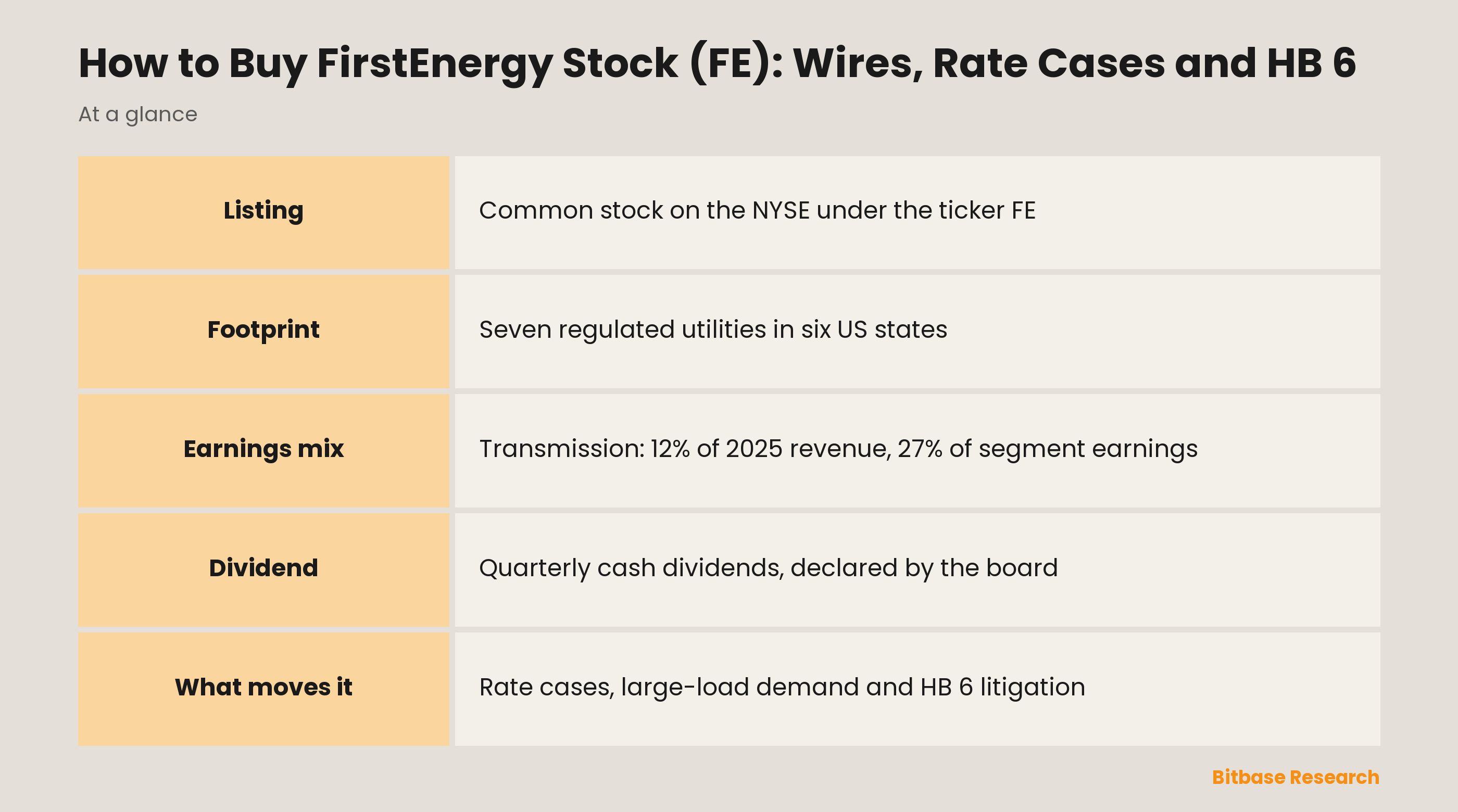
The wires earn the money. Rates are set "through traditional, cost-based regulated utility ratemaking": regulators approve a return on the capital invested in lines and substations, and the company recovers approved costs from customers. The 2025 segment note shows the split:
| Segment | Share of 2025 revenue | Share of 2025 segment earnings | What it covers |
|---|---|---|---|
| Distribution | 50% | 28% | Ohio utilities and FE PA |
| Integrated | 38% | 45% | New Jersey, West Virginia and Maryland utilities, plus regulated generation |
| Stand-Alone Transmission | 12% | 27% | FirstEnergy's share of FET and KATCo |
Earnings shares use earnings from continuing operations and leave out the loss-making Corporate/Other line, which carries holding company interest.
Transmission's profit outruns its revenue; that revenue comes "primarily" from forward-looking formula rates, reset yearly on projected rate base and costs, then trued up. Distribution earned less in 2025 because of fourth-quarter charges tied to an Ohio settlement and to disallowances in an Ohio rate case. Total revenue rose 12% and earnings from continuing operations about 4%.
FE Stock at a Glance
| Feature | FE |
|---|---|
| Exchange | New York Stock Exchange |
| Ticker | FE |
| Security | Common stock, the only registered class |
| Sector | Regulated electric utility |
| Index membership | S&P 500 |
| Headquarters | Akron, Ohio |
| Incorporated | Ohio |
| Fiscal year | January to December |
| Payouts | Quarterly cash dividends, declared by the board |
| Buybacks | No publicly announced repurchase plan (2025 10-K) |
| EDGAR CIK | 1031296 |
Quotes and yield shift all day; the FirstEnergy stock page on Bitbase shows them live.
How to Buy FirstEnergy Stock
FE is a plain US listing with no ADR layer, and although the 10-K also covers Jersey Central, "there is no market for JCP&L's common stock."
1. Choose a brokerage with NYSE coverage. Abroad, find out which company keeps your account and who supervises it.
2. Complete the sign-up checks. For individuals outside the US this normally includes IRS Form W-8BEN; the IRS tells filers to hand it over "when requested by the withholding agent or payer."
3. Deposit money. If your cash is not in dollars, the exchange is a cost on top of any trading fee.
4. Check the listing. Type FE and make sure the result is FirstEnergy Corp. on the New York Stock Exchange.
5. Set the order. In FINRA's words, a market order "provides the most certainty that your order will be executed," whereas a limit order executes "at or better than a specified price."
6. Size it. Buying part of a share lets you spend an exact sum, though some brokers restrict that to "large-cap stocks or ETFs," and "as a fractional share owner, you might not have shareholder voting rights."
Withholding on dividends. The IRS says "most types of U.S. source income received by a foreign person are subject to U.S. tax of 30%," though a treaty can reduce it. Dividends may also be taxed in the country where you reside.
Through funds. On 10 November 2026, State Street's SPDR S&P 500 ETF Trust (SPY) and Utilities Select Sector SPDR ETF (XLU) both held FirstEnergy, as one position among many.
What Moves FE Stock
Rate cases. Each base rate case resets what a utility may earn. In November 2025 Ohio regulators authorized a return on equity of 9.63% for the Ohio utilities, which the 10-K said planned a new distribution case in the second half of 2026. In August 2026 Jersey Central filed in New Jersey asking for 10.2%, and in September 2026 Potomac Edison filed in Maryland asking for 10.6%.
Large loads and transmission. In October 2026 FirstEnergy reported 7.9 gigawatts of contracted demand from large-load customers, "nearly double since the beginning of the year," and expected its transmission investment plan to grow by at least 25% when rolled forward to 2027–2031. Both depend on PJM and FERC decisions.
Spending and financing. Energize365, the capital plan for 2026 to 2030, aims to "modernize the grid, renew distribution infrastructure and strengthen transmission reliability." The cash goes out before rates catch up, so borrowing costs matter.
West Virginia generation. FirstEnergy has reserved Siemens turbines for the proposed Maidsville Energy Center, a gas plant with delivery expected in 2030; a state decision is projected for the fourth quarter of 2026.
Earnings against targets. Third-quarter 2026 GAAP earnings per share rose 26%, and non-GAAP Core Earnings per share for the first nine months rose 9%. The company reaffirmed Core Earnings growth "near the top end of 6% to 8%" a year through 2030.
Regulators, Lawsuits and Leverage Behind FirstEnergy's Shares
The first risk in the 10-K is the aftermath of Ohio House Bill 6. On 21 July 2021 FirstEnergy signed a three-year deferred prosecution agreement with the US Attorney's Office for the Southern District of Ohio over its lobbying around HB 6, paid a monetary penalty and agreed to a charge of one count of conspiracy to commit honest services wire fraud. It met the obligations within that term by 22 July 2024; some continue until related cases end, including a January 2025 indictment of two former senior officers. A securities class action for buyers between February 2017 and July 2020 is open: a loss is "probable," but the company "cannot yet reasonably estimate a loss or range of loss," and the 10-K expects these matters to keep weighing on "the trading prices of our securities."
Cost recovery. "State rate regulation may delay or deny full recovery of costs"; the 10-K cites Ohio Senate Bill 2 of 2025 and a January 2026 New Jersey executive order.
Affordability. Customer concerns "may result in increased regulatory scrutiny, constraints on the size and timing of rate increases, expanded bill mitigation requirements, or disallowances."
Holding company and credit. FE has "no operations or cash flows of its own," so its dividend relies on what the subsidiaries pay up, and "a credit rating downgrade could negatively affect our or our subsidiaries' financing costs."
Weather. The company has "historically sold less power" in mild seasons, and storm costs may not be recoverable. Finally, one stock concentrates your money in one company, and the dividend depends on "earnings, cash flows, credit metrics" and wider conditions.
How to Research FE Yourself
Filings are on SEC EDGAR under CIK 1031296. The 10-K is combined with Jersey Central, so note which company each table describes. The business section lists the utilities and segments, the risk factors come next, the MD&A covers rate cases and delivery volumes, and the commitments note tracks the HB 6 matters. In 2026, quarterly results came by 8-K on 17 February, 28 April, 28 July and 27 October.
Compare GAAP earnings with non-GAAP Core Earnings: the difference is listed as "special items," including investigation-related costs. For other regulated utilities, see our guides to American Electric Power stock and Duke Energy stock, or browse every US stock quote page on Bitbase.
FirstEnergy Stock FAQ
Can I buy FirstEnergy stock with crypto?
Not directly. FE shares are bought in US dollars through a broker, so any crypto has to be converted to cash first, and that conversion can count as a taxable disposal. Shareholders get dividends and votes in a company, one of several differences between stocks and crypto.
Does FirstEnergy pay a dividend?
Yes. FirstEnergy "has historically paid quarterly cash dividends," but each payment must be declared by the board; check the latest earnings release for the amount.
Is FE in the S&P 500?
Yes. On 10 November 2026 FirstEnergy appeared in the daily holdings of SPY, which tracks the S&P 500, and of the utilities fund XLU. Weights change daily.
What was FirstEnergy's role in the HB 6 case?
It signed a deferred prosecution agreement in July 2021 over its HB 6 lobbying and paid a penalty. In January 2026 Ohio regulators approved a settlement under which the Ohio utilities pay customers restitution and refunds over three billing cycles from February 2026.
Conclusion
Owning FE means owning earnings set by regulators more than by electricity demand: seven utilities overseen by six state commissions and FERC, and a transmission arm that shares its profit with Brookfield. New large-load demand and a big capital plan point one way; affordability pressure, rate case outcomes and the open HB 6 litigation point the other. The filings and each state's docket are where those forces show up first, and they are worth reading before deciding what share of your money one utility deserves.
Related reading
Other Bitbase articles on this topic:
- How to Buy Brookfield Infrastructure Stock (BIP): Units to Shares
- How to Buy CenterPoint Energy Stock (CNP): Houston Grid and Gas
- How to Buy Con Edison Stock (ED): NYC Grid, Steam and Dividends
- How to Buy WEC Energy Stock (WEC): Wisconsin Grid, Data Centers
Disclaimer: This article is educational content from Bitbase Academy, provided for information only. It explains what a company or fund does and how the instruments referenced here differ from one another; it does not constitute investment, trading, tax, or financial advice, and it is neither a recommendation nor an endorsement of any security, token, or trading strategy. A tokenized stock is issued by a third party and is designed to give economic exposure to an underlying asset: it is not a share, it carries no shareholder rights, and it depends on the issuer's structure, eligibility rules, and redemption terms, which the issuer can change. Perpetual futures are leveraged derivatives that hold no underlying asset and can be liquidated, and trading hours, product availability, and eligibility differ by instrument and by jurisdiction and can change at any time. Written as of November 2026; verify everything yourself through company filings, the issuer's own documentation, and the product pages of the venue you trade on.
References
[1] FirstEnergy combined Form 10-K for 2025 (SEC EDGAR) www.sec.gov
[2] FirstEnergy 2025 Form 10-K, XBRL cover page (SEC EDGAR) www.sec.gov
[3] FirstEnergy 2025 Form 10-K, XBRL segment data (SEC EDGAR) www.sec.gov
[4] FirstEnergy Form 10-Q for the third quarter of 2026 (SEC EDGAR) www.sec.gov
[5] FirstEnergy third-quarter 2026 earnings release, filed with Form 8-K (SEC EDGAR) www.sec.gov
[6] FirstEnergy Form 8-K, 20 May 2026: FirstEnergy Transmission ownership with Brookfield (SEC EDGAR) www.sec.gov
[7] State Street SPDR S&P 500 ETF Trust (SPY): daily holdings file www.ssga.com
[8] State Street Utilities Select Sector SPDR ETF (XLU): daily holdings file www.ssga.com
[9] FINRA: Order Types www.finra.org
[10] FINRA: Investing in Fractional Shares www.finra.org
[11] IRS: NRA Withholding www.irs.gov
[12] IRS: About Form W-8 BEN, certificate of foreign status for withholding www.irs.gov





