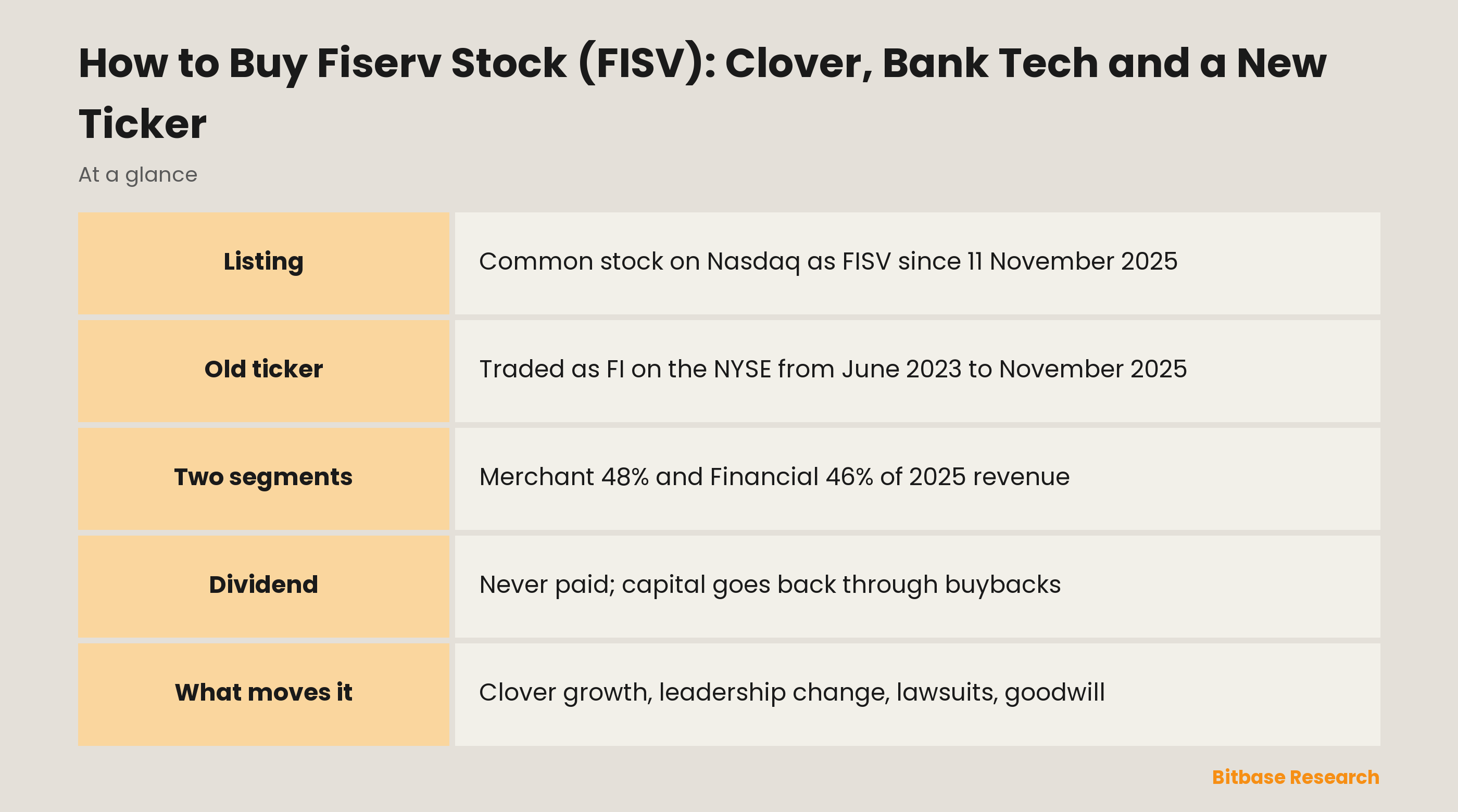
After moving its listing from the New York Stock Exchange back to Nasdaq on 11 November 2025, Fiserv trades as FISV, so any broker that offers US shares can take the order; between June 2023 and that date the same common stock traded as FI. Behind the ticker sits a company that runs the Clover point-of-sale platform for small merchants and the account, card and debit systems that banks and credit unions run on, and whose filings since late 2025 record a guidance reset, a change of chief executive and a goodwill write-down.
What Does Fiserv Do?
Fiserv calls itself "a leading global provider of payments and financial services technology solutions." Its clients range from small merchants to banks, credit unions and public sector bodies, and the 10-K stresses that "most of the products and services we provide are necessary for our clients to operate their businesses and are therefore non-discretionary in nature."
The company was originally incorporated in Delaware in 1984 and reincorporated in Wisconsin in 1992. Its headquarters are in Milwaukee. The shape of today's business dates from 29 July 2019, when Fiserv completed its acquisition of First Data Corporation, described in the filing as "a global leader in commerce-enabling technology and solutions for merchants, financial institutions and card issuers." Clover came with it: that year's report listed Clover inside the new First Data segment. At the end of 2025 the company had more than 38,000 employees.
Fiserv reports two segments. Merchant Solutions sells payment acceptance and commerce tools in three business lines:
1. Small Business, built around Clover, a cloud-based point-of-sale and business management platform that also advances working capital through Clover Capital. Fiserv is taking Clover into markets that include Australia, Singapore, Brazil, Mexico, Belgium, Spain and Japan.
2. Enterprise, which serves large merchants through Commerce Hub, its payment gateway and orchestration layer, plus gift card and bill payment services.
3. Processing, which supplies the technology behind merchant services sold by banks, joint ventures and independent sales organizations.
Financial Solutions serves financial institutions, also in three lines. Digital Payments covers debit card processing, the Accel and STAR debit networks, bill payment through CheckFree RXP, and a turnkey version of the Zelle person-to-person service. Issuing processes credit cards on platforms such as Optis and VisionPLUS, produces cards and runs prepaid programs. Banking provides core account processing systems such as DNA, Finxact and Premier, plus the Experience Digital banking platform.
The newest product line is a stablecoin. The 10-K says Fiserv is "building our stablecoin capabilities with the launch of FIUSD," aimed at its bank clients, and plans to offer custody for stablecoin reserves under the GENIUS Act, the 2025 US stablecoin law.
How Fiserv Makes Money
Most revenue is recurring fees. In 2025, processing and services made up 80% of total revenue, generated "from account- and transaction-based fees under multi-year contracts that generally have high renewal rates." The other 20% was product revenue: card production and printing, software licenses, data and analytics, and point-of-sale hardware, which Fiserv buys from third-party vendors rather than manufactures.
The disaggregation note in the 10-K splits 2025 revenue into six business lines:
| Business line | Segment | Share of 2025 revenue | Main products |
|---|---|---|---|
| Small Business | Merchant | 32% | Clover, small-merchant acquiring |
| Enterprise | Merchant | 11% | Commerce Hub, gift cards, bill payments |
| Processing | Merchant | 5% | Technology for bank and partner merchant programs |
| Digital Payments | Financial | 19% | Debit processing, Accel and STAR, bill pay, Zelle |
| Issuing | Financial | 15% | Credit card processing, card production, prepaid |
| Banking | Financial | 11% | Core account processing, digital banking |
| Corporate and Other | n/a | 7% | Postage reimbursements and other items |
Taken together, Merchant produced 48% of revenue and Financial 46%, but the profit split runs the other way. Financial's 2025 operating margin was 45.3%, against 34.5% for Merchant, so Financial earned 56% of the two segments' combined operating income and Merchant 44%.
Growth in 2025 came mainly from small merchants. Total revenue rose 4%, Merchant revenue 5% and Financial revenue 2%; Small Business revenue grew about 7%, "primarily driven by volume growth, including from our Clover POS and business management platform," while Banking revenue fell about 2%. By geography, the United States and Canada provided 84% of revenue and international regions 16%.
2026 has been weaker. In the first nine months, revenue fell 2%, with Merchant down 1% and Financial down 4%. The 10-Q attributes much of the Merchant decline to lower "anticipation revenue in Argentina, attributed to lower inflation and interest rates." Operating margins narrowed in both segments: in the third quarter of 2026 Merchant's margin was 28.7% against 37.2% a year earlier, and Financial's 38.1% against 42.5%.
FISV Stock at a Glance
| Feature | FISV |
|---|---|
| Exchange | Nasdaq Global Select Market, since 11 November 2025 |
| Ticker | FISV (traded as FI on the NYSE from June 2023 to November 2025) |
| Security | Common stock, the only equity class registered under Section 12(b) |
| Sector | Payments and financial services technology |
| Index membership | S&P 500 |
| Headquarters | Milwaukee, Wisconsin |
| Incorporated | Wisconsin (reincorporated 1992; first incorporated in Delaware in 1984) |
| Fiscal year | Calendar year, ending 31 December |
| Dividends | None ever paid; capital returns come through share buybacks |
| SEC identifier | CIK 798354 |
Quotes, market value and volume change through every session, so the table leaves them out; the Fiserv stock page on Bitbase shows them live.
How to Buy Fiserv Stock
Fiserv is a US corporation; what changes hands on Nasdaq is its common stock, with no depositary receipt in between. A purchase takes seven steps:
1. Pick a broker that reaches Nasdaq. Outside the US, check which legal entity holds your account and who regulates it.
2. Complete the onboarding. Expect identity checks, and if you are not a US person, IRS Form W-8BEN; the IRS tells foreign individuals to hand it in "when requested by the withholding agent or payer."
3. Fund it. If you pay in another currency, compare the exchange rate as well as the commission.
4. Search for FISV, not FI. The ticker changed in November 2025, and older watchlists, articles and charts may still use FI. Confirm that the result reads Fiserv, Inc. common stock on Nasdaq.
5. Skip the look-alike codes. Fiserv's senior notes are also listed on Nasdaq under codes such as FISV27 and FISV36; they are debt securities, not shares.
6. Set the order. A market order takes whatever price is available when it reaches the exchange; a limit order names the highest price you will pay.
7. Decide on size. Fractional shares, where offered, let you invest a fixed sum; check how the broker handles voting on them.
Tax notes for investors abroad. US-source income paid to a foreign person is generally taxed at 30%, according to the IRS, unless a treaty or a specific code section lowers the rate. Fiserv has never paid a dividend, so at present there is no dividend income to withhold on; how a sale is taxed depends on your country of residence.
Through index funds. Fiserv is an S&P 500 constituent; the SPDR S&P 500 ETF Trust (SPY), run by State Street, showed FISERV INC under FISV in its 9 November 2026 holdings file.
What Moves FISV Stock
Clover's growth rate. Clover sits at the center of the litigation. A federal securities complaint filed in July 2025, now captioned In re Fiserv, Inc. Securities Litigation, alleges that statements about the growth of Clover were false or misleading, and an amended version adds statements about the impact of the Argentina business on organic growth. The company has moved to dismiss. In the November 2026 earnings release, chief executive Takis Georgakopoulos said that "Clover continues to produce consistent underlying growth."
The 2025 reset and the leadership turnover. With third-quarter 2025 results, then chief executive Mike Lyons announced what he called "today's guidance reset" together with the One Fiserv action plan, and said that "our current performance is not where we want it to be." Lyons resigned on 12 June 2026, and Georgakopoulos, previously co-president for merchant and technology, became chief executive two days later. In the 10-K's performance graph, Fiserv's cumulative return from the end of 2020 to the end of 2025 was minus 41%, against plus 96% for the S&P 500, with the indexed value falling by about two thirds in 2025 alone.
Goodwill. Past acquisitions have left a goodwill balance in the tens of billions of dollars. At the end of 2025, eight reporting units had fair values less than 15% above their carrying values, and in the third quarter of 2026 "sustained decreases" in the share price and market capitalization triggered a non-cash goodwill impairment. Further declines could lead to more charges.
Bank clients. The Financial segment, 46% of 2025 revenue, sells to banks and credit unions, so contract renewals, bank mergers and in-house development all feed into results. In the third-quarter 2026 release, Georgakopoulos said net attrition in banking was down more than 25% year to date.
Debit rules and networks. Under the Dodd-Frank Act and the Federal Reserve's Regulation II, debit interchange is capped for certain issuers and every US debit issuer must participate in at least two unaffiliated networks, rules the 10-K says affect its card processing and debit network businesses, including Accel and STAR. Our guide to Visa explains how a network earns its fees.
Portfolio changes and buybacks. In August 2026 Fiserv sold a 51% stake in its MoneyPass network and related ATM businesses, keeping 49% of the new MoneyPass Group, and in September it sold its student loan servicing unit. It doubled the savings target of Project Elevate, its business transformation initiative, and said it expects to resume share repurchases in the fourth quarter of 2026 under a 60 million share authorization from February 2025.
Stablecoins. FIUSD ties part of the plan to digital asset rules, and the 10-K warns that "it is not clear what the market demand will be for our stablecoin offering from our financial institution customers." For background, see what stablecoin and infrastructure stocks give you.
Where Fiserv's Own Filings Expect Trouble
Item 1A of the 10-K runs to dozens of risk factors. These bear most directly on a FISV holding:
Competition. "The markets for our products and services are highly competitive from new and existing competitors," including large technology companies and start-ups, and many large clients "have historically developed their key applications in-house."
Renewals and pricing. "Larger clients may be able to seek lower prices from us when they renew or extend a contract," and small merchants "may seek reduced fees due to pricing competition."
Security and outages. Fiserv stores and moves sensitive payment and personal data, and the 10-K expects that "unauthorized parties will continue to attempt to gain access to our systems."
Debt and rates. "Existing or future leverage may harm our financial condition and results of operations," and part of the borrowing carries variable rates.
Litigation and investigations. Beyond the securities class action, shareholders have filed derivative suits in federal court and in the Wisconsin Circuit Court for Milwaukee County, and since November 2025 the SEC's Enforcement Division and the US Attorney's Office for the Southern District of New York have sought information in investigations related to the 2025 earnings guidance.
At the level of the stock, there is no dividend to cushion a falling price, and one company can swing far more than an index, as 2025 showed.
How to Research FISV Yourself
EDGAR files everything Fiserv submits under CIK 798354: the annual 10-K, a 10-Q after each of the first three quarters, and 8-Ks whenever something material happens. The 2026 earnings releases came on 10 February, 5 May, 6 August and 3 November. The 10-K says the reports are also free on fiserv.com.
In the 10-K, Item 1 describes the segments, Item 1A the risks, and Item 5 the dividend statement, buybacks and performance graph; the critical accounting estimates show the goodwill cushions. Note 3 splits revenue by business line, and Note 17 covers the lawsuits and investigations, updated in each 10-Q.
Two checks help. Price history before 11 November 2025 is filed under FI, and some EDGAR file names still begin with "fi," so search both codes when you pull older data. And compare GAAP revenue with the organic figures in the releases, which exclude items such as postage reimbursements. For live prices use the stock page linked above; Bitbase also keeps an index of US stock pages for comparing other payments names.
Fiserv Stock FAQ
Can I buy Fiserv stock with crypto?
Not directly. A broker settles FISV purchases in US dollars, so you would first convert crypto to cash, possibly creating a taxable gain in your country, and then transfer the money. Fiserv's FIUSD stablecoin is a product for its bank clients, not a route into the shares; for the difference between owning a share and holding a token, see how stocks and crypto differ.
Does Fiserv pay a dividend?
No. The 10-K says the company has "never paid dividends on our common stock" and does not expect to in the foreseeable future. Its stated policy is to use operating cash flow for investment, debt repayment and buybacks "rather than to pay dividends."
Why did Fiserv's ticker change from FI to FISV?
Fiserv moved its common stock from Nasdaq to the NYSE in June 2023, where it traded as FI, and transferred it back to Nasdaq on 11 November 2025 under FISV. The 10-K now benchmarks the stock against the Nasdaq Composite, which it says "reflects our peer group."
Is FISV in the S&P 500?
Yes. The 10-K says Fiserv is "part of the S&P 500 Index," and State Street's SPY holdings file listed it on 9 November 2026. Index weights change daily.
Has Fiserv stock ever split?
Yes. The board declared a two-for-one split on 21 February 2018; the extra shares were distributed on 19 March 2018 to holders of record on 5 March, and the stock began trading at the split-adjusted price on 20 March 2018.
Conclusion
Fiserv sits between two very different businesses: Clover and merchant acquiring, where growth is faster and margins thinner, and bank technology, where contracts run for years and profits are higher but growth is slow. Since 2025 the questions have been about execution: whether Clover's growth holds up, whether the new chief executive can stabilize banking and margins, and how the lawsuits and investigations end. Before you buy, read the latest 10-Q next to the 10-K, compare organic and GAAP growth for both segments, and decide how much of your portfolio one payments company should carry.
Related reading
Other Bitbase articles on this topic:
- How to Buy Atlassian Stock (TEAM): Jira, Cloud Shift and Perps
- How to Buy Autodesk Stock (ADSK): AutoCAD, Revit and MaintainX
- How to Buy Baidu Stock (BIDU): Search, AI Cloud and Apollo Go
- How to Buy Thomson Reuters Stock (TRI): Westlaw, Reuters and AI
Disclaimer: This article is educational content from Bitbase Academy, provided for information only. It explains what a company or fund does and how the instruments referenced here differ from one another; it does not constitute investment, trading, tax, or financial advice, and it is neither a recommendation nor an endorsement of any security, token, or trading strategy. A tokenized stock is issued by a third party and is designed to give economic exposure to an underlying asset: it is not a share, it carries no shareholder rights, and it depends on the issuer's structure, eligibility rules, and redemption terms, which the issuer can change. Perpetual futures are leveraged derivatives that hold no underlying asset and can be liquidated, and trading hours, product availability, and eligibility differ by instrument and by jurisdiction and can change at any time. Written as of November 2026; verify everything yourself through company filings, the issuer's own documentation, and the product pages of the venue you trade on.
References
[1] Fiserv Form 10-K for 2025 (SEC EDGAR) www.sec.gov
[2] Fiserv 2025 Form 10-K, XBRL cover page (SEC EDGAR) www.sec.gov
[3] Fiserv 2025 Form 10-K, XBRL revenue by business line (SEC EDGAR) www.sec.gov
[4] Fiserv 2025 Form 10-K, XBRL segment data (SEC EDGAR) www.sec.gov
[5] Fiserv Form 10-Q for the third quarter of 2026 (SEC EDGAR) www.sec.gov
[6] Fiserv third-quarter 2026 earnings release, filed with Form 8-K (SEC EDGAR) www.sec.gov
[7] Fiserv third-quarter 2025 earnings release, filed with Form 8-K (SEC EDGAR) www.sec.gov
[8] Fiserv Form 8-K, October 2025: listing transfer to Nasdaq (SEC EDGAR) www.sec.gov
[9] Fiserv Form 8-K, May 2023: listing transfer to the NYSE (SEC EDGAR) www.sec.gov
[10] Fiserv Form 8-K, June 2026: change of chief executive (SEC EDGAR) www.sec.gov
[11] Fiserv Form 10-K for 2019: First Data, incorporation and 2018 split (SEC EDGAR) www.sec.gov
[12] State Street SPDR S&P 500 ETF Trust (SPY): fund page and daily holdings www.ssga.com
[13] IRS: NRA Withholding www.irs.gov
[14] IRS: About Form W-8 BEN www.irs.gov





