
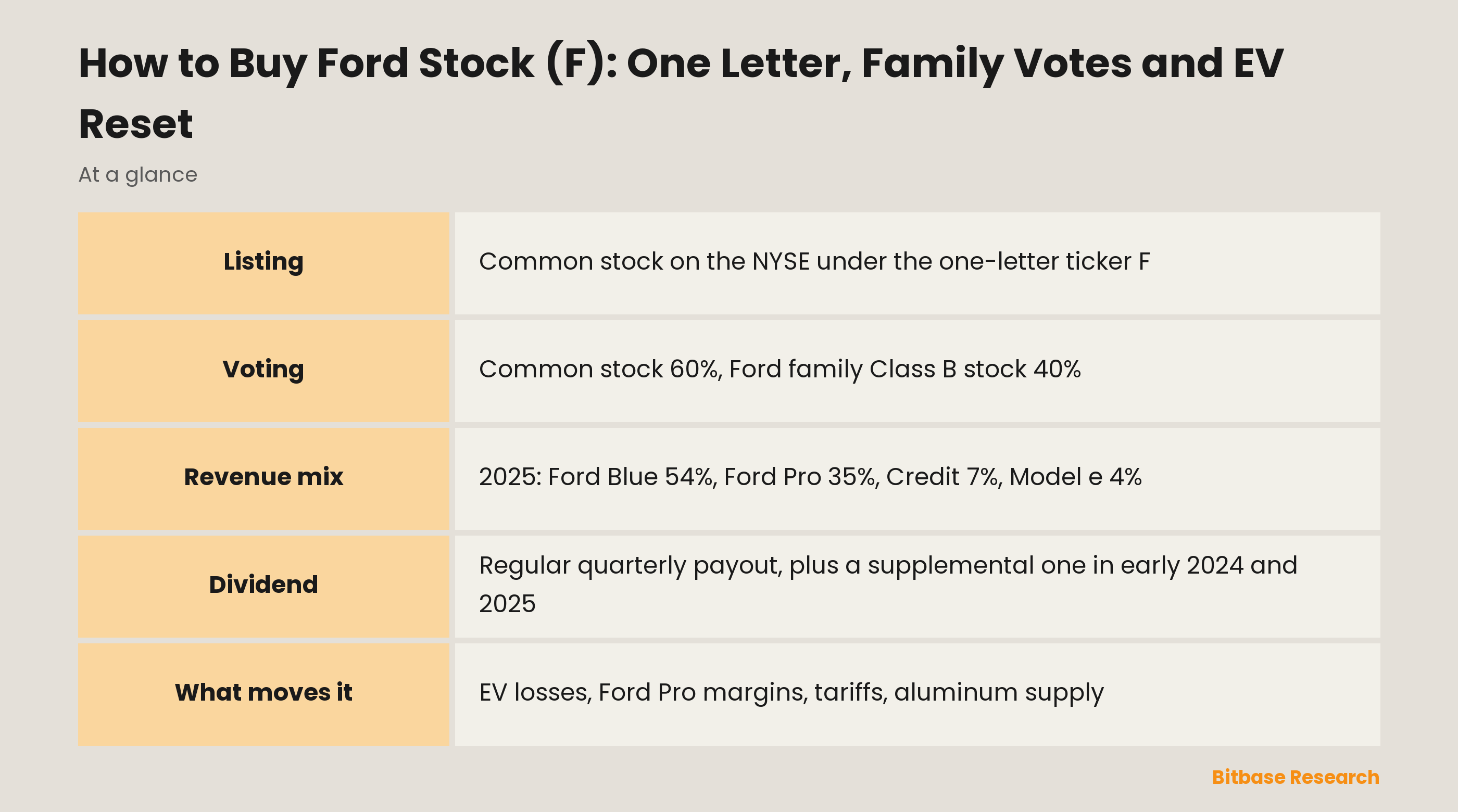
The ticker is one letter: Ford Motor Company common stock trades on the New York Stock Exchange as F, so any brokerage account with NYSE access can buy it. What sets the share apart is who votes next to you, because Class B stock held by the Ford family carries 40% of the voting power and the common stock you can buy carries the other 60%. The business is shifting too: in 2025 Ford Pro, the commercial arm, earned more than twice the EBIT of Ford Blue on about a third of revenue, while Ford Model e lost money again and charges from an EV reset pushed the company to a net loss.
What Does Ford Do?
Ford designs, builds, sells and finances cars, pickups, SUVs and commercial vans under two brands, Ford and Lincoln. It was incorporated in Delaware in 1919 and took over the business of an earlier Michigan company, also called Ford Motor Company, which had been incorporated in 1903 "to produce and sell automobiles designed and engineered by Henry Ford." It is still based in Dearborn, Michigan.
Ford organizes its vehicle business in three customer-facing segments, and the annual report describes them in one line each: "Ford Blue, engineering iconic gas-powered and hybrid vehicles; Ford Model e, inventing breakthrough electric vehicles ... along with embedded software that defines always-on digital experiences for all customers; and Ford Pro, helping commercial customers transform and expand their businesses with vehicles and services tailored to their needs." A fourth reportable segment, Ford Credit, lends to buyers and dealers.
The split is by customer more than by factory. Ford Blue builds the gas and hybrid vehicles and also manufactures vehicles for Ford Pro. Ford Pro handles the Super Duty pickups, the Transit vans and every sale to commercial, government and rental customers in the United States and Canada, and adds fleet services such as telematics and charging. Ford Model e sells the electric vehicles, including extended-range models, writes software for the whole company and, by the third quarter of 2026, also included a business selling battery energy storage systems.
The 10-K says "substantially all of our vehicles, parts, and accessories are sold through distributors and dealers," most of them independently owned. In 2025 Ford sold about 4.4 million vehicles at wholesale worldwide, a count that includes vehicles built by unconsolidated affiliates such as Jiangling Motors in China.
The United States is the core market. Ford's US market share rose to 13.2% in 2025 from 12.6% in 2024; in Canada it was 15.2%, while in China, where the figure counts vehicles made by its joint ventures, it was 1.3%. The US sales table in the 10-K shows how far the lineup still leans on combustion engines: of the vehicles Ford sold in the United States in 2025, about 86% had internal combustion engines, about 10% were hybrids and about 4% were fully electric.
The annual report names no rivals, saying only that the industry "consists of many producers, with no single dominant producer." For the closest US comparison, see our General Motors stock guide.
How Ford Makes Money
Revenue in 2025 was up about 1% on 2024, and most of it came from two segments:
| Segment | Share of 2025 revenue | 2025 segment margin | What it sells |
|---|---|---|---|
| Ford Blue | 54% | 3.0% (EBIT) | Gas and hybrid Ford and Lincoln vehicles for retail buyers, plus parts and services |
| Ford Pro | 35% | 10.3% (EBIT) | Super Duty, Transit and other vehicles for fleets, governments and rental firms, plus fleet services |
| Ford Credit | 7% | 19.3% (pre-tax) | Retail loans, leases and dealer financing |
| Ford Model e | 4% | Loss, about −72% (EBIT) | Electric vehicles, software and battery energy storage systems |
Calculated from the 10-K segment note, net of sales between segments; margins are each segment's EBIT, or pre-tax earnings for Ford Credit, over its revenue.
Ford Blue brings in more than half of the money on a thin margin, while Ford Pro, with about a third of revenue, earned more than twice as much EBIT. Ford Credit's pre-tax earnings rose 55% from 2024. Ford Model e lost money in each of 2023, 2024 and 2025, and in 2025 its EBIT loss equalled about 72% of its revenue.
Volume matters because of how the costs are built: the 10-K cites "a high proportion of relatively fixed structural costs, so that small changes in wholesale unit volumes can significantly affect overall profitability."
Sorted by where customers are, 2025 revenue came about 65% from the United States, 8% from Canada and 7% from the United Kingdom.
The bottom line for 2025 was nonetheless a loss, because of special items. In December 2025 Ford said it would "rationalize our EV manufacturing capacity and product roadmap, including cancelling three previously planned EVs and ending production of the current generation F-150 Lightning EV," and it wrote down the assets of Ford Model e. In the same month it agreed to exit BlueOval SK, its battery joint venture with SK On, and booked an impairment on that investment; the deal closed in May 2026, when Ford took over two battery plants in Kentucky. Those fourth-quarter charges outweighed a year of positive segment earnings.
F Stock at a Glance
| Feature | F |
|---|---|
| Exchange | New York Stock Exchange |
| Ticker | F |
| Security you can buy | Common stock |
| Other share class | Class B stock, not listed; no quoted market, convertible into common stock one for one to be sold |
| Other NYSE listings | Three series of Ford notes due 2059 to 2062, under FPRB, FPRC and FPRD |
| Voting power | Common stock 60%, Class B stock 40% |
| Sector | Automobiles: cars, trucks, vans and vehicle finance |
| Brands | Ford and Lincoln |
| Index membership | S&P 500 |
| Headquarters | Dearborn, Michigan |
| Incorporated | Delaware, 1919 |
| Fiscal year | Calendar year, ending 31 December |
| Dividends | Regular quarterly cash dividend; a supplemental dividend was added in the first quarter of 2024 and of 2025 |
| SEC identifier | CIK 37996 |
Price, market value and yield change daily; for live figures, see the Ford stock page on Bitbase.
How to Buy Ford Stock
Ford is a US company, so there is no depositary receipt to think about: the share that trades on the NYSE is the common stock itself. An order runs through these steps:
1. Find a broker that reaches the NYSE. Abroad, either a domestic broker with US market access or a global one works; check which entity holds your account and who regulates it.
2. Open the account and confirm your identity. If you are not a US person, the broker will usually ask for IRS Form W-8BEN; the IRS tells foreign individuals to submit it "when requested by the withholding agent or payer."
3. Fund it. Paying in another currency means a conversion, which can cost more than the commission.
4. Search for F carefully. A one-letter ticker turns up many near matches. Pick the line that reads Ford Motor Co common stock on the NYSE, not FPRB, FPRC or FPRD: those are Ford debt securities that pay interest, not shares.
5. Choose the order type. FINRA explains that a market order "provides the most certainty that your order will be executed," while a limit order is "an order to buy or sell a security at or better than a specified price."
6. Decide on the size. Fractional shares let you invest a fixed amount instead of a whole number of shares, but FINRA notes that some firms limit them to "large-cap stocks or ETFs" or do not offer them, and that "as a fractional share owner, you might not have shareholder voting rights."
7. Keep the records. Confirmations and statements prove your cost and dividends at tax time.
Withholding for non-US investors. According to the IRS, "most types of U.S. source income received by a foreign person are subject to U.S. tax of 30%," and a tax treaty may lower the rate or remove it, which is why brokers ask for the W-8BEN. Your own country may tax the same dividend again, so check local rules.
Owning it through a fund. Ford is in the S&P 500, so index funds that track it, such as State Street's SPY, hold a small slice of Ford among hundreds of companies.
The Class B shares are not for sale. You cannot buy Class B stock on any exchange. The 10-K says there is "no quoted market" for it, and a Class B holder who wants to sell first converts into common stock.
What Moves F Stock
The EV reset and Model e's losses. In the third quarter of 2026 the segment's EBIT loss was 25% smaller than a year earlier, which Ford put down mainly to lower losses on first-generation vehicles, partly offset by spending on next-generation products and Ford Energy. Ford's chief executive, Jim Farley, said the company was entering "a defining phase" with "the launch of our Universal Electric Vehicle platform, Ford Energy, an all-new F-150 and a new lineup of vehicles."
Ford Pro's margins. Ford Pro produces the largest share of segment EBIT. In the third quarter of 2026 Ford Pro's EBIT fell 16%, which Ford attributed to higher commodity costs and temporary launch costs as Super Duty production began at its Oakville Assembly Complex, partly offset by lower tariffs.
Tariffs and refunds. The 10-K says the tariffs introduced in the United States and elsewhere "have caused significant disruption, increased costs ... and uncertainty in the automotive industry." After first-quarter 2026 rulings by the US Supreme Court and the Court of International Trade on tariffs imposed under the International Emergency Economic Powers Act, Ford began receiving refunds, but it says their timing "is uncertain and is subject to changes in trade policy." For a carmaker that ships into the US from abroad, see our Toyota stock guide.
Aluminum supply. Fires in September and November 2025 disrupted a New York plant of Novelis, which the 10-K calls "a major aluminum supplier to Ford." Ford says it began to partly recover the lost production in the third quarter of 2026.
Product changes in Ford Blue. Ford Blue's wholesales fell 10% in the third quarter of 2026, mainly because production of the Escape and Lincoln Corsair ended in North America and of the Focus in Europe, and to a lesser extent because of the conflict in the Middle East.
Warranty costs. Chief financial officer Sherry House said Ford was on track to achieve "our warranty and material cost reduction objectives," spending that moves earnings directly.
Used-vehicle prices. Ford Credit's earnings before taxes rose 27% in the third quarter of 2026, helped, Ford says, by "healthy financing margins and a supportive used vehicle pricing environment." When used prices fall, lease returns are worth less.
Cash returned to shareholders. Ford says it generally targets shareholder distributions "of 40% to 50% of adjusted free cash flow," so cash flow sets the room for dividends and buybacks. Farley says cost actions and growth in software and parts are moving Ford "toward an 8% adjusted EBIT margin by 2029," a goal, not a promise.
Where a Ford Share Can Go Wrong
From the 2025 10-K, these risk factors bear most directly on an F share:
Reliance on big combustion vehicles. "A shift in consumer preferences away from larger, more profitable vehicles with internal combustion engines (including trucks and utilities) to other vehicles in our portfolio that may be less profitable could result in an adverse effect on our financial condition or results of operations."
Quality, recalls and regulators. Ford's products "have been and could continue to be affected by defects that result in recall campaigns, increased warranty costs, or delays in new model launches." Under a 2024 consent order with the National Highway Traffic Safety Administration, Ford has retained an independent third party, selected by the regulator, to assess its compliance and report on its progress.
Suppliers. Ford "is highly dependent on its suppliers to deliver components in accordance with Ford's production schedule and specifications," as the Novelis fires showed.
Restructuring. Ford "may not realize the anticipated benefits of restructuring actions and such actions may cause Ford to incur significant charges," as the EV reset did.
Government incentives. "The impact of government incentives on Ford's business has been and could continue to be significant," and the company says it could face their "reduction, termination, or clawback."
Ford Credit. The finance arm "could experience higher-than-expected credit losses, lower-than-anticipated residual values, or higher-than-expected return volumes for leased vehicles."
Labor. About 99% of Ford's unionized hourly employees in the United States are covered by collective bargaining agreements with the United Auto Workers, so contract talks affect costs and production.
Three further risks come with the share itself. Class B stock makes up under 2% of the shares outstanding but carries 40% of the votes, so a common shareholder's voting weight is smaller than the share of the company owned. Dividends are not guaranteed: Ford intends to keep paying a regular quarterly dividend "subject to legally available funds," and payment is "at the sole discretion of our Board of Directors." And holding a single carmaker concentrates your money in one cyclical business.
Tracking Ford Through the 10-K and the Proxy
Ford files with the SEC under CIK 37996. Its 10-K, three 10-Qs a year and event-driven 8-Ks are on EDGAR; quarterly results arrive as 8-Ks, which in 2026 were filed on 10 February, 29 April, 28 July and 28 October. Ford also posts the same reports free at shareholder.ford.com.
In the 10-K, the business section covers segments, market share and the US sales mix by powertrain, followed by the risk factors. The segment note sets revenue, EBIT and assets for the four segments side by side, and the capital stock note sets out the 60% and 40% split of voting power. The proxy statement, filed before each annual meeting, says how many votes each Class B share carries that year and who owns more than 5% of the Class B stock.
Two habits avoid common mistakes. Ford's segment EBIT and adjusted EBIT leave out special items, so read the reconciliation in each release before comparing them with net income. And the first quarters of 2024 and 2025 included a supplemental dividend, so compare years with that in mind. For live prices, the stock page linked above is the place to start, and Bitbase also keeps pages for other US stocks.
Ford Stock FAQ
Can I buy Ford stock with crypto?
Not directly. Brokers sell F shares for US dollars, so you would convert crypto to cash, withdraw it and fund the brokerage account, and in many countries that conversion counts as a taxable disposal. The two assets are not interchangeable either: owning F gives you dividend and voting rights in the company, which our guide to how stocks and crypto differ explains.
Does Ford pay a dividend?
Yes. Ford pays a regular quarterly cash dividend on its common and Class B stock, and it declared the fourth-quarter 2026 dividend with its third-quarter results. In the first quarters of 2024 and 2025 it also paid a supplemental dividend. The board decides each payment, so check the latest earnings release for the amount and dates.
What is Ford Class B stock?
It is a second class of stock that is not listed and has no quoted market. Class B holders together get 40% of the general voting power, however many shares they hold, and both classes share equally in dividends. Ford's proxy statement says the Ford family retains a significant interest in the company through its ownership of the Class B shares, and that the structure has been in place since Ford became a public company in 1956.
What are FPRB, FPRC and FPRD?
They are three series of Ford notes, due in 2059, 2059 and 2062, which are also listed on the NYSE. They pay a fixed rate of interest and are debt, not shares, so they carry no vote and no dividend. If you want Ford stock, the ticker is F.
Is Ford in the S&P 500?
Yes. State Street's daily holdings file for SPY, dated 5 November 2026, lists Ford Motor Co, so S&P 500 index funds hold it. Its weight changes every day.
Conclusion
An F share buys a voice in Ford, but only part of one: all the common holders together share 60% of the votes. The business behind that share takes longer to understand. This is a company whose commercial vehicles earned more than its consumer car business in 2025, and whose electric vehicle unit is still losing money after a costly reset. Go through the newest annual report and earnings release, track segment EBIT over several years, and decide how much one carmaker should weigh in your portfolio.
Related reading
Other Bitbase articles on this topic:
- How to Buy Copart Stock (CPRT): Salvage Auctions, ACV and Splits
- How to Buy Coupang Stock (CPNG): US Listing, Korean Revenue
- How to Buy Darden Stock (DRI): The Company Behind Olive Garden
- How to Buy Trip.com Stock (TCOM): ADSs, 9961 and the SAMR Fine
Disclaimer: This article is educational content from Bitbase Academy, provided for information only. It explains what a company or fund does and how the instruments referenced here differ from one another; it does not constitute investment, trading, tax, or financial advice, and it is neither a recommendation nor an endorsement of any security, token, or trading strategy. A tokenized stock is issued by a third party and is designed to give economic exposure to an underlying asset: it is not a share, it carries no shareholder rights, and it depends on the issuer's structure, eligibility rules, and redemption terms, which the issuer can change. Perpetual futures are leveraged derivatives that hold no underlying asset and can be liquidated, and trading hours, product availability, and eligibility differ by instrument and by jurisdiction and can change at any time. Written as of November 2026; verify everything yourself through company filings, the issuer's own documentation, and the product pages of the venue you trade on.
References
[1] Ford Motor Company Form 10-K for 2025 (SEC EDGAR) www.sec.gov
[2] Ford 2025 Form 10-K, XBRL cover page (SEC EDGAR) www.sec.gov
[3] Ford 2025 Form 10-K, XBRL segment data (SEC EDGAR) www.sec.gov
[4] Ford 2025 Form 10-K, XBRL geographic data (SEC EDGAR) www.sec.gov
[5] Ford Form 10-Q for the third quarter of 2026 (SEC EDGAR) www.sec.gov
[6] Ford third-quarter 2026 earnings release, filed with Form 8-K (SEC EDGAR) www.sec.gov
[7] Ford 2026 proxy statement (SEC EDGAR) www.sec.gov
[8] State Street SPDR S&P 500 ETF Trust (SPY): fund page and daily holdings www.ssga.com
[9] FINRA: Order Types www.finra.org
[10] FINRA: Investing in Fractional Shares www.finra.org
[11] IRS: NRA Withholding www.irs.gov
[12] IRS: About Form W-8 BEN www.irs.gov





