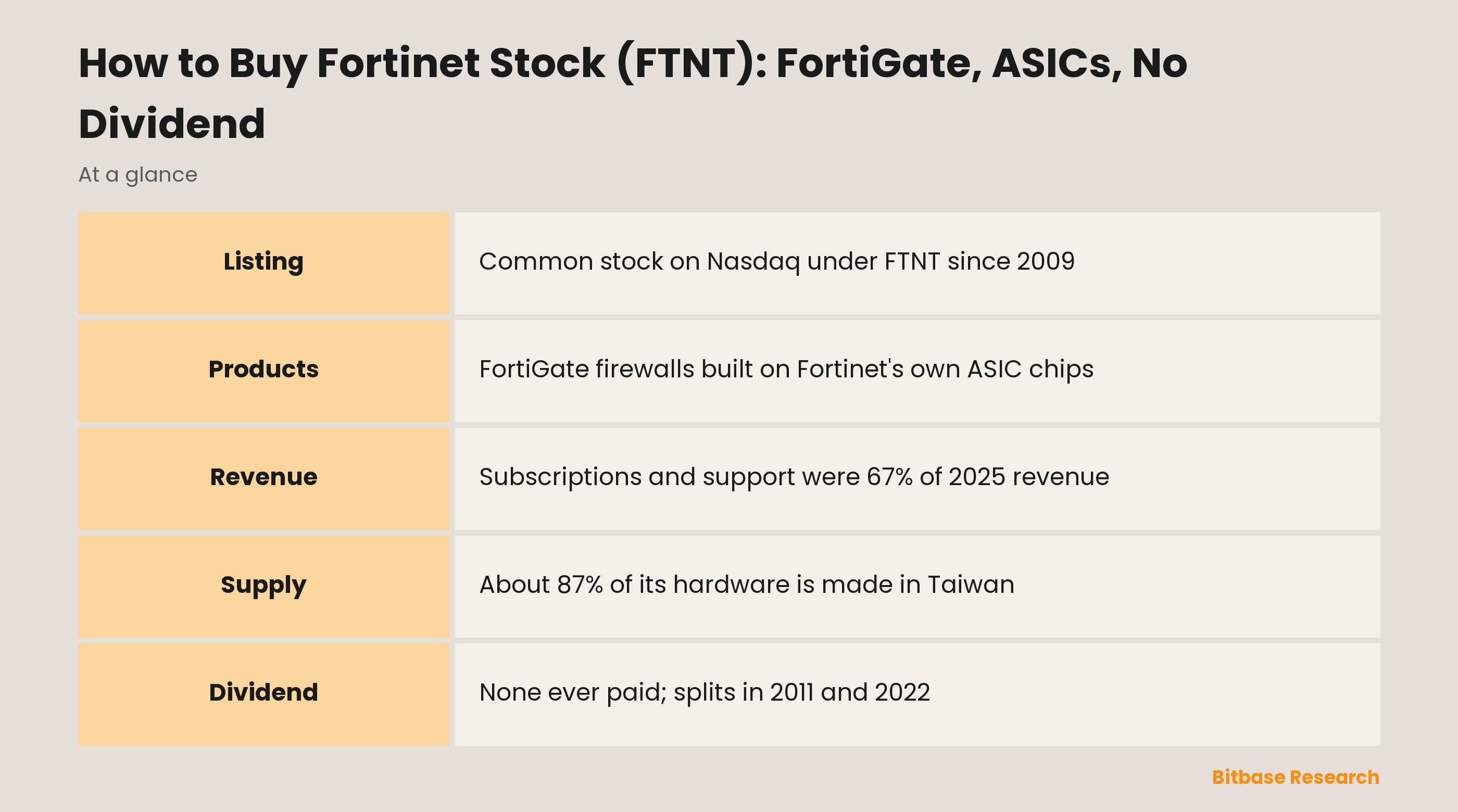
Fortinet has been listed on the Nasdaq Global Select Market as FTNT since November 2009, so an account at any broker that reaches US exchanges can buy its common shares. The unusual part is the hardware: its FortiGate firewalls run on security chips the company designs itself, yet subscriptions and support brought in about two-thirds of 2025 revenue. Below: what Fortinet sells, how to place the order, its two stock splits and absent dividend, and the risks Fortinet spells out in its own annual report.
What Does Fortinet Do?
Fortinet sells cybersecurity built into networking equipment and cloud services. Its annual report describes the company as "driving the convergence of networking and security": one device and one operating system handle both the networking and the security inspection. Incorporated in Delaware in November 2000 and headquartered in Sunnyvale, California, it sells to enterprises, service providers and government organizations, with end-customers in over 100 countries. According to the fiscal 2025 10-K, its two co-founders still run it: Ken Xie as chief executive and chairman, Michael Xie as president and chief technology officer.
Two pieces of in-house technology sit under the product line. FortiOS is the operating system behind its firewalls and its SASE service. FortiASIC is its own line of security processors: the company develops its network and content processors "in-house," and firewall functions are "accelerated through our proprietary ASIC technology." Fortinet does not fabricate the chips; contract manufacturers such as Toshiba America and Renesas build them, using foundries in Taiwan and Japan.
The 10-K groups more than 50 products into three pillars:
Secure Networking is the core: FortiGate firewalls for branches, campuses, data centers and public or private clouds, plus FortiSwitch for the wired network and FortiExtender for cellular links.
Unified SASE (secure access service edge) protects remote users and branch offices from the cloud, through more than 190 points of presence.
AI-Driven Security Operations gives monitoring teams FortiAnalyzer as a central platform, alongside FortiSIEM, FortiSOAR and FortiSandbox.
Services wrap around the products: FortiGuard Labs, the threat-research team, feeds the FortiGuard subscriptions that keep a deployed firewall's defences current, and FortiCare sells round-the-clock technical support. Research and development happens mainly in the United States and Canada.
How Fortinet Makes Money
The pattern is a one-off sale of an appliance or licence, followed by services that renew. The revenue note of the 10-K splits the business three ways:
| Revenue line | What it covers | Share of 2025 revenue | Growth on 2024 |
|---|---|---|---|
| Product | Physical and virtual appliances, mostly secure networking, and software licences | 32.6% | 16% |
| Security subscription | FortiGuard and other security services, on-premises and cloud-delivered | 38.7% | 14% |
| Technical support and other | FortiCare technical support and other services | 28.6% | 13% |
Shares are calculated from the fiscal 2025 revenue note and rounded to one decimal.
The two halves behave differently. Product revenue comes mainly from appliances, and most of it from secure networking, which in practice means firewalls. Service revenue is recognised ratably, over subscription and support terms that typically run one to five years. Services as a whole were 67% of 2025 revenue, and contracts keep feeding revenue long after signing: 71% of the service revenue recognised in 2025 was already in deferred revenue at the end of 2024.
Mix drives margins: gross margin was 80.5% in 2025, and "service revenue and software licenses have higher gross margins compared to hardware products," the company notes.
Hardly anything is sold directly. In Fortinet's "two-tier distribution model," distributors such as Arrow Electronics, Ingram Micro and TD Synnex sell to resellers and service providers, who sell to end customers. Three distributors each accounted for at least 10% of 2025 revenue, at 28%, 15% and 12%, or 55% between them; the filing does not say which is which.
Most of the money comes from abroad. In 2025 the Americas produced 40% of revenue, Europe, the Middle East and Africa 42%, and Asia Pacific 18%; the United States alone was about 28.4%.
FTNT Stock at a Glance
| Item | Detail |
|---|---|
| Exchange | Nasdaq Global Select Market, trading since 18 November 2009 |
| Ticker | FTNT |
| Security | Common stock, the only security registered on the 10-K cover |
| CUSIP | 34959E109 |
| Index membership | S&P 500 and Nasdaq-100 |
| Headquarters | Sunnyvale, California |
| Incorporated | Delaware, November 2000 |
| Fiscal year | Calendar year, ending 31 December |
| Dividend policy | Never declared or paid; share repurchase program instead |
| Stock splits since listing | Two-for-one (June 2011), five-for-one (June 2022) |
| SEC identifier | CIK 1262039 |
These facts do not change with the share price. For the live quote, market value and price history, open the Fortinet stock page on Bitbase.
How to Buy Fortinet Stock
FTNT is the common stock of a US company, so there is no depositary receipt or foreign line to choose between. A purchase usually runs like this:
1. Find a broker with Nasdaq access. Outside the US, that can be a local firm that routes orders to US markets or an international one; confirm which legal entity will hold the shares and which regulator oversees it.
2. Open the account. Non-US investors are asked for IRS Form W-8BEN, which the IRS says to submit "when requested by the withholding agent or payer."
3. Fund it. FTNT is priced in US dollars, so compare the currency conversion cost as well as the commission.
4. Check the line. Search FTNT and confirm it reads Fortinet, Inc. common stock on Nasdaq; a broker that asks for an identifier will find it under CUSIP 34959E109.
5. Choose an order type. FINRA says a market order "provides the most certainty that your order will be executed"; with a limit order, "you're guaranteed to get your limit price or a better price if your order is executed," though it may not execute at all.
6. Decide on the amount. Fractional shares let you invest a set sum, but "the availability of fractional share trading varies by brokerage firm," a fraction may carry no voting rights, and, FINRA adds, "at the moment, you can't transfer fractional shares to another brokerage firm."
7. Keep the confirmations. They are your record of cost basis.
For non-US buyers, there is no US dividend withholding to plan for, since Fortinet pays no dividend; a gain on a later sale falls under your own country's rules.
Through an index fund, Fortinet comes as one holding among many: it appeared in the 28 October 2026 holdings of State Street's SPY, which tracks the S&P 500, and of Invesco's QQQ, which tracks the Nasdaq-100.
What Moves FTNT Stock
The firewall refresh cycle. Product revenue depends on customers replacing appliances, and it is uneven. It slipped about 1% in 2024 while security subscriptions grew 22%, then rose 16% in 2025; in the third quarter of 2026 it was up 37% from a year earlier, against 20% for revenue as a whole. The 10-K anticipates "a significant firewall refresh and upgrade cycle in the coming years," and the same cycle sits at the centre of a shareholder lawsuit, covered below.
Billings. Because service revenue is spread over multi-year terms, new business reaches revenue slowly, so Fortinet also reports billings, a non-GAAP measure equal to revenue plus the change in deferred revenue; in its words, billings "drive current and future revenue as well as cash flows." Billings grew 16% in 2025. Seasonality matters too: buying peaks at year-end, the first quarter is usually softer, and the company has "usually generated the majority of our product revenue in the final month of each quarter."
Its own product security. Because it sells network security products, Fortinet "may be a more attractive target for attacks by computer hackers," the 10-K warns, and an incident involving it may hurt its reputation more than it would a company outside the security business. Its Product Security Incident Response Team posts known vulnerabilities and mitigations on the FortiGuard Labs website. Item 1C adds that incidents have hurt operations before, but that cybersecurity threats "have not materially affected our business strategy, operating results, and/or financial condition" to date.
Hardware supply. About 87% of Fortinet's hardware is manufactured in Taiwan, by contract manufacturers including Accton, Micro-Star and Wistron, and certain processors, network chips and memory devices come "from limited or sole sources of supply." The company is raising prices to cover higher component costs and warns that product gross margin "may decline if these pricing actions do not fully offset rising input costs."
The dollar. Most revenue is earned outside the United States and "a significant portion of our expenses" is paid in other currencies; the 10-K notes that a weaker dollar may push operating expenses up.
FTNT Risks: Patches, Partners and Taiwan
The risk section of the 10-K runs long; five of its risks bear most directly on an FTNT share:
Competition. "We face intense competition in our market and we may not maintain or improve our competitive position." The filing names a dozen rivals, from Microsoft, CrowdStrike and Zscaler to two with their own guides on this blog: Cisco's stock and dividend and Palo Alto Networks' platform and splits.
Product vulnerabilities. "We are susceptible to defects or vulnerabilities, including critical vulnerabilities, in our products or services," the risk summary begins; a flaw that lets attackers into customers' networks could "harm our operational results and reputation more significantly as compared to other companies."
Channel concentration. Fortinet relies "on third-party channel partners for substantially all of our revenue," and one distributor alone held 32% of net accounts receivable at the end of 2025.
Taiwan. Rising tensions between China and Taiwan "could adversely affect our manufacturing operations in Taiwan, which, given the large percentage of our hardware that is manufactured in Taiwan, could have significant impacts on our business and operations."
Securities litigation. Shareholders who bought between 8 November 2024 and 6 August 2025 have sued, alleging misleading statements "including regarding the 2026 firewall refresh cycle." The cases were consolidated as In re Fortinet, Inc. Securities Litigation; the defendants moved to dismiss on 15 June 2026, and the company calls the suit "without merit."
Two more sit above the business. With no dividend, any return on FTNT comes from the share price, and the 10-K says buybacks "could increase the volatility of the trading price of our common stock." And for buyers who count in euros, yen or any other currency, exchange rates add a second layer.
How to Research Fortinet Yourself
Fortinet files with the SEC under CIK 1262039. The fiscal 2025 10-K was filed on 25 February 2026; 10-Qs cover the first three quarters, and 8-Ks carry events in between, including the 2026 results releases of 5 February, 6 May, 29 July and 28 October. Earnings calls are webcast on investor.fortinet.com.
In the 10-K, Item 1 describes the three pillars and names the competitors, Item 1A sets out the risks, and Item 1C explains cybersecurity oversight, including a board committee dedicated to it since July 2024. The revenue note splits product, subscription and support revenue; the segment note gives the distributor concentration. For product security, the PSIRT advisories on the FortiGuard Labs website are where the company publishes known vulnerabilities and fixes.
Two habits avoid misreadings. Compare a quarter with the same quarter a year earlier, because the fourth carries the year-end buying. And adjust per-share history: figures from before June 2011 need dividing by ten, those from June 2011 to June 2022 by five. For other companies, open the full list of US stock pages on Bitbase.
Fortinet Stock FAQ
Does Fortinet pay a dividend?
No. The 10-K states that Fortinet has "never declared or paid cash dividends" and expects to pay none in the foreseeable future. It returns cash through a share repurchase program instead, set up in January 2016 and enlarged several times, most recently in the 28 October 2026 results release; the program "may be suspended, modified or discontinued at any time without prior notice."
Has Fortinet stock ever split?
Yes, twice since listing: two-for-one in the form of a stock dividend, effective 1 June 2011, and five-for-one, effective 22 June 2022 after shareholders approved it at that month's annual meeting. One share held before June 2011 has become ten.
Can I buy Fortinet stock with crypto?
Not directly. A broker sells FTNT for US dollars, so crypto must first be converted to cash and the cash moved into the brokerage account; depending on where you live, the conversion can itself be taxable. The practical routes from crypto into shares are set out in a separate guide.
Is FTNT in the S&P 500 and the Nasdaq-100?
Yes. Fortinet appeared in the 28 October 2026 holdings of State Street's SPY, an S&P 500 fund, and of Invesco's QQQ, which tracks the Nasdaq-100. Index weights change daily.
When did Fortinet go public?
In November 2009. Its shares began trading on the Nasdaq Global Select Market under FTNT on 18 November 2009, and the fiscal 2025 10-K still lists the same market and ticker.
Conclusion
Placing an FTNT order is quick once a broker with Nasdaq access has opened your account: confirm the line, then choose a market or a limit order. Understanding it takes longer: a firewall maker with its own chips whose revenue now comes mostly from subscriptions and support, sold through a few large distributors, built largely in Taiwan and paying no dividend. Read the latest 10-K, the quarterly release and the state of the securities lawsuit before sizing a position in a single cybersecurity company.
Related reading
Other Bitbase articles on this topic:
- How to Buy Corning Stock (GLW): Gorilla Glass and AI Fiber
- How to Buy Hewlett Packard Enterprise Stock (HPE): After Juniper
- How to Buy Lumentum Stock (LITE): Lasers, NVIDIA Stake and Perps
Disclaimer: This article is educational content from Bitbase Academy, provided for information only. It explains what a company or fund does and how the instruments referenced here differ from one another; it does not constitute investment, trading, tax, or financial advice, and it is neither a recommendation nor an endorsement of any security, token, or trading strategy. A tokenized stock is issued by a third party and is designed to give economic exposure to an underlying asset: it is not a share, it carries no shareholder rights, and it depends on the issuer's structure, eligibility rules, and redemption terms, which the issuer can change. Perpetual futures are leveraged derivatives that hold no underlying asset and can be liquidated, and trading hours, product availability, and eligibility differ by instrument and by jurisdiction and can change at any time. Written as of October 2026; verify everything yourself through company filings, the issuer's own documentation, and the product pages of the venue you trade on.
References
[1] Fortinet Form 10-K, fiscal 2025 (SEC EDGAR) www.sec.gov
[2] Fortinet Form 10-Q, quarter ended 30 June 2026: securities litigation www.sec.gov
[3] Fortinet release, 28 October 2026: third-quarter 2026 results www.sec.gov
[4] Fortinet Form 8-K, 22 June 2022: five-for-one stock split www.sec.gov
[5] Fortinet Form 10-K, fiscal 2011: two-for-one stock split www.sec.gov
[6] Fortinet Form 10-K, fiscal 2009: Nasdaq trading from 18 November 2009 www.sec.gov
[7] State Street: SPY daily holdings, 28 October 2026 www.ssga.com
[8] Invesco: QQQ, which tracks the Nasdaq-100, and its holdings www.invesco.com
[9] FINRA: Order Types www.finra.org
[10] FINRA: Fractional Shares www.finra.org
[11] IRS: Form W-8 BEN www.irs.gov





