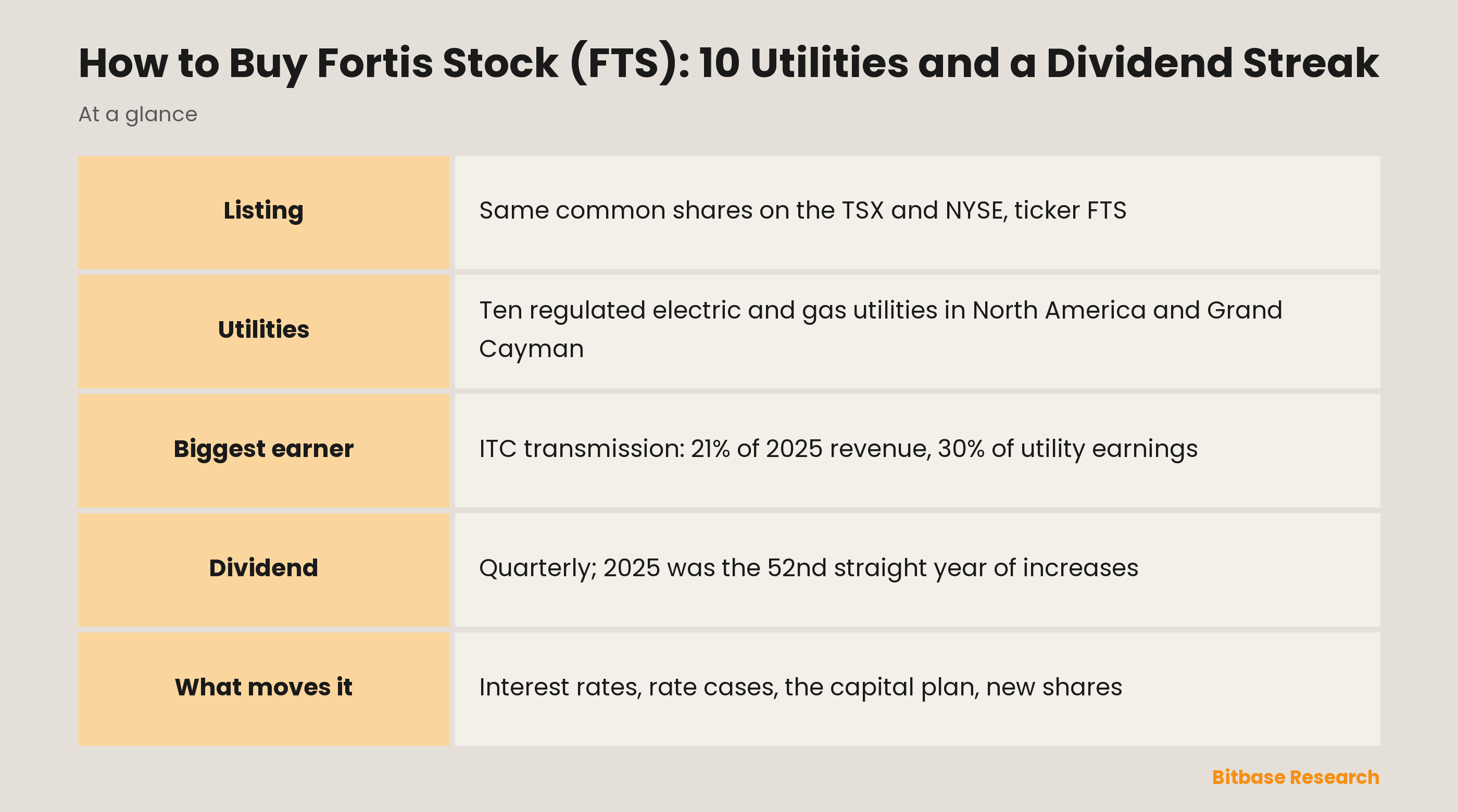
From Toronto or New York, Fortis common shares can be bought under the same ticker, FTS, in Canadian or US dollars, through any broker that reaches either exchange. The company is a holding group in St. John's, Newfoundland, that owns ten regulated electric and gas utilities in Canada, the United States and Grand Cayman, and 2025 marked its 52nd consecutive year of higher dividends paid. Below are its earnings sources, the buying steps and the forces that move the share.
What Does Fortis Do?
Fortis owns the wires and pipes that deliver electricity and natural gas. Its annual information form (AIF), the yearly disclosure document Canadian issuers file, calls it "principally an energy delivery company, with approximately 95% of its assets related to transmission and distribution." Incorporated in 1977, it moved under Newfoundland and Labrador law in 1987, and its 9,900 employees serve 3.5 million utility customers in five provinces, ten US states and the Caribbean. Each utility keeps its own management and board, and the AIF says they "operate on a substantially autonomous basis."
Three businesses form the US side. ITC owns high-voltage transmission lines in eight states from Michigan to Oklahoma, with rates set by the Federal Energy Regulatory Commission (FERC) through cost-based formulas. Fortis bought it with GIC Private Limited on 14 October 2016, then the largest acquisition in Fortis history, and holds 80.1%. UNS Energy in Arizona, parent of Tucson Electric Power (TEP), serves 738,000 customers and owns most of the group's power plants; coal fuelled 26% of that capacity at the end of 2025, and TEP plans to convert two Springerville coal units to gas by 2030. Central Hudson delivers electricity and gas to 405,000 customers in New York State.
In Canada, FortisBC Energy distributes gas to 1,105,000 customers in British Columbia, more than any other Fortis utility, and FortisAlberta runs a power distribution network with 615,000. Smaller utilities serve parts of British Columbia, Newfoundland, Prince Edward Island and Ontario, plus Grand Cayman through Caribbean Utilities, about 60% owned. In 2025 Fortis sold its utility in the Turks and Caicos Islands and its interests in Belize.
Rivals are few: "Most of the Corporation's regulated utilities operate as the sole supplier of electricity and/or gas within their respective service territories," the AIF says.
How Fortis Makes Money
Regulators set the prices. Under cost-of-service rules, the 2025 management discussion and analysis (MD&A) explains, rates allow "a reasonable opportunity for the timely recovery of the estimated costs of providing service, including a fair rate of return on a deemed or targeted capital structure applied to an approved Rate Base." Rate base is the investment a utility may earn on, so Fortis grows by building; the MD&A attributes the 2025 earnings increase "primarily" to "Rate Base growth across the utilities."
| Segment | Share of 2025 revenue | Share of 2025 utility earnings | What it does |
|---|---|---|---|
| ITC | 21% | 30% | Electric transmission in eight US states |
| UNS Energy | 24% | 22% | Generation, power lines and gas in Arizona |
| FortisBC Energy | 15% | 17% | Gas delivery in British Columbia |
| Central Hudson | 13% | 10% | Electricity and gas in New York State |
| FortisAlberta | 7% | 9% | Power distribution in Alberta |
| FortisBC Electric | 5% | 4% | Integrated electric utility in British Columbia |
| Other Electric | 15% | 8% | Eastern Canada and Grand Cayman |
Earnings shares exclude holding company costs; ITC revenue counts all of ITC, its earnings the 80.1% stake. Transmission thus brings in about a fifth of revenue but three tenths of utility earnings. By location, the United States produced 58% of 2025 revenue, Canada 38% and the Caribbean 4%.
Common equity earnings rose about 7% in 2025, despite losses on the Caribbean sales. Canadian and New York utilities earn most in winter quarters, UNS Energy in Arizona's air-conditioning season.
FTS Stock at a Glance
| Feature | FTS |
|---|---|
| Exchanges | Toronto Stock Exchange and New York Stock Exchange, both under FTS |
| Security | Common shares, no par value; the sole class registered under Section 12(b) |
| ADR or depositary shares | No; Toronto and New York quote the same shares |
| Preference shares | Seven series, listed in Toronto only |
| Index funds | Held by XIU (S&P/TSX 60); not held by SPY (S&P 500) |
| Fiscal year | Ends 31 December |
| Reporting | US GAAP, in Canadian dollars |
| Annual SEC filing | Form 40-F; quarterly results on Form 6-K |
| Dividends | Quarterly, at the board's discretion |
| SEC identifier | CIK 1666175 |
For live prices, see the Fortis stock page on Bitbase.
How to Buy Fortis Stock
Fortis registered its shares for NYSE trading in October 2016. Both listings are one security, so the real choice is currency:
1. Choose the market. New York quotes FTS in US dollars, Toronto in Canadian dollars.
2. Open an account. Expect identity checks and a tax-residency question.
3. Fund it. On small orders, currency conversion can cost more than the commission.
4. Find the right line. Pick Fortis Inc. common shares, not the Toronto preference series whose symbols begin FTS.PR, and not Fortinet or Fortive, unrelated names nearby in US fund lists.
5. Choose an order type. Limit orders set a maximum price; market orders fill at the best price available.
Dividend tax. Canada generally withholds tax on dividends sent abroad: a prospectus supplement Fortis filed in December 2024 gives a 25% rate that treaties can cut, generally to 15% for US residents who qualify under the Canada-US treaty. In that document Fortis also says it does not consider itself a passive foreign investment company (PFIC), a US tax category.
Through funds. XIU, BlackRock's iShares fund tracking the S&P/TSX 60, listed FTS among its holdings on 9 November 2026; SPY, State Street's S&P 500 fund, held no Fortis that day.
What Moves FTS Stock
Interest rates. "Generally, the market price of the Corporation's common shares is inversely correlated to interest rate changes," the MD&A says.
Rate cases. In October 2026 an administrative law judge at the Arizona Corporation Commission recommended a 9.65% return on equity and a 55.5% equity share of capital for TEP, with new rates proposed by 1 December 2026; the commission's vote was still pending in early November. FERC rulings can reach backwards: in October 2024 it cut the base return for ITC's utilities in MISO, the Midcontinent grid operator, from 10.02% to 9.98%, partly retroactively.
The capital plan. On 3 November 2026 Fortis released its 2027-2031 plan, the largest in its history, which it expects to support 7.5% annual rate base growth, much of it ITC transmission for MISO's long-range grid plan. Data centers feature too: ITC is upgrading lines for up to 1,600 MW of new data center load at the Big Cedar Industrial Center, and TEP has an approved supply agreement with a data center customer for about 300 MW.
New shares. Most new equity is expected from the dividend reinvestment plan, but Fortis also sold shares through its at-the-market program in the third quarter of 2026. More shares spread earnings thinner.
The dividend. In November 2026 the board raised the quarterly dividend by 4% and extended its 4-6% annual growth guidance through 2031. Dividends are declared in Canadian dollars, so their US-dollar value moves with the exchange rate.
Regulators, Wildfires and Funding Needs at Fortis
These items from the MD&A's "Business Risks" chapter matter most to a shareholder.
Regulatory lag. Slow cost recovery "could have a Material Adverse Effect," and the risk "may be significant for UNS Energy given the past practice of its regulator to use historical test years in setting customer rates." FERC formula rates "can be challenged by third parties which could result in rate reductions and customer refunds."
Fire and weather. Utilities "may become liable for fire-suppression costs, regeneration and timber value costs, and third-party losses if their facilities are determined to have been responsible for, or contributed to, a fire or wildfire."
Execution. "The Corporation's dividend growth guidance is significantly dependent upon achieving the Rate Base growth expected from the execution of the five-year Capital Plan."
Funding, gas and cyber. Repaying debt depends on new financing, climate policy may weaken gas against electricity, and critical infrastructure attracts cyberattacks.
And one stock ties your outcome to one company.
How to Research FTS Yourself
Fortis files with the SEC under CIK 1666175: a Form 40-F each February, bundling the AIF, the annual MD&A and the audited financial statements, and Form 6-K for quarterly results and news. Quarterly results in 2026 were released on 12 February, 6 May, 31 July and 3 November. Canadian copies are on SEDAR+.
Start with the AIF's "Summary of Operations" table, then the MD&A's "Business Unit Performance", "Capital Plan" and "Business Risks" sections; rate decisions come from the regulators themselves. Figures are Canadian dollars unless labelled US$.
Compare our American Electric Power stock guide, on a US utility with a big transmission arm, and our TC Energy stock guide, on another Toronto and New York listing; more US stock pages on Bitbase cover other companies.
Fortis Stock FAQ
Can I buy Fortis stock with crypto?
No, not directly. FTS is priced in US or Canadian dollars, so crypto has to be converted to cash first, and that sale may be taxable. A share also carries dividend and voting rights, part of what separates a share from a crypto asset.
Are FTS in Toronto and FTS in New York the same shares?
Yes. It is a single class of common shares listed on both exchanges, with no depositary receipt in between; the currency is what changes.
Does Fortis pay a dividend?
Yes, quarterly. The MD&A calls 2025 the 52nd consecutive year of increases in dividends paid, and in November 2026 the board raised the payment again by 4%. The board decides each dividend.
Is Fortis in the S&P 500?
No. On 9 November 2026 the S&P 500 fund SPY held no Fortis shares, while the S&P/TSX 60 fund XIU did.
Which utilities does Fortis own in the United States?
ITC (80.1% owned), UNS Energy in Arizona and Central Hudson in New York State.
Conclusion
Fortis is a set of regulated monopolies, so what decides its results is whether Arizona, FERC and the Canadian commissions let it earn on what it builds, whether the largest capital plan in its history lands on schedule, and how many new shares that plan requires. Its price also answers to interest rates. Read the latest MD&A, follow the TEP rate decision, and decide how much weight one utility holding company deserves in your portfolio.
Related reading
Other Bitbase articles on this topic:
- How to Buy CenterPoint Energy Stock (CNP): Houston Grid and Gas
- How to Buy Con Edison Stock (ED): NYC Grid, Steam and Dividends
- How to Buy DTE Energy Stock (DTE): A Century of Dividends
- How to Buy Xcel Energy Stock (XEL): Eight States and Two Wildfires
Disclaimer: This article is educational content from Bitbase Academy, provided for information only. It explains what a company or fund does and how the instruments referenced here differ from one another; it does not constitute investment, trading, tax, or financial advice, and it is neither a recommendation nor an endorsement of any security, token, or trading strategy. A tokenized stock is issued by a third party and is designed to give economic exposure to an underlying asset: it is not a share, it carries no shareholder rights, and it depends on the issuer's structure, eligibility rules, and redemption terms, which the issuer can change. Perpetual futures are leveraged derivatives that hold no underlying asset and can be liquidated, and trading hours, product availability, and eligibility differ by instrument and by jurisdiction and can change at any time. Written as of November 2026; verify everything yourself through company filings, the issuer's own documentation, and the product pages of the venue you trade on.
References
[1] Fortis Form 40-F for 2025 (SEC EDGAR) www.sec.gov
[2] Fortis 2025 Form 40-F, XBRL cover page (SEC EDGAR) www.sec.gov
[3] Fortis 2025 Annual Information Form, filed with Form 40-F (SEC EDGAR) www.sec.gov
[4] Fortis 2025 management discussion and analysis, filed with Form 40-F (SEC EDGAR) www.sec.gov
[5] Fortis 2025 Form 40-F, XBRL segment data (SEC EDGAR) www.sec.gov
[6] Fortis third-quarter 2026 results release, filed with Form 6-K (SEC EDGAR) www.sec.gov
[7] Fortis third-quarter 2026 MD&A, filed with Form 6-K (SEC EDGAR) www.sec.gov
[8] Fortis prospectus supplement, December 2024: tax considerations (SEC EDGAR) www.sec.gov
[9] Fortis and GIC complete acquisition of ITC Holdings, October 2016 (SEC EDGAR) www.sec.gov
[10] Fortis Form 8-A: registration of common shares on the NYSE, October 2016 (SEC EDGAR) www.sec.gov
[11] BlackRock iShares S&P/TSX 60 Index ETF (XIU): fund page and holdings www.blackrock.com
[12] State Street SPDR S&P 500 ETF Trust (SPY): fund page and daily holdings www.ssga.com





