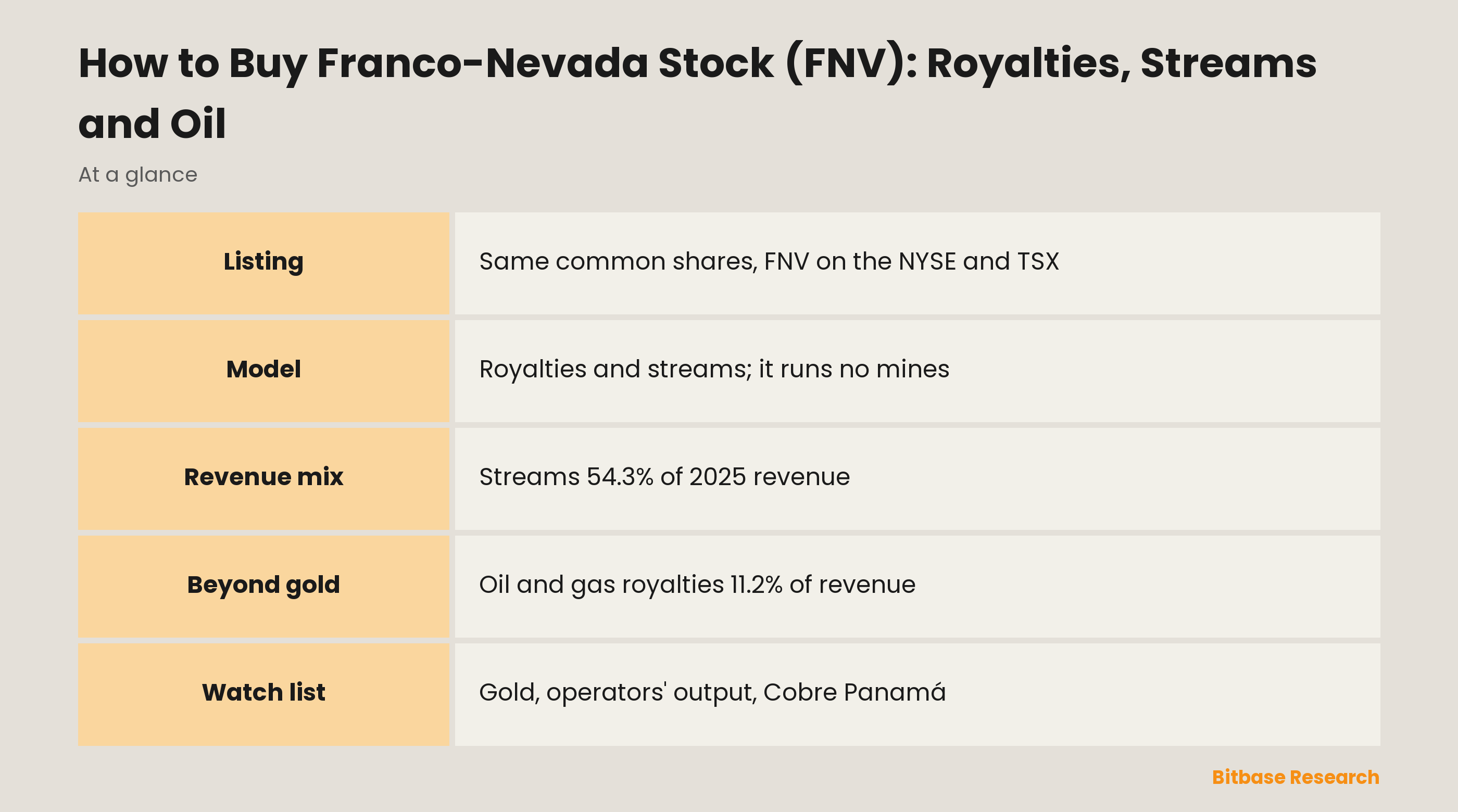
Two stock exchanges, Toronto and New York, list the same Franco-Nevada common shares under the ticker FNV, so a brokerage account that reaches either market can place the order. What the shares buy is less common: the company operates no mines or wells, but collects royalties and metal streams from mines and oil fields that others operate, and in 2025 streams alone supplied 54.3% of its revenue. Below: how that model earns money, how to buy the stock step by step, and why a copper mine in Panama, idle since November 2023, still runs through the filings.
What Does Franco-Nevada Do?
Franco-Nevada puts up money for mining and energy producers and is repaid in metal or cash for as long as their assets produce. Its annual information form (AIF), the yearly business description that Canadian issuers file, calls it "the leading gold-focused royalty and streaming company with the largest and most diversified portfolio of cash-flow producing assets." That is the company describing itself. What the same document states as plain fact is narrower: "Franco-Nevada does not operate mines, develop projects or conduct exploration."
Two kinds of contract do the work. A royalty is "a payment to a royalty holder by a property owner or an operator of a property," usually a percentage of what the property produces or of its revenue or profit, and the holder is generally not responsible for operating costs, capital spending or environmental clean-up. A stream works differently. Streams are "metal purchase agreements where, in exchange for an upfront deposit and ongoing payments for metal delivered, the holder purchases all or a portion of one or more metals produced from a mine, at a preset price."
Royalties themselves vary. A net smelter return royalty is calculated on the value of the metal produced, so the operator's costs barely reach it, while net profit interests and gross margin royalties are paid after costs and shrink when a mine gets more expensive to run.
The company was incorporated under the Canada Business Corporations Act on 17 October 2007 and went public the same year. It is based in Toronto, with further offices in Barbados, Denver and Perth, and the AIF counted 44 full-time employees and 5 part-time contractors on 19 March 2026. Paul Brink, who joined at the 2007 initial public offering and later led business development, became chief executive in 2020; in September 2026 he was also named chair of the World Gold Council, the gold miners' industry body.
On 19 March 2026 the AIF tallied 438 assets: 249 in precious metals and 189 described as "diversified," of which 106 are in other mining and 83 in energy. Only 120 were producing. The rest were advanced projects or exploration ground, held for whatever an operator may discover later at no extra cost to Franco-Nevada. The energy side consists of royalty and working interests in western Canada and in Oklahoma, North Dakota, Pennsylvania, Louisiana, Texas and New Mexico, including the Haynesville gas play and the Permian basin.
Among the best-known precious-metals contracts are streams on Lundin Mining's Candelaria copper mine in Chile, Glencore's Antapaccay in Peru, silver from the Antamina mine in Peru, and Coeur Mining's Guadalupe-Palmarejo in Mexico. Royalties include a 1.8% net smelter return on Newmont's Yanacocha operations in Peru, a royalty on Agnico Eagle's Detour Lake in Ontario and, since June 2025, a 7.5% gross margin royalty on the Côté Gold mine in Ontario, run by IAMGOLD. In February 2025 the company also bought a precious-metals stream on Sibanye-Stillwater's Western Limb operations in South Africa.
How Franco-Nevada Makes Money
Revenue arrives in three main ways: metal delivered under streams, which the company then sells; cash royalties calculated on production or revenue; and smaller royalties tied to profit. The revenue note to the 2025 financial statements splits it as follows:
| Revenue type | Share of 2025 revenue | How the amount is set |
|---|---|---|
| Streams | 54.3% | Metal bought at a preset price, then sold at market |
| Revenue-based royalties | 35.1% | A percentage of production value or revenue |
| Profit-based royalties | 7.9% | A share of profit or margin after the operator's costs |
| Interest and other | 2.7% | Interest on loans to operators, dividends from an equity stake and similar items |
By commodity, gold supplied 70.0% of 2025 revenue, silver 12.9% and platinum group metals 2.0%; with interest income added, the precious metals segment came to 85.7%. Energy, mostly oil and gas royalties, made up 11.2%, and other mining, chiefly iron ore, 3.1%. Total revenue rose 63.7% from 2024, a jump the AIF credits to higher gold prices.
The design is meant to keep the operator's costs out of the result. Most of the contracts pay on production "with no adjustments for the operator's operating costs," and the AIF says such interests accounted for 91% of 2025 revenue. On a stream, the price Franco-Nevada pays per ounce is either fixed or set as a percentage of the spot price when the contract is signed, so a higher metal price widens the gap between what it pays and what it sells for. The other side of that arrangement is control: the company has no say over how much a mine produces, when it expands or whether it stops.
Geography matters as well. South America produced 41.2% of 2025 revenue, Canada 19.4%, the United States 14.6% and Central America and Mexico 11.9%. Peru alone supplied 21.1% and Chile 13.8%, the countries of Antapaccay, Antamina, Yanacocha and Candelaria. Growth has mostly come from buying: the AIF notes that the company's "attributable production has typically been supplemented by acquisitions of new assets."
FNV Stock at a Glance
| Feature | FNV |
|---|---|
| Exchanges | New York Stock Exchange and Toronto Stock Exchange |
| Ticker | FNV on both |
| Security | Common shares, the only class registered under Section 12(b); no preferred shares outstanding |
| Depositary receipt | None: the same common shares trade in both markets |
| Business | Royalties and streams on precious metals, other mining and energy |
| Index membership | Held by funds tracking the S&P/TSX 60; not in the S&P 500 |
| Headquarters | Toronto, Ontario |
| Incorporated | Canada Business Corporations Act, 2007 |
| Fiscal year | Calendar year, ending 31 December |
| SEC annual report | Form 40-F, under the multijurisdictional disclosure system |
| Dividends | Quarterly, declared in US dollars; raised every year since the 2007 IPO |
| SEC identifier | CIK 1456346 |
Quotes, market value and yield move all day; the Franco-Nevada stock page on Bitbase shows the live figures.
How to Buy Franco-Nevada Stock
Franco-Nevada lists its own common shares in New York and Toronto, so the first decision is which market, and with it which currency, to use. Then:
1. Pick the market. The NYSE line trades in US dollars and the TSX line in Canadian dollars; check that the broker offers the one you want and which regulated company holds your account.
2. Open the account. Expect identity checks and a question about your country of tax residence, which later decides how dividends are taxed.
3. Fund it. Converting money into either dollar has a cost; compare the exchange spread as well as the commission.
4. Find the right listing. Search FNV and confirm the result reads Franco-Nevada Corporation common shares on the exchange you picked.
5. Choose the order type. A market order fills straight away at the best available price; a limit order waits until your price or a better one is reached.
6. Decide on size. Some brokers sell fractions of a share and some do not, and a fraction may not carry a vote.
7. Keep the records. Contract notes and dividend statements show what you paid and any tax withheld.
Toronto or New York. Both lines are the same security in two currencies; compare them only after converting, and at the same moment.
Dividends and tax. Dividends are declared in US dollars. The US tax summary in the 40-F refers to "Canadian income tax withheld" from distributions and explains that US holders may claim a deduction or a credit for it, but the filings do not state a rate for other countries. Ask your broker how much will be withheld, whether a tax treaty lowers it and which form it needs; your home country may tax the dividend again. Shareholders can also reinvest through the dividend reinvestment plan, which issues new shares at a 1% discount to the average market price; holders outside Canada and the United States have to meet conditions and contact the company first.
Through a fund. BlackRock's iShares S&P/TSX 60 Index ETF (XIU) listed FNV among its holdings on 6 November 2026, while State Street's SPDR S&P 500 ETF Trust (SPY) did not hold it on 5 November 2026.
What Moves FNV Stock
Gold, above all. The annual MD&A puts it directly: "The prices of gold and other precious metals are the largest factors in determining profitability and cash flow from operations for Franco-Nevada." It names interest rates, fiscal and monetary stimulus, inflation expectations, the strength of the US dollar, and supply and demand as the main influences on gold.
What operators produce. The AIF says short-term results are "primarily tied to the price of commodities and the amount of production from its portfolio of assets," and that over the longer term they depend on how much money operators spend on exploration and development. Contract terms shift too. At Candelaria the stream is due to step down from 68% to 40% of the gold and silver produced in the second half of 2027, and at Antapaccay it is expected to change in the second half of 2028 to 30% of gold and silver output instead of being indexed to copper.
Cobre Panamá. First Quantum's copper mine in Panama, on which Franco-Nevada holds a gold and silver stream, has been under "preservation and safe management" with production halted since November 2023. Concentrate produced before the halt was exported in mid-2025, which is why Panama reappeared at 2.1% of 2025 revenue. In April 2026 the government authorised the processing of ore stored on site, the first concentrate followed in May, and stream deliveries were expected to start in the third quarter of 2026. An integral audit by SGS, published by Panama's environment ministry in June 2026, reported an overall compliance rate of 87.7%. On 30 September 2026 a ministerial commission recommended formal negotiations on a new agreement that would end the pending international arbitrations and let the project run toward "an orderly closure, at no cost to the Nation and with no possibility of extension." Franco-Nevada itself suspended its arbitration against Panama in June 2025. Each step in that process bears on what the stream is worth.
New contracts and buybacks. In 2025 the company added the Côté Gold royalty and the Western Limb stream; in 2026 it agreed a gold stream on the Casa Berardi mine in Quebec, a royalty from i-80 Gold in Nevada and royalties on the Bullabulling project in Western Australia, where it signed a follow-on package in September. Operators can also buy part of a contract back, and IAMGOLD and Sumitomo hold options to repurchase up to 50% of the Côté royalty. In Ecuador, after Jiangxi Copper took over SolGold, the new owner bought back 50% of the Cascabel stream and royalty in 2026.
Oil and gas. Energy is a minority of revenue but follows fuel prices: in the second quarter of 2026 the company reported higher revenue from its Weyburn interests in Canada "due to the leverage of the NRI royalty to the increase in oil prices."
Currencies and tax. The MD&A names the Canadian dollar against the US dollar as the largest currency exposure, affecting head-office costs and depletion. On tax, a settlement with the Canada Revenue Agency on 11 September 2025 closed a transfer-pricing dispute: no Canadian tax is payable on the foreign earnings of the Barbadian and Mexican subsidiaries for the 2013 to 2019 tax years.
Operator, Country and Tax Risks Behind FNV
These risk factors from the AIF bear most directly on the shares.
Someone else runs the mine. Franco-Nevada "is dependent on the payment of royalty, stream, and other payments by the owners and operators of the relevant properties," relies on those operators to calculate what it is owed and "may not be able to detect errors." It is also "subject to the same risk factors as the owners and operators" of those properties: accidents, permitting delays, labour problems and reserve estimates that turn out too high all reach its revenue.
A contract can be challenged. One heading reads "Royalty, stream and other interests may not be honoured." The Karma mine in Burkina Faso is a live example. In June 2026 a local court issued a decision "purporting to nullify" the stream agreement; Franco-Nevada says the agreement is governed by Ontario law, regards the ruling as invalid, and is seeking to have it vacated while pursuing remedies in Ontario and elsewhere.
Governments change the rules. The AIF warns that "political volatility and potential changes to mining legislation in Chile, Peru, Mexico and South Africa may affect operations," and Cobre Panamá shows how a single government decision can halt a mine for years.
Leverage works both ways. The same structure that lifted 2025 revenue passes a fall in metal prices straight through, and profit-based royalties also absorb any rise in the operators' costs.
Tax status. "Reviews conducted by tax authorities, now or in the future, may result in adverse tax consequences." US investors face one more question: the company believes, "on a more-likely-than-not basis," that it was not a passive foreign investment company (PFIC) for 2025, but it cannot rule out a challenge by the IRS, and PFIC status brings heavier US tax treatment for holders.
The share and the payout. Franco-Nevada's "securities are subject to price volatility," and the board may change the dividend policy "at any time at its sole discretion," with "no assurance" that any level of payment will be sustained. A single stock also concentrates your money in one company's contracts, however many assets sit behind them.
How to Research FNV Yourself
Franco-Nevada files with the SEC under CIK 1456346 as a Canadian issuer using the multijurisdictional disclosure system, so there are no 10-K or 10-Q reports to look for. Each year's Form 40-F bundles the AIF, the annual MD&A and the audited financial statements; quarterly results and other news arrive on Form 6-K.
The AIF explains each royalty and stream type and lists the past three years of acquisitions. The MD&A's metal sales table shows, asset by asset, how many ounces each contract delivered and what percentage interest it carries. The revenue note in the financial statements splits revenue by commodity, region and contract type, which is where the percentages in this article come from. Reserve and resource figures are prepared by the operators under Canada's NI 43-101 standard, and the AIF cautions that they may not be comparable with what US companies disclose.
To compare a company with the same business model, see our Wheaton Precious Metals stock guide. The same filings are on SEDAR+ and franco-nevada.com. Live quotes sit on the stock page linked earlier, and Bitbase's full list of US stock pages covers other listed companies.
Franco-Nevada Stock FAQ
Can I buy Franco-Nevada stock with crypto?
Not directly. FNV shares are bought through a broker and paid for in US or Canadian dollars, so crypto would first have to be sold for cash and the cash transferred, and that sale may be taxable where you live. The two are different assets: a common share carries a vote and a claim on declared dividends, which is how a share differs from a crypto asset.
Does Franco-Nevada pay a dividend?
Yes. It pays a quarterly dividend declared in US dollars and has raised it every year since its 2007 IPO; the 16% increase announced in January 2026 was the 19th consecutive annual rise. The board decides each payment, so check the latest 6-K for the amount and dates.
Does Franco-Nevada own any mines?
No. It holds royalties, streams and some working interests, mostly in energy, on properties that other companies own and run, and it does not develop projects or explore.
Is FNV the same stock in Toronto and New York?
Yes. One class of common shares trades on both the TSX and the NYSE under FNV, with no depositary receipt in between; the two prices are simply quoted in different currencies.
Is Franco-Nevada in the S&P 500?
No. State Street's SPY holdings file dated 5 November 2026 did not include it. In Canada, BlackRock's XIU, which tracks the S&P/TSX 60, listed it among its holdings on 6 November 2026.
Does Franco-Nevada still earn anything from Cobre Panamá?
Only from material already mined. Production stopped in November 2023 and the mine is held under a preservation plan. Concentrate exported in 2025 produced stream deliveries, and the processing of stockpiled ore approved in April 2026 was expected to bring more from the third quarter of 2026. Its longer-term future turns on the negotiations a ministerial commission recommended in September 2026.
Conclusion
Buying FNV takes a broker with NYSE or TSX access, a choice of currency and an order. Understanding it takes longer: the share is a claim on hundreds of royalty and stream contracts, mostly tied to gold, on mines and wells that other companies run in other countries, with oil and gas on the side. Read the latest 40-F and quarterly 6-K, check where Cobre Panamá and the Karma dispute stand, and decide how much of your portfolio one royalty company should carry.
Related reading
Other Bitbase articles on this topic:
- How to Buy AngloGold Ashanti Stock (AU): A UK Gold Miner on NYSE
- How to Buy ArcelorMittal Stock (MT): Real Shares, Not an ADR
- How to Buy Cameco Stock (CCJ): Uranium, Westinghouse, Vote Caps
- How to Buy Steel Dynamics Stock (STLD): Steel, Scrap and Aluminum
Disclaimer: This article is educational content from Bitbase Academy, provided for information only. It explains what a company or fund does and how the instruments referenced here differ from one another; it does not constitute investment, trading, tax, or financial advice, and it is neither a recommendation nor an endorsement of any security, token, or trading strategy. A tokenized stock is issued by a third party and is designed to give economic exposure to an underlying asset: it is not a share, it carries no shareholder rights, and it depends on the issuer's structure, eligibility rules, and redemption terms, which the issuer can change. Perpetual futures are leveraged derivatives that hold no underlying asset and can be liquidated, and trading hours, product availability, and eligibility differ by instrument and by jurisdiction and can change at any time. Written as of November 2026; verify everything yourself through company filings, the issuer's own documentation, and the product pages of the venue you trade on.
References
[1] Franco-Nevada Form 40-F, fiscal 2025: MJDS status and US tax summary (SEC EDGAR) www.sec.gov
[2] Franco-Nevada, fiscal 2025 Form 40-F XBRL cover page, R1.htm (SEC EDGAR) www.sec.gov
[3] Franco-Nevada 2025 annual information form: business model, assets, deals, dividends and risk factors (SEC EDGAR) www.sec.gov
[4] Franco-Nevada 2025 annual MD&A: metal sales by asset, outlook and currency exposure (SEC EDGAR) www.sec.gov
[5] Franco-Nevada 2025 audited financial statements: revenue by commodity, region and type (SEC EDGAR) www.sec.gov
[6] Franco-Nevada second-quarter 2026 results: Cobre Panamá update and dividend (Form 6-K, SEC EDGAR) www.sec.gov
[7] Franco-Nevada, Cobre Panamá update of 30 September 2026: ministerial commission report (Form 6-K, SEC EDGAR) www.sec.gov
[8] Franco-Nevada, Burkina Faso stream update of June 2026: Karma court decision (Form 6-K, SEC EDGAR) www.sec.gov
[9] Franco-Nevada news release of 28 September 2026: Paul Brink named chair of the World Gold Council (Form 6-K, SEC EDGAR) www.sec.gov
[10] BlackRock Canada, iShares S&P/TSX 60 Index ETF (XIU): holdings as of 6 November 2026 www.blackrock.com
[11] State Street, SPDR S&P 500 ETF Trust (SPY): daily holdings as of 5 November 2026 www.ssga.com





