
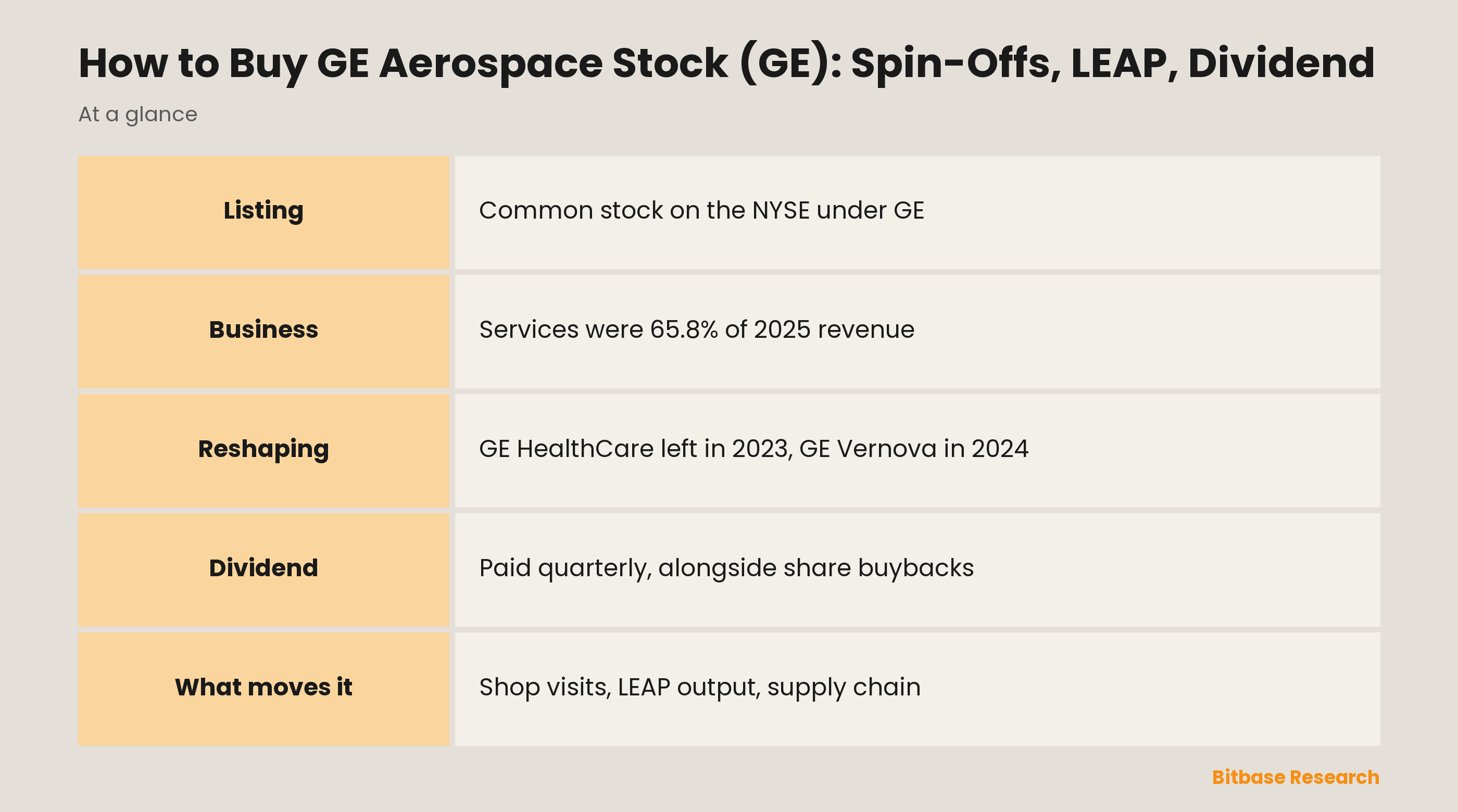
With any brokerage account that reaches the New York Stock Exchange, you can buy GE Aerospace stock under the ticker GE, even though the filings behind it are still made in the name of General Electric Company. The share is far narrower than the name suggests: GE HealthCare left in 2023, GE Vernova in 2024, and what remains is a jet-engine maker whose 10-K puts aftermarket services at "approximately 70% of revenue." This guide covers how the business earns that money, how the order works and what moves the share price.
What Does GE Aerospace Do?
GE Aerospace designs, builds and services aircraft engines. The registrant is General Electric Company, incorporated in New York, and the business description in its annual report begins by saying that it "operates as GE Aerospace." Headquarters are at Evendale, Ohio. The company describes itself as having "the industry's largest and growing commercial propulsion fleet," and its 2025 10-K counts an installed base of approximately 50,000 commercial and 30,000 military engines.
It reports two segments. Commercial Engines & Services (CES) designs, manufactures and services jet engines for commercial airframes, business aviation and aeroderivative uses, selling to airframers and airlines, Boeing and Airbus among them, and to independent repair shops. The most significant of the joint ventures that sell its engines is CFM International, a 50-50 venture with Safran Aircraft Engines that GE does not consolidate; it produces the CFM56 and LEAP families, the engines behind GE's narrowbody business. LEAP entered service in 2016, and the 10-K expects it to overtake the mature CFM56 as the industry's largest fleet in the coming years. On widebodies GE has the CF6, GE90, GEnx and the GE9X, which will power the Boeing 777X. On some Boeing models, the filing notes, a GE engine is the sole option.
Defense & Propulsion Technologies (DPT) combines two businesses. Defense & Systems makes engines for fighters, helicopters and ships, including the F110, F404 and F414, the T408, T700 and T901, and the LM2500. Propulsion & Additive Technologies supplies components and systems under the Avio Aero, Unison, Dowty Propellers and Colibrium Additive brands.
The 10-K refers to "the Company's long history across many different industries," and two spin-offs finished the narrowing: GE HealthCare on 3 January 2023 and GE Vernova on 2 April 2024, after which "General Electric Company now operates as GE Aerospace." Legacy pieces remain: a run-off insurance book from the former financial services arm, a mortgage portfolio in Poland held through Bank BPH, and US tax equity investments.
How GE Aerospace Makes Money
Commercial engines dominate the 2025 revenue split:
| Segment | What it sells | Share of 2025 revenue | 2025 segment profit margin |
|---|---|---|---|
| Commercial Engines & Services | Commercial jet engines, overhauls, spare parts | 72.7% | 26.6% |
| Defense & Systems (DPT) | Combat, rotorcraft and marine engines; avionics and power systems | 14.3% | 12.3% for DPT as a whole |
| Propulsion & Additive Technologies (DPT) | Components, transmissions, propellers, additive manufacturing | 8.7% | Included in DPT |
| Corporate & Other | Run-off insurance revenue, net of intersegment eliminations | 4.3% | Not a segment |
Shares are calculated from 10-K segment revenue; DPT as a whole was 23.0%.
The engine is often the start of the money, not the bulk of it. A commercial engine, the 10-K says, can "operate for decades with services in the aftermarket," and maintenance, repair and overhaul plus spare parts make up 75% of CES revenue; in DPT the services share is 51%. Across the company, services brought in 65.8% of 2025 revenue, equipment 26.5% and insurance 7.7%. That is why, the filing warns, rivals may offer "substantial discounts" to win an installed base.
Long-term service agreements also make that revenue visible years ahead: at the end of 2025, services were about 86% of the remaining performance obligation, GE's measure of unfilled contracted revenue.
In 2025 total revenue rose 18%, CES revenue 24% and DPT revenue 11%. GE delivered 2,386 commercial engines, up from 1,911, of which 1,802 were LEAPs against 1,407 a year earlier. And 60% of revenue was earned outside the United States, with Asia alone at 23.6%.
GE Stock at a Glance
| Feature | Detail |
|---|---|
| Legal name | General Electric Company, operating as GE Aerospace |
| Exchange | NYSE (New York Stock Exchange) |
| Ticker | GE |
| Security | Common stock; CUSIP 369604301 since the 2021 reverse split |
| Other listed securities | Four note series, each with its own symbol (for example GE 29) |
| Sector | Aerospace and defense: engines, services and aircraft systems |
| Index membership | S&P 500; no longer in the Dow Jones Industrial Average |
| Headquarters | Evendale, Ohio |
| Incorporated | New York |
| Fiscal year | Calendar year, ending 31 December |
| Dividend policy | Cash dividend each quarter, declared by the board, plus buybacks |
| SEC identifier | CIK 40545 |
Quotes, market value and yield change by the second; check the GE Aerospace stock page on Bitbase for those.
How to Buy GE Aerospace Stock
GE is a US company with one class of common stock on the NYSE, so you will not meet a depositary receipt or a second share class. The steps:
1. Choose a broker with NYSE access. Outside the US, that can be a local firm that routes orders to US exchanges or an international broker; confirm which legal entity holds your account and which regulator supervises it.
2. Open the account and complete identity checks. Non-US individuals certify foreign status with IRS Form W-8BEN, and the broker relies on it to withhold tax on US dividends.
3. Add funds. Converting from another currency has a cost too, so compare the exchange spread as well as the commission.
4. Search for the right line. Type GE and check that the result reads General Electric common stock on the NYSE. Entries such as GE 29 or GE 37 are notes, which are debt, and GEV and GEHC are different companies.
5. Decide how the order executes. A market order "guarantees that the order will be executed, but does not guarantee the execution price"; a buy limit order "can only be executed at the limit price or lower."
6. Size the position. "Not every brokerage firm offers fractional share investing," and you "generally cannot transfer fractional shares to another brokerage firm."
7. Submit, then file the paperwork. Trade confirmations and account statements are your record of cost basis and dividends.
If you live outside the United States, US dividends are withheld at source. According to the IRS, "most types of U.S. source income received by a foreign person are subject to U.S. tax of 30%," and a treaty between your country and the US can lower that rate. Local tax may apply on top.
If you held GE on 16 December 2022 or 19 March 2024, the two record dates, check your account for shares of GE HealthCare and GE Vernova: both spin-offs paid shareholders in stock, and cash replaced any fractional entitlements.
Through funds, you hold GE indirectly. State Street's holdings files for SPY (S&P 500) and XLI (Industrial Select Sector) both listed General Electric in October 2026, and a fund that replicates the S&P 500, such as the one in the VOO explainer, holds it as one name among hundreds.
What Moves GE Stock
Shop visits and spare parts. With services carrying most of the revenue, the market watches how often engines come in for overhaul and how much work each visit needs. Internal shop visit revenue grew 24% in 2025. Flying feeds straight into it: departures rose 3% in 2025 but were "roughly flat" in the first half of 2026, according to the second-quarter 10-Q.
The LEAP ramp and its durability. Today's deliveries are tomorrow's overhauls. Commercial engine deliveries rose 37% and LEAP deliveries 41% in the first half of 2026, and GE certified a LEAP-1B durability kit with an upgraded high-pressure turbine blade it expects to roughly double time on wing, with full cutover planned from early 2027.
Supply chain and castings. The 10-K says global material availability and supplier performance "continue to cause disruptions." On 8 September 2026 GE agreed to buy Consolidated Precision Products, which it calls "a leading manufacturer of highly engineered castings," for cash; closing is expected in the second half of 2027, subject to regulatory approval.
Airline health and conflict. In the second-quarter 10-Q, GE said it was monitoring the conflict in the Middle East for effects on commercial aviation, "including lower utilization and increased prices," which could mean fewer shop visits and lower profitability on long-term contracts. Through June it saw no material impact.
Defense budgets. Most Defense & Systems revenue comes from funding that flows through the US defense budget or allied equivalents, so appropriations and programme decisions move that segment. The 10-K adds that "greater reliance on uncrewed aircraft systems" could change what militaries buy.
Tariffs. Estimated tariff costs cut the expected profitability of long-term service agreements in 2025. Late that year the US agreed zero-for-zero aerospace tariffs with the EU, UK, Japan and Korea, and in 2026 the Supreme Court struck down tariffs imposed under emergency powers; GE has had part of those payments refunded.
Risks to Weigh Before Buying GE
Five of the 10-K's risk factors weigh most on a GE share:
A cyclical customer base. "Our financial performance is dependent on the condition of the commercial aviation sector," which the filing says "has historically been cyclical in nature."
Product safety. The 10-K names "a catastrophic product failure or similar event resulting in injuries or death, a fleet grounding or other systemic consequences" as a material risk, and regulators can "order the grounding of entire fleets."
Supply constraints. "Significant input shortages, supplier capacity constraints" and price increases "have increased, and may continue to increase, our operating costs."
The spin-offs. Both separations were designed to be tax-free. If either were found taxable, the company "would incur a significant tax liability," and the distributions would become taxable to shareholders. GE also lists the credit support it still provides to GE Vernova.
Run-off insurance. The reinsurance book covers long-term care, life insurance and annuities and no longer takes new business, yet its reserves depend on assumptions about inflation, interest rates, morbidity and mortality. Adverse changes could require GE to put more capital into those subsidiaries.
Beyond the business, a single stock ties your return to one company. Dividends are declared quarter by quarter, not promised, and for anyone investing from another currency, an exchange rate sits between the share and its returns.
How to Research GE Aerospace Yourself
GE's SEC filer number is CIK 40545, and its filings still carry the name General Electric Co. Annual results come in the 10-K, quarterly ones in 10-Qs, and 8-Ks carry events in between, from earnings releases to the September 2026 CPP agreement.
GE's 10-K does not run in the usual Item order: the business description, MD&A and risk factors sit under its own headings, such as "About GE Aerospace," with a cross-reference index at the back. Segment data also changed in 2026: the Aeroderivative business moved from CES to DPT, so compare 2026 segment figures with the recast prior-year numbers in the 10-Q, not with the original 10-K table. The structured cover of the 2025 report, R1.htm, lists five registered securities, and the common stock is the only one whose symbol is simply GE.
Earnings releases note that CFM International "produces CFM56 and LEAP engine families," and the 10-K that GE makes "substantial sales of parts and services to CFM International"; keep both in mind when setting LEAP deliveries against GE's own revenue. Live quotes are on the stock page linked earlier, and all US stock pages on Bitbase list the rest.
GE Aerospace Stock FAQ
How are GE, GE Aerospace, GE Vernova and GE HealthCare related?
They were one company and are now three. General Electric Company is the legal entity; it operates as GE Aerospace and trades as GE. GE HealthCare (Nasdaq: GEHC) was spun off on 3 January 2023, one share for every three GE shares, and GE Vernova (NYSE: GEV) on 2 April 2024, one share for every four. GE Aerospace still licenses the GE name and logo to both, but a GE share today holds no stake in either.
Can I buy GE Aerospace stock with crypto?
Not directly. A GE share is bought from a broker and paid for in US dollars, which means selling the crypto first and moving the cash across, and that sale may be taxable where you live. Treat them as separate decisions: a share carries a stockholder's voting and dividend rights, the main difference between a share and a crypto asset.
Does GE Aerospace pay a dividend?
Yes. GE pays a cash dividend every quarter, and the 10-K says the company intends to return a portion of free cash flow "through dividends and share repurchases," and the board approved a new buyback authorization in December 2025. Dividends declared per share in the first half of 2026 were about 31% higher than a year earlier.
Has GE stock split?
In reverse. GE effected a one-for-eight reverse stock split on 30 July 2021, and the shares began trading on a split-adjusted basis on 2 August 2021. Price histories from before August 2021, and from around the 2023 and 2024 distributions, need adjusting before you compare them.
Is GE in the S&P 500 or the Dow?
GE is in the S&P 500: State Street's SPY holdings listed it on 16 October 2026. It is no longer in the Dow Jones Industrial Average. S&P Dow Jones Indices replaced it with Walgreens Boots Alliance effective 26 June 2018, noting that GE "was an original member of the DJIA in 1896 and a member continuously since 1907."
Conclusion
The trade itself is routine: an account that can reach the NYSE, the General Electric common stock line, a market or limit order. What needs thought is the business behind it, an engine maker that earns most of its money servicing a fleet it has already sold, with a run-off insurance book and two spin-offs in its tax history. The CPP closing, the LEAP durability fix and airline traffic are the dated items to follow in the next 10-Q and 8-Ks.
Related reading
Other Bitbase articles on this topic:
- How to Buy CSX Stock (CSX): An Eastern Railroad on Nasdaq
- How to Buy Cummins Stock (CMI): Engines to Data Center Power
- How to Buy Delta Air Lines Stock (DAL): Fuel, Miles and a Refinery
Disclaimer: This article is educational content from Bitbase Academy, provided for information only. It explains what a company or fund does and how the instruments referenced here differ from one another; it does not constitute investment, trading, tax, or financial advice, and it is neither a recommendation nor an endorsement of any security, token, or trading strategy. A tokenized stock is issued by a third party and is designed to give economic exposure to an underlying asset: it is not a share, it carries no shareholder rights, and it depends on the issuer's structure, eligibility rules, and redemption terms, which the issuer can change. Perpetual futures are leveraged derivatives that hold no underlying asset and can be liquidated, and trading hours, product availability, and eligibility differ by instrument and by jurisdiction and can change at any time. Written as of October 2026; verify everything yourself through company filings, the issuer's own documentation, and the product pages of the venue you trade on.
References
[1] General Electric Company (GE Aerospace) Form 10-K, fiscal 2025: business, segment revenue, risk factors and cover data (SEC EDGAR) www.sec.gov
[2] GE Aerospace Form 10-Q for the quarter ended 30 June 2026: deliveries, segment changes, dividends and the Middle East conflict (SEC EDGAR) www.sec.gov
[3] GE Aerospace second-quarter 2026 results release, including the CFM International note and the LEAP-1B durability kit (Form 8-K, Exhibit 99) www.sec.gov
[4] General Electric Form 8-K, 4 January 2023: completion of the GE HealthCare spin-off and distribution ratio www.sec.gov
[5] General Electric Form 8-K, 2 April 2024: completion of the GE Vernova spin-off; the company now operates as GE Aerospace www.sec.gov
[6] General Electric Form 8-K, 30 July 2021: one-for-eight reverse stock split and new CUSIP www.sec.gov
[7] GE Aerospace Form 8-K, 8 September 2026: agreement to acquire Consolidated Precision Products (SEC EDGAR) www.sec.gov
[8] S&P Dow Jones Indices, 19 June 2018: Walgreens Boots Alliance replaces General Electric in the Dow Jones Industrial Average press.spglobal.com
[9] State Street SPDR S&P 500 ETF Trust (SPY): fund page and daily holdings www.ssga.com
[10] State Street Industrial Select Sector SPDR ETF (XLI): fund page and daily holdings www.ssga.com
[11] Investor.gov (SEC): Types of Orders www.investor.gov
[12] Investor.gov (SEC): Investor Bulletin on fractional share investing www.investor.gov
[13] IRS: NRA Withholding www.irs.gov





