
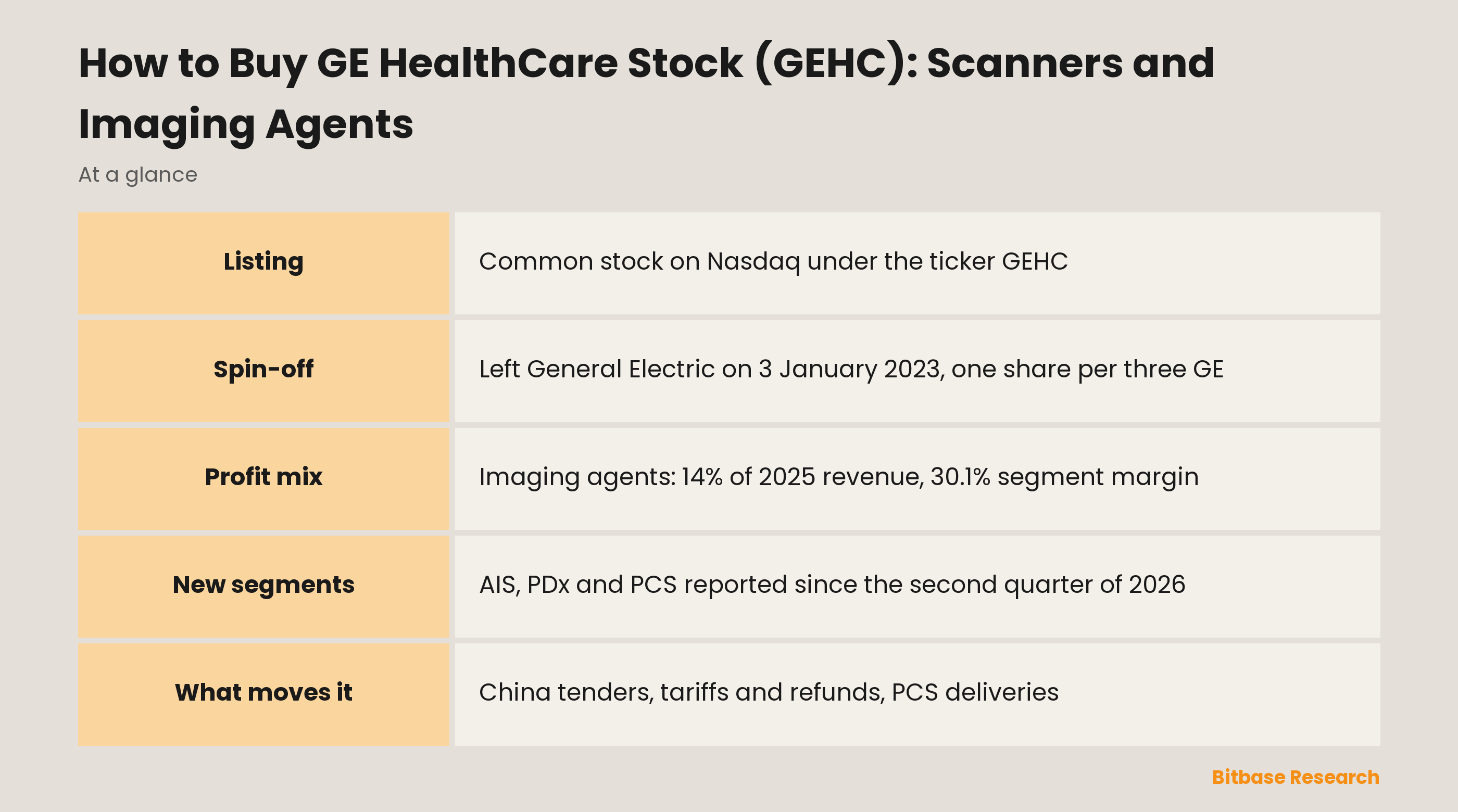
Since its spin-off from General Electric on 3 January 2023, GE HealthCare has been a separate company whose common stock trades on Nasdaq as GEHC, so the order goes through any broker that offers US shares. The ticker buys more than scanners: the smallest of its four 2025 segments, Pharmaceutical Diagnostics, sells contrast media and radioactive tracers and earned a segment EBIT margin of 30.1%, against 9.6% for the much larger Imaging business. Below: the business, the order, the drivers and the filings.
What Does GE HealthCare Do?
GE HealthCare builds the machines hospitals use to see inside the body, the monitors and anesthesia systems that watch over patients, and the drugs injected to make scans easier to read. It reports about 54,000 employees, 32% of them in the United States, and customers in more than 160 countries, mainly hospitals, health systems and researchers. The company is incorporated in Delaware and based in Chicago.
The separation from GE. General Electric handed about 80.1% of GE HealthCare's common stock to its own shareholders on 3 January 2023: one new share for every three GE shares held at the close of business on 16 December 2022. GE sold the rest over the following two years; by 31 December 2024, the 10-K says, "GE had sold the rest of its remaining ownership." General Electric, today called GE Aerospace, later spun off GE Vernova too, as our guides to GE Aerospace stock and GE Vernova stock explain. The main thread left is the name: GE HealthCare does not own the GE trademark or monogram and uses them under a license signed at the spin-off.
Four segments in 2025. Imaging covers molecular imaging (PET and SPECT), computed tomography, magnetic resonance, mammography and bone density systems, and X-ray, with AI-enabled software for those machines. Advanced Visualization Solutions (AVS) is ultrasound plus procedural guidance: cardiovascular and interventional systems and mobile surgical C-arms. Patient Care Solutions (PCS) sells patient monitors, ECG equipment, anesthesia machines, incubators and infant warmers, plus the sensors they use. Pharmaceutical Diagnostics (PDx) makes contrast media for CT, X-ray, MR and ultrasound exams, and radiopharmaceuticals, tracers that collect in a target such as a tumor and show up on a PET or SPECT scan. The 10-K notes that these agents also work with other vendors' scanners.
A new segment map from 2026. In the second quarter of 2026 the company merged Imaging and AVS into Advanced Imaging Solutions (AIS), with three areas: Radiology (the former Imaging business), Specialized Ultrasound and Procedural Guidance. It now reports three segments, AIS, PDx and PCS, and has recast earlier periods to match.
Deals since the spin-off. On 31 March 2025 the company bought the remaining 50% of Nihon Medi-Physics, a Japanese radiopharmaceutical maker, from Sumitomo Chemical. In November 2025 it acquired icometrix, which provides AI-powered brain imaging analysis, and on 18 March 2026 it completed the purchase of Intelerad, a medical imaging software company now inside AIS. In October 2026 it agreed to buy SOFIE Biosciences, a deal it says establishes "a 'final mile' footprint for PET radiopharmaceutical supply in the U.S."; closing is expected in the first half of 2027.
The 10-K names its main global competitors as Siemens Healthineers, Philips Healthcare, United Imaging, Mindray and Canon, and in pharmaceutical diagnostics Bayer, Bracco, Guerbet and Curium.
How GE HealthCare Makes Money
Revenue grew 4.8% in 2025, or 3.5% on an organic basis, which strips out acquisitions and currency effects. Split by segment, with each unit's margin on segment EBIT, the profit measure the chief executive reviews:
| Segment (2025) | Share of revenue | Segment EBIT margin | Main products |
|---|---|---|---|
| Imaging | 45% | 9.6% | CT, MR, PET and SPECT, mammography, X-ray |
| Advanced Visualization Solutions | 26% | 21.9% | Ultrasound, interventional systems, surgical C-arms |
| Patient Care Solutions | 15% | 6.8% | Patient monitors, ECG, anesthesia, neonatal care |
| Pharmaceutical Diagnostics | 14% | 30.1% | Contrast media and radiopharmaceuticals |
Source: segment note, 2025 10-K; a small financing arm reported as "Other" makes up the rest.
Scale and profit point in different directions. Imaging is more than three times the size of PDx, yet the two produced almost the same segment EBIT in 2025. PDx also grew fastest: its revenue rose 15.6%, helped by consolidating Nihon Medi-Physics, and 8.8% organically, "driven by continued growth in volume and price." PCS moved the other way, with revenue slightly lower as Life Support Solutions declined.
Products, meaning equipment, consumables and agents, made up 66% of 2025 revenue and services 34%. In patient care, the company describes consumables and services as sources of "recurring revenue streams."
By country of sale, the United States accounted for about 44% of 2025 revenue and China about 10%, down from 13% in 2023. China region revenue fell 4.6% in 2025. No single customer accounted for more than 10% of revenue, and fourth-quarter results "have historically been higher than in other quarters due to the spending patterns of our customers."
Under the new structure, AIS supplied about 71% of revenue in the first nine months of 2026. In the third quarter, total revenue rose 7.2%, or 6.2% organically, and PDx reported a segment EBIT margin of 29.9%.
GEHC Stock at a Glance
| Feature | GEHC |
|---|---|
| Exchange | The Nasdaq Stock Market LLC |
| Ticker | GEHC |
| Security | Common stock; no other class is listed on the 10-K cover |
| Industry | Medical technology and pharmaceutical diagnostics |
| Segments | AIS, PDx and PCS since the second quarter of 2026; four segments before that |
| Index membership | S&P 500 |
| Headquarters | Chicago, Illinois |
| Incorporated | Delaware |
| Trading since | 4 January 2023, the first day of regular-way trading after the spin-off |
| Fiscal year | January to December |
| Payouts | Quarterly cash dividend; a share repurchase program authorized in April 2025 with no expiration date |
| SEC identifier | CIK 1932393 |
Share price, valuation and yield are live numbers; follow them on the GE HealthCare stock page on Bitbase.
How to Buy GE HealthCare Stock
Because GE HealthCare is a US issuer, what trades on Nasdaq is the common stock, with no ADR layer. A purchase runs through seven steps:
1. Find a broker that reaches Nasdaq. Abroad, that may be a local broker with a US-shares service or an international platform; confirm the firm's regulator and the entity your account sits with.
2. Get the account verified. Brokers usually ask non-US clients for IRS Form W-8BEN, which the IRS says to submit "when requested by the withholding agent or payer."
3. Fund it. Paying in a currency other than dollars adds an exchange spread, which can cost more than the commission.
4. Search for GEHC. The result should read GE HealthCare Technologies Inc. common stock on Nasdaq, the only class on the 10-K cover.
5. Choose the order. A market order takes the going price when it executes; a limit order names your maximum and can go unfilled.
6. Settle the size. Many brokers sell fractional shares, letting you invest a set amount rather than whole shares; ask whether yours does and whether a fraction comes with a vote.
7. File the paperwork. Trade notes and monthly statements record your purchase price and every dividend.
Tax for investors abroad. The IRS says "most types of U.S. source income received by a foreign person are subject to U.S. tax of 30%," and a tax treaty may lower that rate. The rule covers GEHC dividends, which your home country may tax again.
Through a fund. The 6 November 2026 holdings files of two State Street ETFs, SPY (an S&P 500 fund) and XLV (its health care sector fund), both list GEHC, so either gives a diluted, indirect exposure.
What Moves GEHC Stock
China. The company says it watches "increased competition from local companies and the prevalence of Volume Based Procurement policies, both of which have impacted our orders and revenues and may continue to do so." China's share of revenue fell from 13% in 2023 to about 10% in 2025; in the first nine months of 2026 China region revenue grew 1.8%, helped by currency.
Tariffs and refunds. The 10-K says tariffs, "primarily the bilateral U.S. and Chinese tariffs," materially hit 2025 operating income, and that its mitigation is not expected to "fully offset" the cost. After the US Supreme Court ruled in February 2026 that the International Emergency Economic Powers Act does not let the President impose tariffs, the company began receiving refunds of tariffs paid under that law; its third-quarter 10-Q says the timing and amount of further refunds "remain uncertain."
Imaging agents. In the third quarter of 2026 PDx revenue grew 13.0%, "driven by contrast media and radiopharmaceutical volume, and price." Nihon Medi-Physics added a Japanese tracer business in 2025, and the pending SOFIE purchase would add US supply of PET agents.
Hospital budgets and reimbursement. Scanners and monitors are capital purchases. The 10-K warns that efforts by payers to control healthcare costs "may affect the price of and demand for our products," and that private US insurers sometimes follow Medicare's reimbursement decisions.
Execution at PCS. Patient Care Solutions revenue fell 4.0% in the first nine months of 2026, "primarily driven by operational and fulfillment challenges," then rose 8.5% in the third quarter on improved fulfillment in monitoring and maternal infant care.
Acquisitions and debt. Intelerad was funded with senior notes issued in late 2025, a delayed-draw term loan and cash, and SOFIE is another cash purchase; integration costs, amortization and interest all pass through earnings.
Payer Pressure, Helium and Other GEHC Risks
From the 10-K's risk factors, the items closest to the share:
Competition. "Healthcare markets are characterized by rapidly evolving technology, frequent introduction of new products, intense competition, and pricing pressures." The company also lists independent service organizations, which repair other makers' equipment, among its competitive pressures.
Raw materials. "We rely upon supplies of certain raw materials, including helium, iodine, and rare earth minerals." The 10-K adds that in 2025 China "significantly tightened its export controls on rare earth minerals," and only some of those restrictions were temporarily suspended in October 2025.
Regulation and software. New products need clearance or approval before sale, and a compliance failure could lead to "recalls of products, product withdrawals, revocation of marketing authorizations." Because the machines run on software and hold patient data, a cyberattack carries similar consequences.
The spin-off. GE obtained an IRS private letter ruling that the separation would be tax-free. If it were found taxable, the 10-K says, "it could result in significant tax liability to GE and its stockholders and we could have an indemnification obligation to GE."
Debt and pensions. The risk summary lists the company's existing indebtedness and "significant postretirement benefit liabilities" whose costs "could exceed current estimates."
Two risks sit at the level of the share itself. Owning one company's stock ties your result to that company alone. And the dividend is not promised: future dividends, "if any, will fall within the discretion of the Board of Directors."
Tracking GE HealthCare Through EDGAR
On EDGAR, CIK 1932393 holds the annual 10-K, three quarterly 10-Qs a year and 8-K event reports; in 2026 the results releases came on 4 February, 29 April, 29 July and 28 October.
Inside the 10-K, the business section describes the segments and names the competitors, and the MD&A section "Trends and Factors Impacting Our Performance" covers tariffs, China and Russia. The segment note gives revenue and segment EBIT side by side; the related-party note explains the remaining ties to GE. Two habits help. Compare like with like: 2026 10-Qs use the three-segment structure, so a 2025 Imaging figure does not line up with a 2026 AIS figure. And treat organic revenue and adjusted EBIT as non-GAAP measures, checking the reconciliation published with them. For prices, use the stock page linked above, or browse Bitbase's index of US stock pages for other companies.
GE HealthCare Stock FAQ
Can I buy GE HealthCare stock with crypto?
Not directly. Brokers settle GEHC trades in dollars, so the route is to convert crypto to cash, transfer it, then place the order; converting can create a tax bill in your country. What you end up holding is also different: a GEHC share is equity in a registered company, with a vote and a dividend, which is not true of a crypto asset.
Is GE HealthCare still part of General Electric?
No. GE distributed about 80.1% of the shares to its stockholders in January 2023 and, according to the 10-K, had sold its remaining stake by the end of 2024. GE is still treated as a related party "due to board member affiliation," and GE HealthCare uses the GE name under license.
Does GE HealthCare pay a dividend?
It does, every quarter. The dividend declared for holders of record on 23 October 2026 was 14% higher than the one before, and the board decides each payment.
How many GE HealthCare shares did GE shareholders receive?
The ratio was one to three: each three GE shares held at the close of business on 16 December 2022, the record date, brought one GEHC share. If you owned GE then, your statements from early January 2023 should show the GEHC shares.
Is GEHC in the S&P 500?
Yes. SPY, State Street's S&P 500 fund, listed GE HealthCare in its 6 November 2026 holdings file. Weights change daily.
Conclusion
GE HealthCare is mostly an equipment maker, but a contrast-and-tracer business that is a seventh of its sales earns close to as much segment profit as its largest unit, which is why PDx results deserve as much attention as scanner orders. The other open questions are dated and checkable: tariff refunds, demand in China, whether PCS keeps its fulfillment recovery, the integration of Intelerad and the planned SOFIE closing in 2027. Read the latest 10-Q with the new segment map in mind, and size any position for one company exposed to hospital budgets and trade policy.
Related reading
Other Bitbase articles on this topic:
- How to Buy Alcon Stock (ALC): Same Share on SIX and the NYSE
- How to Buy Centene Stock (CNC): Medicaid, Ambetter and Wellcare
- How to Buy Dexcom Stock (DXCM): G7, Stelo and Medicare Bidding
- How to Buy IQVIA Stock (IQV): Clinical Trials and Health Data
Disclaimer: This article is educational content from Bitbase Academy, provided for information only. It explains what a company or fund does and how the instruments referenced here differ from one another; it does not constitute investment, trading, tax, or financial advice, and it is neither a recommendation nor an endorsement of any security, token, or trading strategy. A tokenized stock is issued by a third party and is designed to give economic exposure to an underlying asset: it is not a share, it carries no shareholder rights, and it depends on the issuer's structure, eligibility rules, and redemption terms, which the issuer can change. Perpetual futures are leveraged derivatives that hold no underlying asset and can be liquidated, and trading hours, product availability, and eligibility differ by instrument and by jurisdiction and can change at any time. Written as of November 2026; verify everything yourself through company filings, the issuer's own documentation, and the product pages of the venue you trade on.
References
[1] GE HealthCare Form 10-K for 2025 (SEC EDGAR) www.sec.gov
[2] GE HealthCare 2025 Form 10-K, XBRL cover page (SEC EDGAR) www.sec.gov
[3] GE HealthCare 2025 Form 10-K, XBRL revenue by segment (SEC EDGAR) www.sec.gov
[4] GE HealthCare 2025 Form 10-K, XBRL segment EBIT (SEC EDGAR) www.sec.gov
[5] GE HealthCare 2025 Form 10-K, XBRL revenue by country (SEC EDGAR) www.sec.gov
[6] GE HealthCare Form 10-Q for the third quarter of 2026 (SEC EDGAR) www.sec.gov
[7] GE HealthCare third-quarter 2026 results release, filed with Form 8-K (SEC EDGAR) www.sec.gov
[8] GE HealthCare Form 8-K of 4 January 2023: completion of the spin-off (SEC EDGAR) www.sec.gov
[9] State Street SPDR S&P 500 ETF Trust (SPY): fund page and daily holdings www.ssga.com
[10] State Street Health Care Select Sector SPDR ETF (XLV): fund page and daily holdings www.ssga.com
[11] IRS: NRA Withholding www.irs.gov
[12] IRS: About Form W-8 BEN www.irs.gov





