
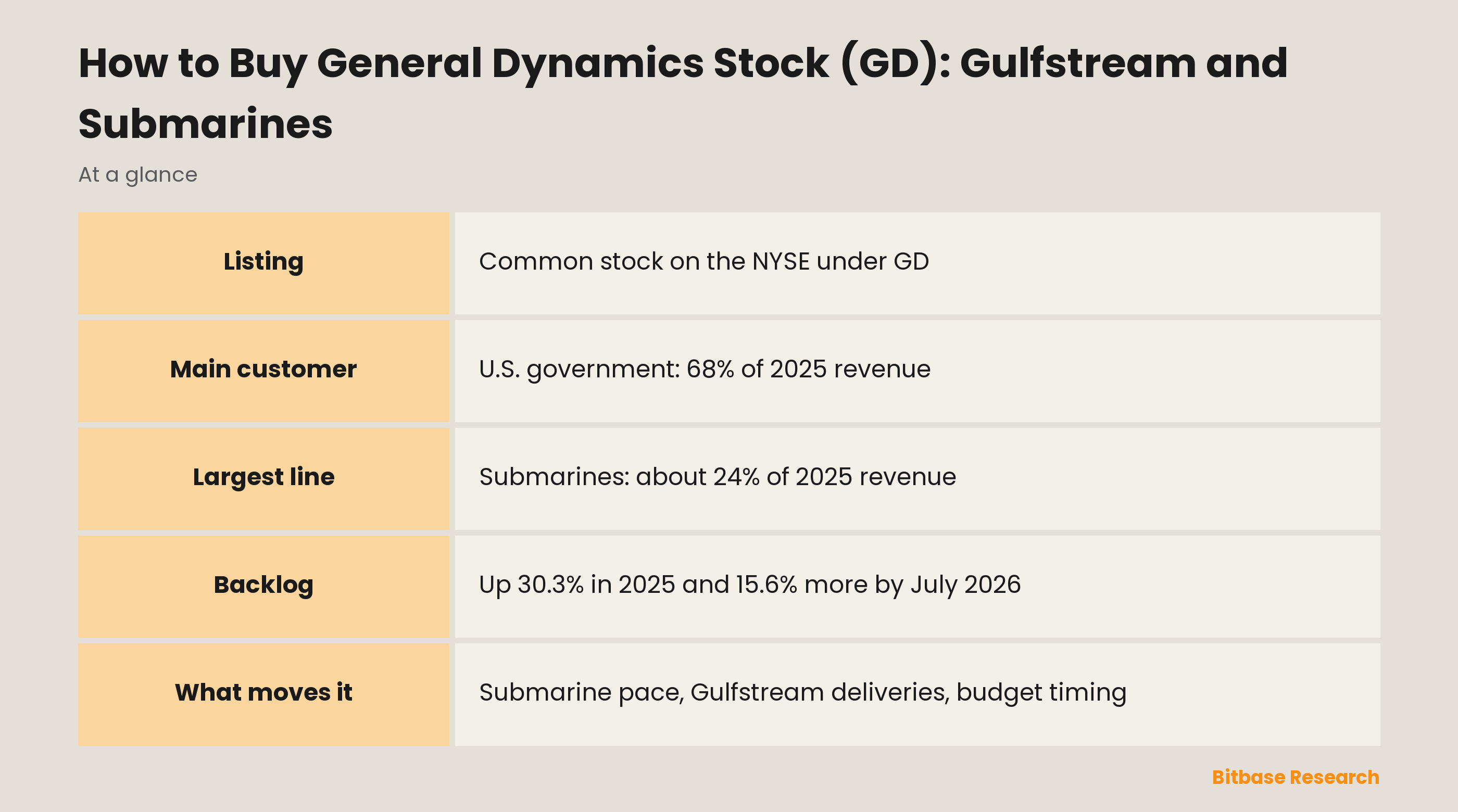
Buying into a company that builds Gulfstream business jets, nuclear-powered submarines and Abrams tanks takes nothing more than a brokerage account with NYSE access, since General Dynamics common stock trades on the New York Stock Exchange under the ticker GD. Two figures explain most of what that share holds: 68% of 2025 revenue came from the U.S. government, and submarines alone brought in about 24% of the total. Below are the four segments, the purchase step by step, and the shipyard, business-jet and budget factors that the filings tie to results.
What Does General Dynamics Do?
The annual report introduces General Dynamics as "a global aerospace and defense company that specializes in high-end design, engineering and manufacturing." Incorporated in Delaware and based in Reston, Virginia, it groups ten business units into four segments: Aerospace, Marine Systems, Combat Systems and Technologies. The last three are what the company calls its defense segments.
Aerospace combines Gulfstream and Jet Aviation. Gulfstream builds all its large-cabin business jets in Savannah, Georgia, while a partner outside the United States assembles the midsize models. The G700 entered service in 2024 and the G800, the longest-range Gulfstream, in 2025; the G400 is in development, and the super-midsize G300, announced in 2025, will replace the G280. Jet Aviation adds maintenance, aircraft management and fixed-base operator services, and the segment supports more than 3,000 Gulfstream aircraft in service. General Dynamics bought Gulfstream "more than 25 years ago," in the 10-K's words.
Marine Systems consists of three shipyards. Electric Boat is "the prime contractor and lead shipyard on all Navy nuclear-powered submarine programs." It leads the Columbia-class ballistic-missile submarine, a 12-boat program whose first boat is expected in 2028, and the Virginia-class attack submarine, built with an industry partner, of which 14 were in backlog at the end of 2025 for delivery through 2034. Bath Iron Works is one of two companies that build the Arleigh Burke-class destroyer, and NASSCO builds Navy support ships such as the John Lewis-class fleet oiler.
Combat Systems covers Land Systems, European Land Systems and Ordnance and Tactical Systems. Land Systems is the U.S. Army's sole-source producer of the Abrams main battle tank and the Stryker wheeled combat vehicle, and is developing the next-generation M1E3 Abrams with the Army as well as prototypes for the XM30, the vehicle meant to replace the M2 Bradley. The European unit builds Piranha and ASCOD vehicles for several countries in Europe. Ordnance and Tactical Systems makes ammunition, artillery components, propellants and missile parts such as warheads and solid rocket motors.
Technologies has two units. GDIT sells IT services, including cloud, cybersecurity and artificial intelligence work, to defense, intelligence and federal civilian agencies. Mission Systems makes defense electronics, among them encryption products certified by the National Security Agency and the fire-control and weapon-launch systems on Navy submarines.
How General Dynamics Makes Money
Revenue rose 10.1% in 2025, with double-digit growth in Aerospace and Marine Systems. The four segments are close in size but earn very different margins:
| Segment | Business units | Share of 2025 revenue | 2025 revenue growth | 2025 operating margin |
|---|---|---|---|---|
| Marine Systems | Electric Boat, Bath Iron Works, NASSCO | 31.8% | 16.6% | 7.0% |
| Technologies | GDIT, Mission Systems | 25.6% | 2.6% | 9.5% |
| Aerospace | Gulfstream, Jet Aviation | 24.9% | 16.5% | 13.3% |
| Combat Systems | Land Systems, European Land Systems, OTS | 17.6% | 2.8% | 14.4% |
Shares are calculated from 2025 segment revenue in the 10-K; growth and margins are as the company reports them.
In 2025, 68% of revenue came from the U.S. government, 15% from U.S. commercial customers, 8% from non-U.S. governments and 9% from non-U.S. commercial customers. The government share was 72% in 2023 and has fallen since, because commercial revenue, mostly business jets and aircraft services, grew faster than government work. The 10-K names the Department of War (DoW), its term for the U.S. defense department, as the primary customer; it alone accounted for about 56.7% of total revenue.
Inside each segment, one line dominates. Nuclear-powered submarines made up 75.4% of Marine Systems revenue and rose 21.3% in 2025, and almost all of the segment's revenue came from the U.S. government. At Aerospace, aircraft manufacturing was 71.8% of revenue and services the rest, with commercial buyers accounting for nearly 90%. Military vehicles brought in 53.8% of Combat Systems revenue and weapon systems and munitions 33.6%, while non-U.S. governments paid 32.2% of the segment's total. IT services were 67.2% of Technologies.
How the work is priced matters too. Fixed-price contracts produced 64.2% of 2025 revenue, and within U.S. government revenue the split was 51% fixed-price, with most of the rest cost-reimbursement. The 10-K is plain about the trade-off: "Typically, we assume more risk with fixed-price contracts. However, these types of contracts offer additional profits when we complete the work for less than originally estimated."
Much of the revenue is booked years ahead. Total backlog grew 30.3% during 2025 and a further 15.6% in the first half of 2026, to 5 July 2026. On that date Marine Systems held 47.8% of the company's backlog.
GD Stock at a Glance
| Topic | Detail |
|---|---|
| Exchange | New York Stock Exchange (NYSE) |
| Ticker | GD |
| Security | Common stock; the 10-K cover registers no other security |
| CUSIP | 369550108 |
| Industry | Aerospace and defense |
| Index membership | S&P 500 and S&P Aerospace & Defense Index; not in the Dow Jones Industrial Average |
| Headquarters | Reston, Virginia |
| Incorporated | Delaware |
| Fiscal year | Ends 31 December; quarters are typically 13 weeks |
| Dividend policy | Quarterly; the March 2026 increase was the 29th consecutive annual raise |
| Stock splits | Two-for-one in March 2006 |
| SEC identifier | CIK 40533 |
Live prices, market value and yield are left out of the table because they move constantly; the General Dynamics stock page on Bitbase tracks them.
How to Buy General Dynamics Stock
General Dynamics is a US company listed directly on the NYSE, so what you buy is the common stock itself, not a depositary receipt. The route runs through a broker:
1. Choose a broker with NYSE access. From outside the US, that can be a broker at home that offers US markets or a firm with international reach; confirm the legal entity behind your account and its regulator.
2. Complete the account checks. If you are not a US person, the broker will usually ask for IRS Form W-8BEN, the "Certificate of Foreign Status of Beneficial Owner for United States Tax Withholding," which it uses to set the tax rate on your dividends.
3. Fund it. A currency conversion carries its own spread, so weigh it next to the commission.
4. Find the right listing. Type GD in capitals and confirm the result reads General Dynamics Corp common stock on the NYSE, not another company whose symbol starts with the same letters. If your app also lists digital assets, check the asset type too: stock symbols and crypto tickers are allocated under different rules.
5. Pick an order type. Investor.gov describes a market order as one that "guarantees that the order will be executed, but does not guarantee the execution price," while a limit order fills only "at a specific price or better."
6. Decide on size. Buying part of a share lets you commit a fixed sum, but "not every brokerage firm offers fractional share investing," "some firms only allow market orders for fractional share investing," and "you may not have voting rights if you own fractional shares."
7. Save the paperwork. Confirmations and statements document your cost and dividends for tax purposes.
From outside the United States, dividends are taxed before they arrive. According to the IRS, "most types of U.S. source income received by a foreign person are subject to U.S. tax of 30%," while a treaty between your country and the United States can mean "a reduced rate, including exemption"; Form W-8BEN is how you claim it. Where you live may levy its own tax on the same payment.
Through a fund, you can hold GD without choosing it. SPY, State Street's S&P 500 fund, and XLI, its Industrial Select Sector fund, both held General Dynamics according to their holdings files for 28 October 2026, while DIA, its Dow fund, did not.
What Moves GD Stock
Submarine production pace. Marine Systems is the largest segment and the one with the thinnest margin, so its execution weighs on results. Electric Boat is building up its workforce "to enable sustained production of one Columbia-class submarine plus up to two Virginia-class submarines per year as the submarine industrial base expands to support that pace." That depends on suppliers: in 2024, "supplier quality issues and late supply chain deliveries" caused cost growth and schedule delays on the Virginia-class Block IV contract. In the first half of 2026 segment revenue rose 15.3%, mostly from Navy ship construction led by Columbia-class work.
Gulfstream deliveries and model mix. Revenue on a new jet is recorded "upon delivery and acceptance by the customer of the fully outfitted aircraft," so Aerospace results follow the number and type of aircraft handed over: 158 in 2025, up from 136 the year before. New models start out less profitable, since "a new aircraft model typically has lower margins in its initial production lots." With the G400 and G300 still to come, that pattern can repeat.
The federal budget calendar. Government revenue depends on agency budgets that "operate on an October-to-September fiscal year." If no budget passes in time, parts of the government "can shut down or operate under a continuing resolution that maintains spending at prior-year levels," and future revenue under multi-year contracts "is conditioned on the continuing availability of congressional appropriations." In 2025 federal cost-cutting also brought "contract modifications and terminations, and award delays," an effect the company says was "largely limited to our IT services business." Defense peers share this calendar in other proportions, as the RTX stock guide shows for a company weighted more toward commercial aerospace.
Army vehicle programs and international orders. U.S. military vehicle revenue fell in 2025 "due primarily to the termination of the M10 Booker program and lower volume on Stryker programs," and again in the first half of 2026 on "lower U.S. Army demand as part of its recapitalization efforts." International vehicle programs in Europe and higher propellant and missile-subsystem output pulled the other way, and Combat Systems backlog rose 60.3% in 2025 on international vehicle awards, munitions orders and next-generation Abrams work.
A change of chief executive. On 7 October 2026 the board elected Danny Deep, president since December 2025, as chief executive from 1 January 2027. Phebe Novakovic, chairman and chief executive, will then become executive chairman.
GD Risk Factors to Read First
Item 1A of the 10-K opens by stating that "our revenue is concentrated with the U.S. government." The latest quarterly report says the risk factors have not changed materially. Five of them bear most directly on a GD share:
Government dependence. "The U.S. government provides a significant portion of our revenue," and "decreases in U.S. government defense and other spending or changes in spending allocation or priorities could result in one or more of our programs being reduced, delayed or terminated."
Termination for convenience. "U.S. government contracts generally permit the government to terminate a contract, in whole or in part, for convenience." If that happens, the contractor is usually entitled to its allowable costs and a proportionate share of fees or earnings for the work performed.
Contract performance. "Earnings and margin depend on our ability to perform on our contracts," which rest on estimates of labor, materials and schedules.
Suppliers. "Revenue, earnings and margin depend in part on supplier performance," and the 10-K warns: "We sometimes rely on only one or two sources of supply."
Business-jet demand. "Our Aerospace segment is subject to changing customer demand for business aircraft," which can shift with "general economic conditions, the availability and cost of credit, pricing pressures and trends in capital goods markets."
Two more come with any single stock: your result rests on one company, even one with four very different businesses, and the dividend record is history rather than a promise, since the board declares each payment. And if your savings are in another currency, exchange rates move both the value of the holding and every dividend.
How to Research GD Yourself
General Dynamics files with the SEC under CIK 40533: the 10-K each year, 10-Qs each quarter and 8-Ks when something material happens, from quarterly earnings releases to the October 2026 announcement of the new chief executive.
In the 10-K, Item 1 describes each segment with a table of revenue by products and services, Item 1A lists the risks, and the MD&A reviews each segment and sets out backlog. Note B breaks revenue down by customer and by contract type, which is where the per-segment customer shares in this guide come from.
Three details prevent misreadings. Aerospace revenue is recorded at delivery while defense revenue is recognized over time as costs are incurred, so a quarter with fewer jet handovers can look weak without anything going wrong. Backlog also differs from "estimated potential contract value," which adds unexercised options and estimates on indefinite-quantity contracts; for the unfunded part of backlog, "there is no guarantee that future budgets and appropriations will provide the same funding level." And fiscal quarters are typically 13 weeks long, which is why the second quarter of 2026 ended on 5 July.
The 10-K's performance graph compares GD with the S&P 500 and the S&P Aerospace & Defense Index, and its structured cover, R1.htm, lists a single registered security. Quotes are on the GD page linked above, and Bitbase's directory of US stock pages covers other companies.
General Dynamics Stock FAQ
Does General Dynamics pay a dividend?
Yes, quarterly. The board's declaration on 9 March 2026 was, in the company's words, "the 29th consecutive annual increase," and the 10-K lists "a predictable dividend" among its capital deployment priorities. Each payment is still a board decision; amounts and dates appear in the 10-Q and 10-K.
Can I buy General Dynamics stock with crypto?
No, not directly. NYSE trades in GD settle in US dollars and brokers accept cash, not tokens, so selling crypto for dollars and transferring the proceeds both come before the purchase; that sale can also create a tax bill, depending on your country. The share you receive is a stake in a Delaware corporation with dividend and voting rights, a bundle that a crypto asset does not replicate.
Is GD in the S&P 500 or the Dow?
Yes for the S&P 500: the 10-K says the index includes General Dynamics, and SPY's holdings file listed it on 28 October 2026. No for the Dow Jones Industrial Average, whose tracking fund, DIA, did not hold it on the same date.
Is General Dynamics the same company as Gulfstream?
No. Gulfstream is one of General Dynamics' ten business units, inside the Aerospace segment with Jet Aviation, so its results reach shareholders through GD's own reports, and a GD share comes with the shipyards, vehicles and IT work as well.
Has General Dynamics stock ever split?
Yes. The board declared a two-for-one split, distributed in the form of a stock dividend on 24 March 2006, and the announcement noted that the previous split was on 4 March 1998. Per-share figures from before 2006 need adjusting before comparison.
Conclusion
The purchase itself is routine: an account with NYSE access, the GD common stock line, and a market or limit order. What deserves more thought is the mix inside the share. It combines a submarine builder paid almost entirely by the U.S. government, a business-jet maker whose results follow deliveries, a vehicle and munitions business selling to the U.S. Army and foreign governments, and an IT unit tied to federal agencies. Read the latest 10-Q for the submarine schedule, Gulfstream deliveries and backlog before deciding how much of a portfolio belongs in one defense contractor.
Related reading
Other Bitbase articles on this topic:
- How to Buy Delta Air Lines Stock (DAL): Fuel, Miles and a Refinery
- How to Buy Eaton Stock (ETN): Data Centers, Irish Tax, Dana Deal
- How to Buy Emerson Stock (EMR): Valves, Sensors and AspenTech
Disclaimer: This article is educational content from Bitbase Academy, provided for information only. It explains what a company or fund does and how the instruments referenced here differ from one another; it does not constitute investment, trading, tax, or financial advice, and it is neither a recommendation nor an endorsement of any security, token, or trading strategy. A tokenized stock is issued by a third party and is designed to give economic exposure to an underlying asset: it is not a share, it carries no shareholder rights, and it depends on the issuer's structure, eligibility rules, and redemption terms, which the issuer can change. Perpetual futures are leveraged derivatives that hold no underlying asset and can be liquidated, and trading hours, product availability, and eligibility differ by instrument and by jurisdiction and can change at any time. Written as of October 2026; verify everything yourself through company filings, the issuer's own documentation, and the product pages of the venue you trade on.
References
[1] General Dynamics Form 10-K, fiscal 2025: segments, revenue by customer, backlog and risk factors (SEC EDGAR) www.sec.gov
[2] General Dynamics Form 10-Q for the quarter ended 5 July 2026: segment results, backlog and dividend (SEC EDGAR) www.sec.gov
[3] General Dynamics Form 8-K, 7 October 2026: Danny Deep elected chief executive from 1 January 2027 (SEC EDGAR) www.sec.gov
[4] General Dynamics press release, 1 March 2006: dividend increase and two-for-one stock split (Form 8-K exhibit, SEC EDGAR) www.sec.gov
[5] State Street SPDR S&P 500 ETF Trust (SPY): fund page and daily holdings www.ssga.com
[6] State Street Industrial Select Sector SPDR ETF (XLI): fund page and daily holdings www.ssga.com
[7] State Street SPDR Dow Jones Industrial Average ETF Trust (DIA): fund page and daily holdings www.ssga.com
[8] Investor.gov (SEC): Types of Orders www.investor.gov
[9] Investor.gov (SEC): Investor Bulletin on fractional share investing www.investor.gov
[10] IRS: NRA Withholding www.irs.gov





