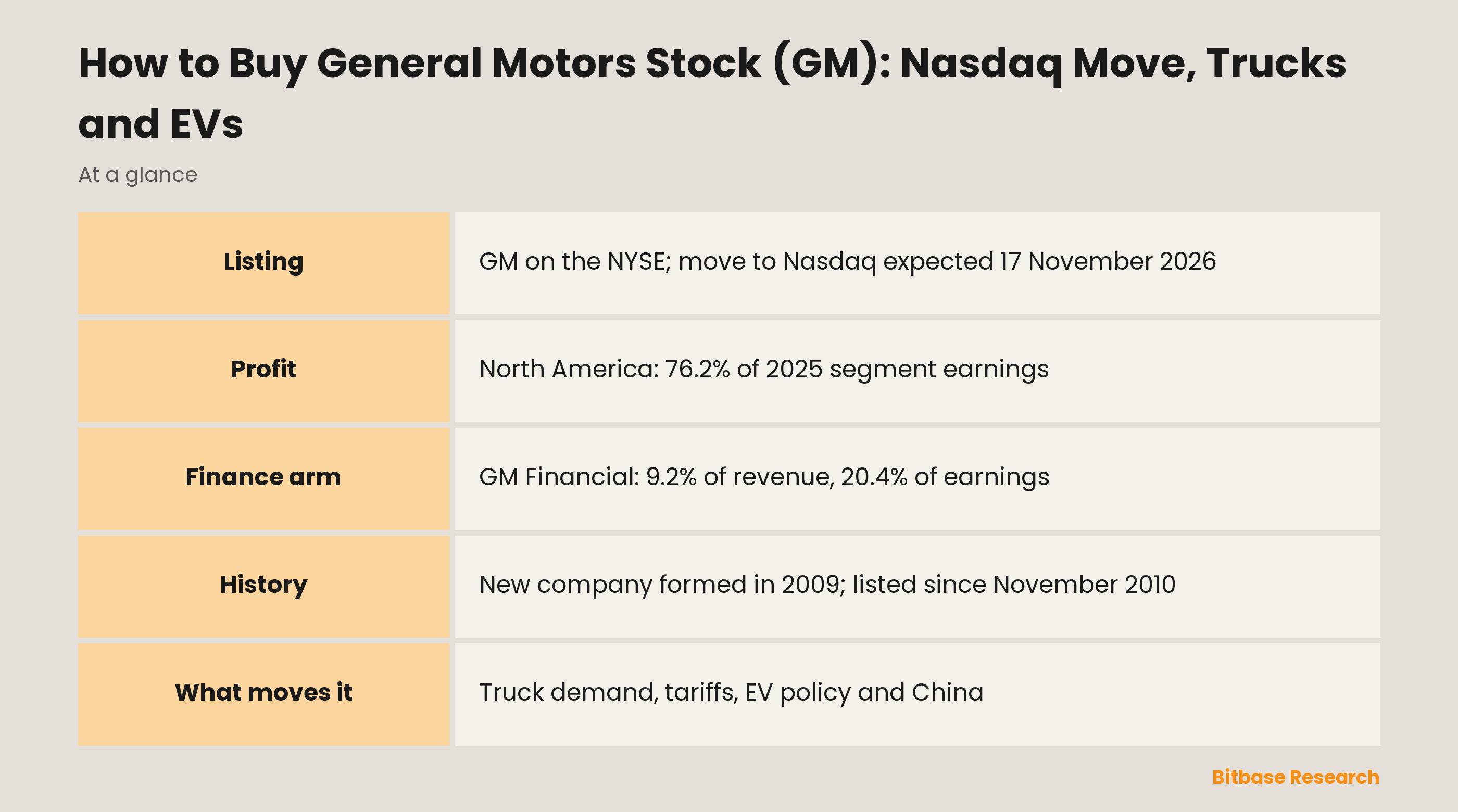
That GM symbol is all a broker needs: you buy General Motors common stock through any brokerage account with New York Stock Exchange access and, once the listing moves to Nasdaq as expected on 17 November 2026, through any broker that reaches Nasdaq. The company is not the one that went bankrupt in 2009; it was formed that year and has traded since November 2010. North America produced about three quarters of its 2025 segment earnings, with full-size combustion-engine pickups and SUVs carrying the highest margins.
What Does General Motors Do?
General Motors designs, builds and sells trucks, crossovers, cars and parts, and adds "software-enabled services and subscriptions" such as OnStar and the hands-free Super Cruise system. Its vehicles carry four brands, Buick, Cadillac, Chevrolet and GMC; in China its joint ventures also sell Baojun and Wuling models. Independent dealers do most of the selling, and battery cells come from Ultium Cells, a joint venture with LG Energy Solution.
The annual report has three reportable segments. GM North America serves North America and now also houses the autonomous-driving work. GM International "primarily meets the demands of customers outside North America"; in China the business runs primarily through joint ventures such as SAIC General Motors, whose results reach GM as equity income rather than revenue. GM Financial, "our global captive automotive finance company," lends to buyers, leases vehicles and finances dealer inventory.
Cruise, the robotaxi developer, was once a fourth line; GM stopped funding robotaxi work in December 2024.
The listed company dates from 2009. After the old General Motors Corporation filed for Chapter 11, a new company formed by the US Treasury took over substantially all of its assets that July, and its common stock began trading on 18 November 2010. A GM share today is a share in that Delaware corporation, headquartered in Detroit.
How General Motors Makes Money
Nearly everything starts with a vehicle sale: vehicles, parts and accessories made up 95.6% of 2025 automotive revenue. By segment:
| Segment | What it covers | Share of 2025 revenue | Change from 2024 | Share of 2025 segment earnings |
|---|---|---|---|---|
| GM North America | Vehicles and parts sold in North America | 83.4% | −2.0% | 76.2% |
| GM International | Vehicles sold elsewhere, plus China joint-venture income | 7.3% | −3.3% | 5.4% |
| GM Financial | Retail loans, leases and dealer financing | 9.2% | +7.5% | 20.4% |
| Cruise | Robotaxi wind-down | Negligible | — | −2.0% |
Revenue shares use consolidated net sales and revenue, which fell 1.3% in 2025; corporate items and eliminations make up the last 0.1%. Earnings shares are of the four lines' combined segment earnings: EBIT-adjusted for the automotive lines and EBT-adjusted for GM Financial, non-GAAP measures that leave out special charges.
North America is the profit engine. GMNA's EBIT-adjusted margin was 6.8% in 2025, down from 9.2%. Truck volume matters most: the 10-K says a truck carries roughly 160% of the GMNA portfolio's weighted-average variable profit, a crossover about 40% and a car about 60%. GM's US market share was 17.2% in 2025, but 33.0% in trucks, 13.7% in crossovers and 2.1% in cars.
The finance arm earns more than its revenue suggests. GM Financial brought in 9.2% of revenue but 20.4% of segment earnings. Lease income was 46% of its 2025 revenue, retail finance charges 41% and commercial lending 7%, and it financed 33% of GM's US retail sales, down from 39% in 2024.
Most revenue is American. US customers produced 82.5% of 2025 revenue, although 27.5% of wholesale vehicle volume was generated outside the country.
China counts differently. Joint-venture sales enter GM's vehicle sales and market share, not its revenue; GM's 7.1% share of the Chinese market in 2025 came from those ventures, which posted an equity loss that included restructuring charges at SAIC General Motors.
GM Stock at a Glance
| Item | Detail |
|---|---|
| Exchange | New York Stock Exchange; transfer to the Nasdaq Global Select Market expected on 17 November 2026 |
| Ticker | GM, unchanged after the transfer |
| Security | Common stock, the only class registered on the 10-K cover |
| Publicly traded since | 18 November 2010 |
| Sector | Motor vehicles (SEC industry code 3711) |
| Index membership | S&P 500 |
| Headquarters | Detroit, Michigan |
| Incorporated | Delaware, 2009 |
| Fiscal year | Calendar year |
| Dividend policy | Quarterly cash dividend, raised in 2025 and again in January 2026 |
| Share buybacks | Ongoing; more authorised in October 2026 with no expiration date |
| SEC identifier | CIK 1467858 |
These facts change slowly. Quotes, market value and yield move all day; for those, open the General Motors stock page on Bitbase.
How to Buy General Motors Stock
GM is a US company listed at home, so there is no depositary receipt to think about:
1. Choose a broker with US market access. Abroad, that can be a local firm offering US shares or an international broker; check which company keeps custody of your shares and under which regulator.
2. Get the account approved. Non-US individuals usually file IRS Form W-8BEN with the broker.
3. Add money. Funding in another currency adds a conversion rate, which can cost more than the commission.
4. Find the right line. Search for GM and confirm it reads General Motors Company common stock. The exchange move changes nothing for holders: "No action is required by existing stockholders."
5. Choose an order type. FINRA notes that a market order "provides the most certainty that your order will be executed," but "you might not get the price you saw or were originally quoted, especially in fast-moving markets." A limit order fixes your price, yet "there's a chance your order doesn't get executed at all."
6. Decide on the amount. Some brokers sell fractions of a share; ask how yours treats them for voting and transfers.
7. Keep the records. Confirmations fix your cost basis.
Investors outside the United States meet withholding tax on dividends. The IRS says "most types of U.S. source income received by a foreign person are subject to U.S. tax of 30%," and a tax treaty can reduce that. Brokers request W-8BEN whether or not you claim a reduced rate, and the country where you live may tax the dividend again.
Through a fund, you hold GM without picking it. State Street's SPY, which tracks the S&P 500, listed General Motors in its holdings file dated 29 October 2026, so any fund replicating that index owns it among about 500 companies.
What Moves GM Stock
Pickup and SUV demand, and fuel prices. The 10-K warns that a shift "toward smaller, more fuel-efficient vehicles," driven by oil prices or stricter rules, could weaken demand for its most profitable models, and in early 2026 GM added a risk factor on Middle East conflict, which it says has raised oil and gasoline prices. High fixed costs magnify the swings: "small changes in sales volume can have a disproportionately large effect on our profitability."
Tariffs. US import tariffs on vehicles and parts arrived in 2025, and in GM North America their cost equalled roughly three quarters of the year's 28.1% fall in EBIT-adjusted. On 20 February 2026 the US Supreme Court concluded that the International Emergency Economic Powers Act (IEEPA) did not authorise the imposition of tariffs, and GM booked a net benefit for IEEPA tariffs it had already charged that are refundable. Other tariffs remain in place; for how they hit a carmaker shipping into the US, see the Toyota stock guide.
The EV reset. GM built electric capacity for emissions rules that have since been eased; the One Big Beautiful Bill Act, signed on 4 July 2025, "accelerates the phase-out of clean vehicle and other clean energy credits." GM calls the EV slowdown that began in 2025 industry-wide, so it touches rivals such as Tesla too. It took large charges in late 2025, switched its Orion, Michigan plant from EVs to combustion-engine full-size SUVs and pickups, and sold its interest in the Ultium Cells plant in Lansing to LG Energy Solution. More net charges followed in 2026, though GM believes it has "substantially completed" recognising the material cash ones.
The North American margin. GM's stated top priority is a sustained GMNA EBIT-adjusted margin of 8% to 10%. In the first nine months of 2026 it was 9.1%, against 7.0% a year earlier, while US market share slipped by 0.7 percentage points to 16.4%.
China. Industry sales in China fell 18.2% in the first nine months of 2026, and GM's share eased to 6.7%. In the third quarter GM agreed to extend SAIC General Motors to 15 May 2047, subject to conditions.
Buybacks. GM repurchased 65 million shares in the first nine months of 2026, and shares outstanding fell from about 904 million on 15 January to about 844 million on 9 October. In October the board authorised further repurchases with no expiration date.
Used-car prices. GM Financial's lease residual values are "heavily dependent on used vehicle prices."
How a GM Share Could Disappoint
Item 1A of the 10-K is GM's own list of risks. Five bear most directly on a shareholder:
Dependence on big combustion-engine models. "Our near-term profitability is dependent upon the success of our current line of vehicles, particularly our full-size ICE SUVs and full-size ICE pickup trucks." Their cash also funds the EV, autonomy and software work.
The EV plan. Long-term strategy "is dependent on consumer adoption of EVs," which has been "slower than anticipated"; slow adoption could mean "additional portfolio actions," such as using less plant capacity.
Trade policy. Tariffs "continue to evolve," and their ultimate impact "could exceed our current estimates."
China and joint ventures. "Our business in China subjects us to unique operational, competitive, regulatory, and economic risks," and the joint ventures GM relies on, there and in battery cells, are ones "which we cannot operate solely for our benefit."
Recalls and legal matters. Recalls bring costs and reputational damage, and GM faces class actions and state lawsuits over data collected through its former OnStar Smart Driver product.
Owning the stock brings risks of its own: vehicle volume "can be volatile," one stock ties your result to one company, and each dividend is paid only when declared, in dollars.
Doing Your Own Homework on GM
GM's filings sit on EDGAR under CIK 1467858: the 10-K annually, 10-Qs quarterly and 8-Ks for events such as the 27 October 2026 Nasdaq announcement. In the 10-K, Item 1A holds the risks, the MD&A splits each segment's change in revenue and EBIT-adjusted into volume, mix, price and cost, and Item 5 compares the stock with the S&P 500 and the Dow Jones Automobile & Parts Titans 30 Index.
Two checks prevent misreadings. EBIT-adjusted excludes special items such as the EV charges, so read its reconciliation to net income before comparing years. And the 10-K and 10-Q covers filed so far name the NYSE; the move is set out in the October 2026 8-K. For other companies, browse Bitbase's US stock pages.
General Motors Stock FAQ
Does General Motors pay a dividend?
Yes, quarterly. The board raised it in February 2025 and again in January 2026, and GM anticipates continuing quarterly payments, though each declaration is up to the board "in its sole discretion." Per-share amounts are in each 10-Q.
Can I buy General Motors stock with crypto?
Not directly. A broker sells GM shares for US dollars, so crypto must first be sold and the cash sent to the brokerage account, and that sale may create a tax bill, depending on your country. What you then hold is a registered share with a vote and a claim on dividends, which is how a stock differs from a crypto asset.
Is GM stock moving from the NYSE to Nasdaq?
Yes. GM announced on 27 October 2026 that it expects NYSE trading to end at the close on 16 November and trading on the Nasdaq Global Select Market to begin on 17 November, under the same GM symbol. The release says the move brings "eligibility for potential inclusion in the Nasdaq-100 Index"; it does not say GM will be added.
Is today's GM the same company that went bankrupt in 2009?
Not legally. General Motors Corporation filed for Chapter 11 on 1 June 2009. On 10 July 2009 the new company acquired substantially all of its assets and took the General Motors name, while the old one became Motors Liquidation Company, existing "for the sole purpose of liquidating its remaining assets and liabilities." Today's GM shares are the new company's.
What happened to Cruise?
After ending robotaxi funding, GM acquired the Cruise stakes held by outside shareholders in February 2025, wound down the robotaxi operations and merged the engineering teams into GM North America. Their aim is driver assistance "on a path to fully autonomous personal vehicles," building on Super Cruise.
Is GM in the S&P 500?
Yes. SPY's holdings file listed General Motors on 29 October 2026. Its weight changes daily.
Conclusion
Buying GM takes a broker with US access, the correct listing and either a market or a limit order; the November 2026 move to Nasdaq changes the venue, not the security. What you own is a company whose earnings lean on North American pickups and SUVs, with GM Financial as a second source of profit. Tariffs, EV policy and the North American margin are the milestones; each 10-Q and 8-K shows which way they move before you decide how much of one carmaker belongs in a portfolio.
Related reading
Other Bitbase articles on this topic:
- How to Buy Airbnb Stock (ABNB): Class A Votes, Fees, City Rules
- How to Buy Booking Holdings Stock (BKNG): The 25-for-1 Split
- How to Buy Carvana Stock (CVNA): Class A Shares, Split and Perps
- How to Buy Starbucks Stock (SBUX): China JV, Licensing, Dividend
Disclaimer: This article is educational content from Bitbase Academy, provided for information only. It explains what a company or fund does and how the instruments referenced here differ from one another; it does not constitute investment, trading, tax, or financial advice, and it is neither a recommendation nor an endorsement of any security, token, or trading strategy. A tokenized stock is issued by a third party and is designed to give economic exposure to an underlying asset: it is not a share, it carries no shareholder rights, and it depends on the issuer's structure, eligibility rules, and redemption terms, which the issuer can change. Perpetual futures are leveraged derivatives that hold no underlying asset and can be liquidated, and trading hours, product availability, and eligibility differ by instrument and by jurisdiction and can change at any time. Written as of October 2026; verify everything yourself through company filings, the issuer's own documentation, and the product pages of the venue you trade on.
References
[1] General Motors Form 10-K for fiscal 2025 (SEC EDGAR) www.sec.gov
[2] General Motors Form 10-Q for the quarter ended 30 September 2026 (SEC EDGAR) www.sec.gov
[3] General Motors Form 10-Q for the quarter ended 31 March 2026 (SEC EDGAR) www.sec.gov
[4] General Motors Form 8-K, 27 October 2026: listing transfer to Nasdaq (SEC EDGAR) www.sec.gov
[5] General Motors release on Form 8-K, 27 October 2026: transfer of stock exchange listing to Nasdaq (SEC EDGAR) www.sec.gov
[6] General Motors Form 8-K, 8 January 2026: EV capacity charges (SEC EDGAR) www.sec.gov
[7] General Motors Form 10-K for 2010: formation of the company and 2010 listing (SEC EDGAR) www.sec.gov
[8] State Street: SPY daily holdings, 29 October 2026 www.ssga.com
[9] FINRA: Order Types www.finra.org
[10] IRS: NRA Withholding www.irs.gov
[11] IRS: About Form W-8 BEN www.irs.gov





