
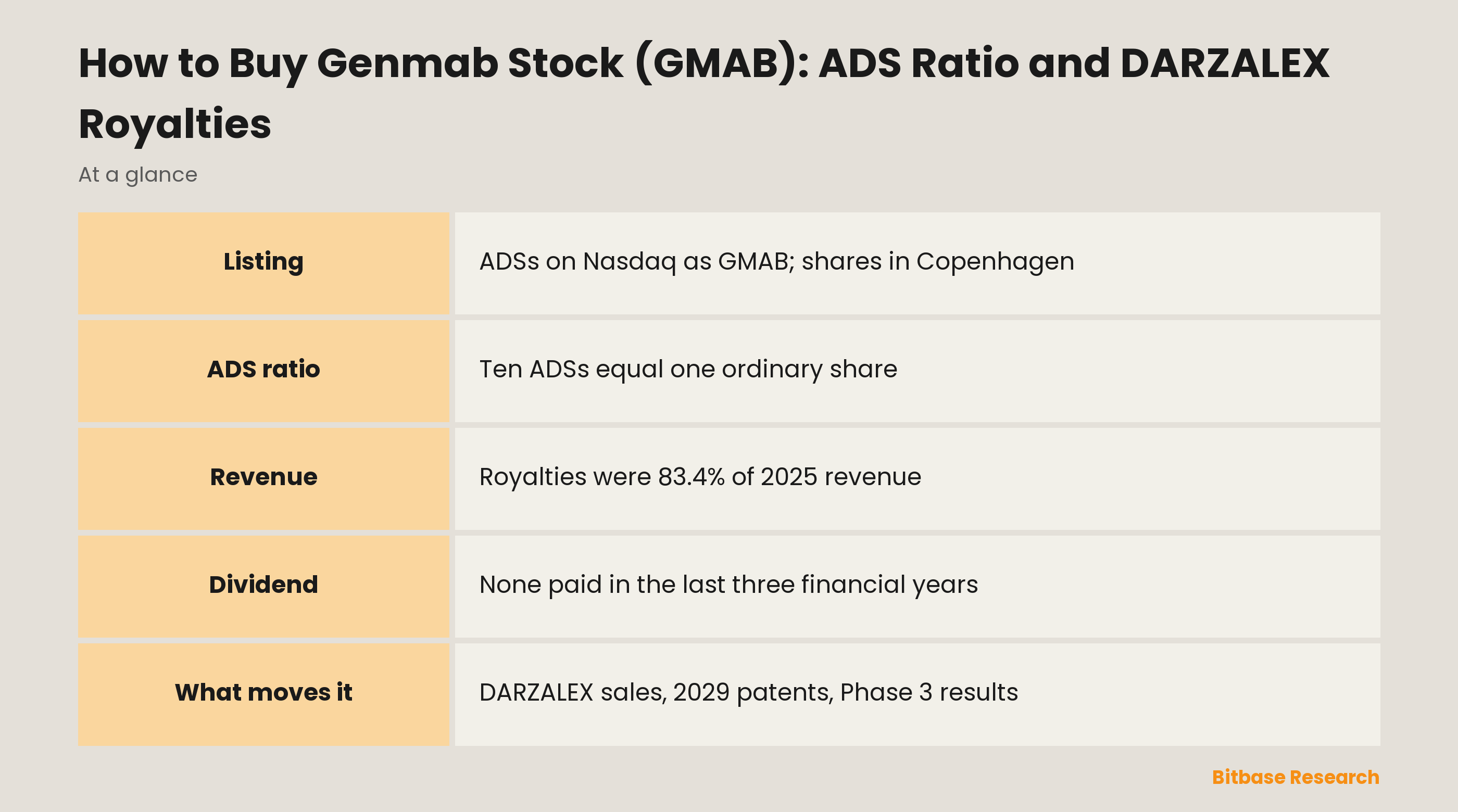
Ten Genmab ADSs add up to a single ordinary share of the Danish company, and those American depositary shares are what most investors outside Denmark buy: open a brokerage account with US market access, search for GMAB on Nasdaq and place the order in dollars. Genmab invents antibody medicines, yet in 2025 royalties paid by its partners made up 83.4% of revenue, and DARZALEX, a drug Johnson & Johnson sells, accounted for about two thirds, under US patents that expire in 2029, the year Genmab expects those royalties to start falling materially.
What Does Genmab Do?
Genmab A/S calls itself, in its Form 20-F, "an international biotechnology company with a pipeline of novel antibody-based products and product candidates" for "patients with cancer and other serious diseases." It was set up in June 1998, began operating in February 1999 and is based in Valby, a district of Copenhagen. Its staff numbered 3,029 at the close of 2025, including 1,158 people in the United States.
The business has two halves that are easy to confuse. The first is medicines that Genmab created, or that use its technology, but that other companies develop and sell. The 20-F counts six: daratumumab, sold by J&J as DARZALEX and, under the skin, as DARZALEX FASPRO or DARZALEX SC, for multiple myeloma and AL amyloidosis; three more J&J products, RYBREVANT for a form of lung cancer and TECVAYLI and TALVEY for multiple myeloma; Kesimpta, which Novartis sells for relapsing multiple sclerosis; and TEPEZZA, which Amgen sells for thyroid eye disease. On each, Genmab collects royalties; a seventh royalty, on BIZENGRI, came with an acquisition in 2025.
The second half is medicines Genmab sells itself. Epcoritamab, a bispecific antibody that binds two targets at once, is marketed as EPKINLY in the US and Japan and as TEPKINLY in the EU, in partnership with AbbVie; the 20-F calls it "the first and only bispecific antibody approved for the treatment of multiple B-cell malignancies." Tivdak, developed with Pfizer, treats recurrent or metastatic cervical cancer and was the company's first approved product of its own.
Underneath sit antibody platforms: DuoBody for bispecifics, HexaBody for potency, and antibody-drug conjugate (ADC) technology bought with ProfoundBio in May 2024. Genmab runs no factories for these products; partners and contract manufacturers make them.
The latest step was the largest. On December 12, 2025, Genmab completed its acquisition of the Dutch company Merus N.V. Merus brought petosemtamab, an antibody aimed at the EGFR and LGR5 proteins, and its Biclonics platform. Genmab now names three priorities: epcoritamab, Rina-S (rinatabart sesutecan, an ADC for ovarian and endometrial cancer) and petosemtamab, the last two wholly owned.
How Genmab Makes Money
Royalties dominate. The revenue note in the 2025 annual report splits income by type:
| Revenue type | Share of 2025 revenue | Where it comes from |
|---|---|---|
| Royalties | 83.4% | A slice of partners' sales of DARZALEX, Kesimpta, TEPEZZA and others |
| Net product sales | 10.7% | EPKINLY in the US and Japan, the only source of this line |
| Milestones | 2.6% | Payments when a partnered drug passes set development, approval or sales points |
| Collaboration revenue | 1.9% | Genmab's half of the profit on Tivdak sales in the US |
| Reimbursement | 1.4% | Partners repaying research costs under collaboration deals |
By product, DARZALEX royalties alone came to 65.7% of total revenue, which the 20-F rounds to 66%. Kesimpta added 11.9%, TEPEZZA 2.8% and all other royalties 3.0%. J&J's entity Janssen was the source of 69.0% of revenue once its other products are counted.
The terms behind those numbers differ by drug. For DARZALEX, J&J has held an exclusive worldwide license since 2012 and pays tiered royalties of 12% to 20%, the rate rising as yearly sales cross set thresholds, minus a share of what J&J pays Halozyme for the under-the-skin formulation. An arbitration found Genmab is not owed royalties on J&J's own patents for that version. Novartis pays 10% on Kesimpta sales outside cancer, and that obligation ends only if Novartis stops selling the drug in a country. The other products pay lower rates.
Genmab's own products are booked in different ways. In the US and Japan, Genmab records EPKINLY sales and shares 50% of the result with AbbVie, whose half is counted in the cost of product sales; outside those two countries AbbVie sells it and pays Genmab royalties of 22% to 26%. For Tivdak, Pfizer records US sales and passes Genmab half of the profit, while Genmab records sales in Europe, Japan and other markets outside the US and China.
The 2025 figures show the mix shifting slowly. Revenue rose 19%, royalties 23% and the DARZALEX royalty 21%; Kesimpta royalties grew 37% and net product sales 57%. Research and development equalled 43% of revenue, and the operating margin slipped to 28.6% from 31.1% in 2024. Net profit fell 15%, largely because financial income was lower. From 2025 Genmab reports in US dollars instead of Danish kroner.
GMAB Stock at a Glance
| Feature | GMAB |
|---|---|
| Legal name | Genmab A/S, a Danish public limited company |
| US line | ADSs on the Nasdaq Global Select Market as GMAB, since July 2019 |
| ADS ratio | One ADS represents one-tenth of one ordinary share; ten ADSs equal one share |
| Home line | Ordinary shares on Nasdaq Copenhagen as GMAB, publicly traded since October 2000 |
| Depositary bank | JPMorgan Chase Bank, N.A. |
| Headquarters | Valby, Copenhagen, Denmark |
| Industry | Biotechnology: antibody medicines for cancer and other serious diseases |
| Fiscal year | Calendar year, ending December 31 |
| Accounting | IFRS, presented in US dollars from 2025 |
| Dividends | None paid in the last three financial years |
| Largest holders | BlackRock and Orbis at 5.80% each (February 2026); Darwin reported 5.11% of voting rights in September 2026 |
| SEC reports | Form 20-F yearly, Form 6-K in between; CIK 1434265 |
The ordinary shares are registered in the US only so the ADSs can be listed, "Not for trading" there. At the end of 2025 there were 64,238,408 ordinary shares outstanding and 64,377,450 ADSs, so the New York line covered about 10% of the share capital. Genmab estimates that roughly 36% of its shares were held by US residents. For the current ADS price and chart, open the Genmab stock page on Bitbase.
How to Buy Genmab Stock
A non-Danish investor has two routes: the ADS in New York or the ordinary share in Copenhagen, which is quoted in Danish kroner and needs a broker with access to Nasdaq Copenhagen. For most readers the ADS is simpler:
1. Pick a broker that reaches Nasdaq in the US. Find out which company holds your assets and which regulator oversees it.
2. Fund the account in dollars. Converting from euros, kroner or any other currency costs a spread, so weigh it next to the commission.
3. Search for GMAB. Confirm the line reads Genmab A/S American depositary shares, since Copenhagen uses the same ticker.
4. Decide how to price the order. A market order buys at whatever ask is on offer; a limit order names your ceiling and can sit unfilled.
5. Count in ADSs, think in shares. Because ten ADSs make one share, a single ADS is a small slice. To compare with Copenhagen, multiply the ADS price by ten and convert. Some brokers also sell fractions of an ADS.
Rights that stay with the depositary. The 20-F is plain: "Holders of our ADSs are not treated as our shareholders and do not have shareholder rights." JPMorgan, as depositary, holds the shares. To vote you either withdraw the shares or instruct the depositary, and instructions count only for a number of ADSs that adds up to whole shares, so it takes ten ADSs to steer one vote. If instructions arrive late, the depositary may give a proxy to a person Genmab designates. Disputes under the deposit agreement go to federal court in Manhattan, and holders waive a jury trial.
Taxes. Non-Danish individuals and companies are generally not taxed in Denmark on gains from selling shares. Should Genmab ever pay a dividend, Denmark generally withholds 27%, and the 20-F calls it "highly uncertain" whether an ADS holder counts as the owner of the underlying share for Danish tax relief. For US holders, the company does not expect to be a passive foreign investment company for 2026. The depositary also charges an annual servicing fee per ADS.
Through funds. Danish, European or biotechnology funds may hold Genmab; check each fund's holdings list.
What Moves GMAB Stock
DARZALEX sales at J&J. Genmab publishes J&J's worldwide DARZALEX figures each quarter on Form 6-K, because they decide most of its income. In the first nine months of 2026, J&J's DARZALEX net sales rose 19%, and Genmab's royalty revenue 22%. Because the rate is tiered, sales above the highest threshold earn the top rate of 20%.
The 2029 patent date. J&J pays royalties country by country until 13 years after the first sale there or until the last relevant Genmab patent lapses, whichever comes later. First sales came in the US in 2015, Europe in 2016 and Japan in 2017, and the patents, with extensions, expire in the US in 2029, in Europe in 2031 and begin to expire in Japan in 2030. "We expect that our royalties from sales of DARZALEX will begin to decline materially in 2029," the 20-F says, even if sales hold steady. A biosimilar launch in any country would cut the royalty there too.
Three trial readouts in one month. In October 2026 all three priority programs reported positive Phase 3 results. On October 5, epcoritamab added to R-CHOP chemotherapy cut the risk of disease progression or death by 51% in newly diagnosed diffuse large B-cell lymphoma. On October 23, Rina-S met its primary endpoint of progression-free survival and its key secondary endpoint of overall survival in platinum-resistant ovarian cancer, with a 71% lower risk of progression or death in the full trial population. On October 28, petosemtamab with pembrolizumab cut the risk of death by 50% in first-line PD-L1 positive head and neck cancer at the first interim analysis. The company says the data support "multiple regulatory submissions and potential launches in 2027"; approval decisions are still ahead.
EPKINLY's growth. Global EPKINLY and TEPKINLY net sales rose 47% in the first nine months of 2026. In the third quarter, the drug won approval in the EU and Japan in combination with rituximab and lenalidomide for relapsed or refractory follicular lymphoma, which Genmab calls the first bispecific-based therapy approved in Europe for second-line follicular lymphoma.
Kesimpta. The 10% royalty from Novartis helped drive 2026 royalty growth, and its term is tied to Novartis selling the drug, not to the DARZALEX patent dates.
The cost of Merus. Operating expenses climbed 35% in the first nine months of 2026, on Rina-S and petosemtamab trials, launch preparations and Merus integration, and operating profit came in slightly below a year earlier. Genmab borrowed through term loans and secured and unsecured notes in December 2025 to help fund the deal, and the 20-F notes that servicing that debt takes a portion of its cash flow.
The DARZALEX Cliff, Partners and Debt in Genmab's Filing
The 20-F opens its risk factors with this sentence: "The substantial majority of our revenue comes from royalties on sales of DARZALEX, and our patents underlying these royalties will start to expire in the late 2020s." It adds that there is no assurance lost royalties can be replaced "in a timely manner or at all."
Competition for DARZALEX. The drug "is subject to intense competition in the MM therapy market," from approved and investigational treatments.
Reliance on J&J and other partners. J&J alone develops and sells daratumumab, so Genmab's near-term prospects are "substantially dependent on J&J's efforts."
Trials and manufacturing. Clinical trials carry "a high risk of failure," and Genmab relies "on a limited number of third-party manufacturers for our product supply."
Merus. The company warns it "may not realize the anticipated benefits from the acquisition of Merus," which hinge on petosemtamab. Integration charges continue in 2026 and "may be significant."
Debt. "Our substantial indebtedness could adversely affect our financial condition," the 20-F states, and the loan and note covenants restrict, among other things, the payment of dividends.
Then there is the shareholder layer. ADS holders vote only through the depositary and may be left out of rights offerings, since subscription rights can go to the depositary instead. With no dividend in the last three financial years, any return depends on the ADS price, and in a single biotech that price rests on one company's trials and patent dates.
How to Research GMAB Yourself
Genmab's SEC filings are listed on EDGAR under CIK 1434265. The 20-F for 2025 was filed on February 17, 2026, and it incorporates parts of the statutory Annual Report 2025, filed with it, where the revenue note breaks income down by type, partner and product. In between, Form 6-K carries quarterly DARZALEX sales, interim reports such as the one for the first nine months of 2026 on November 5, trial results and notices from major shareholders.
Three checks pay off. Read the royalty sections of the 20-F for each partner's rate and term, which differ by drug and country. Remember that figures before 2025 were translated from Danish kroner. And per-share figures refer to ordinary shares, each worth ten ADSs.
J&J's side of the DARZALEX arrangement appears in our Johnson and Johnson stock guide. For a royalty model built on buying rights rather than inventing drugs, see the Royalty Pharma stock guide; for another Danish drugmaker held in New York through depositary receipts, the Novo Nordisk stock guide. Live GMAB quotes are on the Bitbase stock page linked above, while the Bitbase US stock directory covers other listed companies.
Genmab Stock FAQ
Can I buy Genmab stock with crypto?
Not directly. The GMAB ADS is priced and settled in US dollars, so any crypto must be converted into cash and moved to a broker first; in many countries that conversion is itself a taxable event.
How many Genmab shares does one ADS represent?
One-tenth of a share. Ten ADSs equal one ordinary share listed on Nasdaq Copenhagen. One ADS therefore corresponds to a tenth of the Copenhagen share price once kroner are converted into dollars, and voting instructions count only in blocks of ten ADSs.
Does Genmab pay a dividend?
No. The 20-F says Genmab does not currently pay cash dividends and has paid none in the last three financial years, and its loan agreements restrict payouts.
Does Genmab make DARZALEX?
No. Genmab created daratumumab and licensed it to J&J in 2012; J&J develops, manufactures and sells DARZALEX and pays Genmab tiered royalties of 12% to 20% on its worldwide net sales.
When do Genmab's DARZALEX royalties end?
Country by country. In the US, Genmab expects the royalties to begin falling materially in 2029, when its patents expire; European patents run to 2031 and Japanese ones begin to expire in 2030.
Conclusion
Genmab today is two companies in one listing: a royalty collector whose largest payment comes from J&J and, by its own forecast, starts shrinking in 2029, and a drug developer that must turn three positive Phase 3 programs into approved, profitable medicines before then. Holding it through the ADS means ten units to a share, votes routed through JPMorgan and no dividend. Before deciding, read the DARZALEX patent dates and royalty tiers in the 20-F, follow the quarterly 6-K sales reports and trial filings, and judge how much weight one antibody company in that transition deserves in your portfolio.
Related reading
Other Bitbase articles on this topic:
- How to Buy BeOne Medicines Stock (ONC): The Former BeiGene
- How to Buy IDEXX Stock (IDXX): Vet Diagnostics, No Dividend
- How to Buy Roivant Stock (ROIV): The Vants Behind LISRAYA
- How to Buy Teva Stock (TEVA): Generics, AUSTEDO and NYSE Shares
Disclaimer: This article is educational content from Bitbase Academy, provided for information only. It explains what a company or fund does and how the instruments referenced here differ from one another; it does not constitute investment, trading, tax, or financial advice, and it is neither a recommendation nor an endorsement of any security, token, or trading strategy. A tokenized stock is issued by a third party and is designed to give economic exposure to an underlying asset: it is not a share, it carries no shareholder rights, and it depends on the issuer's structure, eligibility rules, and redemption terms, which the issuer can change. Perpetual futures are leveraged derivatives that hold no underlying asset and can be liquidated, and trading hours, product availability, and eligibility differ by instrument and by jurisdiction and can change at any time. Written as of November 2026; verify everything yourself through company filings, the issuer's own documentation, and the product pages of the venue you trade on.
References
[1] Genmab Form 20-F for 2025 (SEC EDGAR) www.sec.gov
[2] Genmab Annual Report 2025, filed with the 20-F www.sec.gov
[3] Genmab Form 6-K: results for the first nine months of 2026 (November 5, 2026) www.sec.gov
[4] Genmab Form 6-K: DARZALEX net sales, third quarter of 2026 (October 13, 2026) www.sec.gov
[5] Genmab Form 6-K: EPCORE DLBCL-2 topline results (October 5, 2026) www.sec.gov
[6] Genmab Form 6-K: RAINFOL-02 topline results for Rina-S (October 23, 2026) www.sec.gov
[7] Genmab Form 6-K: LiGeR-HN1 topline results for petosemtamab (October 28, 2026) www.sec.gov
[8] Genmab Form 6-K: major shareholder announcement (October 2, 2026) www.sec.gov





