
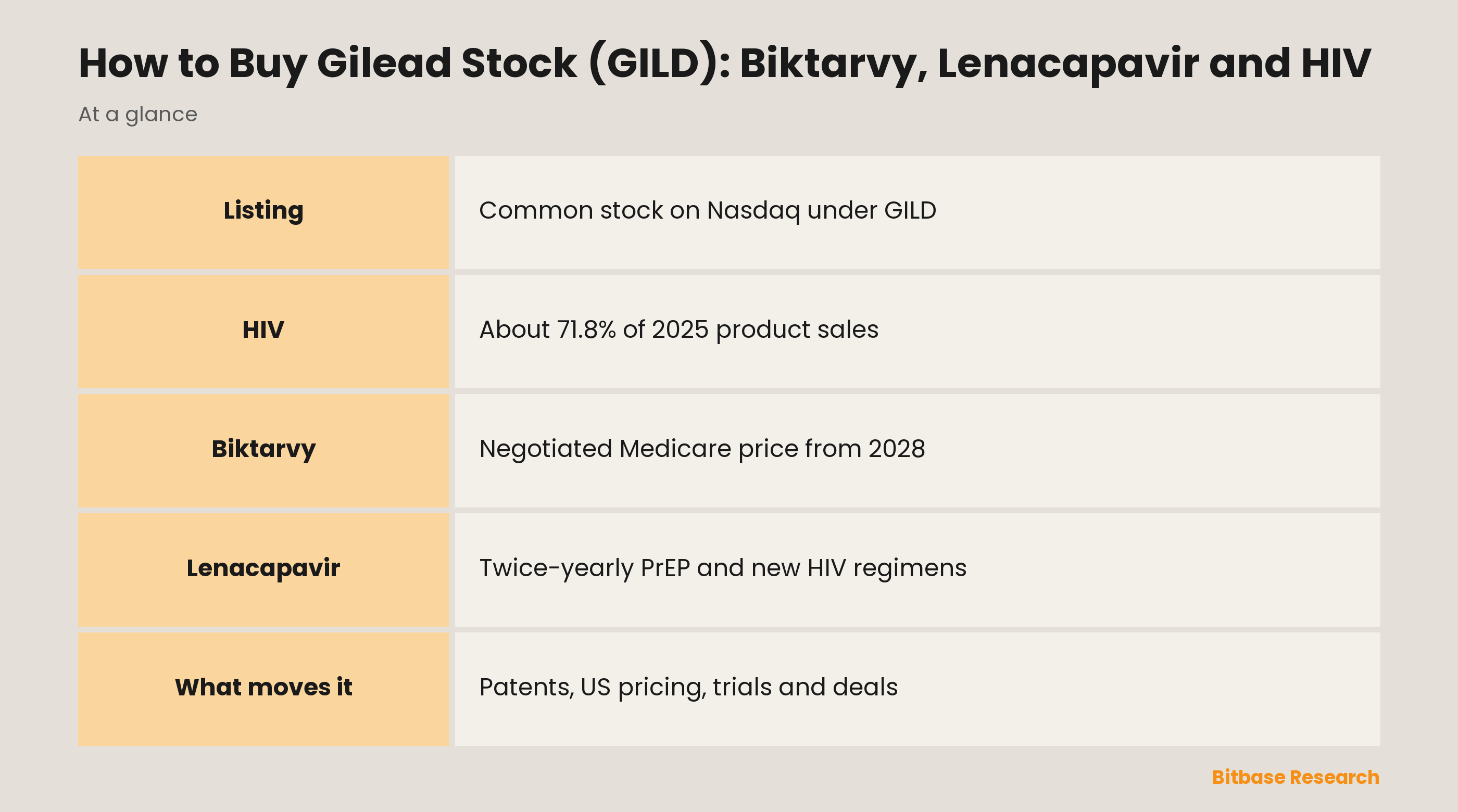
Two things are enough to buy Gilead Sciences stock: a brokerage account that reaches the Nasdaq Global Select Market, and an order for the ticker GILD. The company behind the symbol leans on one disease area, with HIV medicines bringing in about 71.8% of its 2025 product sales and a single tablet, Biktarvy, about 49.6%. This guide covers what Gilead sells, how to place the order and the dates its filings attach to that franchise, from a negotiated Medicare price for Biktarvy in 2028 to the long-acting HIV drug lenacapavir.
What Does Gilead Do?
Gilead Sciences develops and sells prescription medicines; its annual report describes "a biopharmaceutical company that has pursued and achieved breakthroughs in medicine for more than three decades," working on medicines "to prevent and treat life-threatening diseases, including HIV, viral hepatitis, COVID-19 and cancer." Incorporated in Delaware and headquartered in Foster City, California, it reports a single operating segment and concentrates its research on virology, oncology and inflammation.
HIV is the centre of the business. Biktarvy is a once-daily tablet that combines three Gilead antiretrovirals, bictegravir, emtricitabine and tenofovir alafenamide (TAF), to treat HIV-1. Descovy pairs emtricitabine with TAF; it is used as part of treatment regimens and is also approved for pre-exposure prophylaxis (PrEP), which reduces the risk of sexually acquired HIV in certain people at risk of infection. Genvoya and Odefsey are older single-tablet regimens; Symtuza is sold by Johnson & Johnson's Janssen, and Gilead receives a share of revenue for the components it supplies.
The newest part of the HIV line is built on lenacapavir, a capsid inhibitor that can be given twice a year. Sunlenca uses it to treat heavily treatment-experienced adults with multidrug-resistant HIV whose current regimen is failing. Yeztugo, approved by the FDA in 2025, uses it for PrEP, and the 10-K calls it "the first and only twice-yearly option available in the United States for people who need or want PrEP." On 27 August 2026 the FDA also approved Bixlenvo, a once-daily tablet that pairs bictegravir with lenacapavir for adults whose virus is already suppressed.
Liver disease covers four conditions. Epclusa treats hepatitis C, with an authorized generic sold through the subsidiary Asegua Therapeutics. Vemlidy treats hepatitis B. Hepcludex received accelerated FDA approval in 2026 for hepatitis delta and is, in the company's words, "now the first and only FDA-approved treatment for HDV in the U.S." Livdelzi (seladelpar), for the rare liver disease primary biliary cholangitis, came with the acquisition of CymaBay Therapeutics in March 2024.
Oncology has two halves. Yescarta and Tecartus are CAR T-cell therapies, made by engineering each patient's own T cells in Gilead's facilities and infusing them back; this cell therapy work sits in Kite, a Gilead company. Trodelvy, an antibody-drug conjugate used in breast cancer, joined the portfolio with the 2020 acquisition of Immunomedics. The remaining products include the COVID-19 antiviral Veklury (remdesivir) and AmBisome, an antifungal.
Acquisitions have shaped the business before. The hepatitis C franchise traces back to January 2012, when Gilead bought Pharmasset and, with it, sofosbuvir, which is also one of the two active ingredients in Epclusa.
How Gilead Makes Money
Product sales do nearly all the work: they were about 98% of total revenues in 2025, the rest being royalties, contract payments and other income. Under the headings of Gilead's own sales table, 2025 product sales split like this:
| Area | Share of 2025 product sales | Products in the sales table and its notes |
|---|---|---|
| HIV | 71.8% | Biktarvy, Descovy, Genvoya, Odefsey, Symtuza revenue share, Yeztugo |
| Liver disease | 11.1% | Epclusa and its authorized generic, Vemlidy, Livdelzi, Hepcludex |
| Oncology | 11.2% | Yescarta and Tecartus (cell therapy), Trodelvy |
| Veklury | 3.2% | Remdesivir for COVID-19 |
| Other | 2.8% | AmBisome, Cayston, Letairis and smaller brands |
Shares are calculated from the 10-K sales table and rounded to one decimal, so they do not sum to exactly 100.
Biktarvy alone produced about 49.6% of product sales. Growth in 2025 was modest overall and uneven underneath: total revenues rose 2% and HIV sales 6%, with Biktarvy up 7% and Descovy up 31%, while Genvoya fell 15%. Liver disease also grew 6%, helped by Livdelzi. Veklury dropped 49% as COVID-19 hospitalizations declined, and oncology slipped 2%: cell therapy sales fell 7% on what the company calls "ongoing competitive headwinds," while Trodelvy grew 6%.
About 72% of 2025 product sales were made in the United States, where Gilead sells most products "exclusively through the wholesale channel"; historically about 90% of its US gross product sales have gone to three wholesalers, Cardinal Health, Cencora and McKesson. Gross-to-net deductions, which include rebates, chargebacks and co-pay assistance, took about 41% of gross product sales in 2025, up from 38% a year earlier, mainly because of the redesign of Medicare Part D.
The first half of 2026 tilted further towards HIV and new launches. Total revenues rose 7% from the same period of 2025. HIV sales grew 11% and Descovy 43%, Livdelzi sales more than doubled and Trodelvy rose 31%. Veklury fell 60% and cell therapy 13%. In both periods about 26% of product sales were in foreign currencies, mainly the euro.
GILD Stock at a Glance
| Item | Detail |
|---|---|
| Exchange | Nasdaq Global Select Market |
| Ticker | GILD |
| Security | Common stock, the only security registered on the 10-K cover |
| Business | Biopharmaceuticals, reported as one operating segment |
| Main therapy areas | HIV, liver disease, oncology |
| Index membership | S&P 500 and Nasdaq-100; not in the Dow Jones Industrial Average |
| Headquarters | Foster City, California |
| Incorporated | Delaware |
| Fiscal year | Calendar year, ending 31 December |
| Dividend policy | Quarterly cash dividend since the second quarter of 2015; each payment declared by the board |
| SEC identifier | CIK 882095 |
Anything that changes by the minute, such as the share price, market value or dividend yield, is left out of this table; the Gilead stock page on Bitbase carries the live quote.
How to Buy Gilead Stock
GILD is the common stock of a US company listed in the US, so there is no depositary receipt to consider. Everything runs through a broker:
1. Choose a broker with Nasdaq access. Outside the United States, check which legal entity holds your account and which regulator supervises it.
2. Open and verify the account. Non-US individuals usually certify their status on IRS Form W-8BEN, which the broker needs before it can apply a treaty rate to US dividends.
3. Fund it. If your savings are in another currency, the conversion carries its own cost, so compare the exchange rate as well as the commission.
4. Search GILD and check the name. The result should read Gilead Sciences, Inc. common stock on Nasdaq. Symbols one letter away belong to other companies: SEC records list GIL for Gildan Activewear and GILT for Gilat Satellite Networks.
5. Pick an order type. A market order "guarantees that the order will be executed, but does not guarantee the execution price," while a limit order fills only "at a specific price or better." It is worth knowing how a market order fills before using one.
6. Decide how much. Fractional shares let you invest a set cash amount, but "not every brokerage firm offers fractional share investing," some firms allow only market orders for fractions, and you "may not have voting rights" on a fractional share.
If you are not a US resident, tax comes off the dividend before it reaches you. The IRS sets the default plainly: "most types of U.S. source income received by a foreign person are subject to U.S. tax of 30%," and a lower rate can apply where your country has a tax treaty with the United States. Form W-8BEN is how an individual claims that rate, and your home country may tax the dividend again.
Through index funds, you can hold Gilead without picking it. As a constituent of both the S&P 500 and the Nasdaq-100, it is held by funds that replicate either index; State Street's SPY, for instance, listed it among its S&P 500 holdings on 16 October 2026. Dow trackers do not, since Gilead is not in that 30-stock average.
What Moves GILD Stock
The HIV franchise, line by line. With HIV at about 71.8% of product sales, shifts within it show up in the total. Growth has come from demand and from patients moving within Gilead's own portfolio, which lifts Biktarvy while Genvoya and Odefsey shrink. Prevention is a second source: Descovy is used for PrEP, and Yeztugo, injected twice a year, now reports its own sales.
Patent dates and generic challengers. The 10-K patent table puts the US compound patents for Descovy and Vemlidy at 2031, Epclusa at 2033, Biktarvy at 2036 and lenacapavir at 2037. Under agreements reached in October 2025 with three generic manufacturers, no US generic of full-dose Biktarvy is expected before 1 April 2036, subject to standard acceleration provisions, which is more than two years later than Gilead's earlier projection of December 2033. Challenges continue: in January 2026 Cipla filed an application referencing Descovy that contests two of its listed patents, and Gilead sued the following month. In Europe the dates arrive sooner, with the Descovy compound patent listed as expiring in 2027.
US pricing policy. The redesign of Medicare Part D raised manufacturers' discount obligations from 2025 and was the main reason gross-to-net deductions climbed to about 41% of gross sales. Under the Inflation Reduction Act, the government selected Biktarvy in January 2026 for a negotiated Medicare price effective from 2028, which Gilead anticipates "will be substantially lower than the price we currently charge in Medicare." In December 2025 Gilead also reached an agreement with the administration that pauses Section 232 tariffs on the company for three years, applies most-favored-nation prices in Medicaid for selected products and sets a new direct-to-patient price for Epclusa.
Lenacapavir's next steps. Gilead's priorities, refreshed in late 2025, open with "maximize impact of long-acting HIV therapies." Beyond Yeztugo and Bixlenvo, a once-weekly oral form of Yeztugo for PrEP is under FDA review, a once-yearly lenacapavir injection for PrEP is in Phase 3, and Gilead and Merck reported positive Phase 3 results in 2026 for a once-weekly oral combination of islatravir and lenacapavir for treatment. None of these is approved yet, so each decision and readout is its own event.
Oncology results and acquisitions. Trodelvy won FDA approval in 2026 as a first-line treatment for metastatic triple-negative breast cancer, but the ASCENT-07 study in another breast cancer setting missed its primary endpoint, and the EVOKE-03 lung cancer study with Merck was discontinued, while cell therapy sales keep falling. Gilead has responded partly with deals, completing the acquisitions of Arcellx in April 2026, Tubulis in May and Ouro Medicines in June, and the research charges recorded for those deals, together with an impairment on assets from Immunomedics and higher operating expenses, produced a net loss for the second quarter of 2026. Arcellx gave Gilead full control of anito-cel, a CAR T-cell therapy for multiple myeloma whose application is under FDA review.
Veklury and wholesaler buying. Veklury sales follow COVID-19 hospitalizations; they fell 49% in 2025 and 60% in the first half of 2026. For other products, the 10-K describes "strong wholesaler and sub-wholesaler purchases of our products in the second half of the year," followed by inventory draw-down in the next first quarter, so judge a first quarter against a year earlier rather than against the fourth quarter.
The Risks Behind a GILD Share
Item 1A of the 10-K runs long; these five points bear most directly on the shares:
Dependence on HIV. "We receive a substantial portion of our revenue from sales of our products for the treatment and prevention of HIV infection." The filing adds that sales could weaken through "market share gains by competitive products, including generics."
Pricing and rebates. "Our existing products are subject to pricing and reimbursement pressures from government agencies and other third parties, including required discounts and rebates." The Medicare negotiation for Biktarvy is the concrete case.
Trial outcomes. "We face risks in our clinical trials, including the potential for unfavorable results, delays in anticipated timelines and disruption." ASCENT-07 and the halted EVOKE-03 study show what that heading means in practice.
Litigation. Gilead warns of "potentially significant liability and increased expenses from litigation and government investigations." Product liability suits claim that Viread, Truvada, Atripla, Complera and Stribild caused kidney, bone or tooth injuries; in August 2026 the California Supreme Court ruled in Gilead's favour in the state cases, while a federal bellwether trial is set for March 2027. An appeal of a 2023 jury verdict in Gilead's favour in an HIV antitrust case is pending, and a Texas case over its patient support programs is set for trial in December 2026.
Cell therapy manufacturing. Yescarta and Tecartus are produced patient by patient in Gilead's own sites in California, Maryland and the Netherlands, and the 10-K warns that "any delays or quality issues with our manufacturing operations could adversely affect our business."
Two risks sit above the company itself. One stock concentrates your outcome in a single set of patents, prices and trials. And each dividend needs a board declaration, while for holders outside the dollar zone exchange rates move both the share and the payout.
How to Research GILD Yourself
Gilead files with the SEC under CIK 882095: a 10-K each year, a 10-Q each quarter and 8-Ks for events in between, including every quarterly earnings release.
In the 10-K, Item 1 lists the products, the late-stage pipeline and two patent tables, one for principal products and one for key candidates, with footnotes on generic settlements. Item 1A sets out the risks, the MD&A gives sales by product and region with the reasons each line moved, and the contingencies note covers the lawsuits above. The performance graph compares Gilead's shareholder return with the S&P 500 and the Nasdaq Biotechnology Index.
The sales table needs care in two places. Its lines change: Yeztugo sat inside "Other HIV" in the 2025 annual report but has its own line in 2026 filings, as does Livdelzi, so read the footnotes before comparing years. And each product's explanation separates demand from average realized price, which the gross-to-net table then puts in context. Quotes for other companies are on the US stock listings on Bitbase.
Gilead Stock FAQ
Does Gilead pay a dividend?
Yes, every quarter. Gilead began paying a quarterly dividend on its common stock in the second quarter of 2015, and its 2025 annual report says it expects "to continue to pay quarterly dividends, although the amount and timing of any future dividends are subject to declaration by our Board of Directors." Each quarterly earnings release states the latest amount and dates.
Can I buy Gilead stock with crypto?
Not directly. A broker buys GILD in US dollars, so any crypto would first have to be sold and the cash moved into the brokerage account, and depending on where you live that sale may itself be taxable. The two assets also give you different things: a share is a registered stake in the company that carries dividend and voting rights, which is how a share differs from a token in practice.
Is GILD in the S&P 500 and the Nasdaq-100?
Yes, in both. State Street's holdings file for its S&P 500 trust (SPY) listed Gilead on 16 October 2026, and Nasdaq's own Nasdaq-100 constituent list included it on 19 October 2026. It is not in the Dow: State Street's holdings file of the same date for its Dow Jones Industrial Average trust (DIA) named 30 stocks, none of them GILD. The exchange that lists GILD and the index that includes it both carry the Nasdaq name, a distinction set out in our guide to the Nasdaq exchange and the Nasdaq-100 index.
What is lenacapavir?
Gilead's HIV-1 capsid inhibitor and the base of its long-acting line. It is sold as Sunlenca for treatment-experienced adults with multidrug-resistant HIV and as Yeztugo for PrEP, both given twice a year, and it is one of the two drugs in Bixlenvo, approved in August 2026. Once-weekly oral and once-yearly injectable versions are still investigational.
Has Gilead stock ever split?
Yes. Gilead's filings record two-for-one splits, each carried out as a stock dividend, on 3 September 2004, 22 June 2007 and 25 January 2013. Per-share figures from before a split need adjusting before you compare them with later ones.
Conclusion
The mechanics of buying GILD are simple: an account that reaches Nasdaq, the correct listing on the order ticket and a market or limit order. The harder question is how much of it to own, because a GILD share is largely a claim on an HIV franchise whose biggest product faces a negotiated Medicare price from 2028 and, under the patent settlements, no US generic expected before April 2036. Lenacapavir and the oncology deals of 2026 are Gilead's answer to what comes after that, and the next 10-Q and earnings releases are where those dates move first.
Related reading
Other Bitbase articles on this topic:
- How to Buy AbbVie Stock (ABBV): Skyrizi and Rinvoq After Humira
- How to Buy Amgen Stock (AMGN): Repatha, Prolia and MariTide
- How to Buy argenx Stock (ARGX): Nasdaq, Brussels and VYVGART
Disclaimer: This article is educational content from Bitbase Academy, provided for information only. It explains what a company or fund does and how the instruments referenced here differ from one another; it does not constitute investment, trading, tax, or financial advice, and it is neither a recommendation nor an endorsement of any security, token, or trading strategy. A tokenized stock is issued by a third party and is designed to give economic exposure to an underlying asset: it is not a share, it carries no shareholder rights, and it depends on the issuer's structure, eligibility rules, and redemption terms, which the issuer can change. Perpetual futures are leveraged derivatives that hold no underlying asset and can be liquidated, and trading hours, product availability, and eligibility differ by instrument and by jurisdiction and can change at any time. Written as of October 2026; verify everything yourself through company filings, the issuer's own documentation, and the product pages of the venue you trade on.
References
[1] Gilead Sciences Form 10-K for fiscal 2025 www.sec.gov
[2] Gilead Sciences Form 10-Q for the quarter ended 30 June 2026 www.sec.gov
[3] Gilead Sciences second-quarter 2026 results release (Form 8-K) www.sec.gov
[4] Gilead press release: FDA approves Bixlenvo, 27 August 2026 www.gilead.com
[5] Gilead Sciences Form 10-K for fiscal 2015: start of quarterly dividends www.sec.gov
[6] Gilead Sciences Form 10-K for fiscal 2012: Pharmasset and the 2013 stock split www.sec.gov
[7] Gilead Sciences Form 10-K for fiscal 2007: the 2004 and 2007 stock splits www.sec.gov
[8] SPDR S&P 500 ETF Trust (SPY): daily holdings www.ssga.com
[9] SPDR Dow Jones Industrial Average ETF Trust (DIA): daily holdings www.ssga.com
[10] Nasdaq: Nasdaq-100 index companies www.nasdaq.com
[11] Investor.gov (SEC): Types of Orders www.investor.gov
[12] Investor.gov (SEC): fractional share investing www.investor.gov
[13] IRS: NRA Withholding www.irs.gov





