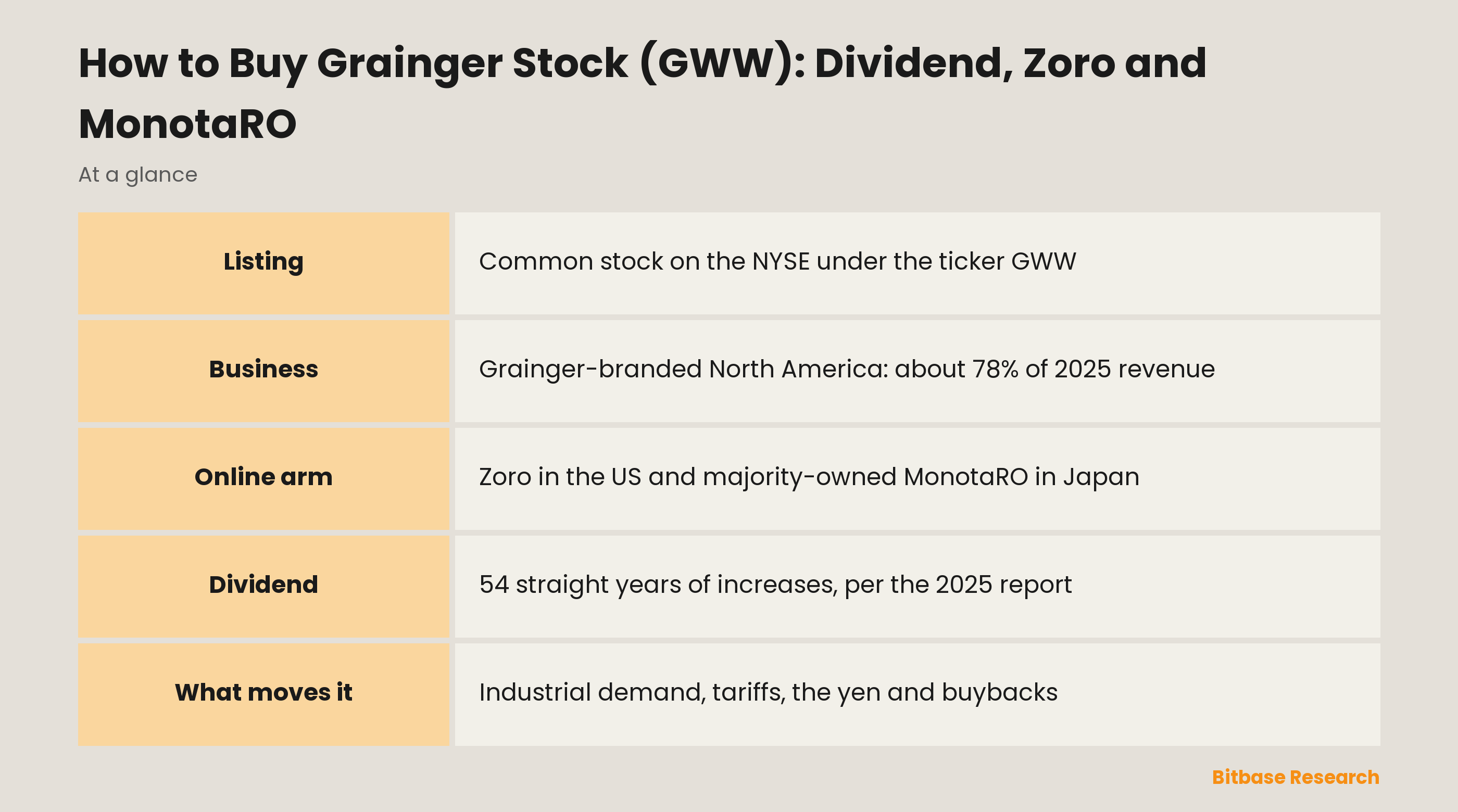
Most brokerage accounts that offer US shares can buy Grainger stock, which trades on the New York Stock Exchange under the ticker GWW. Grainger is a broad-line distributor of maintenance, repair and operating (MRO) supplies, from safety gear and pumps to hand tools, and its Grainger-branded North American business brought in about 78% of 2025 revenue. The rest comes mainly from two online channels: Zoro in the US and MonotaRO, a Tokyo-listed company Grainger controls. This guide covers how the model earns money, how to place an order, and the risks its filings stress: costs it cannot pass on, tariffs and price competition.
What Does Grainger Do?
W.W. Grainger, Inc. was incorporated in Illinois in 1928 and is based in Lake Forest, Illinois. Its latest quarterly report calls it "a broad line distributor of maintenance, repair and operating (MRO) products and services with operations primarily in North America (N.A.) and Japan." Its customers, more than 4.6 million of them, range from small businesses to large corporations and government entities, and no single end customer accounted for more than 10% of 2025 sales.
The 10-K groups products under "safety and security, material handling and storage, pumps and plumbing equipment, cleaning and maintenance, metalworking and hand tools," and no category exceeded 20% of 2025 sales. More than 5,000 primary suppliers stand behind the range, none above 5% of purchases.
Grainger reports two segments:
High-Touch Solutions North America covers the Grainger-branded businesses in the US, Canada, Mexico and Puerto Rico. It serves "customers with complex buying needs," typically mid-size and large organisations whose purchasing systems link to Grainger's through eProcurement, and it adds sales representatives, technical support and KeepStock onsite inventory management to roughly 2 million products. At the end of 2025 its US network had 21 distribution centres, built for next-day delivery, and 245 branches for same-day needs.
Endless Assortment is the online side: Zoro, mainly in the US with about 13 million products, and MonotaRO in Japan with access to about 29 million. Both target smaller and mid-size businesses with simpler needs, though MonotaRO "continues to attract and retain large enterprise customers." Zoro ships from the High-Touch distribution network; MonotaRO fulfils orders from local distribution centres in Japan.
Grainger does not own all of MonotaRO. The 10-K describes "a controlling ownership interest in MonotaRO, which is listed on the Tokyo Stock Exchange," and a 2023 shareholder agreement requires Grainger's consent before MonotaRO issues shares that would cut Grainger's holding ratio to 50% or less. The 10-K and 10-Q give no current percentage, so check any figure you see elsewhere.
How Grainger Makes Money
Grainger buys from suppliers, holds stock near customers and resells it, so earnings are the gap between cost and price, minus the cost of sales staff, warehouses and websites. In 2025 net sales grew 4.5% and gross margin was 39.1%, down 30 basis points. Reported operating earnings fell 5.4% after one-time losses on selling Cromwell, its UK business, and closing Zoro U.K.; the adjusted figure, which excludes them, rose 1%.
The two segments behave differently. High-Touch Solutions N.A. produced about 78% of 2025 revenue and Endless Assortment about 20%, with the remaining 2% or so from other businesses, mainly Cromwell. High-Touch sales rose 2.0%, "primarily due to volume," at a gross margin of 41.7%. Endless Assortment grew 15.7%, which the 10-K attributes to "repeat business for the segment and enterprise customer growth at MonotaRO," but its gross margin was 29.9%. The faster-growing part of the company is also the lower-margin part.
The revenue note breaks 2025 sales down by customer industry, mostly under the North American Industry Classification System:
| Customer industry | High-Touch Solutions N.A. | Endless Assortment | Total company |
|---|---|---|---|
| Manufacturing | 30% | 30% | 30% |
| Government | 19% | 3% | 15% |
| Wholesale | 7% | 18% | 9% |
| Commercial services | 7% | 12% | 8% |
| Contractors | 6% | 12% | 7% |
| Healthcare | 7% | 2% | 6% |
| Transportation | 4% | 2% | 5% |
| Retail | 4% | 4% | 4% |
| Utilities | 3% | 2% | 3% |
| Warehousing | 3% | — | 2% |
| Other | 10% | 15% | 11% |
Government buyers are nearly a fifth of High-Touch sales but a sliver of the online business, and manufacturing is the largest group in both. "Other" covers hospitality, restaurants, property management and natural resources.
US operations generated about 81% of 2025 consolidated net sales. Some products carry Grainger's own brands, such as DAYTON, WESTWARD and SPEEDAIRE: private label items were about 19% of 2025 US stocked product sales in High-Touch.
GWW Stock at a Glance
| Item | Detail |
|---|---|
| Exchange | New York Stock Exchange (NYSE) |
| Ticker | GWW |
| Security | Common stock; the 10-K cover registers no other class |
| Sector | Industrial distribution (MRO supplies) |
| Index membership | S&P 500 |
| Headquarters | Lake Forest, Illinois |
| Incorporated | Illinois, 1928 |
| Fiscal year | Calendar year, ending 31 December |
| Dividend policy | Quarterly; 54 consecutive years of increases, per the 2025 annual report |
| Listed subsidiary | MonotaRO (Tokyo Stock Exchange), majority-owned |
| SEC identifier | CIK 277135 |
Quotes, market value and yield change by the second, so none appear here; the GWW quote page on Bitbase carries them live.
How to Buy Grainger Stock
Because Grainger is a US company with a New York listing, you buy the common stock itself; no depositary receipt sits in between. In practice:
1. Find a broker with access to the NYSE. Investors abroad can use a domestic firm that routes orders to American markets or a global platform; either way, confirm which legal entity will hold your shares and which regulator supervises it.
2. Complete the account checks. If you are not a US person, expect to fill in IRS Form W-8BEN; it is how the broker knows whether a treaty rate applies to US dividends.
3. Deposit money. Funding in a currency other than dollars adds a conversion step, and the spread on it can matter as much as the trading fee.
4. Check the ticker. Search GWW and make sure the listing shown is W.W. Grainger common stock on the NYSE. MonotaRO's own shares are a separate Tokyo security; a GWW share holds MonotaRO only through Grainger's stake.
5. Set the order. FINRA warns that with a market order "you might not get the price you saw or were originally quoted, especially in fast-moving markets," while "a buy limit order can be executed only at or below the limit price." How market orders execute explains the mechanics.
6. Choose whole or fractional shares. A fraction lets you commit a fixed sum, though FINRA says availability "varies by brokerage firm," such orders are often limited to regular hours, and "you might not have shareholder voting rights."
7. Save the records. Trade confirmations and monthly statements later prove what you paid and which dividends arrived.
Expect your shares to sit in "street name": the 10-K counted only 489 shareholders of record in February 2026, while far more hold through "banks, brokers, and other financial institutions."
Outside the United States, dividends face US tax at source. The IRS states that "most types of U.S. source income received by a foreign person are subject to U.S. tax of 30%," with a reduced rate or exemption possible under a tax treaty. Your own country's tax rules then apply on top.
Through an index fund, you own Grainger without selecting it: State Street's daily holdings file for SPY, its S&P 500 trust, showed W.W. Grainger in October 2026 as one small position among hundreds. How an S&P 500 ETF is built is worth reading before you compare funds.
What Moves GWW Stock
Industrial activity and public budgets. The 10-K says demand "is sensitive to the production activity, capital spending and demand for products and services of Grainger's customers." With manufacturing at 30% of sales and government at 15%, factory output and public spending both feed through, and the filing names "government spending and government shutdowns" among the pressures. The company credits the "generally nondiscretionary nature of its products" with some resilience in downturns, a claim each slowdown tests.
Tariffs and how much Grainger can pass on. A distributor sits between supplier prices and customer prices, so trade policy lands in its margin. In the second quarter of 2026 High-Touch sales rose 11.9%, driven, the earnings release said, by "volume growth and price inflation as tariff costs are passed." That quarter's 39.5% gross margin and 16.1% operating margin also included refunds of tariffs imposed under the International Emergency Economic Powers Act on goods Grainger imported directly, so check whether refunds are in the figures when comparing quarters.
Online growth, and the yen. Endless Assortment has grown fastest: 15.7% in 2025, and 13.5% in the second quarter of 2026 as reported, or 20.6% on a daily, organic constant-currency basis. The 10-Q puts the currency drag from the dollar against the yen at 6%, and MonotaRO is consolidated with a one-month lag.
Buybacks and dividends. The 2024 program authorised repurchases of up to five million shares with no expiration date; about 3.1 million remained at the end of 2025. Diluted weighted-average shares in the second quarter of 2026 were about 1.9% lower than a year earlier, so earnings per share can outpace earnings. The quarterly dividend paid that quarter was about 10% above the previous one.
Leadership and portfolio changes. The UK exit changes the 2026 comparison base, and CFO Deidra Merriwether resigned effective 4 September 2026; the board named controller Laurie Thomson interim CFO. D.G. Macpherson has been CEO since October 2016.
Squeezed Between Suppliers and Customers: GWW's Risks
The latest 10-Q reports no material changes to the 10-K's risk factors. These bear most directly on a GWW share:
Costs that cannot be passed on. "Inflation could cause Grainger's operating and administrative expenses to grow more rapidly than net sales, which could result in lower gross margins and lower net earnings." The filing adds that Grainger "may not be able to pass rising product costs to customers if those customers have product or supplier alternatives in the marketplace."
Supply and trade policy. "Unexpected product shortages, product cost increases and risks in trade and tariff policies associated with Grainger's suppliers could negatively impact customer relationships or result in an adverse impact on results of operations."
Competition, including from its own suppliers. Grainger competes with "manufacturers (including some of its own suppliers) that sell directly to customers, wholesale distributors, catalog houses, retail enterprises and online businesses." It also relies on contracts with group purchasing organisations staying on satisfactory terms.
Dependence on search and software. "Grainger relies in part on internet search engines to drive traffic to its websites." The company also expects artificial intelligence to "have a significant impact on customer preferences and market dynamics in its industry."
Government contracts "may provide for termination, reduction or modification by the government at any time, with or without cause."
MonotaRO and currencies. MonotaRO's shares carry their own market risk, and the main currency exposures are "the Japanese yen, Mexican peso, and Canadian dollar."
Above the business sit the usual risks of one stock. The 10-K says the common stock "may be subject to volatility or price declines," and a long dividend record describes the past rather than promising the future: dividends are "at the discretion of Grainger's Board of Directors."
Finding GWW's Numbers at the Source
All of Grainger's SEC filings sit under CIK 277135: the annual 10-K, a 10-Q for each quarter, and 8-Ks for earnings releases and other events.
Inside the 10-K, Item 1 describes segments, products and customers, Item 1A lists the risks, Item 2 counts the distribution centres and branches, and the revenue note holds the customer-industry table above. Item 5 has the shareholder count, the buyback table and a performance graph against the S&P 500 and the Dow Jones US Industrial Suppliers Total Stock Market Index.
Two checks save confusion. The XBRL cover of the 2025 report, R1.htm, lists a single registered security, so plain GWW is the only line to buy. And MonotaRO reports its own results in Japan under Japanese accounting standards; Grainger's release warns those results "will differ" from what it consolidates. Live prices are on the quote page linked above; to compare other companies, start from Bitbase's list of US stock pages.
Grainger Stock FAQ
Can I buy Grainger stock with crypto?
Not directly. A GWW purchase goes through a brokerage account and settles in US dollars, so any crypto would first have to be sold and the proceeds sent to the broker, and in many countries that sale is a taxable event. It helps to keep the two decisions apart: the share is a registered stake in Grainger that carries dividend and voting rights, which is how a share differs from a crypto asset.
Does Grainger pay a dividend?
Yes, every quarter. The 2025 annual report counts 54 consecutive years of dividend increases, and the payment rose again in the second quarter of 2026. The board declares each one; the latest 10-Q records a dividend declared on 29 July 2026 and payable on 1 September 2026.
Is GWW in the S&P 500?
Yes. State Street's daily holdings file for SPY, dated 29 October 2026, lists W.W. Grainger under GWW. Its weight changes daily.
Does Grainger own Zoro and MonotaRO?
Zoro Tools, Inc. is a Grainger subsidiary; MonotaRO is majority-owned, with the rest held by outside shareholders. Both sit in the Endless Assortment segment and are fully consolidated, so a GWW share gives you exposure to both, but MonotaRO's Tokyo shares are a separate security.
Did Grainger leave the UK?
Yes. It completed the sale of Cromwell on 17 December 2025 and closed Zoro U.K. in the same quarter. The business now operates mainly in North America and Japan.
Conclusion
The mechanics of buying GWW are short: open an account with NYSE access, pick the correct listing and choose a market or limit order. Understanding the holding takes longer. Most of the business is a North American supplier to factories and public bodies, alongside a faster-growing but lower-margin online arm made up of Zoro and a majority-owned Japanese company. Read the latest 10-K and 10-Q before deciding how much of one distributor belongs in your portfolio.
Related reading
Other Bitbase articles on this topic:
- How to Buy Delta Air Lines Stock (DAL): Fuel, Miles and a Refinery
- How to Buy Eaton Stock (ETN): Data Centers, Irish Tax, Dana Deal
- How to Buy Emerson Stock (EMR): Valves, Sensors and AspenTech
Disclaimer: This article is educational content from Bitbase Academy, provided for information only. It explains what a company or fund does and how the instruments referenced here differ from one another; it does not constitute investment, trading, tax, or financial advice, and it is neither a recommendation nor an endorsement of any security, token, or trading strategy. A tokenized stock is issued by a third party and is designed to give economic exposure to an underlying asset: it is not a share, it carries no shareholder rights, and it depends on the issuer's structure, eligibility rules, and redemption terms, which the issuer can change. Perpetual futures are leveraged derivatives that hold no underlying asset and can be liquidated, and trading hours, product availability, and eligibility differ by instrument and by jurisdiction and can change at any time. Written as of October 2026; verify everything yourself through company filings, the issuer's own documentation, and the product pages of the venue you trade on.
References
[1] W.W. Grainger Form 10-K for 2025 (SEC EDGAR) www.sec.gov
[2] W.W. Grainger 2025 Form 10-K, XBRL cover page (SEC EDGAR) www.sec.gov
[3] W.W. Grainger Form 10-Q for the quarter ended 30 June 2026 (SEC EDGAR) www.sec.gov
[4] Grainger second-quarter 2026 results release, filed with Form 8-K on 4 August 2026 (SEC EDGAR) www.sec.gov
[5] W.W. Grainger Form 8-K on the CFO change, event dated 31 July 2026 (SEC EDGAR) www.sec.gov
[6] W.W. Grainger 2025 Annual Report to shareholders (SEC EDGAR) www.sec.gov
[7] Shareholder Agreement between W.W. Grainger and MonotaRO, 17 February 2023 (SEC EDGAR) www.sec.gov
[8] State Street: SPY daily holdings, 29 October 2026 www.ssga.com
[9] FINRA: Order Types www.finra.org
[10] FINRA: Investing in Fractional Shares www.finra.org
[11] IRS: NRA Withholding www.irs.gov
[12] IRS: About Form W-8 BEN www.irs.gov





