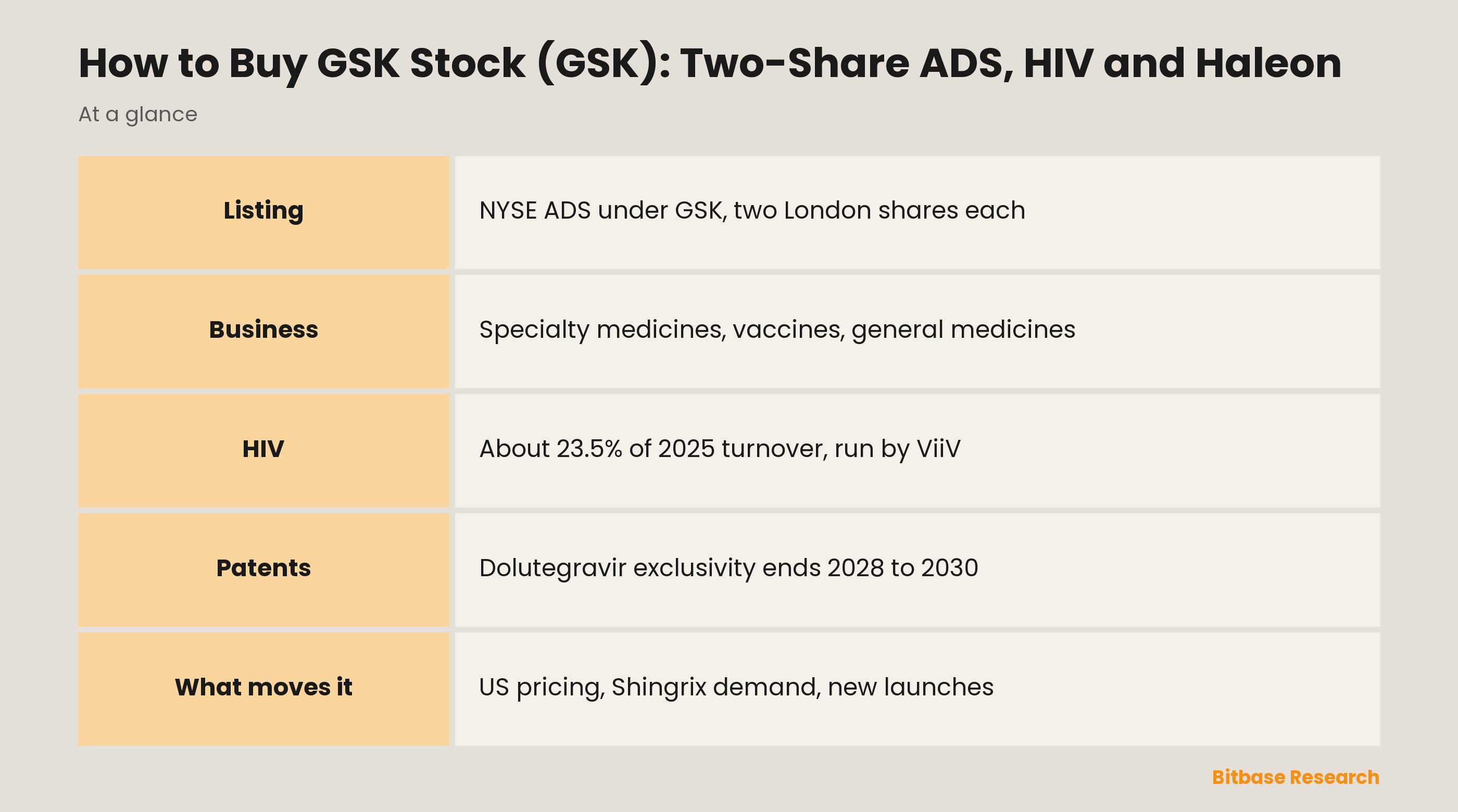
Two exchanges quote GSK under the same three letters, and a broker that reaches the New York Stock Exchange can buy it there in US dollars as an American depositary share (ADS), each one representing two of the ordinary shares listed in London. The company is the former GlaxoSmithKline, which passed its consumer healthcare arm to shareholders as Haleon in July 2022; HIV treatments alone brought in about 23.5% of its 2025 turnover. This guide covers that revenue mix, the order steps, what the ADS changes and the risks GSK names in its own filings.
What Does GSK Do?
GSK discovers, makes and sells prescription medicines and vaccines. Its annual report on Form 20-F sorts the products into three groups. Specialty medicines treat HIV, respiratory and immune diseases and cancer. Vaccines include Shingrix against shingles, Bexsero against meningitis B and Arexvy against respiratory syncytial virus (RSV). General medicines cover inhaled respiratory medicines, dermatology, antibiotics and other products that patients typically get through primary care. The parent, GSK plc, is incorporated in England and has its head office in London.
The company was incorporated on 6 December 1999 as GlaxoSmithKline plc and formed by merging Glaxo Wellcome and SmithKline Beecham, two English companies it acquired on 27 December 2000. It took the name GSK plc on 15 May 2022. On 18 July 2022 it separated its consumer healthcare business into Haleon plc, an independent listed company: shareholders received one Haleon share for each GSK share, and the next day GSK consolidated its own share capital, four new shares for every five old ones.
HIV work runs through ViiV Healthcare, which GSK majority-owns. Since 1 April 2026 the only other shareholder has been Shionogi, with 21.7% of the economic interest against GSK's 78.3%, after the holding of Pfizer was cancelled and replaced by a larger Shionogi investment.
Luke Miels, who joined in 2017 as chief commercial officer, succeeded Emma Walmsley as chief executive on 1 January 2026. For executive pay, GSK measures itself against a global biopharma peer group that includes AstraZeneca, Novartis, Roche and Sanofi.
How GSK Makes Money
GSK reports under IFRS in pounds sterling. Turnover rose 4% in 2025 at actual exchange rates (AER) and 7% at constant exchange rates (CER), the measure GSK uses to take currency swings out of growth. Specialty medicines grew fastest, while general medicines shrank:
| Product area | Share of 2025 turnover | Growth in 2025 at CER |
|---|---|---|
| Specialty medicines | 41.2% | 17% |
| of which HIV | 23.5% | 11% |
| of which respiratory, immunology and inflammation | 11.7% | 18% |
| of which oncology | 6.1% | 43% |
| Vaccines | 28.0% | 2% |
| of which Shingrix | 10.9% | 8% |
| General medicines | 30.7% | 1% decline |
| of which Trelegy | 9.1% | 13% |
Shares are our calculation from the 20-F's turnover by product; growth rates are GSK's own CER figures.
Inside HIV, the largest product is Dovato, a daily two-drug pill, at about 8.2% of group turnover, followed by two long-acting injectables built on cabotegravir: Cabenuva for treatment and Apretude for prevention. Respiratory and immunology sales rest mainly on Nucala for severe asthma and Benlysta for lupus, and oncology on Jemperli, Zejula and Ojjaara.
By customer location, the United States produced about 51.6% of 2025 turnover, Europe about 21.0%, the International region about 25.3% and the UK, GSK's home country, about 2.1%. The 20-F also reports sales to three US wholesalers, without naming them, equal to about 16.4%, 14.7% and 9.8% of group turnover, roughly 40.9% together.
GSK Stock at a Glance
| Item | Detail |
|---|---|
| Exchanges | New York Stock Exchange (ADS); London Stock Exchange (ordinary shares, primary listing) |
| Ticker | GSK in both markets |
| Security traded in New York | American depositary share; one ADS represents two ordinary shares |
| Depositary | JPMorgan Chase Bank, N.A. |
| Sector | Biopharma: specialty medicines, vaccines and general medicines |
| Index membership | FTSE 100 constituent |
| Headquarters | 79 New Oxford Street, London |
| Incorporated | England, 6 December 1999, as GlaxoSmithKline plc; renamed GSK plc in May 2022 |
| Fiscal year | Calendar year, ending 31 December |
| Reporting | IFRS, in pounds sterling; Form 20-F each year, results on Form 6-K each quarter |
| Dividend policy | Paid quarterly; progressive policy guided by a 40% to 60% pay-out ratio |
| SEC identifiers | CIK 1131399; file number 1-15170 |
Anything that changes with the market, such as the share price or yield, is kept off this table; for the live quote and chart, open GSK's stock page on Bitbase.
How to Buy GSK Stock
The two lines share a ticker but are different securities: in London, GSK is one ordinary share priced in sterling; in New York, it is an ADS that stands for two of those shares and is priced in dollars. The steps below follow the New York route:
1. Choose a broker with NYSE access. To hold the ordinary shares instead, check that it also trades on the London Stock Exchange.
2. Open and verify the account. Expect identity checks and the tax forms the broker needs before it can pay you dividends.
3. Deposit money. If your funds are not in dollars, compare the conversion rate, not only the commission.
4. Pick the right line. The 20-F cover registers the ADS on the NYSE under GSK, and next to it eight series of GSK notes with symbols such as GSK/27. Those are bonds, so choose the line described as GSK plc American depositary shares.
5. Set the order type. A market order fills at the next available price, which can differ from the last quote on your screen; a limit order caps what you pay but may not fill.
6. Size the purchase. Ten ADSs carry the economics of twenty London shares. Whether you can buy part of an ADS depends on your broker.
What the ADS changes. JPMorgan Chase Bank runs the programme as depositary, and the ordinary shares behind it are registered in the name of Guaranty Nominees Limited, which on 25 February 2026 held 22.33% of GSK's issued share capital, excluding treasury shares. ADS holders are entitled to dividends and to vote at general meetings, but they vote by instructing the depositary, and the 20-F reminds them that without instructions "their shares will not be voted." The depositary may charge for issuing and cancelling ADSs, per cash distribution and once a year for administration, and it can deduct those fees from dividends.
Dividends and tax. GSK declares dividends in pence per ordinary share, and the depositary converts them into dollars at the exchange rate on a fixed date shortly before payment. The 20-F's tax summary covers only holders who are UK or US citizens and is "intended only as a general guide," so whether anything is withheld from your dividend, and how your own country taxes it, are questions for your broker or tax adviser. The same section says UK stamp duty or stamp duty reserve tax is payable on transfers of shares at 0.5%, subject to certain exemptions; ask your broker whether that applies to your purchase.
Through an index fund. GSK's remuneration report calls the FTSE 100 "the primary index of which GSK is a constituent," so a fund that fully replicates that index holds it.
What Moves GSK Stock
Dolutegravir's loss of exclusivity. Four of GSK's HIV medicines, Tivicay, Triumeq, Juluca and Dovato, are built on dolutegravir. The 20-F's patent table lists the latest compound patents for all four as expiring in 2028 in the US and 2029 in the EU, and the third-quarter 2026 report refers to a "dolutegravir loss of exclusivity period of 2028-2030," adding that in the International region "the DTG LoE has started to impact tender volumes." Luke Miels counts "addressing the loss of dolutegravir exclusivity" in his first priority. The offset is the cabotegravir injectables, whose listed patents run to 2031; in the third quarter of 2026 they made up 35% of US HIV sales.
Shingrix and vaccine demand. Shingrix brought in about 10.9% of 2025 turnover, and its American market has slowed: US sales fell 17% at CER in 2025, which GSK attributed to "the continuing slowdown in the pace of penetration of harder-to-activate unvaccinated consumers," and markets outside the US produced 66% of its sales. In the third quarter of 2026 Shingrix fell 5%, driven by lower sales in the International region, primarily China, and Arexvy fell 24%, while meningitis vaccines grew 12%. Recommendations and public funding move these lines; in 2025, for example, the US immunisation advisory committee recommended extending RSV vaccination to at-risk adults aged 50 to 59.
US pricing and tariffs. With about 51.6% of turnover from the United States, US policy feeds straight into the results. GSK says the IRA Medicare Part D redesign "adversely impacted a number of products across Specialty Medicines, Vaccines and General Medicines" in 2025. On 19 December 2025 it reached an agreement with the US administration that both lowers the cost of prescription medicines for American patients and keeps GSK and ViiV Healthcare out of Section 232 tariffs for three years; the definitive agreement of 9 April 2026 sets that relief through 20 January 2029, "subject to implementation and ongoing compliance."
New medicines and acquisitions. Newer products have to grow before dolutegravir fades. As filed: Exdensur (depemokimab), an asthma antibody dosed twice a year, was approved in the US in December 2025 and in Europe in early 2026; Blenrep for multiple myeloma was approved in the US, Europe and Japan in 2025; Hibsago (bepirovirsen) for chronic hepatitis B was approved in Japan in August 2026 and by the US Food and Drug Administration in October 2026. GSK completed its purchase of Nuvalent on 15 July 2026, and Nuvalent's lung cancer drug Jideytro (zidesamtinib) was approved and launched in the US in the third quarter.
Trelegy and older respiratory brands. General medicines slipped 1% at CER in 2025 as generic erosion cut into older respiratory products, with Trelegy the exception. The patent table gives 2027 for Trelegy's latest US compound patent, with other US patents listed to 2031, and GSK's two infringement cases against Transpire over Trelegy are set for trial on 22 February 2028.
Sterling and the dollar. GSK reports in pounds but trades in New York in dollars. In the third quarter of 2026 a stronger pound held reported growth at 4%, against 5% at constant rates.
GSK's Principal Risks, From Pipeline to Zantac
The Risk Factors section of the 20-F runs from patient safety to climate change. These entries bear most directly on a shareholder:
Pipeline delivery. "The risk that GSK fails or has delays in the delivery of our pipeline of new medicines, vaccines or other products." The entry also warns that "there is a risk that we could misjudge the risks or value of business development transactions," relevant for a company that paid for Nuvalent, RAPT Therapeutics and 35Pharma in 2026.
Policy and trade. "Protectionist policies and new regulations may make it harder for GSK to operate globally, raise costs, and limit access to markets." The UK and the US agreed in December 2025 to keep a zero tariff on UK-made medicines for three years, but "there can be no assurance that this arrangement will not be amended or changed in the future."
Patient safety. "The most important consequence of ineffective pharmacovigilance is the potential for harm to patients." A safety problem can also bring regulatory sanctions and more product lawsuits.
Litigation, including Zantac. The 20-F says GSK's global business exposes it to "product liability litigation, patent and antitrust litigation and sales and marketing litigation." Zantac shows how long such cases run. On 9 October 2024 GSK reached agreements to resolve 93% of the Zantac state court product liability cases pending against it in the United States. In April 2026 the Delaware Superior Court granted summary judgment on the remaining cases filed there by 1 December 2025, and the plaintiffs appealed in May. Federal cases dismissed in December 2022 are on appeal at the Eleventh Circuit, where GSK's second-quarter 2026 report expected a decision in the second half of the year.
Beyond the company, the ADS adds a currency step: the dividend is set in pence and reaches you in dollars, so the exchange rate sits between GSK's earnings and your return.
Checking GSK's Numbers at the Source
GSK files with the SEC under CIK 1131399. The annual report is Form 20-F; the one for 2025 was filed on 6 March 2026. Quarterly results and other announcements arrive on Form 6-K, among them the third-quarter 2026 results of 28 October 2026, and the 20-F's financial calendar puts the next full-year results on 3 February 2027.
Inside the 20-F, the "Turnover and segment information" note gives turnover by product and region; "Legal proceedings" tracks Zantac and the patent cases; and "Shareholder information" covers the ADS, dividends and tax. Two checks prevent misreadings. GSK quotes growth at both AER and CER, and its "Core" results are a non-IFRS measure shown next to the IFRS "Total" figures, so confirm which basis a number uses. And figures for 2021 and earlier, as first published, still included consumer healthcare; the 2022 report restated 2020 and 2021 for the demerger and the share consolidation. Quotes for other listed companies are in the Bitbase list of US stocks.
GSK Stock FAQ
How many GSK shares does one ADS represent?
Two. Each ADS on the NYSE represents two ordinary shares, the same shares that trade under the GSK ticker in London. The ADS is priced in dollars and pays dividends in dollars, you vote through the depositary, JPMorgan Chase Bank, and depositary fees may apply.
Is GSK the same company as GlaxoSmithKline?
Yes. GlaxoSmithKline plc, formed from the merger of Glaxo Wellcome and SmithKline Beecham, changed its name to GSK plc on 15 May 2022. The listed company is the same; what changed that summer is that the consumer healthcare business left as Haleon.
Does GSK pay a dividend?
Yes, every quarter. Since 2022 GSK has followed a progressive dividend policy guided by a pay-out ratio of 40% to 60% "through the investment cycle," and the dividend declared for the third quarter of 2026 was higher than a year earlier. Each quarterly results 6-K gives the amount and the dates; ADS holders receive dollars after conversion and the depositary's annual fee.
Can I buy GSK stock with crypto?
Not directly. Brokers sell the ADS for US dollars and the London shares for sterling, so the crypto has to be sold for ordinary currency and the money moved into a brokerage account first. Selling the coins may itself create a tax bill where you live, so it is worth checking that cost before the transfer.
Is Haleon still part of GSK?
No. Haleon plc was separated from GSK on 18 July 2022 as an independent listed company. Shareholders received one Haleon share for each GSK share they held, and GSK then consolidated its own shares, four new for every five old, with effect from 19 July 2022.
Conclusion
Buying GSK takes a broker with NYSE or London access, the ADS line rather than one of the GSK bonds, and a market or limit order, keeping in mind that one ADS is two shares. The harder part is judging the business behind the ticker: a biopharma company since the Haleon separation, with about a quarter of its turnover from HIV, where dolutegravir loses exclusivity towards the end of the decade, and more than half its sales in the United States. Read the patent table and risk factors in the latest 20-F before deciding how much of a portfolio one drugmaker should carry.
Related reading
Other Bitbase articles on this topic:
- How to Buy Bristol Myers Squibb Stock (BMY): Eliquis and Opdivo
- How to Buy Moderna Stock (MRNA): Vaccines, Cancer Trial and Perps
- How to Buy Novo Nordisk Stock (NVO): ADR, Wegovy and Ozempic
Disclaimer: This article is educational content from Bitbase Academy, provided for information only. It explains what a company or fund does and how the instruments referenced here differ from one another; it does not constitute investment, trading, tax, or financial advice, and it is neither a recommendation nor an endorsement of any security, token, or trading strategy. A tokenized stock is issued by a third party and is designed to give economic exposure to an underlying asset: it is not a share, it carries no shareholder rights, and it depends on the issuer's structure, eligibility rules, and redemption terms, which the issuer can change. Perpetual futures are leveraged derivatives that hold no underlying asset and can be liquidated, and trading hours, product availability, and eligibility differ by instrument and by jurisdiction and can change at any time. Written as of October 2026; verify everything yourself through company filings, the issuer's own documentation, and the product pages of the venue you trade on.
References
[1] GSK plc Form 20-F for 2025: products, turnover, risk factors, patents, ADS and tax (SEC EDGAR) www.sec.gov
[2] GSK plc Form 20-F for 2025, XBRL cover page (SEC EDGAR) www.sec.gov
[3] GSK Annual Report 2022, filed with Form 20-F: Haleon demerger and share consolidation (SEC EDGAR) www.sec.gov
[4] GSK, Pfizer and Shionogi complete changes to the ViiV Healthcare shareholding, 1 April 2026 (Form 6-K) www.sec.gov
[5] GSK completes acquisition of Nuvalent, 15 July 2026 (Form 6-K) www.sec.gov
[6] GSK second-quarter 2026 results, July 2026 (Form 6-K) www.sec.gov
[7] GSK third-quarter 2026 results, 28 October 2026 (Form 6-K) www.sec.gov





