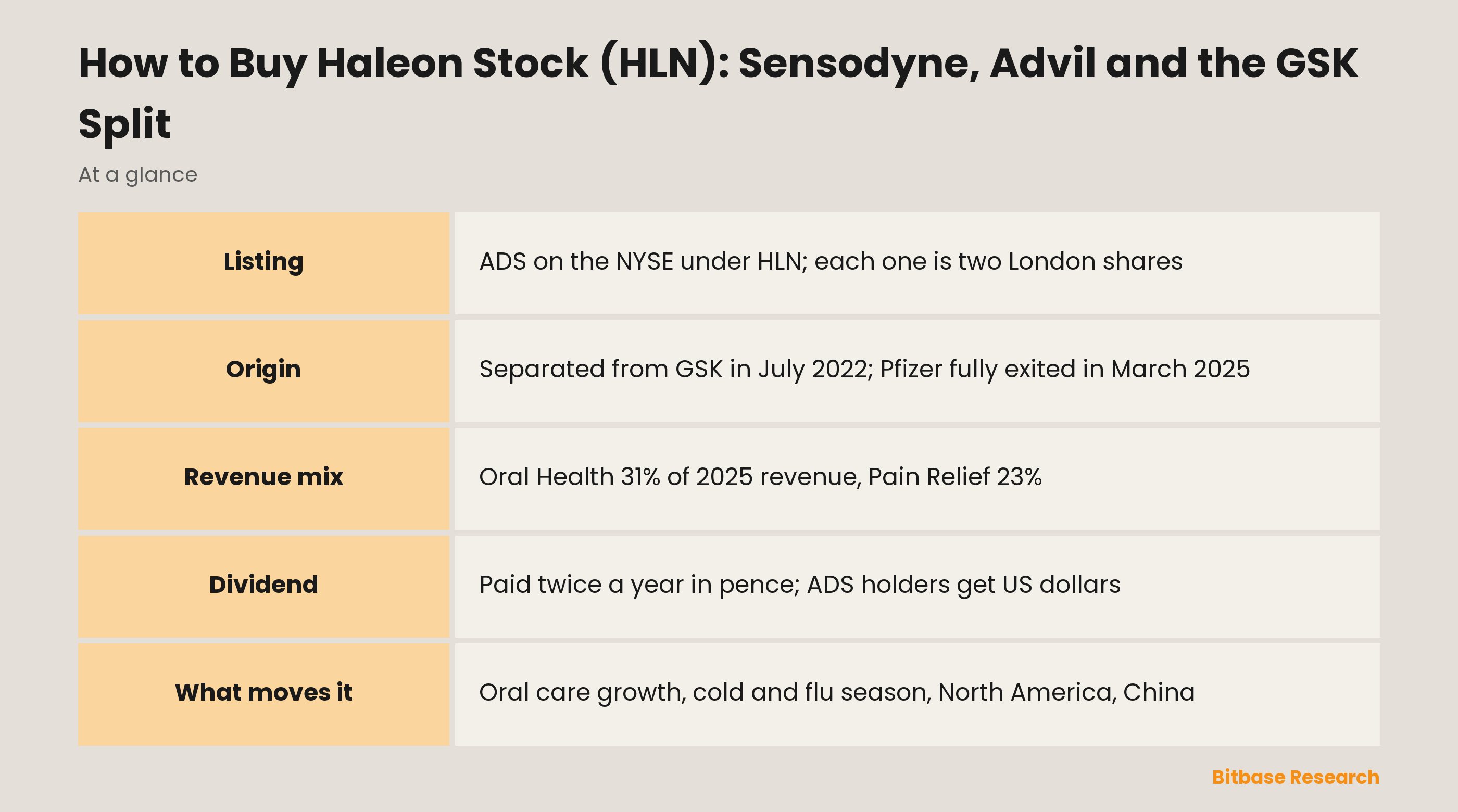
A single HLN share on the New York Stock Exchange stands for two Haleon ordinary shares listed in London, so the consumer health company can be bought in US dollars through any broker with NYSE access. Haleon is the former consumer arm of GSK, separated in July 2022, and since Pfizer sold the last of its stake in March 2025 every share has been in public hands; in 2025, oral care brands such as Sensodyne brought in about 31% of revenue. This guide covers where that revenue comes from, the steps of an order, what the depositary share changes and the risks Haleon names in its 20-F.
What Does Haleon Do?
Haleon sells everyday health products bought without a prescription: toothpaste and denture care, vitamins, painkillers, cold and allergy remedies, digestive aids and skin treatments. The company describes itself as "a consumer company that is solely focused on better everyday health" and says its brands are trusted by more than one billion consumers.
Nine of those brands carry most of the weight. The 20-F calls them Power Brands, "Haleon's nine large-scale multinational brands: Advil, Centrum, Otrivin, Panadol, parodontax, Polident, Sensodyne, Theraflu and Voltaren." Around them sit smaller and regional names, including Tums and Benefiber in digestive health, Caltrate in supplements and Zovirax in skin care.
The business is older than the company. On 2 March 2015 GSK and Novartis formed a consumer healthcare joint venture; in June 2018 GSK bought out Novartis' share; and on 31 July 2019 GSK and Pfizer combined "substantially all" of their consumer healthcare businesses into a new joint venture, in which GSK held 68% and Pfizer 32%. The Pfizer deal, the 20-F says, made the group the leader in over-the-counter medicines and supplements in the US and the leading multinational in that market in China.
On 18 July 2022 GSK separated the business and listed it as Haleon plc. GSK shareholders received one Haleon share for each GSK share they held. Pfizer then reduced its holding in steps: in 2024 its voting rights fell to 15%, and the 20-F calls March 2025 "the final Pfizer sell-down," after which Haleon became, in its own words, "100% free float." Part of that exit ran through Haleon itself, which bought shares directly from Pfizer in March 2025 to reduce its share capital. Neither GSK nor Pfizer is a related party any more.
Haleon plc is a public company incorporated in England and Wales, with its registered office in Weybridge, Surrey. Its Chief Executive is Brian McNamara, who ran GSK's consumer business before the separation, and Vindi Banga became Chair on 1 January 2026.
How Haleon Makes Money
Haleon reports revenue in pounds sterling, by six product categories and by three regional segments. Measured by category, 2025 looked like this:
| Category | Share of 2025 revenue | 2025 organic growth | Best-known brands |
|---|---|---|---|
| Oral Health | 31% | 7.9% | Sensodyne, parodontax, Polident |
| Pain Relief | 23% | 2.3% | Advil, Panadol, Voltaren |
| Respiratory Health | 17% | −1.9% | Theraflu, Otrivin |
| Vitamins, Minerals and Supplements | 15% | 1.9% | Centrum, Caltrate |
| Digestive Health | 9% | 0.5% | Tums, Benefiber |
| Therapeutic Skin Health and Other | 4% | 2.0% | Zovirax, Fenistil |
Shares are calculated from the 20-F segment note; organic growth is Haleon's own measure, excluding currency moves and acquisitions or disposals.
Two things stand out. Oral Health is both the largest category and the fastest grower: Sensodyne grew at a high-single-digit rate in 2025 on new products such as its Clinical range, and the category grew 8.8% organically again in the third quarter of 2026. Respiratory Health went the other way. Reported revenue there fell 11.7% in 2025, most of it from the 2024 sale of the nicotine replacement business outside the US, and a weak cold and flu season pulled organic growth below zero.
Group revenue fell 1.8% as reported in 2025 but grew 3.0% organically, the gap coming from currency and from the 2024 disposals, which also included ChapStick.
Geographically, the three segments are North America, EMEA and LatAm (Europe, the Middle East, Africa and Latin America), and APAC (Asia Pacific). In 2025 they contributed about 35%, 42% and 23% of revenue. North America was the soft one, with organic revenue down 0.4%, while EMEA and LatAm grew 4.7% and APAC 5.2%. Adjusted operating margins were close together: about 24.5% in North America, 23.7% in EMEA and LatAm and 21.5% in APAC.
By customer location, the United States alone accounted for about 31% of 2025 revenue, China for about 9% and the UK for about 3%. China is the company's second-largest market. In 2025 Haleon bought the remaining 12% of TSKF, the Tianjin joint venture through which it runs its Chinese over-the-counter business, taking it to full ownership.
The products reach shoppers through pharmacies, discounters and online retailers, and that channel is concentrated. According to the risk factors, sales to the five largest retailers in the US "account for over half of the Group's revenue in the US market."
HLN Stock at a Glance
| Item | Detail |
|---|---|
| Company | Haleon plc |
| US listing | American depositary shares on the NYSE, ticker HLN |
| ADS ratio | 1 ADS = 2 ordinary shares |
| Home listing | Ordinary shares on the London Stock Exchange, also HLN (the principal market) |
| Depositary | J.P. Morgan Chase Bank, N.A. |
| Incorporated | England and Wales; head office in Weybridge, Surrey |
| Sector | Consumer health |
| Index | FTSE 100 constituent |
| Financial year | Ends 31 December; reports under IFRS in pounds sterling |
| SEC filings | Form 20-F (annual) and Form 6-K (current reports) |
| Dividend | Paid twice a year, declared in pence |
| Listed since | 18 July 2022 |
The ordinary shares appear on the NYSE registration list only "in connection with the listing of the American Depositary Shares," so the line US investors trade is the ADS. Several Haleon bonds are also listed on the NYSE with codes such as HLN/29; those are debt, not shares. Prices and charts are on the Haleon stock page on Bitbase.
How to Buy Haleon Stock
An HLN order works like any other order for a stock listed in New York. The steps:
1. Choose a broker that offers NYSE-listed shares and ADSs; most US brokers and many international ones do.
2. Open and verify the account, which usually involves identity documents and, for non-US residents, a tax form such as the W-8BEN.
3. Fund it in US dollars, or let the broker convert your currency and check the conversion rate it applies.
4. Search for HLN and make sure the result reads Haleon plc ADS, not one of the company's bonds.
5. Pick the order type. The SEC describes a market order as one executed "at the best available price," with a price that "is not guaranteed," and a limit order as one filled "at a specific price or better."
6. Review and submit, then confirm the ADSs have reached your account.
The ADS and the London share
The SEC explains that an ADR "represents shares of non-U.S. companies that are held by a U.S. depositary bank" and that ADRs "trade in U.S. dollars and clear through U.S. settlement systems." Haleon's ordinary shares sit with J.P. Morgan as depositary, and each HLN ADS is backed by two of them. At the start of March 2026, the nominee company that holds the shares behind the ADR programme had about 13.6% of Haleon's issued capital.
Buying in London is the other route, and the tax treatment differs. According to the 20-F, a transfer of ordinary shares generally costs 0.5% in UK stamp duty or stamp duty reserve tax. Moving shares into the depositary system can be charged at 1.5%, but transferring the ADS itself should carry no stamp duty, as long as no instrument of transfer is used. The depositary may also charge holders fees, for example for issuing or cancelling ADSs and for handling cash distributions.
Dividends are declared in pence. ADS holders receive a US dollar amount set by the exchange rate the company achieves before payment, and the ex-dividend date for the ADS can fall a day after the one for the London shares, as it did for the 2026 interim dividend. The 20-F says US holders of ADSs are generally treated as owners of the underlying shares under the UK-US tax treaty; anything beyond that depends on your own country's rules, so check with a tax adviser.
Fractional shares
FINRA notes that "the availability of fractional share trading varies by brokerage firm" and that "as a fractional share owner, you might not have shareholder voting rights." For ADS holders, voting already passes through the depositary, so ask the broker how fractions are handled.
Through funds
Haleon is in the FTSE 100, so funds tracking that index hold its London shares. Weights change, so check a fund's current holdings before treating it as Haleon exposure.
What Moves HLN Stock
Oral care growth. Oral Health is the largest category and has led growth for several years. Each quarterly update shows whether Sensodyne and parodontax keep winning share; in the third quarter of 2026 the category grew 8.8% organically while the group managed 2.6%.
The cold and flu season. Respiratory products such as Theraflu and Otrivin sell on illness, which no marketing plan controls. The 20-F lists "a particularly weaker cold and flu season" as a risk, and the 2025 and third-quarter 2026 updates both blamed soft cough and cold demand, mainly in North America, for weaker results.
North America. The region is Haleon's single largest segment by revenue, and the US is its biggest country. Organic revenue there slipped in 2025, and management calls its plan in the region a "turnaround."
China and emerging markets. China is the second-largest market, and India grew at a double-digit rate in 2025. Policy can move quickly there: in the third quarter of 2026 a change in how a raw material is classified forced Haleon to stop importing Centrum products registered as over-the-counter medicines in China "until further notice," and in the fourth quarter it is speeding up a new sales model in Brazil that it expects to dent revenue there.
Price versus volume. Much of the recent growth has come from price. In the first half of 2026, organic revenue rose 2.6%, with 2.1% from price and 0.5% from volume and mix. Management has said its key priority is "stronger volume growth," and investors watch that split closely.
Capital returns. Since Pfizer left, Haleon has been buying back shares. A new programme started on 29 October 2026 and runs until no later than 19 February 2027; about 80% of the shares bought will be cancelled and the rest held for employee share plans. Dividends are meant to rise at least in line with adjusted earnings, subject to market conditions and board approval.
The pound. Haleon reports in sterling but earns most of its revenue abroad, so currency swings separate reported from organic growth. For HLN holders the dollar-pound rate adds a second layer.
Haleon's Risk Factors, From Retailers to Recalls
The 20-F's risk section is long. These are the risks most specific to this business.
Competition and private labels. The company says it "faces substantial and increasing competition in all of its product categories and geographic markets," with "relatively low barriers to entry" in some categories, "particularly in the VMS category." Retailers' own private label brands are named among the threats. The sector peers the 20-F lists include Bayer, Church & Dwight, Colgate-Palmolive, Kenvue, Nestlé, Opella, Procter & Gamble, Reckitt and Unilever.
Retailer power. Because the top five US retailers bring in over half of US revenue, the company warns that some retailers "have and may continue to have greater bargaining strength than the Group does."
Product quality and recalls. The 20-F says the company "may incur liabilities or be forced to recall products as a result of real or perceived product quality or other product-related issues," and that a failure to comply with manufacturing rules could lead to "product supply interruptions, product recalls or withdrawals."
Regulation of ingredients and claims. Rules cover a product's "development, ingredients, formulation, manufacture, packaging content, labelling" and more, with tightening scrutiny of health claims and ingredient safety. The China Centrum episode shows how a classification change can stop a product line overnight.
Trade, tariffs and supply. The company notes that "tariffs and other trade restrictions have been imposed or expanded" since 2024 and that higher ingredient, commodity, utility and oil prices, including from conflict in the Middle East, can raise costs.
Legacy claims. Haleon "is not a party to any Zantac claims" and "has never marketed Zantac in any form in the US or Canada," but it has received indemnification notices relating to over-the-counter Zantac under its old joint venture agreement, which it has rejected.
Holding the ADS. One stock concentrates risk in one company, the ADS adds currency exposure and depositary fees, and no dividend is guaranteed.
How to Research HLN Yourself
Haleon files with the SEC as a foreign private issuer under CIK 1900304. The annual report is a combined Annual Report and Form 20-F, published each spring; for 2025 it was filed on 13 March 2026. Trading statements, half-year results and buyback reports arrive as Form 6-Ks, often short covers linking to the full announcement on haleon.com.
In the 20-F, the finance review explains revenue by category and region, the segment note gives the underlying figures, and the shareholder information section covers the ADS ratio, depositary fees, dividend dates and tax. For the background to the separation, our GSK stock guide covers the former parent, and the Pfizer stock guide covers the other former partner.
Three checks help. Compare reported and organic growth before reading a headline number. Note that in May 2025 Haleon changed its category structure, moving Smokers' Health into Respiratory Health and splitting Digestive Health from Therapeutic Skin Health and Other, so older category figures are not directly comparable unless restated. And check the depositary's dollar figure for each dividend rather than converting the pence amount yourself. Haleon's results for 2026 are scheduled for 25 February 2027. Quotes for HLN sit on the stock page linked above, and Bitbase's index of US stock pages leads to peers in the sector.
Haleon Stock FAQ
Can I buy Haleon stock with crypto?
Not directly. HLN shares are bought through a brokerage account in US dollars, or the ordinary shares in London in pounds, so any crypto has to be converted to cash and transferred to the broker first, and that conversion may be taxable where you live. A share carries dividend and voting rights in a registered company, which is how a share differs from a crypto asset.
How many Haleon shares does one HLN ADS represent?
Two. Each American depositary share on the NYSE represents two ordinary shares of Haleon plc, held by J.P. Morgan Chase Bank as depositary, so per-share figures in the annual report need doubling to compare with the ADS.
Does GSK or Pfizer still own Haleon?
No, according to the 20-F. GSK separated Haleon on 18 July 2022, giving its own shareholders one Haleon share for each GSK share, and later sold down what it had kept. Pfizer, which held 32% of the original joint venture, cut its voting rights to 15% in 2024 and completed its exit in March 2025, after which the company became fully free float.
Does Haleon pay a dividend?
Yes. Haleon pays an interim and a final dividend each year, with the interim set at about one third of the previous year's total. The 2025 total was about 38% of adjusted earnings, and the board expects to grow the dividend at least in line with adjusted earnings, subject to market conditions and its approval, so check the latest results for amounts and dates.
What brands does Haleon own?
Its nine Power Brands are Advil, Centrum, Otrivin, Panadol, parodontax, Polident, Sensodyne, Theraflu and Voltaren. Other brands mentioned in its filings include Tums, Benefiber, Caltrate, Zovirax and Fenistil.
Conclusion
Haleon is a seller of toothpaste, painkillers and vitamins whose growth has leaned on oral care and on price, with a North American turnaround and a fickle cold season working against it. Owning HLN means owning a London company through a two-share depositary receipt, priced in dollars but reporting in pounds, and fully independent of GSK and Pfizer only since 2025. Read the latest 20-F and trading statement, compare organic and reported growth, watch the split between price and volume, and size any position against the rest of what you hold.
Related reading
Other Bitbase articles on this topic:
- How to Buy Coca-Cola Europacific Partners Stock (CCEP): No ADR
- How to Buy Diageo Stock (DEO): Four Shares per ADS and Guinness
- How to Buy Dollar General Stock (DG): Small Towns, Thin Margins
- How to Buy Kraft Heinz Stock (KHC): New NYSE Listing, Paused Split
Disclaimer: This article is educational content from Bitbase Academy, provided for information only. It explains what a company or fund does and how the instruments referenced here differ from one another; it does not constitute investment, trading, tax, or financial advice, and it is neither a recommendation nor an endorsement of any security, token, or trading strategy. A tokenized stock is issued by a third party and is designed to give economic exposure to an underlying asset: it is not a share, it carries no shareholder rights, and it depends on the issuer's structure, eligibility rules, and redemption terms, which the issuer can change. Perpetual futures are leveraged derivatives that hold no underlying asset and can be liquidated, and trading hours, product availability, and eligibility differ by instrument and by jurisdiction and can change at any time. Written as of November 2026; verify everything yourself through company filings, the issuer's own documentation, and the product pages of the venue you trade on.
References
[1] Haleon plc Annual Report and Form 20-F 2025 (SEC EDGAR) www.sec.gov
[2] Haleon 2025 Form 20-F, XBRL cover page (SEC EDGAR) www.sec.gov
[3] Haleon 2025 Form 20-F, XBRL revenue and profit by region (SEC EDGAR) www.sec.gov
[4] Haleon 2025 Form 20-F, XBRL revenue by product category (SEC EDGAR) www.sec.gov
[5] Haleon 2025 Form 20-F, XBRL revenue by customer location (SEC EDGAR) www.sec.gov
[6] Haleon half-year results 2026, 30 July 2026 (Form 6-K) www.sec.gov
[7] Haleon 2026 Q3 trading statement, 29 October 2026 (Form 6-K) www.sec.gov
[8] Haleon, commencement of share buyback programme, 29 October 2026 (Form 6-K) www.sec.gov
[9] GSK Annual Report 2022, demerger and share consolidation (SEC EDGAR) www.sec.gov
[10] SEC Investor Bulletin: American Depositary Receipts www.sec.gov
[11] SEC Investor Bulletin: Trading Basics www.sec.gov
[12] FINRA Investor Insights: Investing in Fractional Shares www.finra.org





