
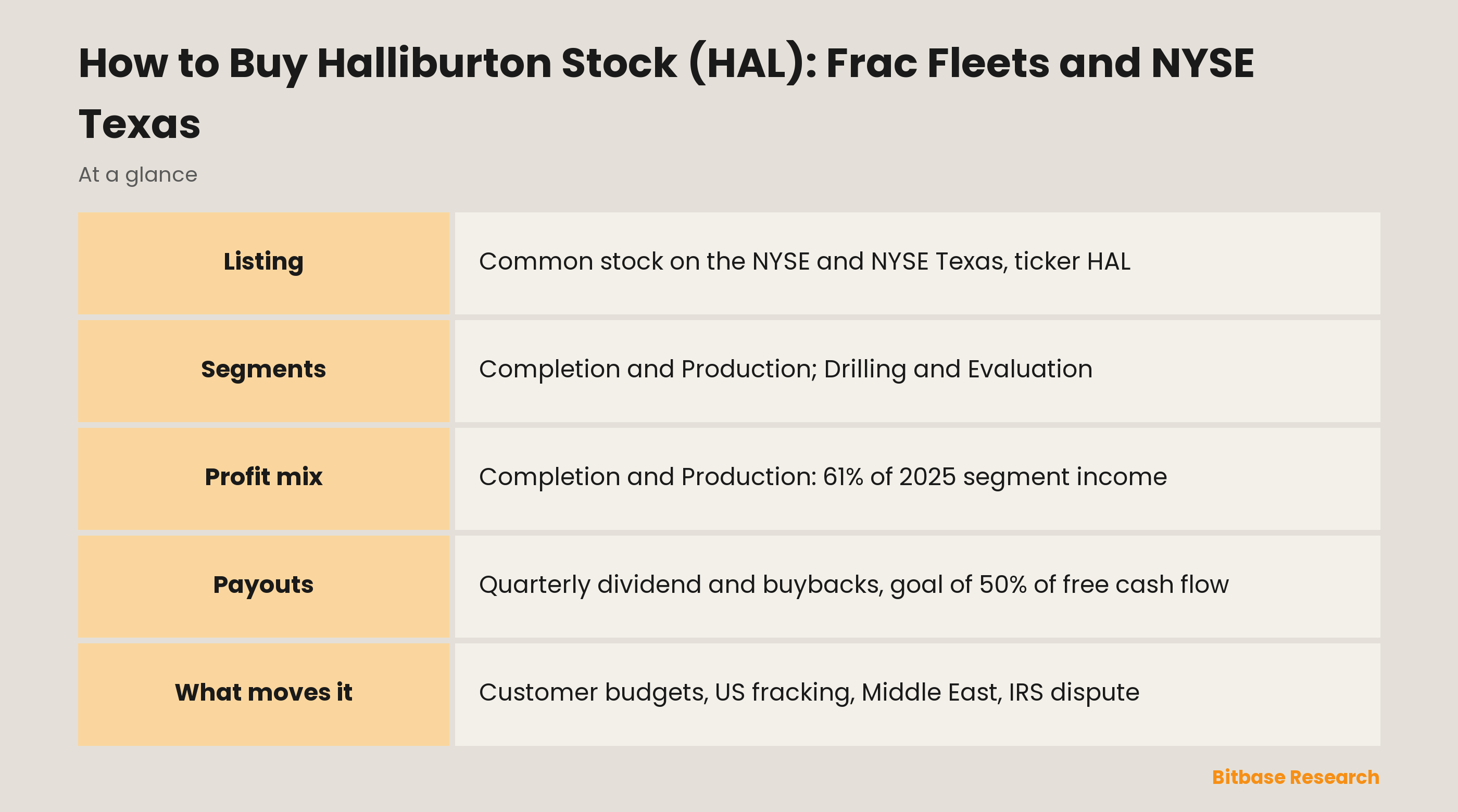
Two exchanges carry Halliburton's common stock under the ticker HAL, the New York Stock Exchange and NYSE Texas, so any broker that offers US shares can take a buy order for it. The Houston company sells services and equipment to oil and gas producers rather than producing oil itself, and in 2025 its Completion and Production segment, home to its hydraulic fracturing fleets, earned about 61% of segment operating income. Below: the business, the order steps and what moves it, from rig counts and the Middle East to a tax dispute left over from a blocked merger.
What Does Halliburton Do?
Halliburton is an oilfield service company. Its 10-K calls it "one of the world's largest providers of products and services to the energy industry" and says its predecessor was established in 1919 and incorporated in Delaware in 1924. Its customers are "major, national, and independent oil and natural gas producers," and its revenue over the past three years came from selling services and products to that industry.
At the end of 2025 it employed over 46,000 people of 146 nationalities and worked in more than 70 countries. The work is split between two divisions, which are also the two segments it reports.
Completion and Production handles a well once the hole exists. That means cementing the casing in place, stimulation (hydraulic fracturing and acidizing, which the 10-K describes as "a variety of pressure pumping services and chemical processes"), completion tools, artificial lift such as electrical submersible pumps, coiled tubing and other well intervention, pipeline and process services, and Multi-Chem specialty chemicals. According to the 10-K, "a significant portion" of this segment provides fracturing services to customers developing shale gas and shale oil.
Drilling and Evaluation handles the hole itself and the data that comes out of it: Baroid drilling fluids, drill bits, Sperry directional drilling and measurement-while-drilling, wireline logging and perforating, well testing and subsea safety systems, Landmark software for subsurface and well data, and Halliburton Project Management, which bundles all of these into integrated contracts.
Two technologies show where management is steering. In North America it runs Zeus electric fracturing pumps, and by the end of 2025 half of its North American fracturing fleet had moved to them. Outside North America it works with VoltaGrid on power generation at customer sites; the 10-K says Halliburton has secured manufacturing capacity for 400 megawatts of modular natural gas power systems, for delivery in 2028, to support data centers in the Eastern Hemisphere. In the other direction, it completed the sale of a portion of its chemical business in the second quarter of 2026.
Jeffrey A. Miller has been Chairman, President and Chief Executive Officer since January 2019.
How Halliburton Makes Money
Halliburton earns money when producers spend on wells, and 2025 was a year of lower activity. Revenue fell 3%. Total operating income fell 41%: income from the two segments fell 19%, and most of the rest came from impairments and other charges for severance, asset write-offs, assets held for sale and facility closures, which are recorded outside the segments. Within the segments the split looked like this:
| Segment | Share of 2025 revenue | Share of 2025 segment operating income | 2025 operating margin | Main product lines |
|---|---|---|---|---|
| Completion and Production | 58% | 61% | 17% | Fracturing and other pressure pumping, cementing, completion tools, artificial lift |
| Drilling and Evaluation | 42% | 39% | 15% | Drilling fluids, bits, directional drilling, wireline, testing, software |
The shares are calculated from the segment note in the 10-K, before corporate costs, SAP S4 upgrade spending and impairments; the margins are the ones the 10-K reports.
Both segments earned less. Completion and Production operating income fell 21%, which the 10-K puts down mainly to decreased pressure pumping services in US Land, lower completion tool sales in the Western Hemisphere, the Middle East and Africa, and less well intervention work in Middle East/Asia. Drilling and Evaluation operating income fell 14%, mostly on lower drilling activity in the Middle East and Latin America.
By where the work was done, the revenue picture for 2025 was:
| Region | Share of 2025 revenue | Change from 2024 |
|---|---|---|
| North America | 41% | down 6% |
| Latin America | 18% | down 7% |
| Europe/Africa/CIS | 15% | up 12% |
| Middle East/Asia | 26% | down 4% |
The United States alone accounted for 39% of revenue in 2025, against 44% in 2023, and no other country reached 10%. No single customer represented more than 10% of revenue in any of the three years.
There is a seasonal pattern too: the 10-K says completion tool spending "typically" peaks in the fourth quarter, and software contract revenue is recognized mostly in the first and fourth.
In 2026 the mix has tilted abroad: in the third quarter, international revenue rose 9% from a year earlier, led by Europe/Africa/CIS at 23%, while North America fell.
In 2023 the board approved a capital return framework with a goal of returning at least 50% of annual free cash flow through dividends and buybacks. Halliburton repurchased 42.4 million shares in 2025 and about 326 million since its buyback program began in February 2006.
HAL Stock at a Glance
| Feature | HAL |
|---|---|
| Exchanges | New York Stock Exchange and NYSE Texas (dual-traded) |
| Ticker | HAL |
| Security | Common stock, the only class registered under Section 12(b) |
| Sector | Oilfield services: completion, production, drilling and evaluation |
| Index membership | S&P 500 |
| Headquarters | Houston, Texas |
| Incorporated | Delaware, 1924 (predecessor established 1919) |
| Fiscal year | Calendar year, ending 31 December |
| Dividend | Paid quarterly, at an unchanged rate through 2025 and the first three quarters of 2026 |
| Buyback | Board authorization with no expiration date |
| SEC identifier | CIK 45012 |
The quote, market value and dividend yield shift during every trading session, so check the Halliburton stock page on Bitbase for live figures.
How to Buy Halliburton Stock
Halliburton is a Delaware corporation, so there is no depositary receipt in the way. The 10-K cover lists one security, the common stock, with the same ticker on both exchanges, which means an order routed to the NYSE or to NYSE Texas buys the same shares. The steps:
1. Choose a broker that sells US-listed shares, and find out which legal entity will hold your account and who regulates it.
2. Open the account and file the tax form. Non-US individuals are normally asked for IRS Form W-8BEN, the "Certificate of Foreign Status of Beneficial Owner," which the IRS says to submit "when requested by the withholding agent or payer."
3. Move money in. Turning another currency into dollars has its own cost, so look at the exchange spread as well as the commission.
4. Search for HAL. Make sure the result reads Halliburton Company common stock.
5. Set the order type. FINRA calls a market order "the most common type of investor order" and says it "provides the most certainty that your order will be executed." A buy limit order, by contrast, "can be executed only at or below the limit price."
6. Decide on the amount. Some brokers let you buy part of a share; others deal only in whole shares.
7. Keep the records. You will need every confirmation and statement later to show what you paid and what dividends arrived.
Tax withheld on dividends. According to the IRS, "most types of U.S. source income received by a foreign person are subject to U.S. tax of 30%," though a tax treaty can lower the rate or remove it. Your country of residence may tax the same dividend.
Owning it through a fund. On 10 November 2026, State Street's daily holdings files listed Halliburton in SPY, its S&P 500 fund, and in XLE, its energy sector fund.
What Moves HAL Stock
Customer budgets, more than oil prices. The 10-K says demand is "particularly sensitive to the level of exploration, development, and production activity of, and the corresponding capital spending by, oil and natural gas companies." It also expects many North American customers to keep "operating within their cash flows and generating returns rather than prioritizing production growth."
North American fracking. 2026 shows how loosely oil prices and frac work can move. According to the third-quarter 10-Q, WTI crude averaged about a third more than in the third quarter of 2025 and the US land rig count was about 10% higher, yet Halliburton's North America revenue fell 9%, mainly on lower stimulation activity and the chemical sale. In October 2026 Miller said his early outlook for 2027 "does not require any recovery in North America hydraulic fracturing. To us, that recovery is purely upside."
The Middle East. Middle East/Asia revenue fell 8% in the first nine months of 2026, which the 10-Q attributes to lower activity in Saudi Arabia, Qatar and Iraq "due to conflict-related disruptions." The region grew 8% from the second quarter to the third, helped by Saudi Arabia and Kuwait, but the 10-Q says "the pace and breadth of that recovery remain uncertain." In the October results release, Miller said: "We are another three months into one of the largest energy disruptions in history."
Latin America and Venezuela. Latin America revenue rose 13% in the third quarter of 2026 from a year earlier, on more work in Mexico, more fracturing in Argentina and project management in Ecuador. During the same quarter Halliburton "re-established" its operations in Venezuela. Mexico also brings a payment question: at the end of 2025 its primary customer there accounted for about 7% of Halliburton's receivables, and the company has experienced payment delays from it, though it says the amounts are not in dispute.
Gas power for data centers. The 10-K credits "emerging structural demand for natural gas, driven by data centers, electrification, and power reliability" for growth over the medium and long term, and the VoltaGrid capacity is the most concrete piece of that. Delivery is due in 2028.
Payouts. Dividends and buybacks are tied to the 50% free cash flow goal, and the 10-K warns that the share returned in any one quarter "will vary and may be more or less than 50%."
Where Halliburton Can Get Hurt
Item 1A of the 10-K lists the risks; the third-quarter 2026 10-Q reports no material changes to them. These bear most on HAL shares:
Commodity swings. Oil and gas prices "are subject to large fluctuations in response to relatively minor changes in the supply of and demand for oil and natural gas," and "even the perception of longer-term lower oil and natural gas prices" can lead customers "to reduce or defer major expenditures."
Fewer, bigger customers. "There have been significant business consolidations within the oil and natural gas industry in recent years," and these "may result in reduced capital spending by our customers."
Fracturing rules. Future laws or regulations "limiting or banning, the hydraulic fracturing process could make it more difficult to complete natural gas and oil wells," which matters for a segment where fracturing is a significant portion of the work.
Working abroad. The 10-K names areas of "significant risk," including the Middle East, North Africa, Argentina, Mexico, Nigeria and Ukraine. Sanctions on Venezuela, Russia and elsewhere "have impacted our business," and in Argentina it has lost money on currency devaluation and on moving cash out.
The Baker Hughes tax case. In September 2023 the IRS proposed reclassifying about 95% of the termination fee Halliburton paid Baker Hughes in 2016, when antitrust regulators "failed to approve" their merger, from an ordinary deduction to a capital loss. Halliburton says it "strongly disagree[s]" and is in the IRS appeals process. If the IRS prevails, it estimates it would owe additional cash taxes plus interest, though it says that would not materially affect its ability to fund its expected uses of cash or return cash to shareholders.
Cybersecurity. In 2024 an unauthorized third party gained access to some of its systems and took information, an incident disclosed in 8-Ks of 23 August and 3 September 2024.
Capital returns. "We can provide no assurance that we will pay dividends or make share repurchases in accordance with our capital return framework goal or at all."
And as with any single stock, one company's results decide your return.
How to Research HAL Yourself
Every filing is on SEC EDGAR under CIK 45012: the annual 10-K, a 10-Q after each of the first three quarters, and 8-Ks when something material happens. In 2026 the earnings 8-Ks came on 21 January, 21 April, 21 July and 20 October, and the same reports appear on halliburton.com.
Inside the 10-K, Item 1 describes the two segments product line by product line, Item 1A lists the risks, and Item 5 compares five-year shareholder return with the Philadelphia Oil Service Index (OSX) and the S&P 500. The MD&A sets average oil and gas prices and rig counts next to the results, which is the quickest way to see whether a weak year was the market or the company.
Two habits help. First, the rig counts in Halliburton's filings come from Baker Hughes' weekly data, and the international counts were adjusted retroactively for a methodology change effective January 2024, so use the restated series when you compare years. Second, read the segment table before the headline: the gap between segment income and total operating income is where impairments, corporate costs and the SAP S4 migration, due to finish in the fourth quarter of 2026, sit.
To set Halliburton beside other oilfield service companies, see our SLB stock guide and Baker Hughes stock guide. The stock page linked above has the live quote, and Bitbase's list of US stock pages covers other listed companies.
Halliburton Stock FAQ
Can I buy Halliburton stock with crypto?
Not directly. HAL is bought with dollars through a brokerage account, so the crypto has to be sold for cash first, possibly a taxable event where you live, and the cash moved to the broker. The result is registered stock with dividend and voting rights, not a token; see how stocks and crypto differ.
Does Halliburton pay a dividend?
Yes, quarterly. The rate was the same in every quarter of 2025 and in the first three quarters of 2026. The board decides each payment, and the 10-K says future dividends depend on earnings, financial condition, capital requirements and business conditions; check the latest release for the current amount.
Is HAL in the S&P 500?
Yes. State Street's daily holdings file for SPY, dated 10 November 2026, includes Halliburton, as does the file for XLE, its energy sector fund. Weights change every day.
Does HAL trade on the NYSE or on NYSE Texas?
Both. The 10-K says the common stock "is dually traded on the New York Stock Exchange and New York Stock Exchange Texas under the symbol 'HAL.'" It is one class of stock, so a share bought on either venue is the same share.
Did Halliburton try to merge with Baker Hughes?
Yes. The two agreed to merge, but antitrust regulators in multiple jurisdictions did not approve the deal, and in the second quarter of 2016 Halliburton paid Baker Hughes the termination fee set out in the merger agreement. The fee's tax treatment is still in dispute with the IRS.
Conclusion
Halliburton's results follow how much producers spend on wells, and North American fracking in particular, more than they follow crude: in 2026 oil prices rose while its North America revenue fell. Growth this year has come from Latin America, Europe and Africa, the Middle East is still recovering from conflict, the VoltaGrid power systems are not due until 2028, and the IRS dispute remains open. Read the latest 10-K and 10-Q against the rig counts they print, follow both segments through a downturn as well as a recovery, and size any HAL position with the oil service cycle in mind.
Related reading
Other Bitbase articles on this topic:
- How to Buy Cheniere Energy Partners Stock (CQP): Sabine Pass Units
- How to Buy Ecopetrol Stock (EC): One ADS, 20 Colombian Shares
- How to Buy EQT Stock (EQT): Range Deal, Marcellus Gas and Perps
- How to Buy Phillips 66 Stock (PSX): Midstream, CPChem and Elliott
Disclaimer: This article is educational content from Bitbase Academy, provided for information only. It explains what a company or fund does and how the instruments referenced here differ from one another; it does not constitute investment, trading, tax, or financial advice, and it is neither a recommendation nor an endorsement of any security, token, or trading strategy. A tokenized stock is issued by a third party and is designed to give economic exposure to an underlying asset: it is not a share, it carries no shareholder rights, and it depends on the issuer's structure, eligibility rules, and redemption terms, which the issuer can change. Perpetual futures are leveraged derivatives that hold no underlying asset and can be liquidated, and trading hours, product availability, and eligibility differ by instrument and by jurisdiction and can change at any time. Written as of November 2026; verify everything yourself through company filings, the issuer's own documentation, and the product pages of the venue you trade on.
References
[1] Halliburton Form 10-K for 2025 (SEC EDGAR) www.sec.gov
[2] Halliburton 2025 Form 10-K, XBRL cover page (SEC EDGAR) www.sec.gov
[3] Halliburton 2025 Form 10-K, XBRL segment and geographic data (SEC EDGAR) www.sec.gov
[4] Halliburton Form 10-Q for the third quarter of 2026 (SEC EDGAR) www.sec.gov
[5] Halliburton third quarter 2026 results release, furnished on Form 8-K (SEC EDGAR) www.sec.gov
[6] Halliburton filings on Form 8-K (SEC EDGAR) www.sec.gov
[7] State Street SPDR S&P 500 ETF Trust (SPY): fund page and daily holdings www.ssga.com
[8] State Street Energy Select Sector SPDR ETF (XLE): fund page and daily holdings www.ssga.com
[9] FINRA: Order Types www.finra.org
[10] IRS: NRA Withholding www.irs.gov
[11] IRS: About Form W-8BEN www.irs.gov





