
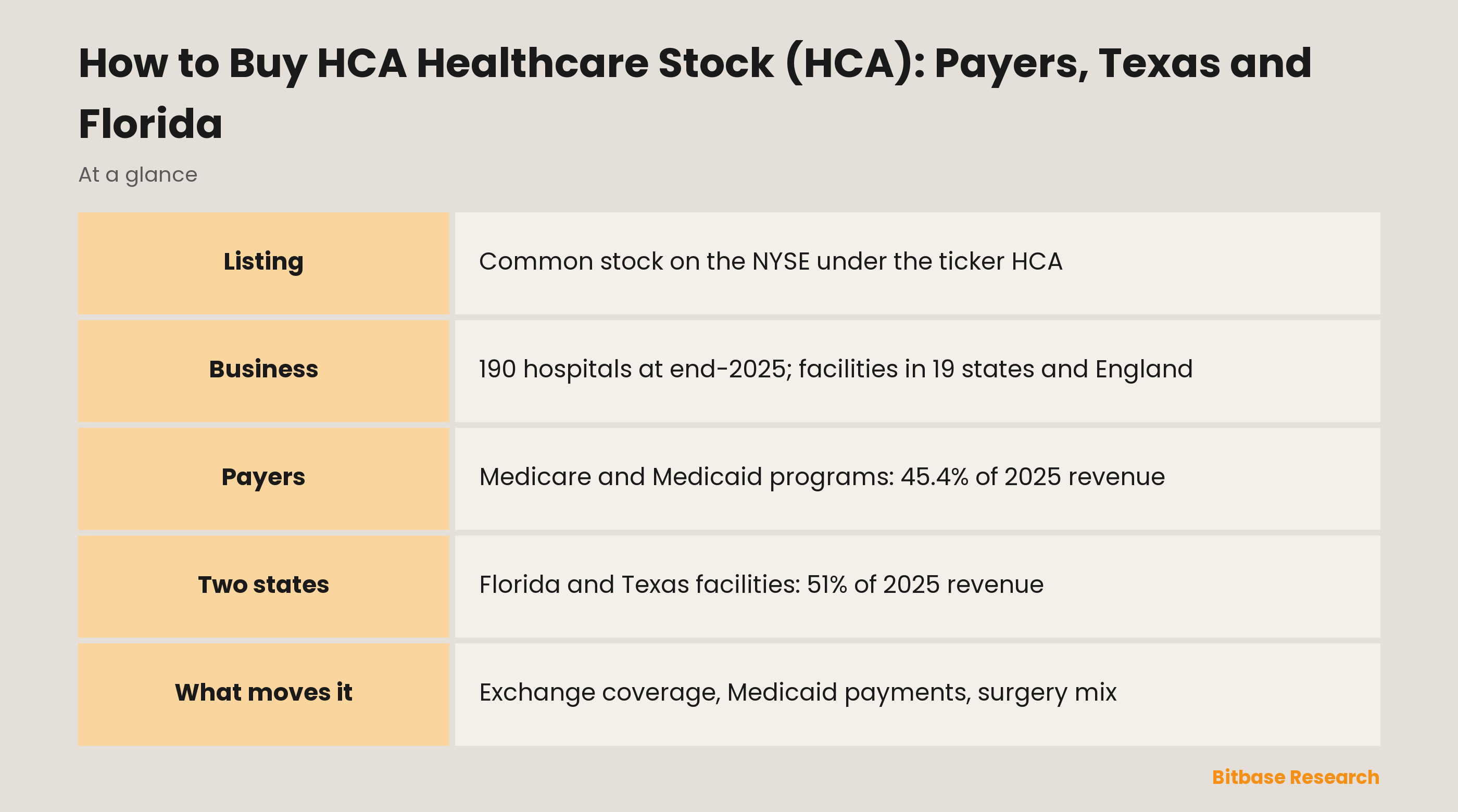
With a brokerage account that reaches the New York Stock Exchange, you can buy HCA Healthcare stock under the ticker HCA, as you would any other US-listed share. What the share holds is a hospital operator that took 45.4% of its 2025 revenue from Medicare and Medicaid programs and 51% from facilities in two states, Florida and Texas. This guide covers who pays HCA's bills, how to place the order, and why the expiry of enhanced Exchange subsidies at the end of 2025 has shaped its 2026 results.
What Does HCA Healthcare Do?
HCA Healthcare runs hospitals. In the words of its 10-K: "We operate in one line of business, which is operating hospitals and related health care entities." At 31 December 2025 that meant 190 hospitals, of which 179 were general acute care, seven behavioral and four rehabilitation hospitals, with facilities in 19 states and England.
Around the hospitals sit surgery centers, freestanding emergency rooms, urgent care clinics, physician practices and home health agencies. The 10-K calls these outpatient services "an integral component" of its local networks, and in 2025 outpatient revenues made up 38% of patient revenues.
HCA manages them in three geographic groups. At the end of 2025 the National Group had 53 hospitals in ten states, among them California, Tennessee and Virginia; the Atlantic Group had 63 in Florida, Georgia, Missouri, South Carolina and northern Kansas; and the American Group had 66 in Texas, Colorado, Louisiana and central Kansas. The eight hospitals in England are reported under corporate and other.
Through its predecessors HCA began operating in 1968; it is based in Nashville, Tennessee. It has also been private: on 17 November 2006 HCA Inc. was acquired by an investor group that included funds sponsored by Bain Capital, Kohlberg Kravis Roberts and Merrill Lynch Global Private Equity, alongside affiliates of founder Dr. Thomas F. Frist, Jr. The present holding company was incorporated in Delaware in October 2010 and, as HCA Holdings, listed on the NYSE through an initial public offering in March 2011.
How HCA Healthcare Makes Money
Nearly all revenue is payment for patient care, and the 10-K sorts it by who pays:
| Payer | Share of 2025 revenue | What it covers |
|---|---|---|
| Managed care and other insurers | 48.9% | Commercial health plans, including those bought on the Exchanges |
| Managed Medicare | 17.8% | Medicare Advantage plans run by private insurers |
| Medicare | 14.9% | Federal cover for people aged 65 and over and some disabled people |
| Medicaid | 7.8% | The federal-state program each state administers |
| Managed Medicaid | 4.9% | Medicaid delivered through managed care plans |
| International | 2.5% | Insurers paying for care at HCA's facilities in England |
| Other | 3.2% | Other sources, including uninsured patients |
The four Medicare and Medicaid lines add up to the 45.4% the 10-K cites. In-network rates with private plans are set by contract, and the risk factors note that payers "continue to demand discounted fee structures."
Revenue rose 7.1% in 2025, which the 10-K splits into a 2.9% rise in equivalent admissions, its measure of combined inpatient and outpatient volume, and a 4.0% rise in revenue per equivalent admission. Inside the Medicaid lines, state directed and supplemental payment programs brought in about 8% of 2025 revenue. These programs are subject to approval by the Centers for Medicare & Medicaid Services (CMS), so the money can arrive in lumps.
Salaries and benefits took 43.5% of 2025 revenue, supplies 15.0% and interest on the company's debt 3.0%.
By region, the American Group produced 35.0% of 2025 revenue, the Atlantic Group 32.7% and the National Group 28.1%, with corporate and other, England included, at 4.2%. Cut the map by state and two names dominate: 102 of the 190 hospitals were in Florida and Texas at the end of 2025, and facilities in those two states generated 51% of consolidated revenue.
HCA Stock at a Glance
| Item | HCA |
|---|---|
| Exchange | New York Stock Exchange (NYSE) |
| Ticker | HCA |
| Security | Common stock, the only security registered on the 10-K cover |
| Listed since | Initial public offering in March 2011 |
| Sector | Health care: hospitals and outpatient facilities |
| Index membership | S&P 500, per SPY holdings dated 28 October 2026 |
| Headquarters | Nashville, Tennessee |
| Incorporated | Delaware, October 2010 |
| Fiscal year | January to December |
| Dividend policy | Quarterly cash dividend, each declared by the board |
| Largest holder group | Frist-affiliated investors, about 31% at 31 January 2026 |
| SEC identifier | CIK 860730 |
Filings carry no live data; for price, market value and yield, open the HCA Healthcare stock page on Bitbase.
How to Buy HCA Healthcare Stock
HCA is a US company with one listed class of common stock, so there is no ADR or second share class to weigh:
1. Pick a broker that offers NYSE shares where you live. Check its licence and which entity will hold your shares.
2. Open and verify the account. Non-US individuals usually complete IRS Form W-8BEN, the certificate of foreign status that lets a treaty rate apply to dividends.
3. Fund it. If your money is not in US dollars, ask about the conversion spread; on a small order it can exceed the commission.
4. Look up HCA and check the result. You want HCA Healthcare, Inc. common stock on the NYSE.
5. Choose the order type. A market order fills at whatever price is available, as how a market order fills explains; Investor.gov notes that a buy limit order "can only be executed at the limit price or lower."
6. Size the position. For a cash amount rather than whole shares, ask about fractional shares; Investor.gov cautions that a firm offering them "may not offer this service to all its customers."
7. Note the reporting calendar. In 2026 HCA released results on 27 January, 24 April, 24 July and 27 October, plus preliminary second-quarter figures on 14 July.
Tax outside the US. The IRS says most types of US-source income received by a foreign person are taxed at 30% unless a tax treaty or a provision of the tax code sets a lower rate. Your home country may tax the same dividend again.
Through a fund. State Street's holdings files dated 28 October 2026 list HCA Healthcare in SPY, which tracks the S&P 500, and in the Health Care Select Sector SPDR ETF (XLV), where it sits alongside insurers such as UnitedHealth.
What Moves HCA Stock
Exchange coverage and the uninsured. Enhanced premium tax credits for Exchange plans expired at the end of 2025. HCA's 10-K said: "We believe the expiration of the enhanced premium tax credits will adversely impact Exchange enrollment and significantly increase the uninsured rate." On 14 July 2026 the company released preliminary second-quarter results before its full report and revised its 2026 guidance, citing a payer mix shift "driven by an increase in uninsured volume, primarily due to patients who lost coverage on the health insurance exchanges"; the third-quarter release reported the same shift. In the first nine months of 2026, managed care and insurers fell to 46.7% of revenue from 48.8% a year earlier, and the estimated cost of uncompensated care rose 24.3%.
Medicaid supplemental payments. The 2025 Federal Budget Act, enacted on 4 July 2025, contains, in the 10-K's words, "restrictions intended to reduce the federal matching funds received by state Medicaid programs," and ties caps on state directed payments to Medicare payment rates "instead of average commercial rates, a change that we anticipate will impact payment rates in many states in which we operate, including Texas." Approvals still swing single quarters: after CMS approved a Florida program in the second quarter of 2026, HCA recognized in that quarter a benefit covering October 2024 through June 2026, and Medicaid rose to 10.1% of nine-month revenue from 7.9%.
Surgery and service mix. Patient numbers kept growing while the mix moved the other way. In the third quarter of 2026, same-facility admissions rose 2.7% and emergency room visits 5.1%, but inpatient surgeries fell 1.4% and outpatient surgeries 3.7%. The July release had already listed "a service mix shift primarily related to a decline in surgical volume" among the second quarter's negatives.
Labor costs. Salaries and benefits are the largest expense line. The 10-K warns about "competition for staffing, the shortage of experienced nurses and other health care professionals and labor union activity," and reports that some employees at 35 of its US hospitals were represented by unions at the end of 2025.
Share repurchases. The board approved buyback programs each January from 2024 to 2026, and the diluted share count behind earnings per share was 8.5% lower in 2025 than in 2024. Repurchases continued in the third quarter of 2026, so per-share results depend on buybacks as well as on profit.
What HCA's Risk Factors Warn About
Item 1A of the 10-K runs long; five headings bear most directly on a shareholder.
Debt. "We have significant indebtedness and may incur further indebtedness in the future." Item 5 adds that debt agreements can limit the dividend.
Government programs. "Changes in government health care programs may adversely affect our revenues and business." On the 2025 law the company adds: "It is difficult to anticipate the ultimate effects of the FBA, as it is a complex law that mandates various changes over time and, in many cases, the details of implementation are not yet clear."
Two-state concentration. "Our facilities are heavily concentrated in Florida and Texas, which makes us sensitive to regulatory, economic, public health, environmental and competitive conditions and changes in those states." Hurricanes Helene and Milton hit facilities in Florida and North Carolina in 2024.
Systems and data. "Cybersecurity incidents or other forms of data breaches could result in the compromise of our facilities, confidential data or critical data systems, causing our operations to be impaired or impacted." HCA says it and its vendors "have experienced cybersecurity incidents in the past," and it is rolling out a new electronic health record platform.
An influential holder. "Certain of our investors may continue to have influence over us." Frist-affiliated investors held about 31% of the stock at 31 January 2026 and can nominate certain directors under a stockholders' agreement.
Beyond the company, a single stock ties your result to one business, and a dividend is not a promise: "There can be no assurance that we will continue to pay dividends," the 10-K says, and HCA suspended its dividend in April 2020.
How to Research HCA Healthcare Yourself
HCA's SEC filings sit under CIK 860730. In the 10-K, "Sources of Revenue" in Item 1 holds the payer table, Item 1A the risk factors, and the MD&A the volume statistics on consolidated and same-facility bases. Note 13 splits revenue by group. Each 10-Q repeats the payer table, where the 2026 shift away from Exchange coverage showed, and 8-Ks carry the results releases. The March 2026 proxy statement sets out the stockholders' agreement under which the Frist group can nominate two directors.
Three habits help. Keep "same facility" figures, which exclude hospitals bought, sold or closed in the current or prior year, apart from consolidated ones. Read revenue per equivalent admission as price blended with service mix. And check the Medicaid line for catch-up payments, as in the second quarter of 2026. The investor site, investor.hcahealthcare.com, has releases and call webcasts; other American companies are on Bitbase's US stock list.
HCA Healthcare Stock FAQ
Does HCA Healthcare pay a dividend?
Yes, quarterly. The board started a regular quarterly cash dividend in January 2018, suspended it in April 2020 in response to the COVID-19 pandemic and reinstated it in February 2021. The latest declaration came on 27 October 2026, payable on 29 December. Each payment is the board's decision; the amount is in the latest results release.
Can I buy HCA Healthcare stock with crypto?
Not directly. Brokers sell HCA shares for US dollars, so crypto has to be sold for cash first, which may be taxable where you live. The result is a registered share carrying dividends and votes, and the gap between owning a stock and holding crypto goes beyond the payment route.
Is HCA Healthcare in the S&P 500?
Yes. State Street's daily holdings file for SPY, the SPDR S&P 500 ETF Trust, dated 28 October 2026, included HCA Healthcare. The 10-K also measures its five-year shareholder return against the S&P 500 and the S&P Health Care Index.
Who owns the biggest stake in HCA Healthcare?
Frist-affiliated investors, linked to founder Dr. Thomas F. Frist, Jr., held about 31% of the common stock at 31 January 2026, according to the 10-K. The board's chairman, Thomas F. Frist III, is the founder's son.
Who are HCA Healthcare's competitors?
Mostly the other hospitals in each town. The 10-K's competition section names no rival company; it says many competing facilities are owned by not-for-profit entities "exempt from sales, property and income taxes," and that freestanding surgery centers, emergency departments and urgent care centers keep multiplying.
Conclusion
Buying HCA takes an NYSE-capable broker, the HCA ticker and an order type you understand. The harder part is knowing what drives the share: who pays for care, how many patients lose insurance and what Medicaid programs in Texas and Florida may pay. Read the payer table in each 10-Q next to the 10-K's risk factors, then decide how much weight one hospital operator deserves in your portfolio.
Related reading
Other Bitbase articles on this topic:
- How to Buy Cencora Stock (COR): Ex-AmerisourceBergen, Walgreens
- How to Buy Cigna Stock (CI): Express Scripts and Rebate Reform
- How to Buy CVS Health Stock (CVS): Insurer, PBM and Drugstores
Disclaimer: This article is educational content from Bitbase Academy, provided for information only. It explains what a company or fund does and how the instruments referenced here differ from one another; it does not constitute investment, trading, tax, or financial advice, and it is neither a recommendation nor an endorsement of any security, token, or trading strategy. A tokenized stock is issued by a third party and is designed to give economic exposure to an underlying asset: it is not a share, it carries no shareholder rights, and it depends on the issuer's structure, eligibility rules, and redemption terms, which the issuer can change. Perpetual futures are leveraged derivatives that hold no underlying asset and can be liquidated, and trading hours, product availability, and eligibility differ by instrument and by jurisdiction and can change at any time. Written as of October 2026; verify everything yourself through company filings, the issuer's own documentation, and the product pages of the venue you trade on.
References
[1] HCA Healthcare Form 10-K, fiscal 2025: business, revenue by payer, segments, risk factors and stockholder matters (SEC EDGAR) www.sec.gov
[2] HCA Healthcare Form 10-Q for the quarter ended 30 September 2026: revenue by payer and uncompensated care (SEC EDGAR) www.sec.gov
[3] HCA Healthcare press release, 14 July 2026: preliminary second-quarter 2026 results and revised guidance (Form 8-K) www.sec.gov
[4] HCA Healthcare press release, 27 October 2026: third-quarter 2026 results and dividend (Form 8-K) www.sec.gov
[5] HCA Holdings Form 10-K, fiscal 2011: the March 2011 initial public offering and NYSE listing (SEC EDGAR) www.sec.gov
[6] HCA Healthcare Form 10-K, fiscal 2018: the cash dividend program begun in January 2018 (SEC EDGAR) www.sec.gov
[7] HCA Healthcare Form 10-K, fiscal 2020: dividend suspended in April 2020 and reinstated in February 2021 (SEC EDGAR) www.sec.gov
[8] HCA Healthcare proxy statement (DEF 14A), March 2026: board leadership and the stockholders' agreement (SEC EDGAR) www.sec.gov
[9] State Street, SPDR S&P 500 ETF Trust (SPY): daily holdings, as of 28 October 2026 www.ssga.com
[10] State Street, Health Care Select Sector SPDR ETF (XLV): holdings, as of 28 October 2026 www.ssga.com
[11] Investor.gov (SEC): Types of Orders www.investor.gov
[12] Investor.gov (SEC): Fractional Share Investing, investor bulletin www.investor.gov
[13] IRS: NRA Withholding www.irs.gov





